

Why AI Task Forces Matter Now
As artificial intelligence rapidly enters the workplace, many organizations struggle with a fundamental challenge: how to move from experimentation to real business value. Leaders face growing pressure to adopt AI responsibly, align it with business goals and ensure employees are prepared for change. This is where AI task forces have emerged as a practical and proven solution.
An AI task force provides structure, governance, and strategic direction during the early and middle stages of AI adoption. According to Andreas Welsch, AI task forces help organizations bridge the gap between curiosity and impact—provided they are set up with the right goals, leadership, and metrics.
What Is an AI Task Force?
An AI task force is a cross-functional group responsible for guiding how artificial intelligence is explored, adopted and scaled within an organization. While the structure may vary, Welsch views task forces as a transitional but critical mechanism for building AI maturity.
From his perspective, AI task forces exist to:
- Educate employees about AI capabilities and limitations
- Identify and prioritize AI use cases aligned with business goals
- Establish guardrails around responsible and effective AI use
Rather than acting as a permanent department, an AI task force serves as a catalyst—helping the organization learn, adapt and prepare for long-term AI integration.
When Organizations Should Form an AI Task Force
Welsch emphasizes that AI task forces are especially valuable when organizations are early in their AI journey and seeking clarity.
He explains that task forces become useful when companies want to upskill employees on AI and explore ways to make work more efficient—whether through personal productivity tools or more advanced applications such as automating insights or screening candidates.
In these moments, organizations often lack:
- A shared understanding of what AI can realistically do
- Alignment across departments on priorities and risks
- Clear ownership of AI-related decisions
An AI task force helps centralize learning and decision-making until AI becomes embedded across the business.
Start With Business Strategy, Not Technology
One of Welsch’s strongest cautions is against launching AI initiatives without a strategic foundation.
“Whoever is in charge of the AI task force needs to figure out what is our overall business strategy or business goal that we want to achieve in the next three [to] five years. How can we use technology like AI to reach these goals more quickly [and] cheaper.”
This framing ensures that AI is treated as an enabler rather than a distraction. Without anchoring efforts to long-term objectives, task forces risk chasing trends or experimenting without impact.
From Welsch’s perspective, effective AI task forces begin by asking:
- What outcomes does the business need to achieve?
- Where are inefficiencies or bottlenecks today?
- Which goals could AI meaningfully accelerate or improve?
Only after answering these questions should tools, vendors, or pilots be considered.
Who Should Lead an AI Task Force?
Leadership is one of the most decisive factors in whether an AI task force succeeds or stalls. Welsch is clear that authority and organizational visibility matter.
He notes that AI task forces should be led by someone senior who understands the business across departments and has the authority to influence decisions. When leadership lacks seniority, task forces often struggle to gain traction or secure buy-in.
A senior leader can:
- Align AI efforts with enterprise priorities
- Resolve conflicts between departments
- Ensure follow-through on recommendations
In practice, AI task forces led by C-suite executives or equivalents tend to move faster and deliver clearer outcomes.
Building a Cross-Functional AI Task Force
While leadership is critical, Welsch also emphasizes the importance of cross-functional representation. AI impacts nearly every function, from HR and finance to marketing, legal and IT.
However, representation alone is not enough.
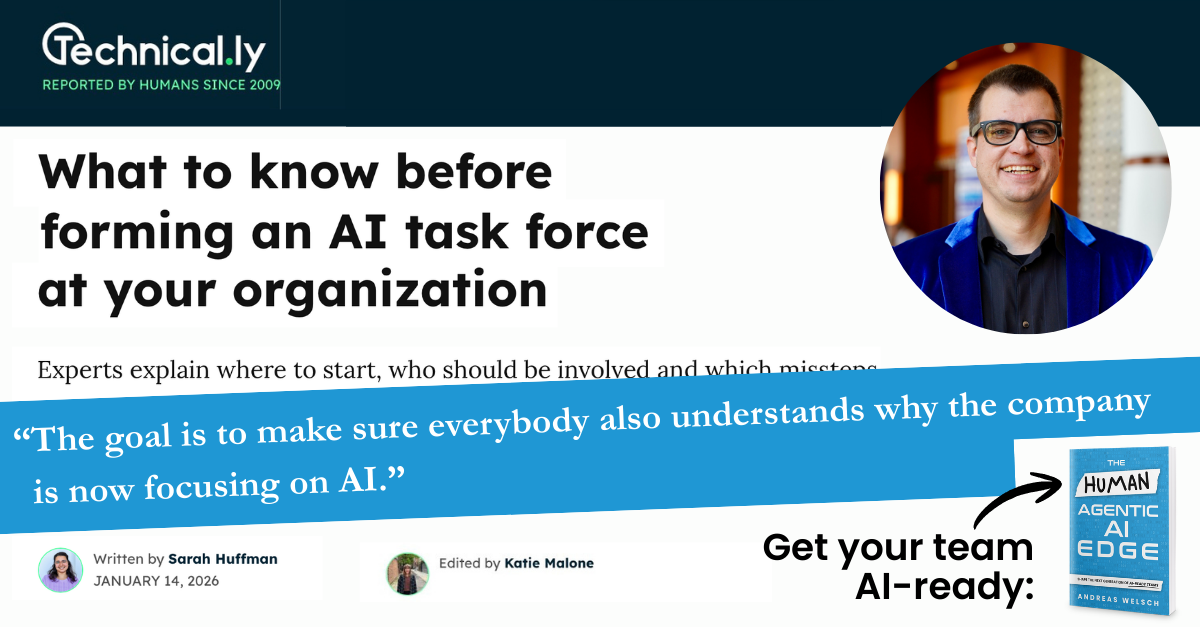
“Everybody has different objectives, but the goal is to make sure everybody also understands why the company is now focusing on AI.”
This shared understanding helps prevent fragmentation, where departments pursue AI for isolated reasons rather than common goals. A well-designed task force creates alignment by ensuring that all participants understand the organization’s AI vision and priorities.
Defining Clear Goals for the AI Task Force
According to Welsch, AI task forces must be outcome-driven. Activity without measurable progress quickly erodes credibility.
Early on, he recommends focusing on adoption metrics. These include how many employees have access to AI tools, how many actually use them and how frequently. These indicators help task forces understand engagement levels and identify where additional training or support may be needed.
Over time, however, adoption alone is insufficient. Welsch stresses the importance of linking AI initiatives to concrete business metrics.
A task force could be deemed successful if the company can provide metrics that show there was time and money saved.
This focus shifts the conversation from experimentation to value creation, reinforcing AI’s role as a business investment rather than a novelty.
Measuring Success Beyond Experimentation
Welsch’s emphasis on metrics reflects a broader principle: AI task forces should mature alongside the organization’s AI capabilities.
As adoption grows, task forces should evaluate:
- Whether AI is reducing manual effort
- Whether processes are faster or more accurate
- Whether costs are being reduced or avoided
By grounding success in measurable outcomes, AI task forces can maintain executive support and demonstrate tangible progress.
Why Authority and Governance Matter
AI initiatives often require changes to workflows, policies and decision rights. Welsch points out that task forces with limited authority struggle to implement recommendations, especially when cross-departmental coordination is required.
A task force supported by senior leadership can more effectively:
- Establish standards for AI use
- Coordinate pilots across teams
- Address concerns related to risk or compliance
This governance role becomes increasingly important as AI use expands beyond isolated experiments.
Avoiding Common AI Task Force Pitfalls
Welsch has observed that many AI task forces lose momentum over time. Initial enthusiasm fades when goals are unclear or when participation becomes inconsistent.
Common risks include:
- Treating the task force as a side project
- Failing to communicate progress and purpose
- Allowing experimentation without accountability
Welsch’s perspective highlights the need for discipline, structure and regular communication to keep AI efforts aligned and effective.
AI Task Forces Are Not Permanent
One of Welsch’s most important insights is that AI task forces should not last forever.
“It’s the most effective method right now… because it’s been tested and proven through different technology cycles. But they won’t be around forever, or else they’d turn into business units.”
In his experience, task forces typically operate for two to four years. As organizations mature, AI responsibility shifts from a centralized group to individual departments.
“From a centralized model, it moves more into a federated or into a decentralized model as time goes on and these organizations scale and mature.”
This evolution reflects success, not failure. It signals that AI has become embedded in day-to-day operations.
Conclusion
Andreas Welsch’s perspective on AI task force best practices emphasizes clarity, leadership and measurable outcomes. AI task forces are not about chasing trends—they are about enabling thoughtful, strategic adoption that delivers real business value.
Organizations that succeed will:
- Anchor AI efforts in business strategy
- Empower senior leaders to guide adoption
- Measure progress through meaningful metrics
- Plan for a transition to decentralized ownership
When designed correctly, AI task forces become the bridge between experimentation and enterprise-wide AI maturity.
FAQ
What is the purpose of an AI task force?
An AI task force helps organizations explore, govern and scale AI adoption while aligning it with business goals.
When should a company create an AI task force?
According to Andreas Welsch, task forces are most useful early in AI adoption when organizations need education, alignment and structure.
Who should lead an AI task force?
Welsch recommends a senior leader with cross-functional visibility and decision-making authority.
What departments should be involved?
AI task forces should include representatives from across the business, such as IT, HR, finance, legal and operations.
How should AI task force success be measured?
Success should be measured through adoption metrics and business KPIs such as time savings and cost reductions.
How long should an AI task force exist?
Welsch suggests AI task forces are temporary and typically transition to decentralized ownership within two to four years.
What is a common mistake AI task forces make?
Lack of clear goals, weak leadership support and insufficient communication often lead to stalled progress.