

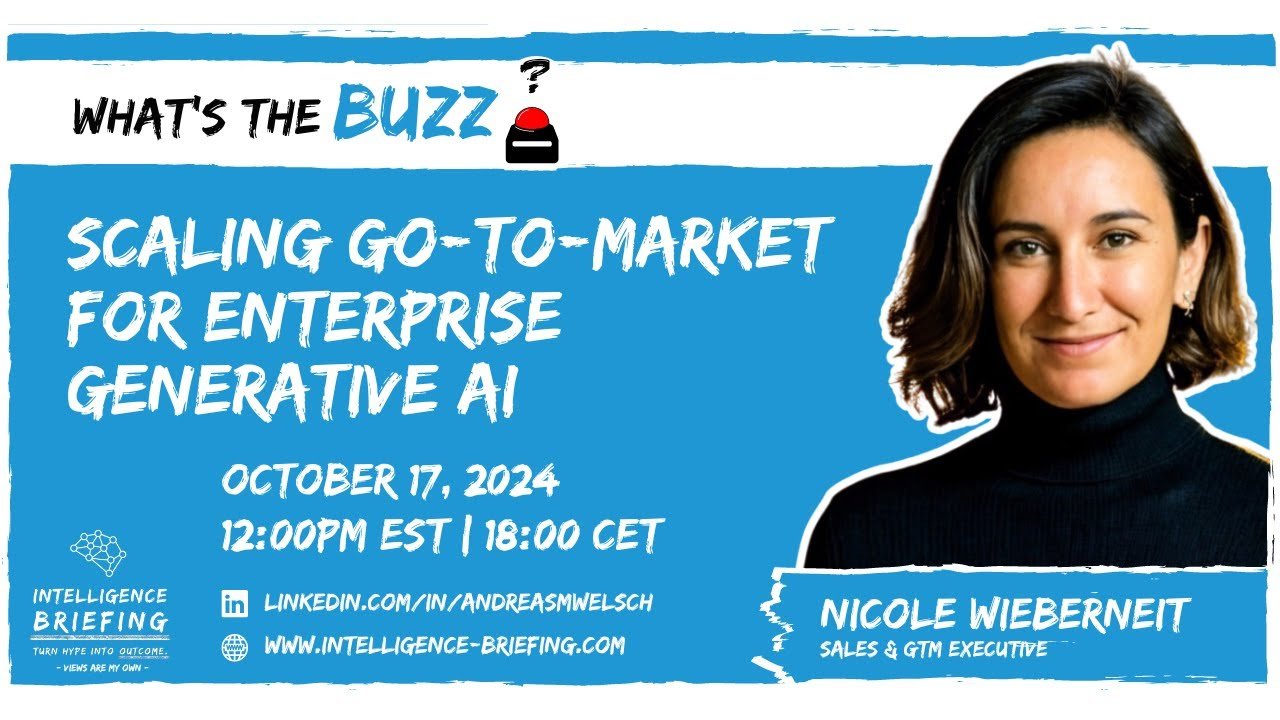
Guest: Nicole Wieberneit, Sales & Go-To-Market Leader
Host: Andreas Welsch
Episode: What’s the BUZZ?, Season 3, Episode 25
Published: October 17, 2024
Episode Summary
Nicole Wieberneit, Sales & Go-To-Market Leader, joins Andreas Welsch to answer how software vendors should scale go to market for enterprise generative AI. Nicole explains why marketing and sales earn a reputation for overhyping AI, and why security concerns and pilot paralysis slow down deployments.
The conversation covers who the ideal customer and buyer are, why go to market planning can no longer happen once a year, and how incentives and overlay teams help sellers build knowledge. Nicole closes with a call to focus on one buyer, industry or region, build the pitch around the problem, and keep testing.
Key Takeaways
- Nicole advises focusing on a specific buyer, industry or region, and building the pitch around the problem and value the product solves.
- Nicole says selling AI functionality is not the way to go to market: the pitch has to solve a customer problem, and that problem can change quickly.
- Nicole points to security and risk concerns, such as an AI assistant surfacing board salaries buried on a SharePoint site, as a reason projects stop and customers fall into pilot paralysis.
- Nicole describes overlay teams that go after big deals while the rest of the sales team stays compensated mostly on established products, for example 70 to 80 percent on those and 20 to 30 percent on new ones.
- Nicole says go to market planning can no longer happen once a year: teams need signals such as product usage and customer feedback, and the ability to adjust quickly.
Timestamps
- 0:35 The guest introduces her go to market background
- 2:17 Icebreaker game called In Your Own Words
- 2:50 If AI were a fruit, what would it be
- 3:58 Why marketing and sales get a bad reputation for overhyping AI
- 6:25 Security concerns, overestimated appetite and pilot paralysis
- 9:43 Who the ideal customer and the buyer are
- 11:43 Why old, boring use cases such as document automation come first
- 14:06 What go to market for AI does differently from traditional software as a service
- 18:39 What larger vendors can learn from startups about listening
- 20:00 Balancing knowledge and depth with quarterly incentives
- 22:09 Overlay teams and how their incentives differ
- 26:25 Audience question on narrowing use cases, and why to go vertical
- 29:55 Starting with the use case that has the fewest dependencies
- 31:00 The three key takeaways
- 32:19 Wrap-up and thanks to the guest
About Nicole Wieberneit
Nicole Wieberneit is a Sales & Go-To-Market Leader. In the episode, Nicole describes building businesses in the go to market space, including several years at Microsoft in the area of incubation products, and a current role with a Microsoft partner focused on partner ecosystem-led growth.
Full Transcript
Read the full transcript
Andreas Welsch: Today we’ll talk about scaling go to market for enterprise Generative AI. And who better to talk about it than someone who’s actively working on that? Nicole Wieberneit. Hey, Nicole. Thank you so much for joining.
Nicole Wieberneit: Hi, Andreas. Thanks for having me. I’m Nicole, and what I’m doing is building businesses. My love really sits in the go to market space. I have done that for several years at Microsoft, really in the area of incubation products: how can we sell better together, lead with AI and bring that to our customers? Nowadays I’m with a Microsoft partner, Digital Agencies, and I look into partner ecosystem-led growth and how I can grow our business together with Microsoft, really being at the edge of data, AI and add modernization. Great being here.
Andreas Welsch: Wonderful. I’m really excited for our conversation, especially because it’s a little different from the topics I usually cover, which are more centered around stakeholder management and governance. Now we take the point of view of a software provider: what do you need to do to get your go to market right, to help your sales teams have that conversation with your customer and be educated and informed? So I’m super excited for our episode today. Folks, don’t forget to get your copy of the AI Leadership Handbook on aileadershiphandbook.com, if you don’t already have one. And subscribe to my newsletter, The AI MEMO, under intelligence-briefing.com/newsletter, so you can stay updated on how you can successfully run AI projects in your business. Now, with that out of the way, Nicole, what do you say, should we play a little game to kick things off?
Nicole Wieberneit: Yeah. Go ahead.
Andreas Welsch: This game is called In Your Own Words. When I hit the buzzer, the wheels will start spinning. When they stop, you’ll see a sentence, and I’d love for you to answer with the first thing that comes to mind and why, in your own words. To make it a little more interesting, you’ll only have 60 seconds for your answer. Nicole, are you ready for What’s the BUZZ?
Nicole Wieberneit: Yes.
Andreas Welsch: Perfect. Then let’s go. If AI were a fruit, what would it be? 60 seconds on the clock. Go.
Nicole Wieberneit: A mixture between a strawberry, a raspberry, and probably a kiwi. The reason why: I really like everything sour, and I think these are the fruits which provide that.
Andreas Welsch: Let’s hope the industry doesn’t go sour on AI, because a lot of analysts are already talking about the disillusionment. But even sour can have its charm, like you said. Awesome answer. I’ve heard different things before, including durian, the king of fruits, because of its distinct taste, but a mix, that’s awesome. Now, when it comes to AI, we see a lot of marketing and a lot of sales teams going out there talking about AI as the next big thing. A lot of times, especially marketing in tech gets a bad reputation for overhyping those capabilities, and sales for being overly shallow. You give them a couple of snippets, they run with it, they talk to the customer, and once it gets a little more technical, we need to bring in additional people who can have the conversation on a more technical level. So what are you seeing? What are the challenges there? Why are marketing and sales getting a bad reputation?
Nicole Wieberneit: I think in general it is marketing’s task to lead the way and build the brand. If you’re going into a new functional category, you need to build that category, so you need to lead a little bit. You have seen that with companies like Microsoft, AWS or Salesforce, which are trying to go that way, leading with what a copilot means and what an agent means. Good sellers will jump on these things, especially if it comes close to what they hear and they are emotionally connected to it. I can give you an example. I come from a 16-year background of implementing CRM systems. When I heard the topic of a customer data platform, I could resonate with it, because for 16 years I heard that customers wanted a 360 view, or even 720, if you think of the consumer world of finance and household data. I could absolutely see it, and then you jump on it and you want to sell it. So that is the leading with it. On the other side, to be very honest, if I go to a customer today and say, let’s talk about a boring data foundation project, they don’t want to talk to me about that. They want to hear about the AI piece. I think what happened, especially in AI over the last two years, is that we are in a hype that is going down, because we haven’t really understood what it means to sell AI and what other topics you need to bring along to get the customer to use it in the right way and get the business value they want. Topics like security come into this. I can ask all the questions, but I heard of one project that was stopped when I was at Microsoft because somebody asked, can you give me the salaries of our board? That information had previously been buried somewhere on a SharePoint site where nobody would have found it. Generative AI could find it, because it was connected, and it found the answer. The project was stopped. So how can you get risk and security in a project into line? That is what customers worry about, and then they say, okay, that’s not where I want to go. That is what companies underestimated. What they overestimated was the willingness to go all in. The idea that I can sell Copilot licenses across the whole seat base is not happening either. Customers want to test one or two use cases and see how it goes. Because of the risk and security concerns, we don’t want to expose it to customers at first, only internally. You get into the pilot paralysis that we also saw with IoT and mixed reality or virtual reality: it takes a while to get out of the pilot stage and start seeing deployments across the whole world.
Andreas Welsch: That’s really interesting, because I remember seeing that with machine learning five or six years ago. Customers would say, sounds great what you’re telling me, but can I see this with my own data? To your point, you end up in a longer proof of concept or pilot cycle where things might pan out, or might not. It might be difficult to get the data, and difficult to get stakeholders around the table to agree. Going into this whole Generative AI wave, my hope and expectation was that things would be a lot easier, because we no longer need a lot of that data, at least for the quick-win early use cases. So it’s interesting that that’s still a concern. I think that comes back to how enterprises work, how enterprise leaders work, think and behave, and what they need to get right.
Nicole Wieberneit: Yes, and if you think about the go to market piece, what was great about Generative AI at the beginning is that it got the buzz going, and everybody saw Generative AI as AI. Predictive analytics suddenly got great attention: we should do this and that. That is actually predictive analytics, which we have done for years, but nobody talked about it. Generative AI put the whole focus on AI, and that’s really great. However, companies are now looking far more at their budget and at what they can use. What are the use cases? What is the business value you can bring to the table very early on for these customers? And the question is, who is your ideal customer? When you are in innovation and trying to build a new category, you first need to find companies who love to be innovative and at the forefront, and not go after the legons. Trying to sell to somebody who doesn’t have a data foundation is the wrong thing. In your segmentation, you should see which companies already have a data foundation and are already connected, like IoT sensors, so that you can build on it and create a critical mass, what I call positive energy. The second question is, who is your buyer? We have often seen different departments with their own budgets. Companies started to bring their Generative AI budgets together, and often the CIO or CTO became the holder of that budget because of the security risk. Then topics like an AI center of excellence around governance became a big topic, which probably delayed things a little before go to market could start scaling across a bigger customer base. So how do you talk to the BDM now? As we discussed before, you have to have different people. The CIO has the budget, but you still need a business use case and have to talk to the BDM, because that is what you need to bring. So what is the use case you want to go after? My learning since is that it’s actually old, boring use cases, things I implemented 16 years ago, like document automation. In the finance department, invoices come in, and instead of just having invoicing, you scan them, automate them and save them somewhere. Now you use AI on top of it, which reads them with Generative AI, indexes them better so you can find them again, and automates the rest. For that use case you need to bring your finance department and the CFO with you and align with them. That makes selling more complex, because you need to talk to different stakeholders. I would say that is probably true of every larger transformation project. Vendors playing in the enterprise space are used to that, but it’s a little different from the very simple entry you had with, say, Dropbox or Canva, which people just started using and then grew. That is not possible here because of the budget merging, the Generative AI center of excellence and the processes around it.
Andreas Welsch: I think you bring up another great point, especially around the boring use cases, things we did many years ago or have done for many years. I remember working on invoice matching and document processing six or seven years ago, when machine learning and RPA started coming on the map. To me, the fact that we’re still talking about this, but in a new and improved way, shows how transformation actually happens in companies. A lot of times it’s relatively slow and timid: let’s try this out, and if it really works, then we can do another thing, and then another. I also see a few regular members in the audience. If you have a question for Nicole, please put it in the chat, and we’ll pick those up in a couple of minutes. But with this part about having to educate your customers to some extent, work with them more closely and figure out those hurdles and barriers, what needs to be done differently when designing a go to market for AI compared to traditional software as a service?
Nicole Wieberneit: What you cannot do is go-to-market planning once a year, where you put together your marketing decks, your sales territories and your orchestration, and you’ve talked about how many different people you need to bring in. The innovation is happening super fast, so you need to stay on what is resonating at the moment. That is true whether you’re a small startup or an enterprise customer. You need to get the signals. You can use product usage and functional usage to see what resonates. It’s also about talking to your customers about their use cases. In the end, it’s about solving a problem for a customer and how you can use AI for that. Let’s be clear: selling AI, selling functionality, is not the way to do it. It’s about solving a problem. What is the problem, and is it even moving? Think about when COVID hit. From one day to the next, the problem changed. That’s an extreme example, but keep track of what is happening, test and experiment on what resonates and what doesn’t, and be able to change quickly. That is quite difficult for big companies, because the machinery to build pitch decks and marketing messages takes a long time. But I believe that is the way we need to go: more customer focused, more customer experience focused, on what they want versus selling a product. You will see the companies that do this well grow exponentially better than other companies. For me that is the main difference: how I use data feedback in my go to market, and understanding the KPIs and leading KPIs on how I need to change it. Go to market is actually very big. It’s marketing, sales, product and even customer success, so it’s about aligning and working very closely with these departments. As sales, I always say, we need to have the ear and the crown to the customer and to our sales teams, listening to what needs to change, at the initiate of the feedback loop, and then bring it back to the responsible teams. It could be, hey, that product feature doesn’t make sense and we need to change it, or we need to close a gap on security because the product is not secure enough. That is what then comes into the news, but it could be smaller things as well. Hey, marketing, we need to change the problem we described for our ideal customer profile, and we need to change our pitch decks and orchestrate differently.
Andreas Welsch: Let me jump in there real quick, because I think it also takes the right kind of culture, process and support system around it to make that happen. It’s relatively easy to get feedback from your customer. At a minimum they will tell you if something isn’t working, or isn’t working the way they expect. But finding the internal stakeholder, somebody who listens with open ears and doesn’t just say, yeah, fine, we’ll archive it, but actually acts on it, is a whole other level. It’s probably easier in smaller companies, or in companies where that culture already exists and is fairly strong, where we need to talk to our customers to get feedback so we can improve for them.
Nicole Wieberneit: I would say that is such an important point. Larger companies and vendors, even the market leaders, can learn so much from startups. That’s often why incumbents get disrupted: the listening was there, they got the signals, they just didn’t react to them. When I was at Microsoft, for example, we ran an experiment where we wanted to get more of that agile, founder-led mentality, to be agile and test and experiment on where to go with your go to market. Even if you tell people here is a department and it’s your job to do that, their minds were still stuck in the old way. For example, the way you measure sellers needs to be very different, because you cannot say, hey, that’s your quota, you need to sell 70 percent of that kind of product, and that’s the amount of money you need to hit, when that product may not be working and we need to adjust. They’re not used to working in that more agile way.
Andreas Welsch: I think the agility, changing the way people work and how they think, is certainly a key piece. You already mentioned that you led go to market enablement globally at Microsoft, one of the largest software companies in the world. How do you strike the balance between providing enough knowledge and depth that everybody can interact confidently with their customers, and not only get them excited but also show them real examples and real value, when there are quarterly incentives and quarterly quotas that people need to hit?
Nicole Wieberneit: When you incubate new products or functionality, you cannot just roll it out completely to everyone, because if you get it wrong, you have quite a negative impact, and at the beginning you don’t know all the points we discussed before. So you do it in steps, like a startup. You incubate, you try to get product market fit, you try to get five or ten customers live. That is what you normally have when you hear that a product or functionality goes GA, and it is often led out of engineering or product teams. The next step is your typical scale-up phase, when you try to make it bigger and go out with a sales team. Depending on how important it is, if you want to go all in on a feature and embed everything, you roll it out and try to educate and enable the field. That happened, for example, with Microsoft Copilots: when M365 Copilot came, they went with an all-in approach. You don’t always do that immediately. You could do what you do with other products and have an overlay team. Microsoft calls them global black belts, and other bigger companies have them as well. They sit either within corporate sales or within engineering, depending on the balance. What you try to do is win big deals or go after a certain vertical or customer profile, to test it out and create momentum, because you need more than one or two case studies. You need to learn how to sell it with your sales team. That is where the balance comes in. These teams get compensated far more on driving big deals and winning logos, going after that technical market, while the rest of the sales team is still compensated as they would be with the old products, maybe 70 or 80 percent on their normal products and maybe only 20 to 30 percent on the new products, depending on how it is set up. You need to keep that balance and learn, because let’s be clear, the money makers are normally the old incumbent products, not the new ones. That is how you can strike the balance. When you start to create positive momentum, you learn, and you hook into the natural ninjas within the field who tend to be early adopters. Back to that customer data platform example: I was one of the sellers who loved that, so I started to create a buzz and got regional momentum. Then you can build on it and ask whether you can start rolling out more, maybe even with a sales campaign. You go to an event, you talk about that use case, you put a customer on stage, and you create buzz within the sales team so that other sellers say, hey, I want to jump in. Customers are reluctant to go into new tech, and you have the same issues with sellers. I’ve sold CRM software for 30 years, I know what I’m doing, so why would I now need a Copilot? You have some of those sellers. So you use the innovative ones who want to be on the change, and the others think, something is going on there, I want to be part of it. Once you run these campaigns, you can start thinking about going out to the whole sales team, and then enablement. Enablement needs to hit five times. That’s why I think it is important to start with an overlay team: if a topic doesn’t constantly come up, you forget it. If you don’t use it, you forget it.
Andreas Welsch: That’s great. It brings up a lot of memories from my own career, and how we did business development for machine learning at SAP early on, from 2016 through 2019, and also what I’ve seen now with Generative AI: everything from enablement, showing sales teams what is already available, what value customers can expect, some sound bites they can take to their customer, and the commercial structure. And to your point about overlay teams, I know that’s what we did with machine learning: business developers going in with sales teams, having the conversation with the customer and doing the qualification before it moves on to more mature phases. Or what you said about the 70 or 80 percent, where people keep selling the established products but also don’t forget to have conversations with the customer about the new things. I do want to be mindful of time, and I see Jodi had a great question. She would love to get your take on this as well. She says: I hear enterprises describe AI as the art of the impossible, where they identify a hundred plus use cases for AI to innovate and grow their business, but it causes analysis paralysis, which delays results. So they never realize the promise of AI. That’s the best way to help enterprises narrow down the art of the possible and select one or two use cases that will have the greatest impact on the organization. I think it’s such a great question and such a relevant one.
Nicole Wieberneit: It’s awesome. Thanks, Jodi, for that one. Personally, I think you need to go vertical, depending on where you are. Think vertical, and then think about the biggest problems. What keeps the BDM in that vertical up at night? There are two or three big hairy problems they want to solve, and that’s where I would start. As a vendor, you need to have a point of view, using this kind of insight. If I say in financial services the biggest issue is regulation, maybe I need to go after that, and I go in with that point of view: we hear these are the problems, and our point is these are the three best use cases I would go after. Those are the use cases I would send my sellers out to hunt with. But that goes back to knowing your ICP, your ideal customer profile, and the problem you are solving. I absolutely believe you need a focused approach and a point of view, and you need to roll that out to your sellers. People always feel that the broader you are, the more chances you have to win a deal. Actually, everything is nothing. It leads exactly to what Jodi describes: oh, let’s do a workshop on what your best use case would be. Some sales teams are doing that, and it’s great if you have a customer you trust who knows very well what’s going on and can tell you. But a lot of customers want your guidance, and that guidance is: these are the three best things, these are the use cases where I see this much business value, cost savings or additional revenue, here we have done it with customer ABC. You drop the logos and the names, and ask, can we go together with you to the next best step? I know it’s simplified, and the world is different and does not move that fast, but I think that is what needs to be done to be successful. It also means that some customers you cannot satisfy because they don’t fit. But you don’t waste your sellers’ time trying to sell something that will never close.
Andreas Welsch: Maybe if I can add, looking at it from an internal perspective: if you are at a company where you feel stuck in analysis paralysis, my recommendation is usually to look for the use case that has the least dependencies. If it is something you can more or less quickly activate in a product you already use, let’s explore that. You still need to do the change management around it, rally people, and get your policies in place and security and legal and everybody else in line to support it. But if you start at the very bottom and dream up what we could be doing and build it from scratch, I think that delays it even further. For me, it’s usually where AI is available in a product you already use, but you either don’t know about it yet or haven’t activated it yet. Does that help us increase value? Again, coming back to your point, Nicole, I think that’s the critical starting point as well: not just that we can do it, but what value we can actually add. Now folks, we’re getting close to the end of the show. Nicole, I was wondering if you can summarize the key three takeaways for our audience today.
Nicole Wieberneit: My three key takeaways: think about the focus you want to have, based on your strengths, if I’m looking at the enterprise software that I need to sell. That focus can be a specific BDM, a specific industry or a specific region, but you need to be focused. Based on that focus, what is the problem and value I need to solve? Build your pitches around that. Who is the buyer, and who do I need to bring along? Based on that, I need to create my sales orchestration. And then it’s testing, experimenting, and being open to feedback and to adjusting what you designed. Go try and go after it. You can only learn and get better.
Andreas Welsch: I think that’s a very powerful message: you can only learn and get better. I wish more people in the field adopted that, along with the culture you mentioned, to bring that back and improve go to market. Now Nicole, thank you so much for sharing your expertise with us. And for you in the audience, thank you so much for being with us today.
Nicole Wieberneit: Thank you.
Listen and Subscribe
Related Reading
- AI Leadership for Enterprise Leaders
- AI Readiness for Enterprise Leaders
- AI Leadership Handbook
- How Successful Organizations Move From Pilots to Scale
- Agentic AI Pilots: From Prototype to Business Value
Frequently Asked Questions
Why do marketing and sales get a bad reputation around AI?
According to Nicole, companies underestimated the security and risk concerns that make customers stop AI projects, and overestimated customers’ willingness to go all in. Customers prefer to test one or two use cases, often internally first, which leads to what Nicole calls pilot paralysis.
How is go to market for AI different from traditional software as a service?
Nicole says go to market planning can no longer happen once a year. Teams need signals such as product usage and customer feedback, need to solve a customer problem rather than sell functionality, and need to test, experiment and change quickly. She adds that go to market spans marketing, sales, product and customer success.
How should incentives and enablement work when selling new AI products?
Nicole describes an overlay team that goes after big deals and winning logos and is compensated on that, while the rest of the sales team stays compensated mostly on established products, for example 70 to 80 percent on those and 20 to 30 percent on new ones. She also recommends finding early adopters in the field to build momentum before enabling the whole sales team.
Why should AI software companies focus on a vertical?
Nicole says a vendor needs a point of view built on the two or three biggest problems of the buyer in one vertical, such as regulation in financial services. She argues that the broader a vendor is, the less focused its sellers are. A focused approach means some customers cannot be satisfied, but sellers do not waste time on deals that will never close.
What are Nicole’s three takeaways for selling enterprise AI?
Nicole recommends choosing a focus, such as a buyer, an industry or a region, building the pitch around the problem and value it solves, and identifying the buyer to shape the sales orchestration. She closes by saying teams should test, experiment and stay open to feedback and adjustments.