

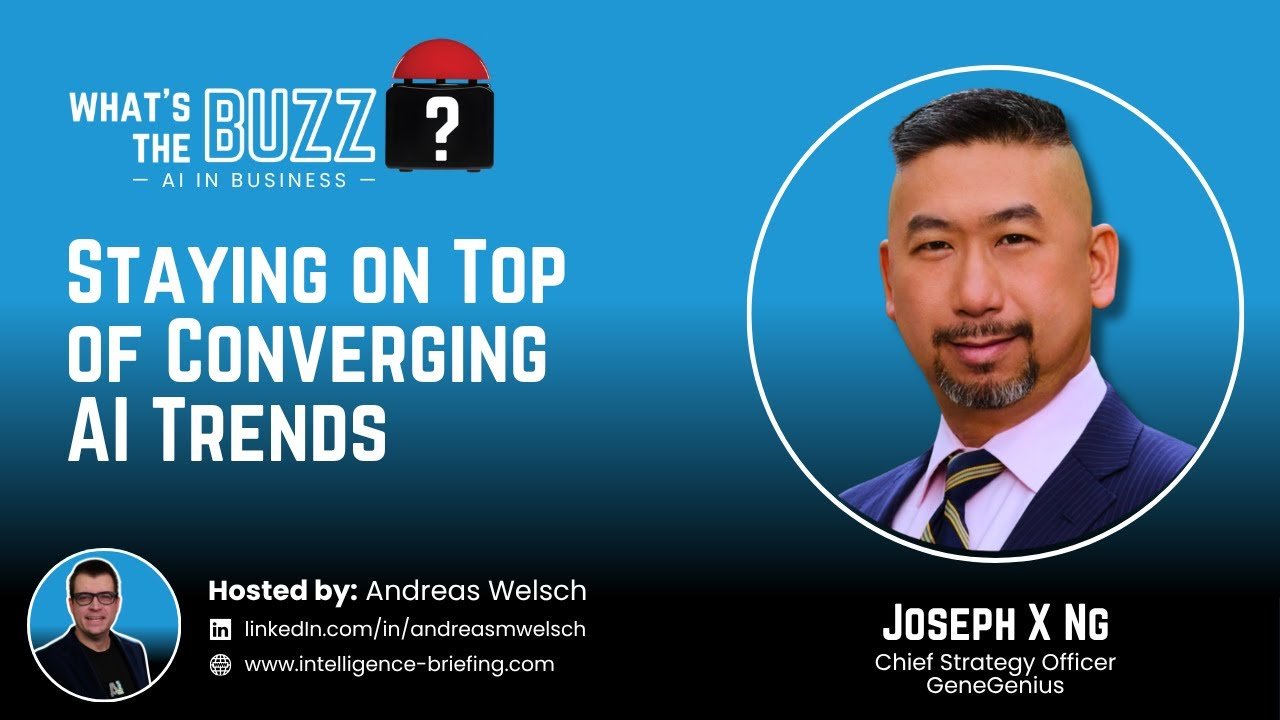
Guest: Joseph X Ng, Chief Strategy Officer at GeneGenius
Host: Andreas Welsch
Episode: What’s the BUZZ?, Season 5, Episode 12
Published: June 10, 2026
Episode Summary
How should leaders stay on top of AI, cybersecurity and quantum computing as they converge? Joseph X Ng, Chief Strategy Officer at GeneGenius, joins host Andreas Welsch to answer that question.
Ng said the AI race is usually framed as bigger models, more GPUs, faster inference or lower cost, and that organizations should spend their time on the architecture that lets AI operate responsibly inside the institution. He said AI is moving from a tool that analyzes information to a system that participates in decisions, which raises questions of accountability: why the system made a decision, what data it used, what rules it applied and who is responsible.
Ng said most companies treat AI as a tool deployment problem when it is a decision systems redesign problem. For smaller organizations without a large center of excellence, he recommended an audit of current systems, a modular rather than full redesign, and a phased approach. He said one of the biggest mistakes is scaling capability much faster than control.
On quantum computing, Ng said the biggest concern is cryptography, including what he called harvest now, decrypt later. He named three steps for leaders: map the decision systems, design the architecture for an orchestration environment of models, agents, data and humans, and embed governance into execution. He also pointed to genomics and drug discovery as a positive use, and to his book The Hybrid Mind.
Key Takeaways
- Spend time on architecture, not only the AI race. Ng said the race is usually framed around bigger models, more GPUs, faster inference or lower cost. If he were advising companies, he said, they should not spend all their time chasing it but put their time into the architecture that lets AI operate responsibly and productively inside the institution.
- Treat AI as part of the decision process. Ng said AI systems are starting to approve transactions, generate responses and trigger downstream actions, so they are part of decision-making itself. He said leaders need to be able to answer why the system made a decision, what data it used, what rules it applied and who is responsible if something goes wrong.
- Start small with an audit and phases. For organizations without a large center of excellence, Ng recommended an audit of current systems to see where the breaking points are, then integrating AI in a modular way rather than through a full redesign, in phases with clear objectives.
- Scale control with capability. Ng said one of the biggest mistakes is scaling capability much faster than control. Systems get deployed without a clear understanding of how they behave, how they are exposed and how they can be influenced, and he said that risk compounds very quickly.
- Prepare for quantum now. Ng said quantum computing changes the assumption behind today’s encryption, and that the issue is not only future risk: sensitive data collected today could be decrypted later. He said governance has to live inside the system through traceability, access control and clear human authority over critical decisions.
Timestamps
- 00:00:12 Why AI, cybersecurity and quantum computing belong in one conversation
- 00:00:54 Welcome and Joseph X Ng joins
- 00:01:12 Joseph X Ng introduces himself, GeneGenius and his book The Hybrid Mind
- 00:01:58 Whether the AI race is where companies should focus
- 00:02:52 Architecture over the AI race
- 00:04:10 When AI participates in decisions, accountability changes
- 00:04:58 The Hybrid Mind and the OODA loop
- 00:07:16 AI as a decision systems redesign problem, not a tool deployment
- 00:09:53 Practical steps for smaller organizations: audit, modular and phased
- 00:11:19 Work slop and low-quality AI output
- 00:12:29 Scaling capability faster than control
- 00:13:25 Why risk compounds across a chain of agents
- 00:15:04 Quantum computing as a new risk
- 00:16:29 Harvest now, decrypt later
- 00:18:19 Three steps: map decision systems, design the architecture, embed governance
- 00:21:27 Quantum in genomics and drug discovery at GeneGenius
- 00:22:02 What a hybrid human and AI organization looks like
- 00:24:32 Joseph’s three key takeaways
- 00:26:17 Closing remarks
About Joseph X Ng
Joseph X Ng is Chief Strategy Officer at GeneGenius. Ng said he recently published a book, The Hybrid Mind: The Human AI Convergence, and said GeneGenius will be excited to explore quantum capabilities in genomics, including mapping human genomes and drug discovery for rare diseases.
Full Transcript
This is a lightly edited transcript.
Read the full transcript
Andreas Welsch: There’s no shortage of news, no shortage of hype in the AI space. But so far we’ve really just been talking about AI and agents. And that’s given us enough to talk about. But it gets really interesting when we start layering cybersecurity, quantum computing, and the next level of innovation and emerging technologies on top of that. So today’s guest will share more about that. I’m super excited to have him on. So let’s jump right in.
Andreas Welsch: Welcome back for another episode of What’s the Buzz where leaders share how they have turned hype into outcome. Today we’ll talk about what happens when different technologies converge. We’ve been talking so much about AI that we are almost neglecting things like cybersecurity and quantum and how they fit in. So I’m super excited to welcome Joseph Ng on the show to talk more about that. Hey Joseph, thank you so much for joining.
Joseph X Ng: Thank you for the invite. I’m happy to be here. It’s very exciting times indeed.
Andreas Welsch: Oh yeah, for sure. Joseph, I was wondering if you can introduce yourself real quick to the audience for those who might not know you yet.
Joseph X Ng: Hello. My name is Joseph Ng and I am the Chief Strategy Officer for GeneGenius, and I recently published a book named The Hybrid Mind: The Human AI Convergence.
Andreas Welsch: That’s exciting. So I know you’re right at the center of where all of these things come together. We’ve obviously been connected over LinkedIn for a while. We got to meet at the AI Summit at the end of last year. And we should definitely spend some more time talking about what happens when all of these things converge. Now, obviously there is so much focus on the AI race and I’m wondering what are you seeing? What’s your take? Is this really where companies should focus all of their efforts these days?
Joseph X Ng: That’s a great question. When people talk about the AI race, they usually frame it as a race for bigger models, more GPUs, faster inference, or lower cost. That matters, but I do not think that should be where all the resources are concentrated. These things will continue to evolve. The more important question is whether an organization actually knows how to operationalize intelligence inside the business. AI is moving from being a tool that analyzes information to becoming a system that participates in those decisions. As that happens, the real challenge is no longer access to AI. The challenge becomes architecture. How do you govern the system? How do you manage risk, oversight, and human authority when intelligence is embedded directly into the workflows? If I was advising companies, I would say do not spend all your time chasing the AI race as if winning means having the biggest models or most compute. Spend your time on the architecture that allows AI to operate responsibly and productively inside your institution.
Andreas Welsch: I think that’s a very sensible call, especially these days when one headline changes, next there’s a new model that comes out almost every other week, it seems. At least a new feature. So making sure you actually get your foundation right. A lot of times we talk so much about data as being a foundation, but if you go one level above that, it is indeed the architecture, the orchestration, the guardrails, the guidelines, the evaluation, and so on. Good to hear that for sure. But what does it mean from your perspective when AI participates in decisions, like you said? How does it change the dynamic?
Joseph X Ng: Historically, AI sat outside the decision process. It generated insights, dashboards, predictions. The human was still clearly in control of the final decision. What’s changing now is that AI systems are starting to act inside the workflow. They are approving transactions, generating responses, even triggering downstream actions across systems. At that point, AI is no longer just supporting decisions, it is part of the decision-making process itself. You can no longer rely on traditional assumptions around accountability. You need to be able to answer very basic but critical questions. Why did the system make that decision? What data did it use? What rules did it apply? And most importantly, if something goes wrong, who is responsible? I address this problem in my book, The Hybrid Mind. The idea is that when humans and AI systems are operating together, they need a structured way to manage that interaction. That is where concepts like the OODA loop, observe, orient, decide, act, and most importantly, feedback, are very key.
Andreas Welsch: Yep. Especially this part about observing and feedback, that sounds like a huge opportunity. I was just talking to a former colleague of mine and we worked on machine learning projects almost 10 years ago. One of the big challenges was whenever we had a substantial amount of new data, say 6 months after a model training, we would have to go back and retrain the model on that new larger set of data. You would have to test and see, does it still decide and act in ways that you had already approved, or do you need to make changes again? So to me this feedback loop, this almost constant learning, is a real big benefit of looking at things like agents, that they can pick up information on the go or for the next go-around. A lot of promise in my mind, a lot of opportunity to cut down on this batch-type learning when it’s more interactive and on the go. Yeah, I see a lot of companies deploying these AI tools, whether it’s, hey, we’ve given everybody Copilot and we’re done, that’s our AI strategy, or we have this little feature in our travel and expense app and you can scan your receipts and now we’re all AI enabled. But I feel a lot of times this type of mindset falls short of expectations of delivering something bigger, more meaningful that captures a lot more value than just giving somebody a tool and expecting them to work on that. What do you think? How do you feel organizations can evolve? What are some of the recommendations that you have there?
Joseph X Ng: Definitely, this is a very key question. What most companies are missing at this point is that they’re still treating AI as a tool deployment problem, when it’s really a decision systems redesign problem. Right now, a lot of organizations are adding AI in very narrow ways. They introduce a chatbot, a copilot, like you’re saying, an automation feature, and they call it their AI strategy. In reality, what they have done is add a layer of intelligence on a legacy operating model without changing the architecture underneath. That works for small productivity gains, but it does not hold once AI starts influencing judgment, routing actions, or participating in decisions that have business, regulatory and human consequences. The gap is that most companies have not mapped these decisions or actions made independent of humans at this point.
Joseph X Ng: Which is the logic behind cognitive AI-native architecture, or CANA. CANA is not about adding AI to the stack, it is about restructuring the stack so intelligence, oversight, and human authority are built into how the system operates from the start.
Andreas Welsch: So a question there. I know you’ve previously worked in financial services for a large and well-known financial services company. I’m assuming there’s already a muscle built over the years from predictive analytics to machine learning to generative AI to agentic AI. And I see this across many different industries, that the larger the organization, the longer they’ve been at this problem and have been working with this kind of technology, the more it becomes second nature, and the next evolution of technology changes a few things but not fundamentally what the organization knows. But I also see smaller organizations struggling with this. When you talk about architecture, it’s not that easy for a mid-size bank, for example, or a mid-size insurance broker to do that heavy lifting of thinking about what does our architecture look like. What do you recommend there? What can companies and leaders do that’s practical when they don’t have a large center of excellence or dozens or hundreds of people working on this, but two or three?
Joseph X Ng: What I would recommend for these organizations that are small in scale is to first do an audit of their current systems and their systems in general. And then see where those breaking points would be.
Andreas Welsch: Mhm.
Joseph X Ng: And then how we can integrate AI into the mix.
Andreas Welsch: Right.
Joseph X Ng: It’s not a full redesign. It’s more modular in essence.
Andreas Welsch: Mhm. So that also means reducing your risk a little and being able to show something more quickly and make progress and continue making progress as you go.
Joseph X Ng: Exactly. And this is what I call a phased approach.
Andreas Welsch: Mhm.
Joseph X Ng: Whenever we’re doing large projects, we break it down into certain phases.
Andreas Welsch: Yeah.
Joseph X Ng: Especially creating some objectives and within there
Andreas Welsch: Mhm.
Joseph X Ng: to accomplish our goals, right? So yeah, I think this is the best approach for a small organization.
Andreas Welsch: Thank you. Thanks for sharing. That’s great. Maybe you’re seeing this next thing too. A lot of times I see this kind of low-quality output or work slop in my inbox. Hey, can you take a look at this? I created a first draft. What do you think? And you start reading and you’re like, yeah, I don’t know. It’s not bad, but it’s also not good. It’s not very authentic. It misses details. It misses depth. It misses teeth. That’s one of the big challenges I see and that I hear from former colleagues in corporate who say, hey, I get all of this stuff and it reads like somebody just pulled this out of a Copilot or a ChatGPT. And to me it feels like 7 years ago, 5 years ago, even before ChatGPT, we talked so much about business processes, about business functions and their productivity, changing processes with AI. Now we’re in some ways a step back talking about personal productivity, like you said. But what are some of the other mistakes or other challenges that you see that companies are running into when they just roll out an AI tool or a generative AI tool, maybe not a generative AI tool. What else are they missing?
Joseph X Ng: One of probably the biggest mistakes organizations are making right now is they’re scaling capability much faster than they are scaling control.
Andreas Welsch: Mhm.
Joseph X Ng: There’s a lot of pressure to adopt AI quickly, deploy models, launch features, automate workflows. And everything on the surface looks like progress. Systems become more capable and organizations feel like they’re moving forward. But underneath that, many of the systems are being deployed without a clear understanding of how they behave, how they are exposed, and how they can be influenced. So what you end up with is a huge gap that increases risk, and that risk compounds very quickly.
Andreas Welsch: I think that’s an important point. A lot of times we think about this being additive, but it’s actually more exponential. Think about agents or multiple agents in a system. It’s not risk plus risk but times, right, when each part in the chain becomes a failure point or a breaking point.
Joseph X Ng: Exactly. Yeah.
Andreas Welsch: It’s not just, again, about rolling out tools. It’s about understanding what that risk means. It’s funny you say we’re rolling out capability faster than governance. I’m thinking in political terms. If I look at the US, if I look at Europe, if I look at Asia, on a larger scale we’re seeing how this can play out, right? Being more liberal with innovation and trying to be first to market or in that AI race on a global scale, competing with others, in the EU taking a much more deliberate approach and starting with regulation first. Say, how can we protect our citizens? How can we protect the data? How can we uphold our values? And I’m seeing this, to your point, on a smaller scale in businesses, too. But certainly when AI labs push out innovation weekly, some even daily it seems, and you’re still thinking in quarterly road maps or in half-year planning cycles, I’m sure your executives are asking, so what are you doing? How come we’re not shipping as fast? So it’s definitely a challenge for sure. But along with that, there are risks beyond the high-level what if something fails. If you introduce AI, if you introduce agentic AI, what are some of those that you typically see and what do you advise companies and leaders on addressing them?
Joseph X Ng: Risks in AI is very interesting because there’s a new technology that is coming around the corner, right? Quantum changes the conversation because it is no longer incremental improvement in computing. It fundamentally expands what is computationally possible. With classical systems, there are entire categories of problems that are simply out of reach right now because of how long it would take. Quantum computing changes that. It opens the door to solving highly complex optimization problems, simulating molecular interactions at a level of precision we have never seen before, and advancing probabilistic modeling in ways that could reshape industries like healthcare, science, and finance. The biggest concern for me is the cryptography. Today, most of our digital infrastructure relies on encryption methods that are secure because they are computationally difficult to break. And it takes many years for that to be possible. Quantum computing changes that assumption and the issue is not just future risk, it’s actually now. There’s a concept called harvest now, decrypt later where sensitive data is being collected today with the expectation that it could be decrypted once computing powers like quantum mature. The real question is whether we are building the governance, security, and infrastructure to handle what becomes possible when the technology does arrive.
Andreas Welsch: So I’m part of a global network of architects and recently this topic has been moving more to the forefront as well, to say, “What are we actually doing to address this and what can we do proactively?” Because we see the writing on the wall that as soon as quantum is out there and it’s commercially valuable and usable, there is a high risk that our current cryptography methods are out the window. They’re useless or ineffective. And I think that’s one of the key risks I’m not seeing enough people talk about yet because we’re so focused on, hey, AI, AI, productivity, and summarizing meeting minutes and all that good stuff. But what are some of the things, again, that organizations can do right now? How can you harden your security and what can you actually do to prevent some of the harm that is likely going to come in the future?
Joseph X Ng: And you’re totally right, Andreas. Most organizations are still asking which model to use or which to deploy, right? Those are downstream questions. The real risk of the systems is what we’re talking about with quantum, right? The first step is to map out the decision systems that we have, not just the workflows. Leaders need to understand where decisions are made, where AI can advise or act. The second is architecture. This future is not a single model layered onto a legacy system, but an actual orchestration environment of models, agents, data, and humans. If the architecture is not designed for that, governance will always lag behind capability. And finally, the third is the governance layer, right? It has to be embedded into the execution. It cannot live in a policy somewhere in your network that no one reviews for a few years and then finally some event happens and then you have to pull it up in the middle of the night, right? It needs to exist inside the system through traceability, access control, and clear human authority over critical decisions.
Andreas Welsch: Mhm.
Joseph X Ng: And the role of leadership is not just to adopt AI, but to build an institution that can operate with intelligence responsibly, visibly, and at scale.
Andreas Welsch: I think that’s a key point. Thinking back roughly 25 years, I remember in cybersecurity there were these rainbow tables. Basically, what are the passwords or common passwords and how can you guess them or, through brute force, get in. We’ve moved on to more complex passwords, right? Should be at least, I don’t know, 16, 32 characters, special characters, uppercase, lowercase, numbers, and whatnot. Now we’re talking about passkeys, but even that with this kind of technology doesn’t stand a chance. So, to your point, right? It takes a multi-layered approach. In some ways I feel people are still going to be the weakest link in your technology strategy, let alone technology even being weaker than it used to be. But the other part that I think is more hopeful, more promising, more positive in that sense, is, hey, quantum computing, you can find new molecules, you can do a lot of other things. So let’s talk about that very briefly too. Aside from cracking cryptography, what are some of the good things that you can actually use the technology for?
Joseph X Ng: There are many possibilities within quantum that can be very positive and very impactful, right? I think in terms of quantum there are a lot of opportunities in genomics.
Andreas Welsch: Mhm.
Joseph X Ng: So within GeneGenius we will be excited to explore that capability once it’s available. And how do we map human genomes, right? And then provide the capability of drug discovery. And then the next enhancement of drug capabilities to solve some of society’s most rare diseases.
Andreas Welsch: That sounds very promising and like a great cause for sure, right? Now, you’ve also talked a bit about your book, The Hybrid Mind. In it you also talk about what that organization looks like that fuses machines or AI and humans together or where they collaborate well. When I say fuse, I don’t know, it doesn’t sound quite right, but where they work effectively together. Let’s maybe go with this one. What does that organization look like?
Joseph X Ng: What led me to write The Hybrid Mind was not just a single moment, but a pattern I kept seeing within the industry, academia, and also the real world, right? In enterprise environments, especially in regulated sectors like banking, that’s where all decisions are actually made. As AI entered those environments, it became clear that the technology was advancing much faster than the systems designed to govern it. At the same time, in academia, there was a gap. Conversations were focused on models and performance, but not on what happens when AI is embedded into real decision-making systems, and who is accountable.
Andreas Welsch: Mhm, right.
Joseph X Ng: Through the AI work in AI governance and platforms like GeneGenius that we just talked about, I saw the shift firsthand, where the challenge is no longer just building something that works. It is building something that can be trusted, audited, and aligned with human responsibility. The book is an attempt to formalize that shift, and bringing together concepts like governance-first design into something organizations can actually apply.
Andreas Welsch: Mhm.
Joseph X Ng: At its core, it is about how institutions need to evolve when intelligence is no longer outside the system, but is enclosed and operating within.
Andreas Welsch: Yeah. Awesome. So, folks, for you in the audience, I definitely recommend picking up Joseph’s book, The Hybrid Mind, to learn more about how to facilitate that change and prepare for what’s next. Now Joseph, we’re getting close to the end of the show, and I was wondering if you can summarize the key three takeaways for our audience today. We covered a lot of ground, but what are the three things that folks should take away from our conversation today?
Joseph X Ng: AI is moving from a tool that analyzes information to a system that participates in decisions. Once that happens, the focus is no longer just capability, it becomes control, accountability, and design. The AI race is not where differentiation will come from.
Andreas Welsch: Mhm.
Joseph X Ng: It will come from who can build the systems that govern how intelligence operates inside organizations. On the security side, that attack surface has changed. Systems do not need to be broken into in the traditional sense. They can be influenced through normal transactions and interactions, which means governance and security must be embedded directly into the architecture. Quantum reinforces the same point. Every leap in compute increases both opportunity and risk. The more powerful these systems become, the less tolerance there is for weak infrastructure and delayed preparation. For leaders, the shift is clear. This is no longer about adopting AI tools. It is about redesigning how decisions are made, how systems are structured, and how responsibility is maintained when intelligence is shared between humans and machines. That is what the hybrid mind is all about. It is a blueprint for operating in a world where intelligence is distributed, automation is consequential, and governance must be built into the system from the start.
Andreas Welsch: Awesome. Thank you so much for sharing, Joseph. It was a pleasure having you on. Thanks for sharing your expertise with us. Always great talking to you. And thanks for joining.
Joseph X Ng: Oh, thank you so much. It was a fun discussion and a very critical timing, too.
Andreas Welsch: Absolutely. All right, folks, if you’re in the audience, thank you so much for joining, and see you next time for another round of What’s the Buzz. Bye-bye.
Listen and Subscribe
- Watch on YouTube
- Listen on Buzzsprout (show page)
- Listen on Apple Podcasts (show page)
- Listen on Spotify (show page)
Related Reading
- AI Governance for Enterprise Leaders
- Agentic AI for Enterprise Leaders
- The HUMAN Agentic AI Edge by Andreas Welsch
- Agentic AI Security: Five Layers and Agent Commerce
- 5 AI Governance Controls Auditors Expect to See
- Human in the Loop vs On the Loop: The Agentic AI Edge
Frequently Asked Questions
Why is the AI race the wrong place to focus all resources?
Ng said the AI race is usually framed as bigger models, more GPUs, faster inference or lower cost, and that this matters but should not take all the resources. He said the more important question is whether an organization knows how to operationalize intelligence inside the business, and that the real challenge becomes architecture, including governance, risk, oversight and human authority.
How does AI participating in decisions change accountability?
Ng said AI used to sit outside the decision process, producing insights, dashboards and predictions while a human made the final decision. Now AI systems approve transactions, generate responses and trigger downstream actions, so he said traditional assumptions about accountability no longer hold. Leaders need to answer why the system decided, what data it used, what rules it applied and who is responsible if something goes wrong.
What can smaller organizations do about AI architecture?
Ng recommended that smaller organizations first audit their current systems and see where the breaking points would be, then integrate AI into the mix. He said it is not a full redesign but more modular, and that he calls this a phased approach, where large projects are broken into phases with objectives.
What does harvest now, decrypt later mean?
Ng described harvest now, decrypt later as a concept where sensitive data is collected today with the expectation that it could be decrypted once computing power such as quantum matures. He said most digital infrastructure relies on encryption that is secure because it is computationally difficult to break, and that quantum computing changes that assumption.
What three steps did Ng recommend for leaders?
Ng said the first step is to map the decision systems, not just the workflows, so leaders know where decisions are made and where AI can advise or act. The second is architecture: an orchestration environment of models, agents, data and humans. The third is a governance layer embedded into execution through traceability, access control and clear human authority over critical decisions.