

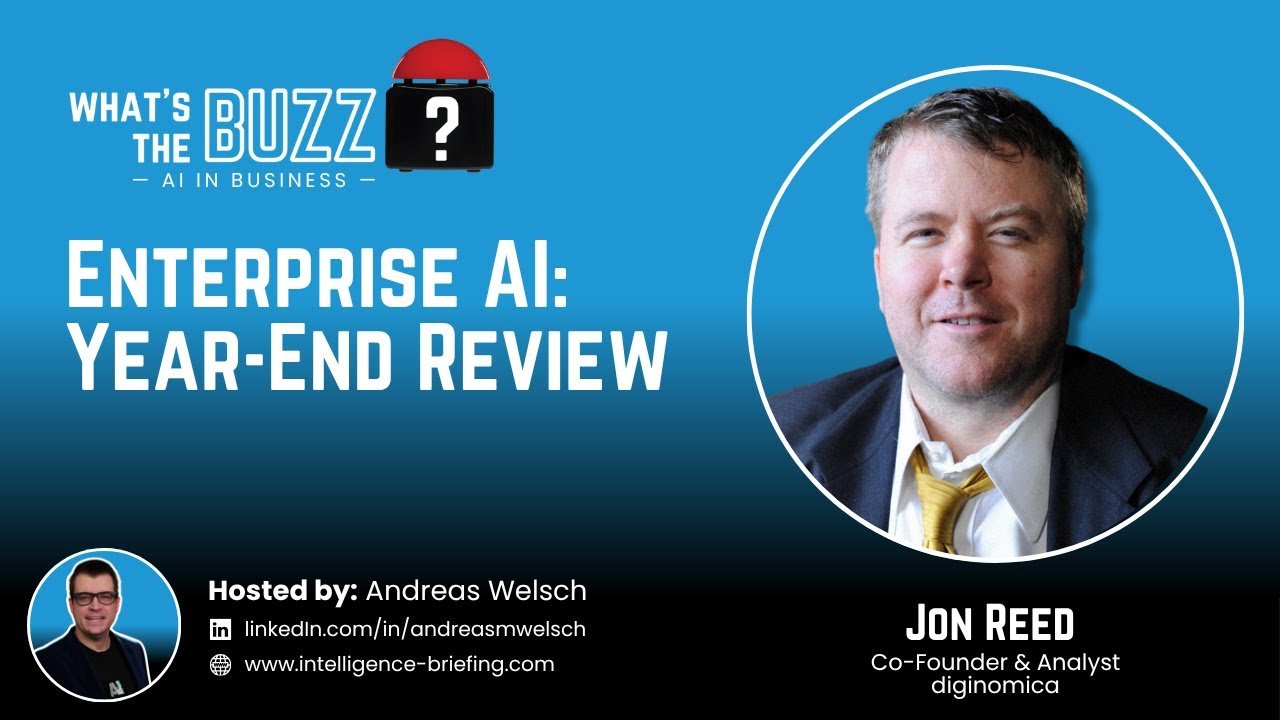
Guest: Jon Reed, Co-Founder & Analyst at diginomica
Host: Andreas Welsch
Episode: What’s the BUZZ?, Season 4, Episode 29
Published: December 16, 2025
Episode Summary
Jon Reed, Co-Founder & Analyst at diginomica, joins Andreas Welsch for a 2025 year-end review that asks what is working and what is not on enterprise AI projects.
Jon reports that enterprise vendors are far ahead of their customers, that agentic AI used for its own sake and multi-agent setups across vendors are not working at scale, and that results come from AI readiness work, compound systems, agent evaluation and focused use cases.
Andreas adds examples from conferences he attended, including a PepsiCo B2B customer engagement case and an in-house legal agent for NDAs, and describes the filtering problem leaders face as AI-generated information piles up.
Both close with views on 2026, including the choice between a fulfilling workplace and a surveillance workplace.
Key Takeaways
- Jon says enterprise vendors are, for better and for worse, far out ahead of customers, who tell him off the keynote stage that they like the roadmap but need help getting there.
- Jon says agentic AI for its own sake and agents from different vendors placed together are not working at scale, while an orchestration agent with a handful of task-specific agents on the same data platform generally works.
- Jon defines AI readiness as getting results on the way to cleaning up processes and data, supported by a right-time data layer with metadata and annotation. Andreas relays a PepsiCo example in which a 9% improvement meant $250 million in additional revenue.
- Jon recommends compound systems that combine agentic steps with machine learning, deterministic automation and human supervision, plus agent evaluation, source documentation for explainability and granular control over autonomy.
- Jon and Andreas both argue that leaders should say clearly how AI changes work. Jon sees a fork between a fulfilling workplace and a surveillance workplace, and Andreas asks what employees could do with better tools.
Timestamps
- 00:00:48 Welcome and the year-end framing
- 00:02:08 What is working and what is not: the gap between vendors and customers
- 00:03:45 The AI bubble and why enterprise AI may shield the fallout
- 00:09:59 Treating AI as a worker or as a tool, and why leaders must communicate
- 00:11:20 An Indeed example of open leadership communication
- 00:15:23 Treat AI like your worst intern, not your best
- 00:18:04 What is not working: agentic for its own sake and multi-agent setups
- 00:24:05 Layering agents onto bad processes and siloed data
- 00:28:38 Work slop and the filtering problem
- 00:32:20 AI readiness as getting results while cleaning up processes and data
- 00:34:48 The PepsiCo example: a 9% improvement and $250 million
- 00:36:11 Compound systems that combine agentic and non-agentic components
- 00:41:55 Giving customers granular control over autonomy
- 00:45:14 Evaluation and observability of agents
- 00:47:38 Explainability through RAG and source documents
- 00:49:29 Context engineering
- 00:52:26 Smaller models and document intelligence
- 00:55:46 A legal NDA agent and the A/B testing approach
- 00:58:27 Other use cases that are working
- 01:01:24 Procurement agents for RFPs
- 01:03:14 Looking ahead to 2026
- 01:04:17 A fulfilling workplace or a surveillance workplace
- 01:06:26 Domain expertise and building a community
- 01:11:05 Closing
About Jon Reed
Jon Reed is Co-Founder & Analyst at diginomica. In this episode he describes a fall spent at major enterprise vendor shows and analyst discussions, a judging role in a competition with UiPath earlier this year, and a demo floor series for AI demos.
Full Transcript
Read the full transcript
Andreas Welsch: Welcome back for another episode of What’s the Buzz, where leaders share how they have turned hype into outcome. It’s been an incredible year for AI with all its ups and downs, and I’m super excited to welcome Jon Reed, distinguished analyst, co-founder of diginomica, to do a year-end review together. Hey Jon, thanks so much for joining.
Jon Reed: It’s so good to be here and I’m really looking forward to getting your reactions, because we’ve both been on parallel tracks of getting out in the field, hitting the events. Now we’re going to find out and compare notes. I’ve got a bunch of stuff to throw at you that no one’s heard before. I want to hear what you have to say.
Andreas Welsch: Fantastic. So why don’t we get right into it? We’ve recorded three episodes over the course of the summer, from looking at what is real, what did we actually hear in the spring circuit, then where are things moving, what are some of the big myths you need to be aware of if you’re an AI leader, to closing us off, at least for the end of the summer, before we hit the circuit now for the fall. So Jon, I’m super curious. What have you seen, what has changed since last time we talked, when you said, yes, agents are there, but there’s probably a little more that leaders and organizations need to think about? I think security was one of the big topics we talked about back then. So what’s new? What surprised you? What have you seen?
Jon Reed: What I really want to get to in our discussion is what’s working and what’s not on AI projects today. Obviously agents will be a part of that, but having been to a bunch of the major vendor shows this fall and a bunch of analyst discussions as well, it’s fair to say that AI vendors, enterprise vendors, are for better and for worse pretty far out ahead of customers. I refer to this as the gap between where customers are at and where vendors are at and how they talk about this technology. That’s not necessarily a terrible thing if customers like the roadmap and like the vision. But again and again, off the keynote stage, I would hear from customers: I like what I heard, but I need help getting there. I don’t know exactly how to get there. We’re going to get into the meat of our discussion today, but the thing I did want to get to first is a little bit of framing, and I want to say a few controversial, spicy things to get this going before I get you into the projects and get your reactions. We’re definitely beyond this first wave of gen AI failures and generic office productivity stuff, into more embedded AI, which to me is much more exciting, embedded in our business processes. It’s mostly not happening at scale yet. Now there is this risk of work slop that I think we’ll get back to. But in the background of all of this, there is this AI bubble, and this discussion around the bubble. There are some really concerning signs around the big AI economy, including the circular deals that are happening between a handful of vendors. That really does get you a little bit concerned. The good news, if there is any in all of that, is that the enterprise is going to help shield us from some of the worst of that if there is fallout, because enterprise AI is chugging along in a sneaky, secretive kind of way. It’s a little bit more modest, because it’s not the trillion dollar AGI economy that vendors like Anthropic and OpenAI were pushing, but it does matter. But the thing is, Andreas, when you have OpenAI going back on their promise not to get into porn and getting into porn, what that tells me is they’re struggling on an enterprise level. If they were signing seven figure enterprise deals, they wouldn’t be getting into porn right now. So there are some issues with the big vendors that have set the tone for this economy, and diminishing returns on where LLMs are headed is certainly part of it. Reasoning models came out last year, and that was the last big trick. So there’s a sense of stagnation in the broader industry, with these big LLM companies feeling a little more like commodities in some ways. But in the enterprise, we see interesting progress, and that’s what I want to talk about with you today.
Andreas Welsch: Many of these points resonate quite deeply. When it’s a fraction of a cent to create some kind of content, some kind of work product, you really need to wonder what the economics are behind it, and what that scale needs to look like in order for AI labs to recoup some of the money they’re spending on data center buildouts and buying future growth. I don’t remember the latest numbers for weekly active users that OpenAI has. If I’m not wrong, I think it’s somewhere around 400 million active users per week, which is still huge. But probably the biggest chunk of those are consumers and students, maybe not necessarily enterprise workloads.
Jon Reed: A lot of them are therapy and companion bots and stuff like that. It’s not business-caliber workloads that are firing the revenue for them. So it is what it is.
Andreas Welsch: That’s right. What’s interesting to me too is OpenAI, Perplexity and others getting into agentic browsers, or browser agents that can act on your behalf. On one hand, as a consumer, I can see where this is going. Lots of convenience. I don’t need to log into all of these different sites to book travel, airline, hotel, rental car. It’s like a dream come true, at least from a productivity point of view. But I’m wondering from a business point of view, what does it mean if your products are now at the mercy of OpenAI, Perplexity or others ranking them as trustworthy? We’ve seen a shift from SEO, search engine optimization, to answer engine optimization or generative engine optimization. How do you build authority so that your products are ranked there? On the other hand, if you’re in the procurement department, how can you in the future automate even more of these tasks? Maybe you spend two hours sourcing material from a new supplier. Maybe in the future you have a browser agent and you say, hey, get these 500 screws or nuts and bolts from the best suppliers. But
Jon Reed: That browser agent example is radically different from the consumer agent proposition. The problem on the consumer side is that having an agent do your personal assistant things for you and book all these things is just not the strength of agents right now. Agents work a lot better in much more specialized contexts, because context is the key and context gets lost, and the permissions required to affect these agentic workflows on a personal assistant level are quite difficult. It’s also not clear what the business model would be for OpenAI, even if that technology was ready. So I don’t see that coming in and saving the day at this moment in time. Like I said, I do think the enterprise is going to help shield from some of the worst of the fallout, but we’ll just have to see what falls out and when. You’re always amazed by how long this can go on, and maybe we’ll be talking about it again next year. But the interesting thing about the enterprise use cases is that it’s not metaverse or blockchain. There’s more there, but getting enterprise projects right is a really big deal right now. And before we get into the project discussions and the things I want to run by you, I really wanted to make the point that companies need to make a decision about AI and communicate it, if they’re using AI to free up their humans to do their work better, to automate the mundane, to set their people up for high value. They need to be clear about that. If there are going to be some layoffs for whatever reason, that needs to be clear. There needs to be some level of trust around the overall strategy. What I’m finding is that the customers I talked to this fall, the successful ones, were all setting a tone internally. It wasn’t always the same tone. Sometimes it was a little more aggressive, more AI first. I didn’t always like the messaging that much, and we talked about why I don’t like AI first, but the point is they were clear on what they were trying to do internally and the employees understood that too. The level of communication around that is so important, because if you don’t have it, I can’t see how you can have much success with your discrete AI projects. So I wanted to hammer that point from the get-go. There probably will be some operational efficiencies with these technologies, and that’s good. But how this impacts the lives of workers is so huge. I really love this Tim O’Reilly quote that I quoted in my hits and misses roundup just this week. He was going off on the use of digital workers, which is a catchphrase I happen to abhor, and he was riffing on Jensen Huang, who had used this term. And Ben Thompson had used it also, I believe. But he said, you can treat AI as either a worker or a tool, but your choice has consequences as an entrepreneur or executive. If you think of AI as a worker, you are more likely to use it to automate the things you or other companies already do. If you think of it as a tool, you will push your employees to use it to solve new and harder problems. Now, I’m not here to solve a semantic debate and I don’t want to have an hour-long discussion with you about digital workers today, but I think it’s really interesting because O’Reilly is getting at the philosophical question of how AI can really transform operations in our company, versus are we just going to go in and try to get rid of a bunch of people and, quote unquote, cut heads? And if you don’t get that, I don’t like your chances of getting the projects right either.
Andreas Welsch: What you mentioned about being clear and being upfront as a leader is super important. I just attended Generative AI Week a couple of weeks ago in Austin, and I heard Hannah Calhoun speak, the head of AI at Indeed. She opened by saying, look, our leadership openly acknowledged to our employees that there’s going to be some change. We don’t know exactly what it is, but we can promise you that we will provide the resources to upskill, to learn about the tools, to learn how this change unfolds as we’re all going through it together. To me, that’s an incredible example and a testament to the leadership: there’s something happening, we don’t know exactly where this is going, but we’ll be with you every step of the way. And to your point, too often we’ve seen over the course of this year, we want to be an AI-first company, do it or else, bye-bye. I don’t think that’s the right way to approach this, and whether you are the one who needs to say bye-bye, or you are the one left behind who now fears you might be next in line, I’m always perplexed at how this can work.
Jon Reed: You and I talked about this in past episodes, the juxtaposition between a culture of experimentation and a culture of fear. I think we’re still there. What environment are you creating? Since we last talked, Meta’s metaverse lead challenged its employees to 5x their productivity. And I’m just like, man, I feel bad for those people, because I’m sure they’re already busting their butts trying to rationalize these metaverse investments and make a really difficult virtual business environment real and compelling. And now someone comes along and says you’ve got to 5x. Wow.
Andreas Welsch: That’s tough. And depending on the role or the type of business you’re in, if you’re on the software vendor engineering side, many of my friends and contacts have shared, hey, there’s an incredible, once-in-a-career opportunity to be doing this kind of work at this moment in time. But it’s also incredibly excruciating. I feel burned out. I don’t think I can go on much longer. The same struggle is there as well. So yes, big opportunity, but I think we need to be a little more realistic. And I think that transfers to the enterprise too. There’s one additional comment I wanted to make in reference to something you said at the very beginning. Enterprise vendors are very quick to deliver things this time around, and they’re far ahead of their customers. To me, that shows that in any business, especially established businesses, we still have roles, we still have guidelines, we have processes, we have security. We have questions about cost, legal risk, and the whole change management of bringing people along on their journey too. So the risk I see is enterprise vendors being light years ahead of their customers, who are not able to catch up and adopt. On the other hand, you have startups that don’t even exist yet that will be born with the idea of the frontier firm, with the idea of using more AI, doing more with a smaller team, and I think that can get lopsided very quickly.
Jon Reed: Indeed. And that whole notion of how vendors close the gap between where they’re at and where their customers are at, even if they’re heading in the right direction, and let’s give them that credit, is still a gap. The best vendors are figuring out how to do that. In the next section of our conversation, I’m going to give you some examples and hear what you have to say, and you probably have some as well. I wanted to say one more thing to frame this conversation. I had an interesting interaction around a post I put up this week about finding human purpose in AI. This was a panel that I did, and we’ll get into it more later. One of the reader comments said, treat AI like your best intern. I said, I loved your comments overall, but I actually recommend treating AI like your worst intern, not your best. My best interns could complete complex projects autonomously and resolve interpersonal issues. Your best interns would never delete your production database, or agree with your worst ideas, or put you in legally compromised situations by citing inaccurate data, just to pick a few. And this is another important point I wrote: on the flip side, even my best interns couldn’t do some of the things AI can do currently, a couple of which are cited in this article. It’s a different set of pros and cons, and to me that’s such an important point. We have to get off this whole thing of comparing everything to a junior employee or to a set of tasks. We need to be really clear on what the strengths are and what the possibilities are as well. I wasn’t just hammering it. I also said that in some ways it’s limiting to compare it to your best human, because some of the things AI is good at, it’s way better than any human. So I think we have to reckon with the technology in a totally different way than that.
Andreas Welsch: I couldn’t agree more. At some point we all start somewhere and we need a crutch or an easy comparison. To me, it’s the part where we compare humans and AI, or humans and agents, when we think about what we have in place for people and what we need to have in place for these systems now. Grounding, code of conduct, system access, data access, security, physical security, the kinds of things we’ve developed in business for people, with people, over decades, need to apply in some shape or form to agents as well. I think of org charts or address books. Who’s even in this business, which agents do we even have in our environment, who are they assigned to, who’s created them, what is their role, what is their function? Think of job descriptions or some kind of standardization. To me, there’s still a big gap around the lifecycle management aspects of agents at a larger scale. So that’s where I feel comparing humans and AI makes sense, but not to the point where we say this is what the agent can do and this is what a human can do, and your junior employee. That’s where I think it’s dangerous.
Jon Reed: Indeed. Okay, so here’s what I’ve got for you and the audience. I’ve got a collection of things that are not working on enterprise projects right now and things that are working. The good news is that the what’s-working part is actually a lot longer than the what’s-not-working part. But let me get to what’s not working, because a couple of those are controversial and I want to put them out there first. One thing that is not working is agentic for the sake of agentic. Agentic AI has a very particular set of strengths and weaknesses and should not be used just because you want to use agentic AI. In many cases there are other technologies that fit the bill better. So stop doing it just because you want to say you’re doing it. But a more important one is that almost anything multi isn’t working right now. Not at scale. It’s not working. So stop it. I know that standards are important, like A2A is cool, and vendors talked a lot about A2A, the agent-to-agent protocol, this fall. But vendor-to-vendor agents, putting agents in the same room and hoping they will understand and talk with each other, is not working. So stop it. Just stop it. Yes, standards are going to be important, and MCP is a little bit better, because MCP is not just agent to agent. There’s a lot of tool calling involved with MCP and other forms of standardization of operations of LLMs. Even so, MCP is an immature protocol, and we’ve written about that a fair amount on diginomica, so we’ve got to be a little careful with MCP also. But when you hear multi-step, multi-agent, all of this stuff, be really careful, because mostly that’s not working. There is an exception, which is within a specialized workflow, where you could have an orchestration agent and then a handful of specialized agents that are very task-specific. That type of orchestration does generally seem to be working pretty well. But again, this is a very focused set of parent and child agents, if you will. And why is it working? Because they share the same context on the same data platform. So quit pretending that the multi stuff works right now, because it doesn’t, and it doesn’t help your customers, because the customers need wins right now, not science experiments. So that’s one thing that’s not working. Will it be working next year when we’re talking? Probably a lot better, but now is now.
Andreas Welsch: I don’t even know how to respond to that. In the conversations I’ve been in and the conferences I attended, to your point, on the vendor side there’s a lot more talk about MCP and A2A. Again, my favorite example of practitioners talking about these sorts of things is Generative AI Week in Austin a couple of weeks ago. I went in thinking, is anybody even doing anything with agents? I’m not seeing anything. I’m not reading a whole lot online other than McKinsey, Deloitte and other vendors saying here’s how you should do it. Is anybody even building agents? To my big and positive surprise, yes, there are lots of organizations doing this. It’s especially the larger ones, as I’ve found, that have been on this AI journey for a much longer time. They have built the muscle. They have the governance, the center of excellence, the champions, the multipliers in place already from either machine learning or at a minimum generative AI. And now it’s about how we build agents, how we scale agents, how we do the guidelines and the guardrails, which kinds of roles we need on the team, all of these things. So I would say just because we’re not hearing a whole lot about it and not a whole lot of organizations talk about it, it does not mean that nobody’s doing it. Everybody’s probably figuring this out on their own terms, at their own pace, and they’re afraid to share it. That was part of my other question: if you’re doing it, why aren’t we sharing it here? Why am I not hearing about this in other news outlets or from other sources? And the answer was, we’re taking a more careful approach because we’re concerned that maybe our employees get concerned all of a sudden and think we might put them out of work. But
Jon Reed: The good news is I was able to get a fair amount of agentic use cases out of companies. You’re right, there’s some secretiveness around it, but there’s some real agent building going on. In general, though, the agent-to-agent stuff, where you put agents in a room and hope they’ll learn how to talk to each other from different vendors and data platforms, isn’t working right now. But there are some ways around that. For example, in a decisioning context it’s a little easier, because you can take different data from different vendors and harmonize it onto one data platform, and then have your agents feeding off that data. If you want to ask about supplier inventory issues, you could have a data platform pulling from multiple vendors. That’s more doable in that context. What’s more difficult right now is executing transactions end to end across different vendors. I’ve talked with partners who are doing this now, and it’s much more like classic integration projects at the moment, where you’re really integrating between two vendors if you want to do it. That will change over time and the standards are important, but I would say vendors overemphasized standards a little bit this fall versus how to get started.
Andreas Welsch: Let me put another question there. To what extent do vendors actually do the work their customers are doing? Yes, there’s standardization in integration, there are partnerships, there are discussions about how we can make this happen, but how many vendors actually go through the process of building the agents and the integrations their customers need to build? I think those are two different pairs of shoes, which is why buyers see this play out in a vastly different context than vendors do, from my point of view.
Jon Reed: Yeah, so let me finish out my what’s-not-working list, because there’s not too much on there. Another thing that’s not working is trying to layer agents onto bad processes and siloed data. It should be obvious by now, but you can’t do that and expect a good result. AI is like icing on your architectural cake in a way. If your cake is half-baked, your AI is going to stink. Today’s generation of AI really requires quality data and effective processes. You can shoehorn some of that in a little bit, but you’re really missing out. That’s obvious, but it still exists. Then, I’m not going to say this is not working, but the architectures that are working today, if you go on YouTube and look at some of these agentic architectures, are pretty complex. They have a lot of moving parts and include a lot of things like swapping models and smaller models. A lot of organizations aren’t sophisticated enough to get a good result from today’s AI. I wouldn’t say it’s not working, because to your point, there are companies that have built centers of excellence and done all that internally. But be careful what you’re getting into, because it’s more than just a handful of data scientists. If you want to get results with enterprise AI, it’s a significant investment, with the architectural complexities involved. Many customers for that reason are choosing to move forward with agents provided by vendors that embed them into existing software processes, and for many companies that’s a good place to start.
Andreas Welsch: I would agree wholeheartedly, especially for mid-size and upper mid-size businesses, where you have someone or maybe a few people working on this topic, but not at the scale or depth of large organizations like JPMorgan Chase, Walmart, PepsiCo or some others. To me that’s the exciting part, when vendors simplify enough of that stack that it gets easier to use and apply, either out of the box or with some customization, where you don’t need to stitch everything together and keep all the dependencies in view and maintained. I think that’s a big opportunity, and that’s when things will propel even further. So my question would be, if you’re in this mid-market or upper mid-market segment: definitely look at what is out there and how this works. I think that understanding is key. But when it comes to building, is it okay to give it another quarter or two, with your vendor’s roadmap in view, so you don’t need to build the entire stack from scratch? The other thing that comes to mind is that now obviously every vendor says, come to my platform. I can optimize your IT service management and I have agents.
Jon Reed: Yeah,
Andreas Welsch: I can optimize your HR workflows and I have agents. I optimize your procurement, your CX, your finance. Everybody has agents, and they’re very likely really good within that platform with the data, to your point. But we also know that work doesn’t just happen in one platform or as one task. Tasks cross multiple data platforms, applications and processes. That’s where I’m curious and excited to see what 2026 has in store and what vendors come out with then.
Jon Reed: Absolutely. There is overall a data platform strategy that companies need to have. I’m skipping a little bit of the transformation theory in our discussion today because there’s only so much time. But in general, leadership at a company needs to start not with technology, but with how we are going to compete in our industry going forward. How is the role of our customers changing? How is the role of our suppliers changing? How are we going to excel in these areas? Then the technology discussion comes into play, and then the data platform and all of that, because like you said, you could get caught up in activating agents in different areas without really understanding how the pieces will eventually tie together. That’s not really the topic of today’s discussion, but it’s really important. I’m really glad you raised it, because we’re skipping it, and it’s important that those high-level conversations happen. I would hope that organizations would contact someone like yourself to start there, rather than starting at a discrete level within a line of business, because I think that isn’t very strategic. So anyway, let’s talk about what is working, because there are a lot of things that are working. Oh, one more thing that isn’t working, which we can get into a little more later, is that we’re moving past some of the generic office productivity use cases, which is great, into more embedded AI, and I’ll get into a couple of examples, but we are dealing with work slop. There’s some debate as to how much work slop we’re dealing with, but work slop is the phrase you brought up before the show, and I think you were right to do that. It’s the sense that we’re accelerating imperfect work inside the organization that’s machine-generated. There’s a lot of work to be done to figure out how we’re not piling noise onto our colleagues. And of course, a classic example, which my colleague Brian Summer hammers on, is actually not from internal employees, and it’s not work slop either, but it’s being bombarded with applications from ambitious job seekers who are applying to hundreds or thousands of places at the same time. They’re justifying it by saying you’re doing the same to us, you’re using the same tools to screen us out. But the point is that when you create that level of volume, either internally or externally, it creates new challenges. So that’s something we need to keep in mind.
Andreas Welsch: Absolutely. I’ve been running a number of leadership workshops for larger organizations, manufacturing, automotive and so on, over the last couple of months. What some of the leaders shared was, hey, now I end up with a full inbox, which was already full before AI, but my team members keep sending me information left and right. Hey, I participated in this meeting, here are the action items. Hey, I wrote this report, can you take a look? And now the leader sits there and needs to decide: do I look at all of these things myself, or do I create some AI agent or tool that filters what really matters to me? To me that comes down to this: we’ve solved two problems already. We’ve solved the problem of access, with the internet democratizing access to information. We solved the problem of generating information, thanks to generative AI. It’s incredibly cheap, anybody can do it. We’re not necessarily thinking about whether I should send this just because I can, but now we have a filtering problem. What really matters? What is the most important information that I need to be aware of today? It’s probably not the 10 emails with three action items each. That’s one big thing for me, and leaders need to think about how to accomplish it. The second part around work slop is a cultural thing in my mind, not a technology thing. Yes, technology could get better, it could write more like you or I do, but it’s still a cultural thing, for the following reason. We’ve been asking people to do more with less for a very long time, but we’re not setting the right expectations. Yes, there are the unwritten rules that anything you create should be of high quality. Certainly if you want to get money for it, your customers expect high quality for the money they pay you. They expect value. But when you use AI as a shortcut to create something really quickly that’s good enough, and the other person has a different expectation, that it’s not just good enough but actually great, then you have that mismatch. Then you have that generic AI workflow output that somebody else now needs to read through and get from good to great. I just send it back and say, no, that’s not what I can accept. Do it again, but use your own expertise.
Jon Reed: I don’t think we’re going to resolve all of those things today, but it’s something we should flag as being raised by senior leadership, and they’re not sure how to combat all of it yet. It’s a topic we’re going to be seeing well into the next year for sure. As far as what is working, one thing that’s working is AI readiness, which I’ve now advanced in my mind, since we last discussed it, into two components. The first one I’ll mention now is that AI readiness is about getting results on the way to cleaning up processes and data. The results part is so key, and we’re seeing so many great examples of this from different vendors right now. I don’t want to turn this into a vendor show, because some of them are our clients and some are not, but I do want to mention a couple so the audience can research this further. One was a piece from Boomi by Mark Samuels on three Boomi end users in the nonprofit space. It was all about how they were able to clean up data and position themselves for more sophisticated AI down the road. In the meantime they’re connecting data, doing predictive analytics, so that if we intervene before it gets too late, it makes a difference for people. A single view of our customers’ transactions. These are not simple things for enterprises to achieve, and if you document and accomplish them with an AI readiness goal in mind, it can build a lot of organizational momentum. We saw another one from Derek Dupree, who just came back from a Solana show, with a piece about six different customers honing their processes with AI in mind for the future. Pfizer was a potent example: they’ve gone from 58% order automation two years ago to 85% today, with a target of 95% across 200 markets globally. But the foundation required years of process work before AI entered the picture. Now, I’m not saying it always takes years to get ready for AI. That’s not the point. The point is, how cool to be able to do that process optimization work while charting benefits as you go? That is the perfect way to set yourself up for AI projects. We’re starting to see companies really understand that and act on it from a data and process perspective.
Andreas Welsch: One of the great examples I heard the other week was from PepsiCo. Their SVP of engineering shared an example of how they engage differently now with their B2B customers in different parts of the world, all with the idea of how you can order more easily from us as PepsiCo as a vendor, but also how we can present additional products to you, do some upselling and cross-selling, and help you get more value out of bundles that you can sell to your customer. Because of the use of AI and the way they’ve changed their customer engagement with B2B customers, they’ve seen a 9% improvement, which in that case meant $250 million in additional revenue. I called this out at the conference as the conference chair, and to me that’s a fantastic example, because a lot of times there’s this false expectation that we need to get to 95, 98, 99% of something. It has to be a hundred percent, it has to be double, it has to be huge and meaningful. Is 9% really that big? Look at the absolute numbers as well. Depending on the size of your organization, even a single-digit percentage improvement can translate into significant absolute monetary savings. So keep that in mind as you’re thinking about where you get value and how you measure it. And to your point, real companies are getting real value from it.
Jon Reed: Indeed. What else is working here? Let me give you a couple more examples. LLMs operating within constraints. What’s really effective right now are compound systems that include agentic components, but I call them compound because they include non-agentic components as well, which might include, quote unquote, tool calls. One of the things that’s working really well is context engineering, where you figure out exactly what context the agent needs, and I’ll get back to that also. These compound systems are very cool because instead of saying agents replace everything we do, you strategically combine a variety of technologies, including old-school machine learning and predictive algorithms, perhaps also deterministic automation where you need that deterministic reliability, and also proper human supervision when it’s needed. It’s really pretty compelling. I was a judge on a competition with UiPath earlier this year, and I was really struck by some of the examples there. I’ll break this down, and I’ll try not to use their product names. It was a services company that redesigned a process using agentic automation that combined document intelligence, which we’ll get back to, intelligent agents and AI-driven decision making, but it included deterministic RPA. The system can process invoices across 160-plus clients without constant rework. It’s not operating at enterprise scale yet, but it was a substantial pilot, not a small pilot. You see the breakdown here, and it was really helpful to see where the document understanding and the agentic intelligence can do real-time triage and apply business rules, escalating when necessary and orchestrating the workflows. The robots handle the more deterministic steps like data consolidation and reconciling with the ERP system, which has to be compliant. Humans step in for flagged exceptions and quality control. Examples were a 30% increase in data accuracy, a 50% reduction in automation development time, and an 80% decrease in yearly maintenance effort. I wanted to get into a little detail there to illustrate how designing these use cases, using different tools and components, and figuring out exactly where the agentic steps make the most sense, is really working for companies. I really want to highlight that, because even though I can be very critical of AI, this is something a lot of AI critics don’t get, because they don’t understand what’s happening in the enterprise at that deep level that you and I do, because we’re talking with so many customers.
Andreas Welsch: I think that also elevates the role of enterprise architects even more in these
Jon Reed: A hundred percent.
Andreas Welsch: being able to understand what is happening here, what we need to make happen, and what kinds of technologies can really help us. We’ve seen this over the past 10 years, roughly, when we had RPA as its own domain, when we had machine learning as its own domain, when we had predictive analytics as its own domain. Little by little, by advancing each of these pieces individually, it’s also made a lot more sense to combine them, to your point, into these composite systems, where we have rules for things that are pretty static, where we need deterministic behavior, where we have more pattern recognition, document intelligence to extract entities and information from documents and put them back in the workflow, and then have orchestration on top, with an agent to say, hey, where does this actually go? What are the right tools I need to call to get the data from here to there, or to make a decision on how to process it next? To me, that’s the big potential. If you’re in a large organization, you’ve likely developed some of that skillset already and you’ve composed these applications. If you’re in a smaller organization, it’s probably more about looking at different building blocks or at workflow automation, from what I’m seeing, and putting these individual pieces in where it makes sense. But wherever you are in your journey, just the fact that this is possible today is already mind-blowing. And to me the next step is how we can bring audio, video, images, multimodal experiences into that. Take a picture of your broken part and say, what is this, how do I fix this? And then the system looks up the information. Some of the promises that were a lot harder to achieve 10 years ago with machine learning and the early versions of deep learning are getting a lot easier now. Just take a picture of an object with ChatGPT and have it analyzed: what is this, give me a description, what can I do with this, how do I repair this. That’s a lot easier than any previous generation. So I’m excited and curious to see more of that come into the enterprise.
Jon Reed: The big distinction I wanted to drive home here is that it’s really working when you design these use cases, like you said, with an architectural perspective, without a judgment that agentic is the latest and so should replace older tools. No, think of all tools as created equal in your mind, and find the best one and the best combination. It’s the combination of tools that seems to get the best result. Now I’m going to rifle through a number of other things that are working and get your commentary on them. One of them is something Andrej Karpathy talks about. I recommend looking at his YouTube videos on the future of software. He talks about the autonomy toggle. I talk about autonomy at a very granular level. Customers want control of the amount of agentic autonomy at a very granular level, within processes, within divisions, et cetera. Vendors that can provide that are having success in earning trust. FYI, stop talking about the fully autonomous enterprise and fantasies about that, and give people control over how much autonomy they want, and you’re going to get a result.
Andreas Welsch: I love that. We talked about autonomous finance or lights-out finance years ago in the industry, and it hasn’t happened. I saw a vendor presentation a couple of weeks ago, a big enterprise software vendor, who said, look, we’ve moved from on-premise to the cloud, now we’re adding AI here, two or three steps in between, but eventually we envision a fully composable, agentic, autonomous system sitting there thinking. So what is that, 2060? It’s a huge process for any software vendor that’s in business today and has a sizable customer base. It’s a huge undertaking already, moving from on-premise to cloud, not just your development and your software but then your customers as well. It’s a decade-long effort, and even longer in some cases. So yes, visions are great. The reality is that very few established vendors will completely turn their stack upside down or develop something new, because of all their legacy.
Jon Reed: And I would add to that that customers are in a very different place with how much they trust this technology and what they want to do. They have very different compliance issues by region and by industry. So give them the control, and the vendors that do are going to be successful. That’s my thought on that.
Andreas Welsch: I would even add, and maybe that’s my provocative bit of today’s episode, alright, here we go, that your largest enterprise customers are already building agents. There was a piece by McKinsey that came out recently that said 6% of the companies they surveyed are really reconfiguring their business, really looking at business processes and moving them to agentic. I think those are the 6% that, for better or worse, will develop their own agentic operating system stack that will look at ways to automate their processes, potentially to replace at some point something like the good old business systems you might have in your basement or that you’re hosting somewhere in the cloud. So I think there is that risk on one hand. On the other hand, there are those companies that don’t exist yet but will be able to build from scratch something that works autonomously or semi-autonomously, and then compete with something that might look a lot more legacy, even if it is in the cloud, even if it has AI sprinkled on top.
Jon Reed: Cool. The next thing that’s working is evaluation and observability of agents. It’s incredibly important to be able to evaluate agents and ideally make real-time adjustments in their behavior, but definitely to audit them afterwards, look at audit trails, see what went wrong. There are all kinds of things that can go wrong. These are probabilistic agents. They don’t always work in your workflows the way you intended. Sadly, Andreas, vendors are not doing a great job on this topic. They are largely dismissing it, but there are some wonderful exceptions. Oracle came out with some very aggressive announcements around this topic. There are a whole bunch of open source tools and vendors in this space doing a great job that customers should be looking at. But the bottom line, I had one vendor tell me it’s not an issue because our AI is explainable. Those are not the same thing. I’ll get to the explainability thing in a second, but it’s not the same. These are being trusted with a lot of important stuff inside your enterprise domain. You need to be able to see what they’re doing and why. Evaluation frameworks are a must if you want the trust of customers.
Andreas Welsch: Absolutely. And somewhat similar in that direction, a great example I heard at one of the conferences I attended was around governance, and to this point of evaluation, but mainly how we even know what agents we have in a business and how we know they’re not going rogue. That company’s solution was to say every agent has a unique human owner. So we know exactly, if we see an agent, who’s responsible for it and who built it. The part about evaluation obviously goes a step further, to say, does this agent actually do what it’s supposed to? Does it do it within the guardrails, or is it going off the rails somewhere, doing something we don’t want it to do? And again, I think we borrow from how we lead and manage human employees. It’s pretty similar. We have a certain level of trust and expectation that somebody does what they’re trained to do or what they’re supposed to do, but that’s also why we have checks and balances in place. And we’ll see that here for agents too.
Jon Reed: Really good call on the governance part, because you could throw governance frameworks into the same discussion as well. For sure. The next thing that’s working is explainability via tools, RAG and knowledge graphs. In a lot of enterprise contexts, AI explainability gets a little bit better, because when you see the demos, you see the source documents that are being pulled for the various workflows and questions you might ask of your agent or your assistant, or whatever you want to call it. Explainability is possible in a RAG context because you’re providing the agent with information that is sourced from various types of databases or vector engines, or whatever you want to call it. It’s there and you can drill into it, and you should often drill into it to make sure of what you’re looking at. That’s very important. It doesn’t solve the LLM black box problem completely by any means, but it’s a major upgrade. In fact, I would go so far as to say to customers that if you don’t have that level of source documentation, you need to ask why, and put the brakes on until the vendor provides it, or until you provide it for your own employees, because you need it. But that’s working right now because it’s taking a little bit of the edge off the mysterious where-did-you-get-this-information-from issue.
Andreas Welsch: I think that’s absolutely critical. From what I’ve seen over the past couple of weeks, whether it’s pharma or financial services, certainly industries with heavy regulation and the need for clear documentation, the same is true there. What did the agent do? Why did it do it? What data did it use in the process of making a decision or proposing a decision? Where did the data come from? Traceability is really important in that same context, to be able to show your regulators, your compliance and your risk departments, hey, this is what the agent did, and here’s the whole trace of why it happened and what exactly has happened.
Jon Reed: A hundred percent. I’m adding context engineering to the list as well. We’ve been talking about some of those concepts. It’s one of those buzzwords that takes on a life of its own, and I’m aware of that, but the reason I’m mentioning it is that with that buzzword in mind, if you head over to YouTube and do a search on it, you’ll find a ton of really relevant content that will help you understand how enterprises are making agents, quote unquote, smarter by putting in data that is specifically relevant to them and their enterprise. The other thing we didn’t mention before is that it’s a major breakthrough for customer data privacy as well to approach it this way, because now you’re not co-mingling your customer data with the LLM and the training data from the LLM. You’re simply providing the data as context, which the LLM does not absorb into the training if you architect this correctly. So it’s a way of really honing what LLMs do into the context that is you and your business and your preoccupations, and in some cases industry requirements as well. There’s an art to doing it. I used to think of it as a band-aid. To some extent it is, because it’s compensating for some weaknesses in LLMs, but it’s more sophisticated than a band-aid now, so it’s not very nice of me to say that anymore. The point is not to get infatuated with the buzzword, but to understand that the discipline behind it, of getting the agent the right information for your company and your role and your job, is getting a lot better. And by the way, in a secure and role-specific way as well, which is yet another reason why it’s very hard for customers to build this stuff right now and why vendors with vast resources have an advantage, because all of that role and security specific stuff also matters in the context.
Andreas Welsch: For sure. Especially if you don’t need to manage roles and permissions in five different places, but it’s transparent in the platform that you connect the agents to, or that they live in, or that they have access to. That’s a big selling argument, and it reduces the risk of data slipping through or anybody getting access to something they’re really not supposed to.
Jon Reed: That’s one reason why a lot of vendors aren’t really trying to train large language models. There are some exceptions, but for the most part they’re using the frontier models or the best large models they can find, and supplementing them with the proper context. However, I did want to note on my list of what’s working that smaller models can be very effective at times, along with specialized agents that draw on those models. Again, we’re seeing some enterprise discipline around these breakthroughs. And like you said, some of these may be percentage-point savings, but they do start to add up. We see this in the document intelligence use case, for example. I revived my demo floor series for AI demos, and I did one with Eversort. One of the cool things they do is spin up a smaller model with your documents in it for a very specific region or area, and it’s just those documents, so it’s just working on those. Then if you want to add a term or a search to that, it can spin it up and retrain it, because it’s small. These are important and they’re going under the radar when people are wringing their hands about the AI bubble, because they don’t add up to enough right now to influence the market economy. But don’t be fooled. These are important developments for enterprises trying to solve problems. In the case of document intelligence, which I know you wanted to comment on as well, we could call it whatever you want, document intelligence is one way of framing it, but the point is that enterprises are deluged with documents and it’s incredibly difficult to manage them all. In the case of legal documentation, for example, you can get thousands of pages of material. It’s an obvious use case to have AI go in and redline some of that and flag problems and phrases, and you say, okay, some of that has existed previously. Sure. But I saw demos this fall that helped me see, for example, how an intelligent system can even point to a clause that has handwritten notes, where you think, oh, that’s actually an adjustment on the termination clause, that’s important, and it spots that. Or it’s force majeure, but the words force majeure aren’t used, and it still recognizes the semantic context of that paragraph. That stuff is really important and valuable and a time saver. Just to give you a sense, these are not small developments in my opinion, even though the results may appear modest at first.
Andreas Welsch: So one would hope that in your business, if you’re listening or watching here, you think about this early in your journey and not after you’ve built agents that access data that’s outdated, that’s incomplete, that’s got issues. I think that’s when organizations start thinking about it most of the time. But don’t make that same mistake. Start at the beginning. Two thoughts come to mind. One was a vendor event I attended, a partner event together with Microsoft, a couple of weeks ago in the document intelligence space. There it was all about how we can help organizations get better decisions and better insights through Copilot agents and data stored on SharePoint and OneDrive, because we have so much more metadata about the actual files stored there. So we know which one is the real, latest version. Is it the 1, 2, 3, 5, F for final, or something else? Who created it? What is this really about? So enriching the data with more metadata so your agents have better information to go by was one thing. The other one was an example one of the startups in this agent document space shared. Their legal counsel built their own agent. They said, usually when I get an NDA, here are the five things I check for. If they’re in there, good. If it’s mutual, great. If not, here’s what I usually write back. So the agent looks for these aspects, and if not, makes a proposal and sends it to me, I’ll review it and send it off. Through an A/B test over a month or three months, I don’t remember fully, they’ve been refining the agent to the point where they say, for an NDA, the agent now handles all of the requests I get, and I, as a legal professional, have time to work on contracts and more complex things. To me that was a great example, because it sounded as if the counsel wasn’t necessarily technical by nature, but they were able to build something that helped them in their role. The part I really liked was the A/B testing. Let it run in parallel for a while. What would the agent decide? What would I have decided? Make it better. Fix the gaps that the agent didn’t cover yet, to over time develop confidence and say, okay, yes, the agent now reviews every NDA that I get and sends it out, and I don’t need to do that anymore.
Jon Reed: Excellent. Those are great examples that reinforce that this is a very promising area to really bear down on. It’s that next level. Now we’re moving beyond the more generic productivity stuff. I think one of the best places to start is with your document workflows. I know we’re on the home stretch, so what I wanted to do now is run through what’s working from a use case perspective. But before I do that, just real quick, because you nailed the second component in AI readiness that I’ve been stressing this fall: we need a real-time data layer for AI, and we’re getting a better understanding of what that looks like. I use real time in quotes, because it’s really more about right time. I still hold firm to the right-time distinction, because sometimes real time is still a little elaborate and expensive for certain kinds of data that isn’t updated constantly. But the point is you need a right-time data layer, and you need a lot of metadata and annotation. This is what’s become very clear: we’re starting to understand what agents need in order to understand what the data is. Think about metadata and annotation as a way to tell the agents what the data is about, so they can access and consume it more accurately. So we’re starting to learn some things about what AI readiness looks like, and I think that’s a really important development in the last year. Let me give you a list of some of the other use cases that I think are working particularly well right now. This is not a comprehensive list, and you can say which ones you respond to the most. One is hyper-personalization. Meta and Google are reporting a lot of revenue off of this. You have to be careful with this in the B2B space, because you can get into the creep factor very quickly. Meta and Google don’t care about being creepy, but you should. The collateral damage of people thinking they’re creepy isn’t a big deal for them, but it should be for you and your customers. But in general, hyper-personalization is one of the best ways to generate content with these machines, and it does work, especially if you design the use case properly and show people the stuff they want to see. First-level support. We know a lot about that. Again, it’s often best not around headcount reduction but around moving people into higher-impact roles. There’s a lot of interesting stuff around sales automation. There’s a bunch of stuff around focused assistance in various domains, including things like supplier management and inventory roles. The point is focused assistance. I could have added general assistance to the what’s-not-working list. Not a general assistant, not yet, but focused assistance in a particular domain, yes. And I would add coding to the list, though that is controversial because of the downstream impacts of code. You have to be careful with coding if you want productivity out of it. It’s a real discipline. It’s not as easy as the vibe coders would make you think, but that’s a much longer discussion. The other thing I would put on the list is 80% templates, for example project plans, marketing plans, campaign plans. 80% is just ballpark, but 80% templates is still a heck of a lot better than zero. But 80% doesn’t obscure the last mile that you often need to apply to it. Then there are a lot of content generation use cases, but you have to be careful because of the work slop factor. And note that I did not say content creation. I said content generation. There’s a big difference between those two, and I’ll fight Mark Zuckerberg in the mud on that one until he gives in that creating ads is content generation, not creation. Sorry.
Andreas Welsch: I love that. That deeply resonates with me, because I identify as a content creator, not as a content generator. There’s something that goes into the process of generating that is a lot lower level in that sense, churning out things rather than creating, thought, experience and everything else.
Jon Reed: Did I miss any use cases that you really like? There’s a bunch of AP and AR automation stuff as well.
Andreas Welsch: I recently moderated a panel with procurement experts, and the topic was autonomous procurement. Granted, autonomous procurement, like the autonomous enterprise, sets a big vision. But one of the procurement leaders, a woman in the semiconductor industry, said, hey, we’ve rolled out agents to help us with RFPs. On one hand, sending out RFPs. On the other hand, when we get the responses back, evaluating how suppliers responded, whether they’re addressing the key points we have in there, where the similarities are, where the gaps are, and doing this kind of analysis and consolidation so our procurement professionals can again work on higher-level tasks and, to your point, be freed up for more valuable work. And we can do it in a fraction of the time. To me that was a great example, because it’s easy to listen to vendors say, yes, we have agents and we’ll help you optimize your long-tail spend and we will do the RFP process for you. Talk is cheap. Still is. But seeing those real examples of people saying, yes, we’re doing this, we’re doing this at scale across many different geographies, thousands or hundreds of thousands of suppliers, thousands of RFPs per year, that really hits home and speaks to the value in these solutions and what they can already do today off the shelf. Love it. Jon, before we wrap up, I’m really curious: 2026, what do you think? Where will we start? And if you dare, where will we end?
Jon Reed: That’s a really good question. I’ll keep it on the enterprise focus and forget about the larger market patterns that are really hard to predict. On the enterprise, I think what we’re going to see is a growing customer maturity, where customers start to take more ownership over the concepts here. While they might work with vendors, there’s going to be more customer input and design, and they’re going to get a better handle on the technology and how it can work for them. I’m looking forward to that because, like you said, at the moment it can be hard to unearth some of these stories. A lot of it is maybe a little more private adoption, if you will. I think we’re going to see more public adoption, and more happening at scale. I’ll be really interested to see how it all lands with the role of humans and the role of AI. I happen to think that a lot of the AI job loss hype is a little overblown, but I’m not going to sit here and say there aren’t impacts, especially with junior roles and certain things like that. I think that’s going to be really interesting, and I’m hoping to continue to unearth companies that do this in a way that energizes them and creates fulfilling roles for their employees. Because I really think we’re at a real fork in the road: do you want a fulfilling workplace or do you want a surveillance workplace? I think you have to make a choice and push one way or the other. I’m going to be really curious, because I know which one I’m rooting for, but I’m not stupid enough to say it’s a foregone conclusion that the one I’m rooting for is going to win. So I think later this year we should start to get some really potent examples on both sides of that, and let’s see who wins out.
Andreas Welsch: Thank you so much for sharing your perspective. Similarly, I think that on one hand, yes, there are opportunities to take some of the repetitive, mundane work and put it into some kind of system, AI, agentic AI, what have you. But a lot of times it feels to me that this is very shortsighted, meaning it’s focused on the here and now, and it misses the opportunity. What if we can give our employees tools and systems that will help them become more efficient and more effective? They already know our process, our product, our customers, our industry. They have deep knowledge. So what would we be able to achieve if we gave them better tools to do the work? To me, that’s one of the big challenger questions I ask participants in my leadership workshops: what else could you be doing if you had the same number of employees, but they were more capable and even more productive?
Jon Reed: Before we wrap, can I ask you one quick thing? You do these workshops. I’ve done a bunch of workshops with college students, and I wrote a piece on finding human purpose in AI that was based on some of that, and also on a panel I recently did. I think it’s really interesting that individuals are also highly motivated right now to better understand this. I don’t know what you’re seeing in your workshops, because part of this is enterprise level, let’s have successful projects, but part of it is deeply personal and it affects you and me as well. What are we shooting for in our careers? I really love those conversations and I think they’re really important. I already ranted about creativity, and we know about critical skills atrophy and critical thinking needs, but I think even more important than critical thinking, in my adventures this fall, is don’t give up on domain expertise either. A bunch of young people were telling me, I’m not sure if I want to become blank anymore, because AI can do that. I kept trying to tell them, no, don’t give up on your passions. You may have to tweak them, but don’t give up on them. And in the enterprise context, we’re going to need domain experts, because sometimes those are the only people who can tell where AI went wrong in a particular area, because it is pretty good at a lot of stuff at certain levels. I don’t know if you’re finding that in your workshops, but I really welcome the conversation, not just on an enterprise level, but on a personal level, of how I do that. I view it as a dual thing of becoming more human, but also, I call it become a cyborg. I was joking, but it’s also learn how to work with machines, and also become more human. Do both.
Andreas Welsch: I feel some of those phrases get overused a little too much and we need to fill them with meaning. What does it mean to become more and more human? Let me answer from two perspectives. One is where I see a lot of need and traction and interest right now in large enterprises and medium-sized enterprises: how do we use these tools? It’s mainly around productivity. How do I get my people off the public version of ChatGPT and onto Copilot or a more governed model garden type of thing, so we at least know the data is not likely to leak or leave our environment? That’s one. The second part from there is how I guide my teams to use this, empowering them. On one hand, yes, I want you to use the tools. On the other hand, you’re not off the hook for doing great work. Here’s how you can do great work together with AI. Review the output. Be specific when you enter your prompt or your goals. Check for bias. What does bias even look like, and how do you get from good to great? The other domain, to me, is similar to what you shared about working with students. I teach management information systems and production operations management, and I introduced generative AI in the classroom about a year ago. We did some prompting techniques, from the simple things, zero-shot, few-shot, to chain of thought and tree of thought. I tried to run the same thing in the spring and my students said, can’t you show us something else, because we’re using ChatGPT on a daily basis and we think we’re pretty good with this. So we looked at other tools, HeyGen, ElevenLabs, Gemini for image generation, and built a scenario around that. I’m going to run it again in a few days, and I’m curious how far adoption has advanced. It’s also not just about adoption, because similar to the questions you’ve mentioned, students keep asking me, do I still have a job when I graduate? Am I going down a path in STEM or some other field where AI will be at least as good as I am when I get out of college? And to your point, I think we still need that level of expertise, but it’s a lot harder to define right now what expertise looks like and how you can build it. Yes, you can perform at that expert level a lot faster, but to really know if something is right or wrong, good or bad, brings it back to Malcolm Gladwell and the 10,000 hours you need to become an expert, which I believe is still true. It just looks different. In a business, it might very likely be your most senior and most expert resources paired with your most junior ones in job shadowing, pair work, what have you. There are many concepts for knowledge transfer in both directions, by the way, that I think can be very fruitful and promising to build up your next generation of experts. But don’t dismiss expertise as now all in the cloud, all in large language models.
Jon Reed: Love it. To be continued. I would just say quickly that we can’t redefine it in one conversation. But I think building community around it, which you alluded to, is what I’m seizing upon. Don’t just be a siloed expert, be cross-disciplinary, and build a community around what you care about, because that’s something machines don’t do, but you can.
Andreas Welsch: Beautifully said. Alright, folks in the audience, thank you so much for your viewership and your listenership over the course of this year. This concludes 2025, and I can’t believe how many different topics we’ve touched on. Jon, we’ve touched on four at least in our episodes, so do go back and listen to those as well to see how things have progressed since the beginning of the summer. Stay tuned for more, and hopefully for more episodes of Jon and me on What’s the Buzz. Have an awesome holiday season and a great new year. Jon, thank you so much.
Jon Reed: Thank you.
Listen and Subscribe
- Listen to this episode on Buzzsprout
- Watch this episode on YouTube
- All episodes of What’s the BUZZ? on Buzzsprout
Related Reading
- AI Readiness for Enterprise Leaders
- Agentic AI for Enterprise Leaders
- AI Governance for Enterprise Leaders
- The HUMAN Agentic AI Edge
Frequently Asked Questions
What is not working in enterprise AI right now?
Jon Reed names agentic AI used for its own sake, multi-agent setups in which agents from different vendors share a room and are expected to talk to each other, and agents layered onto bad processes and siloed data. He says one exception works: an orchestration agent with a handful of task-specific agents on the same data platform, because they share context.
What does AI readiness mean in practice?
Jon describes two parts. The first is getting results on the way to cleaning up processes and data, and he cites Pfizer moving from 58% to 85% order automation. The second is a right-time data layer with metadata and annotation, so agents understand what the data is about.
What is a compound system in enterprise AI?
Jon describes a compound system as a design that combines agentic components with machine learning, predictive algorithms, deterministic automation and human supervision. He cites a services company pilot that processes invoices across more than 160 clients, with robots handling deterministic steps and humans handling flagged exceptions.
How can leaders keep AI agents trustworthy?
Jon points to evaluation and observability of agents, audit trails, source documentation through RAG, context engineering, and granular control over autonomy. Andreas adds one company that gives every agent a unique human owner, and the need for traceability to show regulators what an agent did and why.
How much can a single-digit improvement matter?
Andreas relays a PepsiCo example in which changing how the company engages its B2B customers with AI produced a 9% improvement, which meant $250 million in additional revenue. He says leaders should look at absolute numbers, since a single-digit percentage can be significant at scale.