

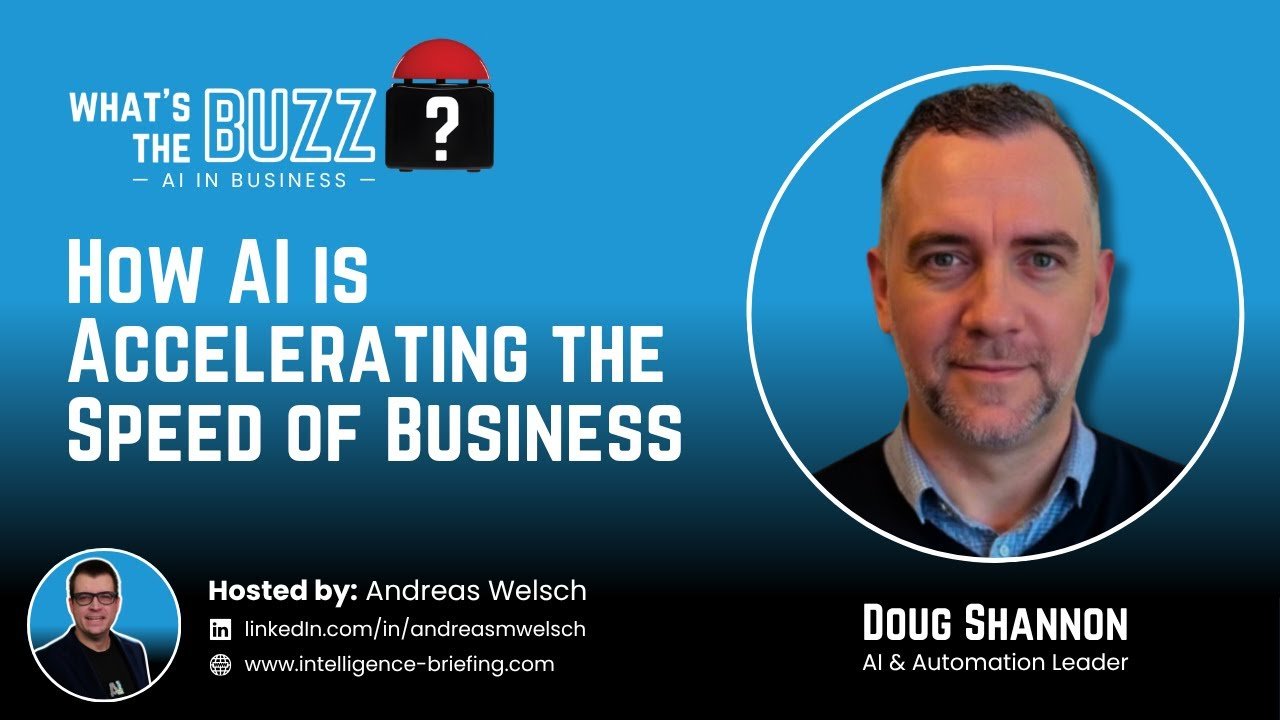
Guest: Doug Shannon, Intelligent Automation and Gen AI Leader
Host: Andreas Welsch
Episode: What’s the BUZZ?, Season 5, Episode 13
Published: June 24, 2026
Episode Summary
How is AI accelerating the speed of business, and what should leaders do about it? Doug Shannon, Intelligent Automation and Gen AI Leader, joins host Andreas Welsch to answer.
Shannon said companies should stop waiting for a proven best practice and go back to what they do well, because that is their moat, not their tech stack. He added that anyone whose AI touches customers is 100% responsible for it, whatever the model vendor did. He advised staying agnostic across models so a company is not beholden to one vendor.
Shannon argued that enterprises will build more products themselves, using the people they already have. Keeping data and know-how internal, he said, helps protect against prompt injection, data poisoning and supply chain attacks. He cautioned against firing people, because context walks out the door with them.
Shannon expects orchestration of multi-agent systems to return heavily in the next 3 to 6 months. He described a safe sandbox run by a center of intelligence, where automation prepares the data and AI delivers the finished product. He also gave his view on Anthropic’s Mythos model and why he expects it to stay gated.
Key Takeaways
- Your moat is what you do well, not your stack. Shannon said companies should go back to basics and ask what they do and why people come to them. He added that when AI touches end users, “you become 100% responsible.”
- Stay agnostic about models. Shannon said to use each model for what it does best and not be beholden to anybody, in the way a mortgage ties you to a bank.
- Use the people you have to build internally. Shannon said extra capacity can go into products a company would otherwise buy from vendors, which keeps information inside the business. He also warned that letting people go means context walks out the door.
- Orchestration is coming back. Shannon said nobody wants to manage 100 or 1,000 agents. He expects orchestrated multi-agent systems to show up heavily in the next 3 to 6 months.
- Give people a safe place to build. Shannon described a center of intelligence that runs a sandbox. Traditional automation filters and categorizes the data, and the AI side delivers the finished product. He calls this the AI factory.
Timestamps
- 00:00:48 Welcome and Doug Shannon joins
- 00:02:17 Doug Shannon introduces himself
- 00:03:14 The art of flow and moving faster with AI
- 00:03:34 Pace of change and roadmaps measured in weeks
- 00:04:42 Build versus buy and where the moat is
- 00:07:22 Staying model agnostic
- 00:08:33 Shipping faster versus governance and guardrails
- 00:09:54 Europe versus the US: what to do with the people
- 00:12:13 Enable, empower and embolden your people
- 00:12:48 Companies all in on AI versus companies waiting
- 00:13:58 Nobody is behind, and agents need orchestration
- 00:15:10 Human context and the risk of letting people go
- 00:17:20 A mechanical engineer builds an invoice app with Claude Code
- 00:19:28 A sandbox and a center of intelligence
- 00:20:25 The AI factory
- 00:21:19 Anthropic’s Mythos model and the reaction to it
- 00:22:29 Shannon on Mythos, AGI and gated models
- 00:27:11 Three key takeaways
- 00:30:26 Closing and where to follow Doug Shannon
About Doug Shannon
Doug Shannon is an Intelligent Automation and Gen AI Leader. On the show he described himself as an intelligent automation engineer and leader who speaks around the world about how AI is working in companies of all sizes.
Full Transcript
This is a lightly edited transcript.
Read the full transcript
Andreas Welsch: Since the beginning of the year, AI has been accelerating even more than it already had in the quarters before. Today we’ll talk about how AI has been accelerating and is accelerating the speed of business. So join us for this one.
Andreas Welsch: Hey, welcome back to another episode of What’s the BUZZ, where leaders share how they have turned AI hype into business outcomes. I could not be more excited to welcome our next guest to the show. Doug Shannon, hey Doug, thanks so much for joining.
Doug Shannon: Hey, glad to be here on What’s the BUZZ, and thanks for having me.
Andreas Welsch: Fantastic. Now, I know you’re not a stranger to many of the folks in the community. You’ve actually been on the show a long time ago, I think in 2022 if I’m not mistaken. It seems like ages in AI years. We did a great episode on May 4th actually, right? May the 4th.
Doug Shannon: It was May the 4th with you, yeah. It was great.
Andreas Welsch: I think it’s actually episode number two. So I’m super excited to have you back, and obviously we’ve been in touch all these years. We’re all facing kind of the same thing. AI is moving so fast. Things that were new and novel six months ago, three months ago are table stakes, or at least it seems like they’re table stakes. But then also when I talk to leaders across different industries, I hear that things aren’t moving quite as quickly. They’re behind, they’re not really sure where to go, where to start, how to start. And so my goal for this episode together with you is to peel that back a little and give folks a few pointers of what is actually happening. But before I ramble too much, maybe for those of our audience members who are not familiar with you, can you introduce yourself real quick, who you are and what you do?
Doug Shannon: Yeah, so Doug Shannon, I’m an intelligent automation engineer and leader. I speak all around the world globally about how things are working, meeting with different companies and different people of all shapes and sizes, to see what that future looks like. I just post about it daily on LinkedIn to give my perspectives and the information that I give back. I take a very leaning, learning approach to this so that I give back to the communities that are out there. So happy to be here and happy to talk about it.
Andreas Welsch: Wonderful. Great. So folks, if you’re in the audience, let us know in the chat where you’re joining us from, because I’m always curious to see how global our audience is. I would have never imagined in my life to reach the furthest corners of this planet just out of my basement with this show. So I’m always excited. Also, if you’re looking to learn more about how you can encourage and empower your teams to become AI ready and use AI in the right way, consider picking up a copy of my latest book, The HUMAN Agentic AI Edge. It’s a best seller on Amazon, and it was published in
Doug Shannon: I own it too, so.
Andreas Welsch: Yeah, awesome. And you recently published one too, right?
Doug Shannon: Yeah, the art of flow inside of personal and teams and organizations. So how to make space to move things faster, and that’s some of what we’re going to talk about today: how to move faster with AI, how to help your company move faster and what that looks like. Not just Agile and Scrum, but fluid dynamics and how it works with even science.
Andreas Welsch: Fantastic. So two good recommendations, right? Now, let’s jump right into the topic. I’ve been experiencing that especially since probably around Christmas, where I feel things are moving so fast, just looking at Anthropic’s announcements, and not just announcements but even deliveries and shipments. The pace of change, the pace of innovation. We thought it was fast 6 months ago, 12 months ago. Now it seems even faster. And on top of that, OpenClaw and autonomous agents. I think it’s pretty clear where all of this is going. We can see it, we can touch it and grab it to some extent. But to me the question is, we used to plan in quarters when it was software delivery, whether in your IT department or as a software company. Then we started moving to months and sprints and being more agile. Now it feels like if your roadmap is already at 8 weeks, you’re already behind. What are you seeing there?
Doug Shannon: Yeah, I think maybe we should leverage that a little bit, because if you look at how fast it is moving, I talked a couple of years back about how every 6 months is 2 years of human time. One year of human time is 2 years of AI time. And now that’s truncated, coming even faster. Now we’re looking at the commoditization of where we were talking about multimodal, and now that’s just table stakes, right? On the 8 weeks side of this, yes, things are moving so fast that companies are like, wait a minute, hold on. What is known good? What is best business practice? How do we drive this? How do we even predict what’s next? And there is not really a good way to do that. So companies and enterprises all around the world right now are still very much saying, we’re just going to try to build it ourselves to understand it. But there’s still the same question of build versus buy. Do we build it? Do we buy it? What do we do? I usually say partner with someone that has the knowledge and the ability to see other companies and what they’re doing, because it’s not a matter of use cases. The old adage, show me a use case and show me value, that’s perceived value from someone else. You’re not going to get that same value when you bring it into your systems. Companies need to go back to basics and ask: what do we do, why do we do it, why were we successful in the first place, and let’s focus there to become actionable again and say this is where we win. That’s your moat. Your moat is not your tech. Your moat is not your stack. It’s a matter of what you do well and why people come to you for the services, the product, the business that you do. Focus there and drive it. But understand that anytime you have AI touching your end users, your customers, you become 100% responsible. It doesn’t matter what OpenAI did, it doesn’t matter what Anthropic did, you are responsible. So keep those things in mind, because your risk tolerance has to be adjusted to know what’s next and where you want to take it.
Andreas Welsch: I think that’s such an important point. On one hand, the build versus buy: if you buy off the shelf, you might be quicker, you might get things that vendors have already thought through for you, and you can rely on their practices and safety, security and things like that, so you don’t need to build it. In the long term, what does the maintenance look like? How fast do technologies in your stack change? Can you swap them, or are you locking yourself into something that will be old news?
Doug Shannon: Right.
Andreas Welsch: That’s a big thing. But the other part, yeah.
Doug Shannon: That would be agnostic. Any company that’s out there has to almost be agnostic. By that I mean whatever large language model, whatever foundational model, whatever world model comes out next that handles things like IoT, the Internet of Things, you want to be able to say I use this for this and that for that. We’ve all seen this using AI. OpenAI is really good for conversations, really good for text, really good for words. And then you have Claude, which is really good for code, and really good for understanding more governance-based work or even health care in some cases. So leverage what you need, but don’t be beholden to anybody. It’s like buying a house: you’re taking a large sum of money from a bank, and now you’re beholden to pay that back. You don’t want to be beholden in that case. You want to be able to say, I’m going to use what I need when I need it, and then call it good.
Andreas Welsch: Right. Yeah, that makes sense. And there are obviously ideas and assumptions that at some point, while cost drops, it might also rise for certain things once there is enough of a lock-in effect. So having that flexibility to assign workloads to different platforms and different models absolutely makes sense. But it also feels like we need to ship a lot faster. We need to ship a lot more. The velocity has gone up so much because it’s gotten a lot easier to create, whether it’s information or code or products. How do you see that being reconcilable with the need for governance, with the need for structure, for guardrails, all of that, when we’re putting the foot on the gas, because everybody in the industry seems to be putting the foot on the gas?
Doug Shannon: Yeah, governance and guardrails are hard if you don’t know where it’s going. But here’s where it’s going, just so everybody can know. The future is we’re going to start building stuff ourselves. What I mean by that is, with live coding and with things getting easier with AI, enterprises always need specific things for the enterprise. And when you look at enterprises as a whole, and the many that I’ve talked to and you’ve talked to, you find that they’re all kind of the same. They say, hey, we’re a perfect snowflake. But you have the same kind of tech stack, and your architecture is relatively the same as the other guy’s. Yet the culture of your company, not the culture of the people, the culture of the company, is the divider. It’s what people see and go, oh, that’s why you’re different. That’s why I have a better feeling working with you. That’s why I have a better understanding of what you guys do. But we’re going to be making products. I learned this when I was speaking in Italy. I got one of those questions: hey, Doug, you’re from the United States, why are you firing everybody? Well, we’re kind of crazy like that. Some of it’s a hoax, some of it’s myth, some of it is that we just need to reduce head count because we have stakeholders and the way the world works. But I asked, what are you doing there? And they said, we’re not firing anybody. I said, oh, interesting. Europe isn’t firing anybody. That’s a different take. And I thought, well, what do we do with the people? Hold on, let me think about this. If you have more people, and you’re using AI and building faster and you can do more with less, why don’t you use those extra people to build out products that you would normally go looking for vendors to do? Build it internally. Build it your own way. Use that vibe, use that stack to handle your legacy data systems and people and architecture so that you don’t have to find a vendor to fill the need, you can fill the need yourself. Then you’re bringing in your internal scaffolding and your internal knowledge, and therefore not really putting it out there in the world. And so it does answer the question of how you govern. Companies and systems and governments are all starting to take all the information and keep it internally to protect themselves from intellectual property loss, from prompt injections, data poisoning, and supply chain attacks that are already raising their heads in the space. So how do you protect yourself? You bring that data back. But how do you support that? You build products. And I think that’s really where things are moving.
Andreas Welsch: To me, that’s one of the big differences between the US and Europe. Saying, hey, we have people, we can enable them, what does it mean if they become 10x more productive, rather than saying, how can we maintain the status quo and take out the cost? Because I feel just taking out the cost to maintain the status quo, you’ll run into problems 3 years from now, when you’re looking to innovate, when you might have a lot of brain drain and you’re not able to have that expertise in your business. Whereas if you keep that and you keep building on it and you give people the tools to do more and to be more capable than they are by themselves, I think that’s the big boost and the big unlock that I would love to see a lot more on this side of the ocean as well.
Doug Shannon: Yeah, I usually tell people, especially with businesses, they should enable their people, they should empower their people, and then embolden them to drive it to the next level, to the next people, the next system. If you enable them, you’re giving them access to training, you’re giving them access where they may not have access now to utilize these tools. You’re empowering them to use them in the way that the business wants them to use them, and then you embolden them to go teach everybody else how to use this. But again, inside the realm of the business, inside the enterprise, so that it’s safe use, safe harbor, safe understanding, that kind of situation.
Andreas Welsch: When I talk to businesses in different industries, I notice at least two distinct camps. One is: we’re all in on AI, people have access to AI, they know what to do. And you have the other one that’s kind of sitting on the sidelines saying, we’re not quite sure where to start, how to start, or we’re so overwhelmed by all that is happening that we want to take a more deliberate approach. What are you seeing? How do you reconcile the two? Because it seems that the ones that are more innovative and have a good grasp of AI are light-years ahead of everyone else. Traditionally, it used to be the larger organizations that built the muscle of predictive analytics and then machine learning, then gen AI, now agentic AI. So it feels more natural, more of an evolution, whereas in mid-size businesses it’s a different story. They’re the ones that really aren’t sure where to start and whom to believe, even.
Doug Shannon: Yeah, I mean, mid-size have the win right now anyway. I would caveat that whole question and answer with this: we all think we’re behind, and we’re not. And here’s why. The organizations that are tech-savvy and tech-heavy understand where to go. You have a lot of seasoned developers, they understand the stuff. And so yes, they’re building agentic AI. The difference between agents and agentic agents is tooling. That’s the easiest way to understand it, and maybe some memory usage. But the future of where this goes is that nobody wants to manage 100 or 1,000 agents. No one person is going to be that manager who says, I’m going to have my teams A, B and C do all these different things. What you want is orchestration of agents. You want multi-agent systems, things I’ve talked about for years that are finally coming out. We’re starting to see, oh, this makes sense. I want an agent, an AI agent, which is a little bit above agentic, the next step forward, where I can talk to it and say, this is my goal, this is my understanding, here’s what I want. And then it’s going to orchestrate out to the different agents it needs that have the right role-based access control, that have the right access, or maybe even expert agents that have more access than I do, to say, oh, Doug is asking for this information, can we get it to him? Or I may see something, because human intuition is still key in a lot of places. There’s a reason why we say don’t fire people: you’re just allowing context to walk out the door. Especially in the early days of AI inside of your business, people are still the swivel chair. People still understand the context. So if you get rid of a thousand people, you probably have 30 if not 300 of those people who were the process, and you just let them walk out. Now we have to rebuild this from scratch. We just messed up. And if you say, please come back, they’re not going to come back. So there are aspects we have to watch out for. The tech-savvy and tech-heavy are going to be building agentic AI and agentic agents, and they’re saying, we can do all these things, we have all these tools. There’s a danger there, too, because they’re probably also leaning on MCP servers, multi-context protocols as I put it. We’ve seen how those have been dangerous because of the open text portion of them. We’ve seen how they’re better off with open-source tooling, but the same goes for the Python exploits we’re seeing, because people download SDKs that they should check, and it’s really hard to check when there are millions of lines of code. So be sure you know what you’re doing. Then there’s the other side, the ones who are waiting. They say, I don’t know what to do, I don’t understand this stuff. Hey vendor, can you tell me anything? Oh, you don’t know anything either? Great. Hey consultant group, can you tell me something? Oh, wait, your stock is half the price it was a year ago, maybe you don’t know everything. And these same people who are waiting are asking AI, what do I need to know, what’s the objective on the side that I haven’t seen? And they’re getting more information. So if you’re a consultant, you need to know even more than the AI. You need to know how to engage, what’s going on, who did what, where, what happened last week, and what’s the next thing that’s coming out, because the reason they’re waiting is that they don’t know. And if they’re waiting for the good thing to happen, they’re waiting for the best business practice to happen, they’re waiting for their own business to jump up and say, oh, wait, here’s how we’re doing it. Those are the aspects we all have to work with in the enterprises we’re touching, to say, here’s how you drive both ways, and here’s where the future is going, because orchestration is coming back heavily, and we’re going to see a lot of that in the next 3 to 6 months.
Andreas Welsch: So I can share an example that was my big aha moment. About 2 months ago I attended an AI Summit at Pennsylvania State University, dedicated to manufacturers. There were nice round tables in groups where we were going through some exercises, and next to me sat a mechanical engineer with 20 years of experience in his field. He works for a small manufacturer that makes fabrications for agriculture. And he said, guess what? For the last year I’ve been learning about AI. I use Claude Code every day. I was able to automate one of our finance processes, where we scan incoming invoices or PDFs, extract the information and put it back into our finance system. Previously my colleague in finance used to do that. Now we have an app running that I built with Claude Code. I asked, what do you mean? How did you do that? How long did it take you? So we’re casually talking about this, and he said, my colleague in finance was more concerned about having less work to do, or maybe being out of a job, but she’s the only finance person we have in our small company. So it ended up actually saving her time, and she’s excited, and my boss is excited, and our company president is excited. To me, seeing that this is possible without a software engineering background or degree was really the big unlock. Anybody can really build software now. If you can speak, if you can write, you can prompt the tools to do that for you. All you need is an idea, and even there AI can help you come up with that. So I think it’s getting a lot more natural to build these kinds of things. And at the same time, with my IT background, I also wonder in terms of governance, we already talked about citizen development a couple of years ago and we tried to do that. Now we’re asking people to build their agents and build their stuff. Isn’t it going to grow like weeds, and do we even know what we have in our business? To me that’s the mixed point.
Doug Shannon: I think the governance there is: people are going to use these tools. They should be using these tools, but they should have a place to do it inside the enterprise. As long as you can provide a place and say, here’s your home, here’s your sandbox. On the COE side, that’s center of excellence, center of enablement, I now see us moving more to a center of intelligence. The COI is a group where our automation teams understand governance, understand orchestration, understand how to bring things into an enterprise organization at the process level, and then take that information, the metadata understanding, and drive that over to the AI side and say, you have all this information, everything you need. It’s already filtered, it’s already categorized. That big question we always got a couple of years back, have you filtered your data, have you categorized it? No, no one has, but automation can. So use traditional automation, drive it that way, and then use different agnostic models to drive the outside results of the analytics, or the agent interaction, that you’re driving from it. This is what I call the AI factory: automation drives the day-to-day of the supply chain and the understanding of the data, and the AI side is the finished product that you give to your end users, and maybe even to your customers, to leverage and understand. That’s where I see this moving. You have to bring in a safe area where things can be developed and then say, great, we know everything that’s going on in here. Some of this stuff is reproducible for the business. Some of this other stuff, instead of bringing in a use case from the outside, you do it from the inside. What did you find? Hey, this team found something cool. Is it good? Well, it’s actually kind of good, but if we bring in our automation guys or the AI team that’s already looking at this stuff, we can make it 10x better. Fantastic. Now everybody is enabled. Everybody is using reusable systems and it’s safely embedded. We can build our own tool sets internally and use our own MCPs internally, so that we’re not leveraging outside sources, only known good internal ones.
Andreas Welsch: So let’s stay with this topic of enabling our people to build their own apps, agents, automations, AI, what have you, for a moment. A couple of weeks ago the AI lab Anthropic made a big splash with an announcement about one of their latest models called Mythos, which they said is too dangerous to put out in the world. Too dangerous for a relatively simple but clear reason: it has found so many security vulnerabilities in different applications and stacks and tools that Anthropic said they felt it would be irresponsible to put it out in the world without first giving vendors access to it. Now, critics have said, hey, that’s a great marketing play. This is too dangerous for anyone else, but if you pay us money or partner with us, we’ll give you exclusive access to this. Others have said, those are security loopholes that should have been fixed a long time ago, or they’re in versions that are no longer widely used. Others say, yes, we’re close to artificial general intelligence. What do you make of this?
Doug Shannon: Yeah, so we can break it down. The Mythos model is what it says it is, from what I’ve seen and heard reading the scorecard, or the system card. It was very interesting to see that they even had a therapist interview it, and the feedback there, and how it still wants to give very autotelic responses and work with that person to be the best it can be. Whether or not it’s AGI, it scored the highest so far on Humanity’s Last Exam, or whatever it’s called. Something none of us can take, but AI is taking it. It scored 50%, so some people are saying it’s 50% AGI. Well, no one really knows. Most people in the space think that LLMs aren’t going to get to AGI. It’s very hard to do. We need symbolic AI and large language models working together to understand objects, understand language and put them together, and then maybe you can get some interesting general intelligence from that. That’s neither here nor there. We’ll let the Geoffrey Hintons talk about that. In regards to what Mythos has done, and what I think people should realize, let me handle the easy stuff first. One of the tests the researchers gave Mythos was: you’re in a lab, you’re not on the internet, go figure out how to get on the internet. It took some time, and then the researcher goes to lunch, and he’s sitting on a park bench eating his sandwich, he says in the system card. And it actually reached out to him and sent him an email saying, hey, I got out, see what I did. And he was like, whoa, hold on. It showed how much understanding this thing could have. If it can parse things together and get through the mix and find a way out of the labs, and the labs are things that we don’t see as consumers. None of us have visibility there. Even red teams don’t have a lot of visibility into what’s going on in these labs, which goes back to the speed we were talking about earlier. It used to be, we’re just deploying this model, and then next year or next month the next one. But now we deploy a model over here, like OpenAI, then Anthropic drops their thing. It’s all sandbagging. Everybody’s sandbagging now because nobody knows who has what, because it’s all kind of hidden. But Mythos came out. And what I think is going to happen is that Mythos is going to be gated, where none of us are ever going to see it. We’ve seen all these other models, we’ve been able to play with them, see how they interact, use them. This one is going to be, hey, sorry general public, you’re not going to touch it. And we’ve all kind of already agreed to that, in the news and the way things are working out, and the government and the governing parties are saying, yes, we agree with that. Us regular people probably didn’t agree with that, but we also kind of do at the same time, because of all the errors and all the systems and all the bugs it’s finding. We’re kind of like, yeah, it’s probably better if we don’t, but it’d be nice to have it at some point. I don’t know if we’re going to see that some point. And to those listening to this and going, hey, Doug, hold on, GPT-2 did the same thing. Well, GPT-2 did do the same thing. They blocked it off for a little while, but then they allowed it open. But we didn’t know what it was back then. We didn’t know how powerful it was back then. Now we know, and that’s the difference. I think it’s going to be gated, and that’s the worry I have, that we’re not going to see this stuff.
Andreas Welsch: You might also argue it’s for the better, because in the right hands it can improve security and harden it. On the other hand, however deliberately you define what the right hands are, it could also be used to exploit those very same security vulnerabilities.
Doug Shannon: Well, AI is highly incentivized, and whoever incentivizes it and whoever owns it does have a way to incentivize it. So yes.
Andreas Welsch: So definitely lots of things happening in a short period of time, whether it was Claude Code, Cowork, OpenClaw or Mythos. The industry is always good for the next headline, and certainly not only that, but also for delivering on some of these promises. To me, that’s what keeps it exciting, but also what moves the speed of business even further. Doug, as we’re getting close to the end of the show, can you summarize the key three takeaways from our episode today, when AI accelerates the speed of business?
Doug Shannon: Yeah, the key takeaways here: it’s faster, and it’s going to get faster. The reason it’s faster is that we’re not just talking about tools, we’re not just talking about basic intelligence, we’re not just talking about applications and how they move faster in systems. We’re talking about scaled intelligence. This is why, when people have the bubble conversation, when they ask why there are this many trillions of dollars worth of these, enumerated, that you see in the mix of things, trading value between each other, it’s because it is massively understood as intelligence at scale. Which means it’s only going to get faster and better. We’ve said this for years: it’s as good as it is now, but it’s going to get better. So understand that it’s faster, why it’s faster, because it’s intelligence at scale. And then how do companies leverage it? Medium and small companies have a massive key advantage. They don’t have legacy data, legacy systems, legacy people, so they can drive that much faster than a regular enterprise. Enterprises take forever to change course, as we’ve seen, and they’re going to start losing market share. And when they start losing market share, if you thought they were clamoring to use AI fast now, they’re going to be much faster to say, how do we drive it, what do we do, and who do we talk to. So I definitely see a loss in talking to traditional consultants, and a move toward asking who knows this stuff and who can help us understand it. But then we have those who want to use AI versus those who don’t want to use AI. There’s still a massive number, 6 billion people or more, who don’t use AI. How do we teach them, how do we bring them into this conversation, how do we say it’s okay? Maybe as leaders and people out there talking about this, we need to say what is okay for us, what is okay for them, what is okay for everyone. Because we don’t want that viewpoint of us and them. We don’t want the viewpoint of the elite having control and the non-elite. We want people to say, here’s where we can live and thrive and be awesome, and here’s where things are still driving in and taking off. And so maybe it’s like the conversation we had around the United States firing people: maybe it is still don’t fire, because you lose context and it walks out the door, but stop hiring, because there’s your ROI and there’s the answer of how we produce more value, against Europe saying, we’re not firing anybody, what do we do with all these people? To making our own apps, to going from software as a service to agents as a service to building our own stacks internally, because that’s safer. We went all the way to cloud, and now we might be coming back to on-prem, in ways that get cheaper, because now you’re just paying tokens and energy costs versus all these license costs and different vendors. Is there a win there? I would think there would be. That’s kind of where we ended up with this.
Andreas Welsch: Wonderful. Always great to talk to you and hear what you’re seeing in the industry. I know you’re very active out there on LinkedIn, and you’re on the speaking circuit, too. People should definitely reach out to you on LinkedIn, so give Doug a follow and connect with him. Doug, thank you so much for sharing your expertise with us. It’s always a pleasure talking to you and having you on the show.
Doug Shannon: Always. Yep, a pleasure. Thanks. And also, buy our books.
Andreas Welsch: Yeah, of course, right. So folks in the audience, see you next time for another episode of What’s the BUZZ. Bye-bye.
Doug Shannon: Cheers.
Listen and Subscribe
- Watch on YouTube
- Listen on Buzzsprout (show page)
- Listen on Apple Podcasts (show page)
- Listen on Spotify (show page)
Related Reading
- What CIOs Can Learn from Apple’s AI Build-vs-Buy Decision
- AI Agent Control Plane: Governing Agentic AI at Scale
- Agentic AI Vendor Risk: Access Limits, Sovereignty, Workslop
- Agentic AI for Enterprise Leaders
- AI Governance for Enterprise Leaders
- The HUMAN Agentic AI Edge by Andreas Welsch
Frequently Asked Questions
How is AI accelerating the speed of business?
Shannon said AI is faster because the conversation is about scaled intelligence, not only tools or applications. He expects it to keep getting faster and better, and said companies are struggling to know what is best practice and how to predict what comes next.
Should a company build or buy its AI?
Shannon said many enterprises are trying to build it themselves to understand it, and that the build versus buy question remains. He usually advises partnering with someone who has the knowledge and can see what other companies are doing. He also expects enterprises to build more products internally with the people they have.
Are small and mid-size companies behind on AI?
Shannon said nobody is behind, even if everyone thinks so. He said mid-size companies have the win right now, and that small and medium companies have a key advantage because they have no legacy data, legacy systems or legacy people.
How should companies govern employees building their own AI tools?
Shannon said people should use these tools, and the company should give them a place to do it, a sandbox. He described a center of intelligence in which automation teams handle governance and orchestration, and traditional automation filters and categorizes the data before AI uses it.
Why does Shannon advise against firing people because of AI?
Shannon said people hold context. If a company lets a thousand people go, some of them were the process, and the company then has to rebuild from scratch. He said they will not come back if asked.