

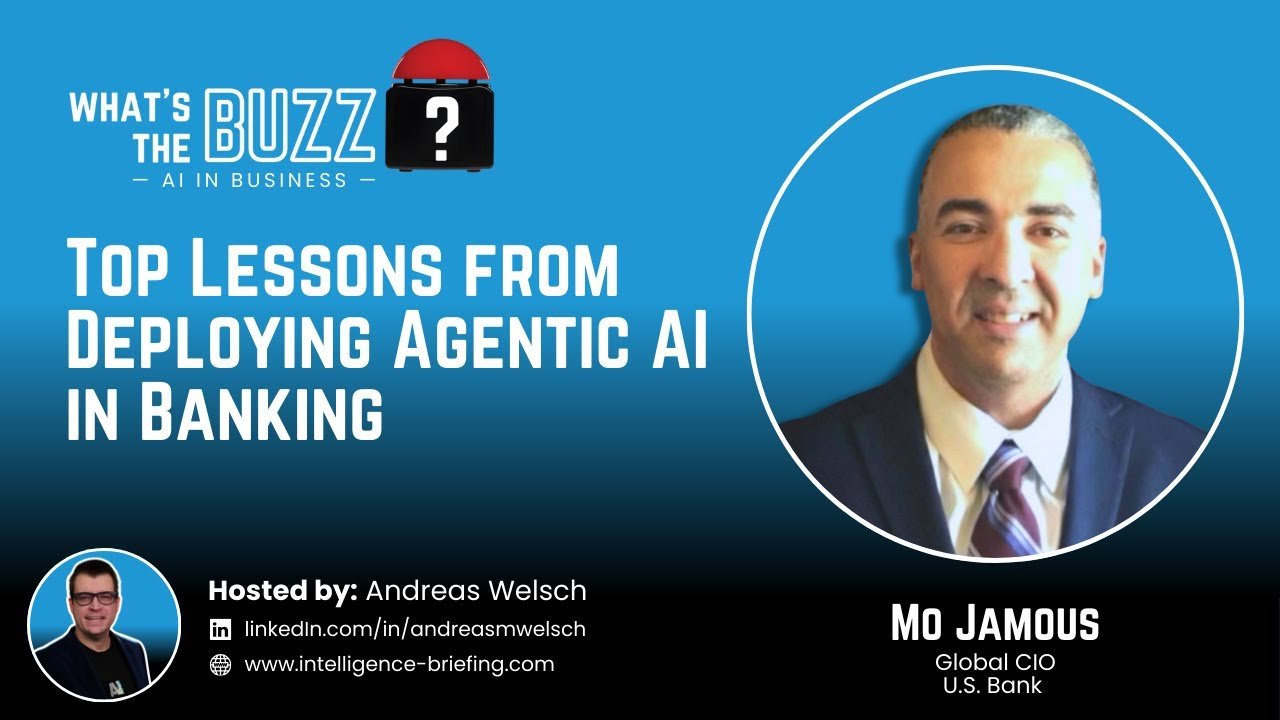
Guest: Mo Jamous, CIO of U.S. Bank
Host: Andreas Welsch
Episode: What’s the BUZZ?, Season 5, Episode 1
Published: January 14, 2026
Episode Summary
What does it take to deploy agentic AI in a bank? Mo Jamous, CIO of U.S. Bank, joins host Andreas Welsch to share the lessons from putting agents to work in a regulated industry.
Jamous said agentic AI is still in its nascent stages, and that banks move more slowly than unregulated industries. The bank started with productivity agents that are not customer-facing, built around personas such as software engineers, product managers, branch bankers and call center agents. Jamous sorted the work into three buckets: productivity, growing the business and operational efficiency.
Jamous described a code review agent that took about two to three weeks to build and cut a merge request review from almost an hour to less than 10 minutes. Jamous said a human stays in the loop for the foreseeable future, and a governance council across technology, risk, compliance and security approves every use case that goes into production.
On measurement, Jamous said every agent is instrumented from the start, with metadata that defines its type and the value of each successful run. For leaders earlier in the journey, Jamous advised against getting stuck on tool selection, building a single view with an agent registry, and starting with one or two agents that deliver quick wins.
Key Takeaways
- Start with productivity that does not face customers. Jamous said agentic AI is nascent and regulated industries move more slowly. The bank began with persona-based productivity agents, then looked at growing the business and at operational efficiency.
- A small agent can have a large effect. Jamous described a code review agent built in about two to three weeks. It took a merge request review from almost an hour to less than 10 minutes, and Jamous said it also improves the quality of the product.
- Adoption needs people, process and platforms. Jamous said the strategy covers upskilling and executive sponsorship, a governance council across technology, risk, compliance and security, and a platform with gateways, observability, evaluation and guardrails. Hackathons and brown bag sessions help teams adopt agents.
- Instrument every agent from the start. Jamous said each agent carries metadata on its type and the value of a successful run. Counting executions shows usage and value, and the results aggregate into a dashboard across business units.
- Do not get stuck on tool selection. Jamous expects agents to come from different tools and advised building an orchestration layer and an agent registry for a single pane of glass. Then start small with one or two agents for quick wins.
Timestamps
- 00:00:16 Welcome to season five and the topic of the episode
- 00:01:06 Andreas Welsch welcomes Mo Jamous
- 00:01:26 Mo Jamous on a career in data, technology and digital
- 00:04:13 Where banking stands with agentic AI
- 00:05:32 Starting with productivity, built around personas
- 00:07:43 Three buckets: productivity, growth and operational efficiency
- 00:09:26 A code review agent cuts a merge request from almost an hour to under 10 minutes
- 00:12:47 Risk appetite and keeping a human in the loop
- 00:16:17 Unexpected hurdles: skills, guardrails and observability
- 00:18:53 People, process and platforms: the enablement strategy
- 00:21:01 Measuring success by instrumenting agents
- 00:23:36 Business metrics beyond cost savings
- 00:26:24 Advice for leaders starting out: do not get stuck on tool selection
- 00:28:32 Start small and find quick wins
- 00:29:32 Wrap-up and thanks
About Mo Jamous
Mo Jamous is CIO of U.S. Bank. Jamous said that the last 15 years in the financial industry, the majority of a career, have centered on data, technology and digital.
Full Transcript
This is a lightly edited transcript.
Read the full transcript
Andreas Welsch: Welcome to 2026, our new year of What’s the BUZZ in its fifth season. I’m so excited you’re here, and today we’ll talk about the top lessons learned from bringing agentic AI into banking. Everybody was talking about agentic AI last year, but I’ve seen very few people go beyond the what-if, the visionary scenarios, the art of the possible, whatever you want to call it. Today, we’ll dive in. We’ll talk about what’s real and what’s working. So let’s jump right in.
Andreas Welsch: All right, welcome back for another episode of What’s the BUZZ, where leaders share how they have turned AI hype into outcome. Today we’ll talk about the top lessons from deploying agentic AI in banking. And who better to talk about it than someone who’s actually done that? Mo Jamous. Mo, thank you so much for joining.
Mo Jamous: Thanks for having me, Andreas.
Andreas Welsch: Wonderful. Mo, can you share a little bit about yourself, who you are and what you do, for our audience who might not be familiar with you yet?
Mo Jamous: Yeah. I’m Mo Jamous. I’ve been in the financial industry for the last 15 years, the majority of my career, and I’ve spent the majority of my career around data, technology and digital. I’m really looking forward to the discussion today. So thank you for having me.
Andreas Welsch: Wonderful. We met in Austin at Generative AI Week in November, and you said we definitely need to have a conversation about this: what’s working, and how you’re bringing it to the enterprise. So I’m so excited that you’ve made yourself available. I know you’re incredibly busy. I hope you in the audience appreciate our conversation as well. By the way, if you’re joining us live, please put in the chat where you’re joining us from. I’m always curious to see how global our audience is. And if you want to learn how you can turn technology hype into business outcomes, consider picking up a copy of my book, The AI Leadership Handbook, where you’ll learn all about that. Also, I have a new book coming out. Let me show that very briefly, too. It’s called The HUMAN Agentic AI Edge, and it helps you shape your next generation of AI-ready teams. There’s so much talk about AI and how we need to use it and roll it out, but not so much guidance on how to do it well and what you need to do as a leader. So stay tuned. It’s coming out at the end of February, so you can learn more. All right. Now, Mo, in good old fashion, should we play a little game to kick things off?
Mo Jamous: Why not go for it?
Andreas Welsch: Okay. So, here we go. When I hit the buzzer, the wheels will start spinning, and when they stop, you’ll see a sentence. I’d like you to answer with the first thing that comes to mind, and why, in your own words. So, are you ready for What’s the BUZZ?
Mo Jamous: Yep.
Andreas Welsch: Okay, here we go. If AI were a sports car, what would it be? 60 seconds on the clock. Go.
Mo Jamous: I would say a Mercedes Formula 1 car.
Andreas Welsch: Oh, okay. Why Mercedes and why a Formula 1 car?
Mo Jamous: I’ve always loved Michael Schumacher, he was always one of my favorite drivers. So I will always want them to win, and knowing how powerful AI is, you can always use that help. [laughter]
Andreas Welsch: Wonderful. I love it. It is very powerful, right? And it sounds like you’re in pole position, seeing this from a very exciting angle at an exciting time. So I’m curious. We talked a little bit about this at Generative AI Week. You said you’ve deployed agentic AI in your organization, but what has your journey been like? Where are you right now in the organization? And what are some of the key learnings?
Mo Jamous: Just to set the context before we dive deep into banking and where banks are with agentic AI, it’s always fair to say that agentic AI is in the nascent stages as a technology. A lot of companies feel that, oh my gosh, we are so behind in implementing agentic AI. I think everybody feels that way, which really tells me it’s not that everyone is behind, it’s that the technology is still taking hold and maturing. It’s an amazing and powerful technology that we’re seeing mature in front of our eyes. Just look at where we were a year ago, and then things came up with MCP and agent-to-agent communication and a lot of protocols for how to make agents talk to tools and be able to do more. I think that’s been very powerful in 2025. Having said that, in the banking industry, or any regulated industry, you’re always going to see things move a little bit slower than in a non-regulated industry. Our journey with agentic AI in the banking world has been about starting with things that are not customer-facing, things like productivity: how do we build agents that make our employees more productive and give them new capabilities and added intelligence to help our customers? The way we’ve been thinking about productivity in particular is persona-based. If we take the PDLC, the product development life cycle, within the product model we have four personas: a software engineer, a product manager, a designer and an agilist. We’ve been looking at how to make each of these personas more productive, and build agents that enhance productivity and accelerate speed to market, getting products into the hands of our customers. But outside of the PDLC, we also look at the bankers. How do we make branch bankers more productive? We look at call center agents. How do we make them more productive? So we look at productivity as persona-based, identify a set of agents for each persona, and ask how we use agentic AI to make them more productive. That is what I consider the productivity bucket. Then we have two similar buckets. One is how we grow the business and identify business opportunities, building agents to boost sales or improve customer experiences. The third one I would say is operational excellence or operational efficiency: things like fraud, cybersecurity, DevOps, data center management, and high availability, resilience and failover. So in my mind, these are the three buckets where we’ve identified that we can build and deploy agents.
Andreas Welsch: To me that’s especially interesting, because in a lot of the workshops I give and my interactions with leaders across different industries, they always ask, show me the use cases. Show me the use cases for Copilot, for ChatGPT, for some AI tool. In my perception it’s indeed a lot about personal productivity, and I know that before these tools emerged we were talking more about operational efficiency and operational excellence. Where can we use AI in HR? Where can we use AI in finance? What are the business drivers? What are the KPIs? Now I see a lot of the conversation is about how can I write a better email, and how can I summarize my meeting minutes. And how can I go beyond that? Where do you feel this conversation is, from your vantage point? Where and how does personal productivity help unlock some conversations and open some doors, now that it’s in anybody’s hands?
Mo Jamous: I’ll give a couple of examples. If you look at the developer persona I mentioned earlier, we’re giving developers very powerful tools to generate code, massive volumes of AI-generated code, and that is amazing. But pretty quickly you notice that you’re generating all of that code and creating a bottleneck when it comes to code reviews. You have all of these commits, but there are not enough people able to keep up with that frequency. So one of the things we did was build an agent to automate code reviews. We’re doing hundreds of thousands of code reviews, or merge requests, a year across the entire technology organization. Normally it takes about an hour to do a merge request for any developer. We built agentic capabilities that took it from almost an hour to less than 10 minutes to review a merge request end to end. That is super powerful. It not only saves money and produces efficiencies, it also accelerates the whole development life cycle. And it improves the quality of the product, because if you have so many merge requests coming in but you’re not able to keep up with the reviews, eventually you’re going to have quality issues from putting things into production without proper review. An agent like this took about two to three weeks to build. It’s not very difficult to build these agents, but the impact it can have across the entire development life cycle is super powerful. Another example: product managers have a lot of documents, a lot of research, a lot of ideas and big-ticket items on the roadmap. We’re looking at building agentic capabilities that automate the creation of user stories out of the product documents, prioritize some of those stories, and refine them as we put them into the backlog. That makes a huge impact on the productivity of the teams and the acceleration of the development life cycle.
Andreas Welsch: That’s awesome. Great to hear. It sounds like some really tangible benefits, and with manageable effort. Two to three weeks to build the agent? Given that there are hundreds of thousands of commits to the codebase, it sounds like it’s really saving a lot of time. What are you seeing in other parts of the business? How are they viewing this? You mentioned agentic AI is still rather nascent, and I would agree. What’s the risk appetite? What’s the opportunity that other business units see?
Mo Jamous: Look, I think everybody understands the value and the power of agentic AI, and knows that in the next couple of years our world will be completely different in how we build software and how we deliver value to the customer. But everyone also understands, at least for the foreseeable future, that this technology is not magic and it’s not going to do things on its own. Having a human in the loop is always going to be the case, at least for the foreseeable future. We see a lot of opportunities in how bankers interact with customers, how they present opportunities and talk about opportunities with the customers. Bankers in the branches spend half an hour to an hour or more on a manual task, and we’re building agents to automate or semi-automate some of this, with the banker pushing the go button before the task is executed. So there are tons of opportunities there as well. Also in the call center, which probably every company is looking at, there are opportunities with knowledge-base documents. When customers call, the agent can assist the call center employee in retrieving the right information as quickly as possible. That improves not just speed but also quality, because when you add more intelligence to the process, you’re making sure you’re getting the right documents in a curated way, and most of the time with way better accuracy than you would get from most humans, because we are prone to make errors. I think adding that level of intelligence goes a long way. There are also things like understanding the customer’s intent and deflecting calls based on what the customer is calling about: is this something we can move to an automated queue? These are ideas that every bank and every financial institution is evaluating. It’s not only about the execution and building of these capabilities but also about change management. Once you build these agents, how do you get your team to adopt them? How do you make sure you go through the rigorous review process from a risk and governance perspective before you deploy these capabilities into production?
Andreas Welsch: One of my previous guests said, everybody just shows you the demos, but nobody talks about governance and what happens when you’ve actually built your first agent. What does the life cycle look like? It sounds a lot like that. What were some of the hurdles that you and your team maybe didn’t expect when you started on this journey, when you said, okay, now let’s look at agentic AI and how it can augment what we do or change entirely how we do things?
Mo Jamous: There are a couple of things. Some of them are technical in nature. If you look at the industry, you don’t really have home-grown agentic AI experts or resident experts. A lot of our engineers, extremely smart and amazing engineers and AI experts, are still learning a lot about these technologies. So figuring out what it takes to build an agent, and what it takes to put an agent into production, means making sure you have the proper guardrails, the gateways, and the evaluation and monitoring capabilities. I see a bit of a struggle in the industry overall: companies not knowing what it takes to productionize an agentic AI capability, all of the components you need in the ecosystem, from observability to evaluation to building to security to guardrails. So there’s a learning process, and we had to go through it to get there. The second aspect is definitely change management. On security, there are things that risk, compliance and security need to have before some of these cases are approved. But once they’re approved, how do you get people to use them? Adoption is a big thing, because building an agent is one thing, but getting people to use it, especially when you have thousands of employees who need to be familiar with it and comfortable with it, takes a long time.
Andreas Welsch: How do you facilitate that change management, to get them to accept it, warm up to the idea, or even become promoters of it?
Mo Jamous: When we looked at our agentic AI enablement strategically, we thought about the strategy as three-pronged: people, process and platforms. Starting with the people, we’re upskilling our teams, getting our teams excited, and building executive sponsorship around agentic AI and generative AI overall. We’re also galvanizing the whole organization around agentic capabilities through hackathons, events and brown bag sessions, so people learn what’s out there and what’s being built, and learn from each other. The second aspect, from a process perspective, is making sure we have a governance council across technology, risk, compliance and security that reviews and approves all of the use cases going into production. And last but not least is building out the platform, the things I mentioned, from the gateways to the observability to the security guardrails, and the frontier large language models we’re going to use. Back to your question, the change management aspect is really hackathons, upskilling, communications and events, and gamifying that process as well, getting the engineers and the teams excited about using some of those capabilities.
Andreas Welsch: I can tell you my mind is racing. I have so many questions I want to ask, and we only have about 10 minutes or so. But you rightfully shared that it’s one thing to build an agent and another to get it adopted and used well. How do you measure success in that situation? What are some of the metrics you look at, some of the metrics you report out to your stakeholders, and what can others who are early on their journey take away from this?
Mo Jamous: That is super critical, Andreas. Throughout my career I’ve believed in a philosophy of fact-based engineering, or data-driven development, where instrumentation and measurement are built into the capability we’re building. To me, instrumenting your agents as you build them is critical to measure usage and consumption along with ROI. As we create those agents, we added extra metadata components that define what type of agent it is. Say it’s a productivity agent, and it’s supposed to save a certain number of dollars. Let’s say it’s going to save you $100 every time it runs, because if a human were to do it, it would be $100 an hour, or $50 an hour, whatever the right rate is. Now that you’ve instrumented the agent with that type of data, all we had to do was start counting how many times the agent successfully executes. All of a sudden you can tell how many people are using it, and how much value it’s creating for the business based on the number of times it runs. It sounds basic, but it’s super powerful for telling the story of what value agentic AI is creating for the organization, especially when you do it for every agent you create, defining up front the goal and objective of the agent and the value it’s supposed to create. Then you can aggregate that in a dashboard across business units and across the three buckets we mentioned, productivity, sales or efficiency, and aggregate it at the enterprise level to demonstrate to leadership and the lines of business how much value you’re getting out of agentic AI.
Andreas Welsch: How do you do that when it’s not necessarily a one-for-one comparison? Meaning a person sits there and does this task and it would cost us $100, and now an agent does it and it costs a couple of cents. But when a person completes this task or this transaction, it can create a much larger amount of value than the $100 it would cost in time. How do you think about business metrics with agents where it’s a transactional comparison, hours to seconds, dollars to fractions of a percent? What does it look like for business metrics, KPIs or process performance indicators?
Mo Jamous: From a business perspective, say you’re using an agent that helps you sell better, because it gives a banker, or a digital flow, more insights about a product you’re trying to sell. You know your baseline, what you’re selling today, and each product you sell brings a certain number of dollars to the organization. As you build those capabilities and move the needle on how many products you’re able to sell, and you count how many times the agent was executed, with each successful execution or conversion associated with a number of dollars, it becomes much easier to understand the value the agent is creating. So it’s not only about saving dollars in the productivity bucket. And saving doesn’t necessarily mean fewer people. It’s about producing more efficiencies, where those dollars can be repurposed for value creation for the customer or for growing the business in other areas.
Andreas Welsch: I love that. That’s music to my ears. I feel a lot of organizations are somewhere stuck in this transactional, apples-to-apples comparison: today I have a team of people or a person doing this, tomorrow I have an agent or a team of agents doing that, how long does it take, how much does it cost. So it’s good to hear that there are additional metrics, especially for operational efficiency and excellence, and for creating new value. Now, Mo, you also mentioned that you have agents in production and some things the team is working on. Like any good organization, there’s a healthy pipeline of things you’re looking at. What is your recommendation for leaders who are earlier in their journey, who are at the beginning of 2026 just starting to look into this and saying, we should be doing something with agents? How do they start with a pilot? How do they go from pilots into production? What is your recommendation?
Mo Jamous: A lot of organizations are getting stuck on tool selection. Often people think we should only have one agentic framework or one tool, and I think that’s a little unrealistic. Imagine, forgetting about agents for a second, if someone said, I’m only going to have one SaaS product within my organization and I’m only going to use that. People would laugh, because of how unrealistic that is. The same thing applies here. My advice is not to get stuck in selection and to understand that one day you will live in a world where agents are created in different areas. Some you may create with Copilot, other agents you might create with a tool like LangChain. So we don’t get too stuck in tool selection, but it’s important to think about an architecture where you can create a single pane of glass to understand and monitor all of the agents being created within your enterprise. If you can build your own orchestration layer that tracks all the different agents in your organization, so you can understand their capabilities, and have an agent registry, that will go a long way. So, don’t get stuck in tool selection, and be open to the idea that you will have multiple agents coming from different sources. Second, from a people perspective, it’s education and upskilling your teams on what agents are, what they can create and what you can do with them, and start small. As I said, we started with the code review agent, which is not super complicated to do but had a huge impact. Find an area where you can create one or two straightforward agents, have quick wins and start to create momentum.
Andreas Welsch: Wonderful. Mo, thank you so much for joining us today and for sharing your experience and your expertise with us. I certainly learned a lot about how to bring AI agents into business, what it takes, where the opportunities are and where we are in the industry. It sounds like it’s still nascent, but it’s good to hear from leaders like yourself that you’re looking at this, bringing it into production, and have a lot of good learnings. So, Mo, all the best for an exciting and successful 2026. We’re just at the beginning, and I would love to reconnect and hear how things are going in the future.
Mo Jamous: Thank you so much, Andreas. Really enjoyed it, and we’ll stay in touch.
Andreas Welsch: Wonderful. Thank you, folks in the audience. Join us next time for another episode of What’s the BUZZ. Bye-bye.
Mo Jamous: Thank you.
Listen and Subscribe
- Watch on YouTube
- Listen on Buzzsprout (show page)
- Listen on Apple Podcasts (show page)
- Listen on Spotify (show page)
Related Reading
- Agentic AI Pilots: From Prototype to Business Value
- How AI Leaders Really Approach Agentic AI Automation
- Agentic AI Security: Five Layers and Agent Commerce
- Agentic AI for Enterprise Leaders
- AI Governance for Enterprise Leaders
- The HUMAN Agentic AI Edge by Andreas Welsch
Frequently Asked Questions
What are the top lessons from deploying agentic AI in banking?
Jamous said agentic AI is still nascent and a regulated industry moves more slowly. Start with productivity agents that do not face customers, keep a human in the loop, review every use case through a governance council, instrument each agent to measure value, and start small.
Where should a bank start with agentic AI?
Jamous said the bank started with productivity, organized by persona: software engineers, product managers, designers, agilists, branch bankers and call center agents. A code review agent that took about two to three weeks to build was an early example. Jamous recommends one or two straightforward agents that deliver quick wins.
How do you measure the value of AI agents?
Jamous said to instrument agents as they are built. Each agent carries metadata for its type and the value of a successful run, such as dollars saved or revenue from a conversion. Counting successful executions shows how many people use it and how much value it creates, and the results aggregate into an enterprise dashboard.
How do you get employees to adopt AI agents?
Jamous said building an agent is one thing and getting thousands of employees to use it is another. The bank upskills teams, secures executive sponsorship, and runs hackathons, events and brown bag sessions. Jamous also mentioned gamifying the process.
Should an organization standardize on one agentic AI tool?
Jamous said no. Jamous compared it to insisting on a single SaaS product and expects agents to be created with different tools. The advice is to build an orchestration layer with an agent registry that tracks every agent in one place.