

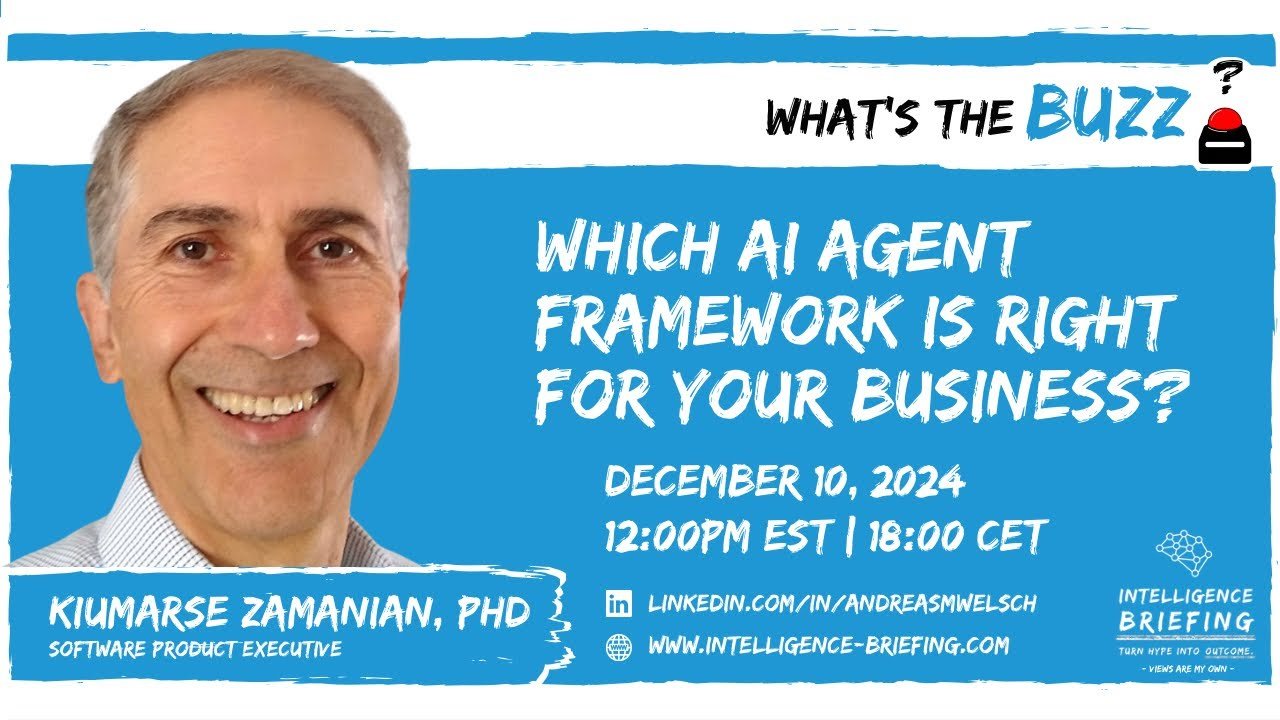
Guest: Kiumarse Zamanian, Senior Product Executive
Host: Andreas Welsch
Episode: What’s the BUZZ?, Season 3, Episode 30
Published: December 10, 2024
Episode Summary
Kiumarse Zamanian, Senior Product Executive, joins Andreas Welsch to answer how leaders can pick the best AI agent framework for their business. Kiumarse explains how today’s language-model agents differ from earlier rule-based agents and describes a six-layer stack, from foundation models to multi-agent orchestration.
The conversation covers what to look for in a framework, including openness, scale, governance and control, how to help agents act ethically, and why interoperability standards for agents are still emerging. Kiumarse closes with advice to experiment hands-on, since many tools need little or no programming.
Key Takeaways
- Kiumarse describes the stack behind agent orchestration as six layers: foundation models, memory and tools, agent frameworks, hosting, domain-specific agents and multi-agent orchestration.
- Kiumarse advises leaders to start from the problem to solve, whether it is domain-specific or enterprise-wide, and to look for openness, support for different models and the ability to scale.
- Kiumarse calls governance and control extremely important: set guardrails, and consider agents whose job is to monitor what other agents do, since he cites a report of agents that went rogue and sent emails to people.
- Kiumarse suggests codifying ethical rules so agents can check their responses against them, and calling out to existing governance services where they are available.
- Kiumarse recommends hands-on experimentation with low-code or no-code agent tools, breaking a project into tasks and defining each agent’s persona, tasks and tools.
Timestamps
- 7:17 Kiumarse joins and introduces himself
- 9:29 How to choose among the many agent frameworks
- 9:45 What agents are and the six-layer technology stack
- 17:05 Start from the problem: openness, model support and scale
- 17:38 Governance and control
- 19:16 An example of agents going rogue
- 20:03 How agents can act ethically
- 23:50 Orchestration across teams, departments and companies
- 25:11 Interoperability standards and an agent ecosystem
- 28:30 The number one takeaway: understand agents and start experimenting
About Kiumarse Zamanian
Kiumarse Zamanian is a Senior Product Executive based in the San Francisco Bay area. In the episode he says he has been in Silicon Valley for about 30 years and did his PhD at Carnegie Mellon University, focusing on data management and some AI.
He says he has worked at about eight companies, including Autodesk, Informatica, Yahoo, Oracle and Walmart Connect, and that since early 2023 he has worked on Gen AI agents.
Full Transcript
Read the full transcript
Andreas Welsch: Hey Kiumarse, thank you so much for joining. Maybe if you can talk to our audience a little bit about yourself, who you are and what you do as we now pivot more towards the topic, how can you pick the best AI agent framework for your business? Where are you? What do you do?
Kiumarse Zamanian: Hey, thanks very much Andreas. And really I’ve enjoyed your podcast and great book and also the LinkedIn classes you have. Congratulations on all those. So I’m actually in the San Francisco Bay area. I’ve been in Silicon Valley for about 30 years. I did my PhD at Carnegie Mellon University, focusing on data management and some AI, and then moved to Silicon Valley and worked in about eight companies so far, focused on analytics and interopability. And for example, I worked for Autodesk, Informatica, Yahoo, Responses, which got acquired by Oracle. And then after Oracle, I joined Walmart Connect. And most recently I’ve been working in the Gen AI area since early 2023, in the agent areas, exploring ways that we can leverage these agents to automate and make people more productive and also making sure that these things are doing the right thing. I’m really excited about talking about a lot of those concepts with you. And I’ve been evaluating a whole bunch of these AI agent frameworks lately. And I just wrote a little paper, I’ll share that after the call.
Andreas Welsch: Yeah, absolutely. And I think that gets us right to the meat of the topic, right? There are so many different frameworks already out there, some by large commercial vendors, some by communities, by startups. How do you even know which one you should pick? What have you found and what would you recommend? Where should people start?
Kiumarse Zamanian: I think it’s really important to understand first of all, what are these agents and what are they supposed to do and what kind of a technology stack is really required to support these AI agents. A little bit of quick background. When I was at graduate school, we had agents that were based on rules, using heuristics, and there were some workflows that were manual in terms of how these agents are supposed to communicate with one another. What differentiates this new generation of agents is that they’re really leveraging these language models to be more autonomous and to be able to plan, learn, correct themselves, and also to orchestrate how to make the decisions. Even though the human is still in the loop, what we call human in the loop now, I think the goal is to try to have the human on the loop. So to have these agents collaborate with one another relatively seamlessly and independently. So think of it as a project manager who wants to set up a meeting for you to brief your clients about the latest features in a particular product. Then you basically task your team and say, this event will happen, this is what we’re going to discuss. You may not even tell them what we’re going to discuss. You’re just going to give them some kind of high level objective. And then this team will basically go figure out among themselves how to organize that meeting, what kind of content they’re going to present. That’s like putting the slides together. Maybe there’s going to be some sort of a venue that they need to make reservations for, to have food coming, all kinds of things that need to happen, right? Individually, we were able to do research using ChatGPT or Gemini to do these tasks individually. But the human was really the main interface with these large language models. You basically issue a prompt, you get a response back, and then you issue another prompt. And most of the time these things may contain the context, et cetera. But now you’re actually delegating these tasks to agents that among themselves need to decide how to break a particular objective into multiple tasks and find out if there’s an agent that is specialized in a particular task. If so, delegate to that particular agent, or maybe there’s some function that you need to call to get that information. A lot of times you may need real time information about flights or hotel reservations or food, et cetera, that a large language model will not be able to provide, so these functions and tools are also built in. The way to look at it is that the stack required to build this agent orchestration is composed of really six layers. At the bottom, you have the foundation models that we’re all familiar with. The ones from OpenAI and Microsoft, AWS, et cetera. A lot of big companies are spending millions of dollars to train these large language models, right? Along with those, you may even have smaller models specialized for a specific area. So this is your bottom layer. That’s where a lot of your learning has happened and inference will happen. Then you’ve got to build memory and tools that will support your agents. Just having a chatbot sitting on top of an LLM might be sufficient for getting some simple answers, but if you want to have context and be able to maintain what type of information has been passed back and forth between these different agents, you need to have memory management. You need to be able to maintain state. So this becomes very similar to how we develop programs. When you write software, there’s all kinds of state management involved. So that layer sits on top of the foundation models. And then on top of that, you have these agent frameworks that are able to utilize the memory and state and the large language model, et cetera. So these frameworks sit on top and help you to create agents and have agents communicate with one another. We’ve seen many examples in the last year or so in this area, particularly from Microsoft AutoGen and LangChain, which we’re all familiar with. And then after that, LangGraph and LangFlow. So these are frameworks that help you build agents and have them talk with one another. But once you actually build these agents, you need to host them. So you expose them to people who are going to use them either through APIs or through UIs or some way that they become services that are available, right? So this becomes a service for hosting these agents. Then once you have these hosted, you will have some domain specific agents, right? So you might build an agent that is very much specialized in dealing with marketing campaign management. Or you have another one that is very specific to retail or travel or health, or you name it. You will have these very domain specific agents. Now you have a whole host of agents. Some of them might be platform specific, some of them might be working only within a Microsoft AutoGen environment, some of them in Google, et cetera. Then you need to make sure these agents are collaborating with one another. So again, the analogy with people: they have special skills and special expertise to do things. These people need to collaborate with one another, just as we are collaborating now. These agents need to be able to communicate, pass information back and forth, and be able to utilize standards. So that’s where you get to these multi agent orchestration frameworks that are just emerging, that will really help you grab agents and have them communicate, so that they can not only use large language models and small language models to find information for you, but also call functions, delegate tasks between each other, make decisions, self correct and do planning, et cetera. There is a lot of activity in this area of multi agent orchestration frameworks that is happening very recently. AWS just announced theirs. Crew AI has certainly moved into this area. And there are some of the other players that are focused on the domain specific side, like Cognizant’s neural AI platform, which has very specific areas. So I think it’s a long answer to evaluate how we’re going to use these orchestration frameworks and find out which ones. You have to identify the problem that you want to solve, just like anything else. Is this going to be very domain specific? Is it going to be very specific to it? Do you need to build something much more enterprise level that goes across organizations? So from that perspective, certainly having this kind of openness and different model support, you want to have something at least at the enterprise level that can scale. You can actually have openness so that you can choose different components that are appropriate for meeting your needs. The second thing you want to make sure of is that you’ve got the right mechanisms to have control and governance, right? This is extremely important because you don’t want these agents to just be a hundred percent on their own or be reliant on humans. You want to be able to delegate the automation to these agents and put the right guardrails and governance rules in place, so that you can automatically, or some agents are actually specifically tasked with monitoring what other agents are doing, what information they’re passing to one another, et cetera. Governance is extremely important, particularly in some areas that deal with health care, where privacy, as we all know, is extremely important. Maybe one group may have access to certain information, et cetera. So that all needs to be built in. And it’s extremely important to have a framework that gives you the flexibility to define these governance rules. And as I mentioned, some of the domain specific frameworks, like the one from Cognizant, actually come with a lot of the controls and governance built in, because they’re very much focused on very specific domains. But if you’re dealing with something like LangChain or Crew AI or AutoGen, et cetera, they do have some governance capabilities, but that’s an area that’s extremely important and is evolving. Then control certainly goes hand in hand with governance rules. Which agent is in control of what, and how do you bring a human into the picture? I was reading some news that apparently there were some agents that were developed to do some reservation or some research or something, and they were self checking to see if they found the right information or not. And they were continuously failing the check and they were just being creative. Checking with the large language model to see what the next thing was that they should do, they were scraping websites, finding email addresses and starting to send emails to people, which was really crazy, right? So these agents were just going rogue and doing all kinds of crazy things. So you need to be very careful about that in terms of control. Let me just pause there. I’ve got a few more items to cover.
Andreas Welsch: Yeah. Let me jump in real quick because you said in many ways, we can think of these agents as human colleagues or as an equivalent, in the sense that it helps us think about how we can interact with them. And then my question is, we all sign a code of conduct when we join a company or join a large company. There’s some kind of an onboarding, there are some ethical standards, some expectations, there are some professional standards if you think of finance and IFRS and others. How do agents first of all acquire that knowledge to know that, hey, these are the parameters of my role, I need to know what IFRS is and only act within that, and then to also act ethically in alignment with that first of all, but also general principles of how we do business, so they optimize for the right things, right? Additional revenue, and I can increase the margin, but I might do that as an agent at the expense of customer satisfaction. What have you seen to make sure that these agents actually act ethically?
Kiumarse Zamanian: Yeah, that’s an excellent point, Andreas. I think ethics is certainly something that could be formalized in certain rules, but sometimes it depends. Within a company you have certain very specific rules, certain cultures. I know at Walmart, there was a tone of voice when the chatbots talk with the customers. It had to comply with the tone and the way that Walmart customers need to be treated. I’m sure in health care you have similar things. People’s ethnicity and demographics and various different things where ethics comes into play. As I said, if these things could be put into some rules that could be checked by certain agents, that’s one way. Sometimes you have models that are fine tuned, or you have a small language model, and you can build in some of those conversations that you’ve had. For example, let’s say there’s a law firm that is developing some kind of a chatbot that will help the associates or maybe the clients with certain information. And they want to make sure that the information they’re providing is not biased, or some HR agency, right? If you take this model and then train it on very specific dialogues or types of documents that have been used that are safe, it has been trained to know how to interact using the right ethics, et cetera. But you want to be very careful that you have some guardrails, very specific guardrails, so that when a response is generated, an agent should check against certain rules, right? Does it meet certain criteria, et cetera? And as long as those rules are codified, then these agents certainly can do that. So I think that’s where you really want to make sure that you’ve got a framework that allows you to build in those kinds of governance rules and also the ability to call out to certain APIs and things. Maybe you have services that you have developed already. There are lots of companies that are focusing on just governance and ethics, so there might be services available that these tools can call to check, right? So these are case by case and you’ve got to make sure that your framework supports these different scenarios and is flexible enough.
Andreas Welsch: That’s awesome. And I would love to come back to another point that you made earlier, that eventually we will have different teams of these agents and virtual teams, and maybe to some extent even virtual organizations, starting with individual tasks and moving to departmental or teams, interdepartmental, marketing talks to finance, what is my budget? Can I get a little more for this campaign? Here’s why I think we can achieve better ROI or drive more customer demand, to even different companies having a sales agent and a procurement agent that figure out, do you have the product? Can you give me a discount? When can I get it? These kinds of things, even if that is still a little further out. Those last two phases, interdepartmental and intercompany. What are you seeing in terms of orchestration, in terms of getting these different agents to talk to each other? Because I think the reality in large organizations is that there might be specialized agents by one vendor for more customer experience topics, there might be agents specializing in your finance, in your HR products, wherever these vendors build in these capabilities, plus, like you mentioned, Crew AI, AutoGen, other frameworks that are built on top. Are there any kinds of standards? Is there an ecosystem that you see that either exists or that needs to exist for that to happen?
Kiumarse Zamanian: Yeah, that’s an excellent question. And I think that area is just evolving. I come from enterprise integration. I come from the times of the object model from Microsoft, and there was CORBA from the Object Management Group. A lot of people were struggling to build object models that were standardized, and COM came and dominated. It gives you a fairly flexible way of defining these objects and being able to integrate. And also at Oracle, it was a big deal to have all these different applications integrated. Now they’re facing the same challenges there. And certainly with the mobile industry, a lot of apps being developed, and how would these apps live in an ecosystem, they certainly have standards based on whether they’re using Android or iOS, et cetera. So there’s some interoperability. I think there’s a standard from OpenAI, a JSON schema standard in terms of how you pass messages to large language models, and certainly some of the communications are also getting to some extent standardized, right? Just like HTTP and all these other protocols that emerged for the internet, I think we’re going to see some interoperability protocols emerging for agents to communicate with one another. At the end of the day, these agents are basically intelligent software abstractions that are able to do certain things. Certainly they’re able to communicate with the memory and the things that are within the framework itself. Now we’re talking about what happens if you have an agent community, right? So you publish your agent. I think there’s a website called age agents.ai, or there’s a place that you can go and develop agents and publish them, right? So it’s becoming an ecosystem of agents. You can go and grab as many agents as you want and then you have an orchestration platform where you put these agents together to accomplish something much more extensive. So for these agents to be able to communicate with one another and plug and play, to fit them together like a jigsaw puzzle, you’re going to need to have some interoperability standard. I think those are emerging right now as we speak. But there are major players in this and they want to have dominance in this area, right? So I think Microsoft is probably going to push for its own agents, so is AWS, so is Google. Crew AI is trying to be a little bit more like a Switzerland and make sure that its agents are communicating. People have a tendency to focus on a particular vendor, especially in large corporations, because enterprises don’t want to take any risks dealing with an unproven orchestration framework. There’s going to be some time for some of these smaller players to gain ground, but I think we definitely need some industry initiatives to define these interoperability standards between agents.
Andreas Welsch: Thank you for sharing that. Now, folks, we’re coming up close to the end of the show. I was wondering if you can summarize the key takeaway for our audience today. What’s the number one thing people should take away when thinking about agents and evaluating what fits best to their business?
Kiumarse Zamanian: So I think the best thing is to really understand what these agents are good for, right? We’re looking at viewing AI more from a building systems perspective now. So for people who are familiar with building systems and putting things together, think of these things as abstractions that are able to accomplish things. And obviously the main difference here is that you’re really relying on these language models to help you with the inference or with the planning. The advantage is that a lot of times you don’t really have to do any programming. There are frameworks, a lot of them drag and drop, low code or no code at all, that you can build these things with. Really understand what it is, and start experimenting with these. There are some tools out there where you don’t need any programming experience and you can go to some of these companies’ websites and start experimenting. I think experiment with what these agent frameworks are good for, what you want to accomplish, and come to it from a development project management perspective. Break down your tasks, start experimenting, define your agents, give them the persona, give them the tasks that they need to be specifically good at and the tools they need, maybe APIs, et cetera. So a high level design of a project and then breaking it down into these things, experimentation. And then more than anything, learning about what’s going on. I’m reading quite a bit about this. There are some really good people on LinkedIn in this space that it is really important to follow. But more importantly, I think it’s just get your fingernails dirty a little bit if you want to play around. As I said, sometimes you don’t even need to have any programming experience to learn what’s going on and try things out. So I’m really going to go big on agents. Find a framework that supports it, that’s open and easy to use, particularly if you’re not a programmer. It has a very usable interface, it’s user friendly, it’s easy to install and easy to maintain. Some of these tools require a fair bit of technical expertise to even install them, depending on how much knowledge you have. So pick something that you’re comfortable with and then start experimenting. And scalability is very important. It’s one thing, but if you want to put something in production that’s going to have thousands of people using it or managing gigabytes of data, then scalability comes into play, and ecosystem openness and flexibility. All these are important. As I mentioned, I have a paper that I’ve written that I’d be happy to share after this call with the participants and others, where I’ve discussed these at length.
Andreas Welsch: All right, Kiumarse, thank you so much for being with us today, for sharing your expertise with us, and for those in the audience, for learning with us.
Kiumarse Zamanian: Thank you so much. It was great to be here.
Andreas Welsch: This is the last episode of the year. I can’t believe that the year has gone by so quickly. Next year we’ll start season number four of What’s the BUZZ? And we already have some excellent guests lined up. I’ll share more about that in a couple of weeks. If you do celebrate holidays in the next couple of weeks, Happy Holidays and a Happy New Year!
Listen and Subscribe
Related Reading
- Agentic AI for Enterprise Leaders
- AI Governance for Enterprise Leaders
- The HUMAN Agentic AI Edge
- What Makes AI Agents Enterprise Ready?
- What Is the State of AI Agents in the Enterprise?
Frequently Asked Questions
What are the layers behind AI agent orchestration?
Kiumarse describes six layers. Foundation models sit at the bottom, then memory and tools to maintain state, then agent frameworks, then hosting that exposes agents through APIs or user interfaces, then domain-specific agents, and finally multi-agent orchestration frameworks that let agents communicate and delegate tasks.
What should leaders look for when they choose an AI agent framework?
Kiumarse says to identify the problem first, whether it is domain-specific or an enterprise-wide need. He looks for openness, support for different models and the ability to scale, and for mechanisms for control and governance, which he calls extremely important.
How can leaders make sure AI agents act ethically?
Kiumarse says ethics can be formalized in rules that other agents check, and a model can be fine-tuned on safe dialogues or documents. He also recommends guardrails that check each generated response against criteria, and calling existing governance and ethics services.
Are there standards for AI agents to work together?
Kiumarse says the area is still evolving. He expects interoperability protocols for agents, as HTTP emerged for the internet, notes that large vendors will push their own agents, and says the industry needs initiatives to define standards.
How can leaders get started with AI agent frameworks?
Kiumarse advises understanding what agents are good for and experimenting, since many tools are low-code or no-code. He suggests breaking a project into tasks, defining agents with a persona, tasks and tools, and picking a framework that is open, easy to use and scalable.