

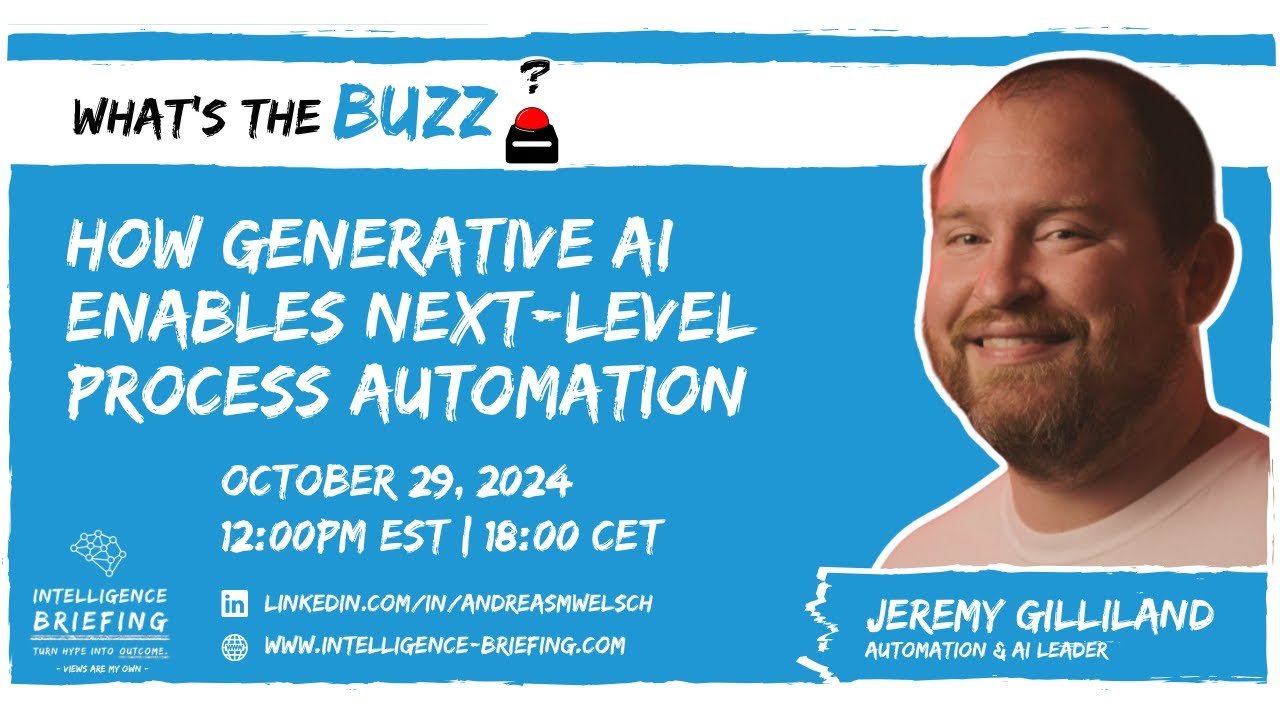
Guest: Jeremy Gilliland, Automation & AI Leader
Host: Andreas Welsch
Episode: What’s the BUZZ?, Season 3, Episode 26
Published: October 29, 2024
Episode Summary
Jeremy Gilliland, Automation & AI Leader, joins Andreas Welsch to answer how generative AI enables the next level of process automation. Jeremy explains how generative AI extends robotic process automation into cases RPA could not cover, such as placing a human-like phone call to a customer.
The conversation covers what the combination means for IT and automation leaders, why Jeremy does not believe RPA is dead, and how automation gives generative AI traceability at scale. Jeremy also explains how to define business value, what he calls technical lag, and why leaders should minimize their tech stack.
Key Takeaways
- Jeremy says generative AI lets RPA reach use cases it was historically disqualified from, such as making a human-like phone call to a customer, and he describes the pairing as fit for purpose.
- Jeremy expects speed to market value to be a key driver, with proofs of concept and pilots arriving in hours and days, and advises tying pilots to board objectives and the larger strategy.
- Jeremy does not believe RPA is dead: he asked every person he interviewed before his presentation at UiPath Forward, and none believed it.
- Jeremy argues that automation supplies traceability, reproducibility and a way to deploy generative AI at scale to every employee.
- Jeremy recommends minimizing the tech stack and pairing an automation platform with generative AI, and warns against betting on only one of the two.
Timestamps
- 0:41 The guest introduces his automation and military background
- 1:32 The UiPath Forward and TechEd Day event
- 2:51 Icebreaker game called In Your Own Words
- 3:23 If AI were a sports car, what would it be
- 4:45 How generative AI expands traditional RPA
- 7:28 What the combination means for IT and automation leaders
- 9:39 Is RPA dead
- 13:11 Why both technologies benefit from integration
- 15:37 What business value looks like
- 17:33 Robustness, resilience and broken bot syndrome
- 21:35 Technical lag and why to be strategic about tools
- 24:01 The three key takeaways
- 25:37 Wrap-up and thanks to the guest
About Jeremy Gilliland
Jeremy Gilliland is an Automation & AI Leader. In the episode, Jeremy describes his role as automation platform team manager for Southern Glazer’s Wine and Spirits, more than a decade in the intelligent automation space, and more than a decade of earlier military service, first as an enlisted soldier and then as an officer.
Full Transcript
Read the full transcript
Andreas Welsch: Today, we’ll talk about how generative AI enables next-level process automation. And who better to talk about it than someone who’s actively working on that? Jeremy Gilliland. Hey, Jeremy, thank you so much for joining.
Jeremy Gilliland: Hey, I’m doing well. I’m glad to be here. Thank you so much for the invite.
Andreas Welsch: Wonderful. Why don’t you tell our audience a little bit about yourself, who you are and what you do?
Jeremy Gilliland: Thank you. My name is Jeremy Gilliland, and I am currently the automation platform team manager for Southern Glazer’s Wine and Spirits. I’ve been working in the intelligent automation space for over a decade, and I’ve helped multiple organizations and consulting practices grow their programs. Before that, I spent over a decade in the military, first as an enlisted soldier and then as an officer. I definitely have a passion for technology, starting all the way back in high school, working with Cisco 1 and 2. As a fan of this show, Andreas, I have to say I’ve been watching for a long time, and I’m so thankful for this opportunity. I can’t wait to dive in.
Andreas Welsch: Awesome. It’s great to have you on. Thank you for making the time. I know you just came back from a pretty big industry event last week, right?
Jeremy Gilliland: Yes, it was a UiPath marquee event here in the States called Forward + TechEd Day. I had an opportunity to give a speech, if you will, a presentation about this same topic, as well as a hands-on demo of using some of the generative technology that they’re trying to roll out. Very interesting. I loved the collaboration and had a chance to speak with a lot of other experts in the field. It’s incredible how quickly this space is moving.
Andreas Welsch: Wonderful. I’m glad we get just the right person for this conversation, and with the latest information too. Folks, for those of you who are just joining the stream, please drop a comment in the chat where you’re joining us from. I’m always curious to see how global our audience is. And don’t forget to get the AI Leadership Handbook on AIleadershiphandbook.com, so you can check it out and learn how you can turn technology hype into outcome. It’s actually based on this podcast and livestream. More than 60 leaders have shared.
Jeremy Gilliland: It got me, too. I got the book. It’s already working.
Andreas Welsch: Awesome. Fantastic. Now, what do you say? Should we play a little game to kick things off?
Jeremy Gilliland: That’s part of the reason I wanted to join. Hit me with it.
Andreas Welsch: This game is called In Your Own Words, and it’s all about coming up with the first thing that comes to mind, and why, in your own words. You have about 60 seconds for your answer, to make it a little more interesting, and I’m keeping an eye on the clock here. For those of you watching us live, please put your answer in the chat too. I’m curious to see what you come up with. Are you ready for What’s the BUZZ?
Jeremy Gilliland: Yes, I’m ready.
Andreas Welsch: If AI were a sports car, what would it be? 60 seconds on the clock.
Jeremy Gilliland: Oh, man, that’s a good one. I haven’t seen this one. If AI were a sports car, I’m going to have to go with future state. This might sound a little awkward because of its size, but let’s go with a Porsche Macan. If you’re thinking about a sports car, it’s not something that’s traditional, right? Even though you could put it up against a supercar, and a Macan Turbo is definitely going to hit those high speeds, there’s also enough room to bring yourself and others. It’s a sleeper. It looks like something you’d take your kids to soccer in, but it has every bit of technology that you’d expect, and on top of it, it has that extra go that you wouldn’t anticipate. I didn’t get this question ahead of time, and being on the spot, I’m going to stick with the Porsche Macan.
Andreas Welsch: I love that. A great answer, especially the part about bringing more people along, bringing your family along. I think that is super critical. Now, moving on from sports cars to the other kind of technology we’ll talk about, AI. For the last two years, generative AI has been getting all the attention, after RPA has matured and proven its value in the tool belt. Vendors have been super quick to pivot towards AI and GenAI, and we’ve always done AI, these claims that we saw early on and that we’re still seeing. But I’m wondering, in what ways does generative AI actually expand traditional robotic process automation?
Jeremy Gilliland: That’s a good question, and I think the answer evolves. Take myself as an example: I’ve been doing this for about a decade, and automation has always been around, whether as macros before we used platform tools or otherwise. I remember there used to be clear-cut criteria. If your process involves making a voice call, that’s not an RPA initiative. Or if it has to work inside a Citrix environment where you can’t access the tools, that was another reason we would disqualify it. But I’d take it a step further and say the combination of these two is the ability to leverage RPA in all of those use cases. You couldn’t have made a phone call with RPA software historically, but now with generative AI, if you have to respond to a customer, you’re able to create the messaging and have a robot call your customer with a human-like interaction, human-like touchpoints, and combine that technology with RPA. That capability definitely gives it the functionality to expand. And in this case, you’re not looking for overlap. You’re not trying to make one tool do something it’s not. One group I’m part of often brings up a term called fit for purpose. If you take that into mind when you’re thinking about where generative AI enables RPA, you can think of it in those terms. If there’s something RPA can’t do, I guarantee you we’re at a stage now where generative AI combined with RPA can do it.
Andreas Welsch: You said fit for purpose. I think the exciting part that I’m seeing is that it goes beyond mere automation of repetitive things. First it was a lot of rule-based work, then we added AI and you could bring in your documents and more unstructured data. Where are you seeing it going next? And what does that combination mean for IT and automation leaders?
Jeremy Gilliland: Very good point. For IT and automation leaders, you almost have to draw a line in the sand. On one side you have the group of incumbents, anybody from a CIO, CTO or Chief Digital Officer to whoever is in these positions now. On the other, you have the people who aspire to be in those roles in the future, because your objectives will be different. If you draw a line in the sand, what the combination means for your organization is that speed to market value is going to be phenomenal. That is going to be a key driver. Historically it took days, weeks or months to build solutions. Now you’re going to see people bring online proofs of concept or pilots, not just of automation but of generative AI in combination with automation, in hours and days. Being able to manage that kind of workflow is very important. If you’re an incumbent sitting in these roles, then getting your house in order is probably the biggest priority right now. There’s a lot of noise, and not everybody has had the opportunity to earn a degree in this space. With a lot of information coming at you, it’s important to realize we’re at a monumental shift, and the combination of automation and generative intelligence is going to clearly reshape what businesses look like. You’re not going to get there today. I think that’s a bridge too big to jump. What you need to do, and I think you’ve been mentioning it with some of your guests, is identify true value and target that value in pilots, to make sure you’re delivering value that’s connected to board objectives and your larger strategy. From there, if you can find ways to use these technologies to shape what your business looks like tomorrow, then you’re getting a step up. If you get your house in order and run pilots to identify value, I think this technology really has a big benefit.
Andreas Welsch: I really like how you’re framing this, especially coming back to business value. Looking at one of the responses in the chat, I see Enes is saying RPA is dead. I think that’s a very polarizing point, and I would love to pick up on it and get your perspective. On one hand, there are traditional RPA vendors that are adding AI in, and they are now talking about agentic AI as the next evolution of their technology capabilities. On the other hand, you have the AI labs like Anthropic, with the computer use beta that they showed, I think, last week. What are you seeing? What are you thinking? Are you seeing RPA vendors move up? Are you seeing AI labs move down? Will we still need both? Will one win over the other? Or is it too early to say?
Jeremy Gilliland: From my perspective, we’ve got to hit the pause button there. The decision hasn’t been made. But what I will say is that the generative component trying to do what RPA does is going to be a tough pill to swallow. If you have organizations where the chief information security officer already doesn’t know how to manage or support generative AI, then asking it to do even more than it’s doing, including RPA work, might be a big ask. And historically, RPA is the long tail of automation. It’s what didn’t get developed, the features that got left off, the functionality the business didn’t get when it asked for some of this to be built. That will always be there, because you’re bound by time, resources and the money you have, and the quickest thing to chop is features and functionality. So there’s always going to be more to automate. But is RPA dead? Leading up to the presentation I gave at Forward, I asked every single person I interviewed, is RPA dead? It was the first thing I asked, and zero people believed that, whether they were automation practitioners or AI practitioners building some of these models. I think the world is going to be different. It’s not going to be just RPA and UiPath, and other people who are doing AI trying to do automation is proof that this space is alive and well. I think they’re fighting for market share. As you well know, it’s hard to take AI and bring it to a business and run it long term if you’re not generating value. They know they can generate value doing what automation does, because we’ve already proved that, as you mentioned in the first question. So I believe RPA is alive and well. It won’t look like it did historically and it won’t look like it does today. It’s going to be a mash-up, but there will be plenty for practitioners to work on.
Andreas Welsch: I think that’s very comforting and assuring to those who are strong in the intelligent automation space. Seeing where this goes, from what you’ve seen at Forward and what you’re seeing others do in the industry, why do we even need both technologies together, and how do they benefit from the integration with one another?
Jeremy Gilliland: I touched on it in my last point, and I think you take it from a CISO perspective. If you’re not familiar with CISO, it’s chief information security officer. What we know about how these generative models create responses is limited in scope. It takes a lot of compute to decipher how it got to a response, even though we know the architecture. Put that in perspective with what’s going on with automation, for example UiPath’s orchestration. I think Gartner put out something called Boat, or something like that, with different models for how we’re going to manage this. I don’t think there need to be individual COEs that run this. You need to take all of your technology, and we talked about reducing the tech stack. I think this is going to give leaders a phenomenal capability to minimize their technology. What automation does, and we’ve been proving this out for years, is give you traceability, reproducibility and the capability to manage other technologies. If you put in AI, how do you get from that model, which is not just a productivity assistant in Microsoft PowerPoint or Word, to something every employee uses? There needs to be a vector, a mode to transmit the capabilities to the employee. On the back end, from a technology perspective, you want to understand metrics and utilization, and from a security perspective, as I started off with, you want to be able to track and have traceability there. Automation already has something well managed and well developed to accomplish that. So even if the need for automation reduces because of what generative AI can do, there is a big question of how we manage it, how we deploy it, and how we maintain traceability on who’s using it and what they’re asking. I think automation is that perfect layer that gives you the trust and confidence to deploy those solutions at scale, and I’m not really seeing anything out there today that gives you a streamlined way to manage all of that orchestration. Maybe I haven’t seen it yet.
Andreas Welsch: Two questions come to mind with that. One is, you talked about business value earlier. What does it mean in concrete terms? We love to throw around the phrase that it needs to create value, but what does it actually mean when you look at something like intelligent automation, or intelligent automation with AI and agents, the next level of what we’ve been talking about? What does value look like?
Jeremy Gilliland: Excellent question, and this is going to be business specific. It has to be tied to whatever your business is. For instance, my organization, very strategically, on a certain timeframe, comes up with a ten-year goal or objective: where do you want to be in five years or ten years? When you cascade that objective down, you have to meet certain metrics or create certain value to achieve it. So generating value will be different for each organization. But what I promise you is that if you’re not deploying this tool in a way that helps you get to where you want to be in 2030, that is a clear demonstration of it not being valuable. That doesn’t mean it doesn’t generate some type of value. It’s just not the value that’s going to turn the key on your organization and help you get where you want to go. We already talked about copilots. We know about assistants. They’re all there, but is that going to be the transformational value that helps you get where you wanted to go? Probably not. Hopefully I gave you a good snapshot of how you can define value in your organization.
Andreas Welsch: Thanks for sharing that. I think that makes it more concrete, and again it’s the call to action to align your AI and automation strategy with your business strategy and not do it in isolation. The usual things we talk about: don’t chase the shiny object, and so on. But I’m also wondering about more gen AI, more agentic AI, whatever you want to call it, as the next evolution being embedded into RPA. What’s your perspective on increasing robustness and resilience on one hand? I see that we might be introducing additional failure points if we don’t know it’s right all the time, every time. On the other hand, we know the underlying applications and UIs change from time to time and your bots break. Do you feel it increases resilience, or introduces more failure points at this point? Looking at the crystal ball, I don’t know if anybody has the right answer, but I’m curious what you’re seeing. From what I’m hearing and seeing in application, some of this is still theory, right? As you mentioned, it’s not something that is universal across different industries.
Jeremy Gilliland: We’ve talked about generative AI and the value it creates in isolation, but as you mentioned, what do we get out of the combination? Instead of having broken bot syndrome, which anybody who has worked in this space knows exactly what I mean, no matter how good your program is, you need governance and some of those guardrails, even for just automation. These tools are pretty much drag and drop nowadays, so I don’t think that paradigm shifts. If anything, it’s more important to have that support mechanism for generative AI. But what I do think, oddly enough, is that when you combine them, generative AI fixes some of automation’s biggest issues, like broken bot syndrome. I’ve already seen, in preview and not quite general release, capabilities for selector fixes and adjustments on the back end. Being from SAP, you’re quite familiar, I’m sure, with Joule and where they’re headed with this. I see a world where our automations talk to other automations that have gen AI capabilities, where these things are fixed on the fly. We have to be careful, because if a selector was supposed to cancel a payment and the fix makes a payment instead, we might have some risks. But that’s back to guardrails and testing and making sure it’s doing what it’s supposed to do. I see this as an overall enhancement once we get the guardrails in place to support both programs. Automation will enhance generative AI deployments, and generative AI will enhance the value that your automation programs bring, in my perspective.
Andreas Welsch: Awesome. Building on this, I’m envisioning that at some point your agents will hit a roadblock when there’s no API. Yes, they can take a screenshot of the screen they’re seeing and anticipate what they should be entering there, but at some point that is not going to be 100 percent, so you need robust and proven technology that can automate the repeatable steps in that process, meaning something like robotic process automation. By the way, I see Vinicius posting in the chat, I don’t think RPA is dead. Good, another supporter. Rather, things are evolving. I think that mirrors what you shared as well. Now we have more tools to integrate with our bots and more opportunities to improve processes. Thanks for sharing that. Building on what you’ve shared so far, there are two capabilities that benefit from integrating with one another, and they will need one another in the foreseeable future. What do you recommend AI leaders and automation leaders need to be aware of and be doing right now? What are the one, two, three things top of mind to either ride this wave or stay ahead of it? I’m really curious what you see in your role.
Jeremy Gilliland: One thing I would really recommend is understanding that we’re currently in a timeframe where a term called technical lag is incredibly prevalent. Technical lag is the concept that all of our technologies and the tools we use to create them are evolving at such a rapid pace that humankind and our brains can’t quite keep up, and we can’t quite envision how to fully maximize the potential of all these tools. We’re just fumbling around. Combine that with the fact that AI itself is a general purpose technology, a GPT, though not the GPT you’re thinking of, that is going to have a fundamental impact. You can imagine the impact that electricity had on society and the impact that the internet had on businesses, and you mash those together in a Hadron Collider. That’s what generative AI is, and I think we’re just scratching the surface. So, one, be aware that there’s this concept called technology lag, and we aren’t quite aware of what we can do. You can see this in the adoption of automation programs. I’ve helped organizations save over 200 million in the last decade, and I still meet multiple organizations that don’t scale the program throughout the organization. There are huge amounts of missed value. If we’re in a situation where there are all sorts of tools that can do pretty much everything, then being very strategic about how you pick those tools is going to be paramount. Money doesn’t grow on trees. If you swing and miss, betting big on just a generative AI solution alone or only automation, you will quickly find yourself a year or two behind, trying to recoup the value from those projects and invest it back. So be aware of that term and try to understand the best value you can get around the tools that you have in the space.
Andreas Welsch: If you also combine the technology lag with technology debt, I’m wondering if that also becomes a technology drag, because it gets more difficult to innovate if even your foundation has some catching up to do.
Jeremy Gilliland: You gave me ideas for a book. Don’t tell me too much, Andreas.
Andreas Welsch: Hey, we’re getting close to the end of the show, and I was wondering if you can summarize the key three takeaways for our audience today.
Jeremy Gilliland: Absolutely. From my perspective, the three major takeaways, if you had to distill the conversation, are these. One, in the future state, RPA and generative AI need each other. The marriage needs to be harmonious. If you do that, there will be bigger wins than trying to leverage these technologies in isolation, and your management will also 2X. Two, this technology will not only transform how we do business, I believe it will fundamentally transform business models in general. So while you get your house in order to leverage these technologies, consider in what ways you can reshape your business with them, because they’ll be that transformative. And lastly, recognize that there’s a technology lag out there, and there’s all sorts of tech, a lot of which can do the same thing. If you can minimize your tech stack and have an automation platform, plus a technology like generative AI that buffers and supports all of the blank spaces your current automation program doesn’t cover, I think between those three points you’ll definitely be well on your way to getting where you need to be, as long as you take those and you read Andreas’s book and put them together.
Andreas Welsch: Awesome. Jeremy, thank you so much for joining us and for sharing your experience with us. And to those in the audience, thank you for learning with us. It’s always exciting to see the different perspectives, and again, from a global audience, what we’re seeing around the globe.
Jeremy Gilliland: Great. Thank you so much for having me, Andreas. I appreciate it.
Andreas Welsch: Perfect.
Listen and Subscribe
Related Reading
- Agentic AI for Enterprise Leaders
- AI Leadership for Enterprise Leaders
- AI Leadership Handbook
- RPA and Agentic AI: What Leaders Need to Know
- How AI Leaders Really Approach Agentic AI Automation
Frequently Asked Questions
How does generative AI expand traditional RPA?
According to Jeremy, RPA used to be disqualified for processes such as voice calls or work inside a Citrix environment. With generative AI, a robot can create the messaging and make a human-like call to a customer, so the combination reaches use cases RPA could not cover. Jeremy describes the principle as fit for purpose.
Is RPA dead?
Jeremy says no. Before his presentation at UiPath Forward he asked every person he interviewed whether RPA is dead, and none of them believed it, whether they were automation or AI practitioners. He sees RPA as the long tail of automation that will remain, in a mash-up with AI that will not look like it does today.
Why do RPA and generative AI benefit from integration?
Jeremy argues that automation provides traceability, reproducibility and the capability to manage other technologies, which leaders need to deploy generative AI to every employee and to track metrics, utilization and security. In the other direction, he has seen previews of generative AI fixing broken bots on the fly, with guardrails and testing required.
How should leaders define the business value of AI and automation?
Jeremy says value is specific to each business and has to tie to its long-term objectives. His organization sets a ten-year goal and cascades it down into metrics. In his view, a tool that does not help the organization get where it wants to be by 2030 is not delivering the value that matters.
What is technical lag?
Jeremy describes technical lag as the concept that technologies and the tools used to create them evolve so quickly that people cannot keep up or fully see how to use them. He advises leaders to be strategic about picking tools, to avoid betting on generative AI or automation alone, and to minimize the tech stack.