

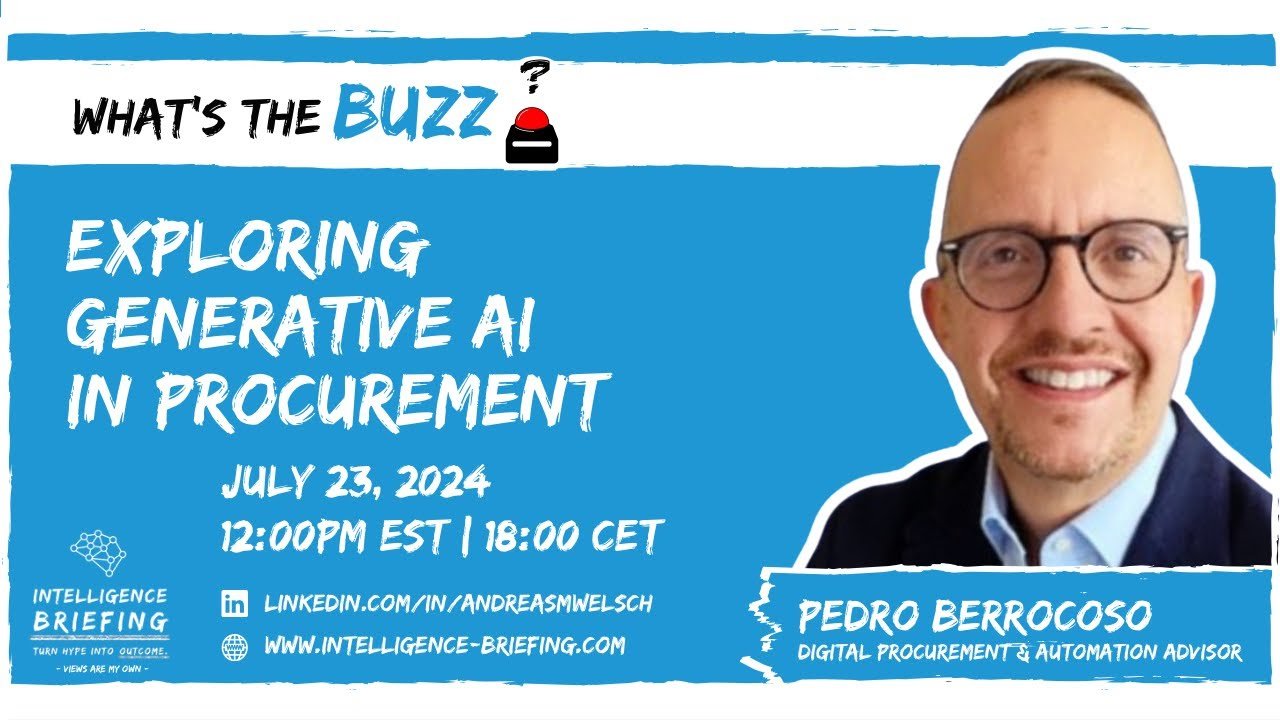
Guest: Pedro Berrocoso, Digital Procurement & Automation Advisor
Host: Andreas Welsch
Episode: What’s the BUZZ?, Season 3, Episode 19
Published: July 23, 2024
Episode Summary
Pedro Berrocoso, Digital Procurement & Automation Advisor, joins Andreas Welsch to answer where generative AI can create value in procurement.
Pedro sorts the opportunities into four buckets: personal productivity, business efficiency, insights generation and user experience.
He walks through a pharmaceutical client case in which generative AI summarizes supplier audit reports with a human in the loop, and explains where AI agents and autonomous negotiation stand today.
The conversation closes on how procurement leaders can build AI literacy in their teams and why suppliers will bring generative AI to the negotiation table.
Key Takeaways
- Pedro sees four buckets for generative AI in procurement: personal productivity, business efficiency, insights generation and user experience.
- Pedro describes a pharmaceutical client that used generative AI to summarize about 2,000 supplier audit reports a year, with analysts reviewing the results, and names data quality and analyst training as the main challenges.
- Pedro says today’s negotiation bots handle low-complexity tasks and return a recommendation to a buyer, and that complex autonomous negotiation still needs trust, ethical guardrails and human oversight.
- Pedro advises procurement leaders to build AI literacy, because suppliers will use generative AI when they pitch, and suggests a conference room pilot, local champions and an AI academy.
- Pedro asks leaders to choose use cases that fit specific pain points, to promote trust and adoption, and to get started now.
Timestamps
- 0:23 Generative AI in procurement: introduction
- 0:40 The guest’s work in digital procurement and automation
- 2:00 Icebreaker game called In Your Own Words: if AI were a fruit
- 4:40 Generative AI opportunities in procurement: four buckets
- 11:22 A pharmaceutical client case: summarizing supplier audit reports
- 16:30 AI agents and autonomous negotiation: where the market stands
- 20:22 Trust and ethics in autonomous negotiation
- 22:00 Research on large language models negotiating against each other
- 23:53 How procurement leaders can build AI literacy in their teams
- 27:34 The guest’s key takeaways
- 28:57 Closing thanks
About Pedro Berrocoso
Pedro Berrocoso is a Digital Procurement & Automation Advisor.
In the episode, Pedro says he is an independent consultant based in Zurich, Switzerland, working on digital procurement, with a background in source-to-pay implementations, and on emerging technologies for process automation.
Full Transcript
Read the full transcript
Andreas Welsch: Today, we’ll talk about using Generative AI in procurement, and who better to talk about it than somebody who’s actively working on that. Pedro Berrocoso. Hey, Pedro. Thank you so much for joining.
Pedro Berrocoso: Good morning and good afternoon to everyone in the audience and to you, Andreas. I’m really excited to be here with you today. It’s a great session, which I’m pretty sure is going to be interesting for many people listening to us. Just to give you some background about myself, Andreas, I’m an independent consultant working primarily on two main topics. One is digital procurement, where I have quite a vast background in source to pay implementations. The other is emerging technologies, using them for process automation and digital activities, such as with AI, to drive productivity and efficiencies in businesses. I’m based out of Zurich, Switzerland.
Andreas Welsch: I’m really excited that this is working out. So thank you so much for making time and spending time with us and with the community today. Wonderful. So hey, for those of you who are just joining the stream, drop a comment in the chat where you’re joining us from today. I’m always curious to see how global our audience is. And I already see a few familiar names and faces here in the chat. So I know the U.S. is definitely represented. But who else has joined? That’s always the question. Pedro, what do you say, should we play a little game to kick things off?
Pedro Berrocoso: Let’s do that.
Andreas Welsch: Wonderful. All right, so this game is called In Your Own Words. And when I hit the buzzer, even the virtual one here, the wheels will start spinning, and when they stop you’ll see a sentence I’d like you to answer with the first thing that comes to mind, and why, in your own words. To make it a little more interesting, you only have 60 seconds for your answer. So are you ready for What’s the BUZZ? For those of you in the audience, feel free to put your answer and why in the chat as well. So here we go. If AI were a fruit, what would it be? 60 seconds on the clock. Go.
Pedro Berrocoso: If it would be a fruit, what could it be? It must be a fruit which is really multi-use, and it’s helping me to be brighter, potentially augmenting my intelligence, or at least giving me a productivity boost. And one thing which comes to mind for me, because I’m an avid gym goer since about a year now, is bananas. Because I think bananas offer you the ability to charge yourself very quickly with energy and at the same time elevate your game when you go to the gym. So I’d be thinking that AI could really be a good fruit, like a banana, which helps you get a quick boost of energy, and at the same time gives you a boost in terms of the intelligence you can potentially get at work.
Andreas Welsch: Awesome. I love that. That’s a fantastic answer. So while I’m traveling, that’s the only question that I have about fruits. And bananas is definitely a unique answer. So that’s perfect. Then let’s maybe peel back the different layers about Generative AI in Procurement. And by the way, looking at the chat, so Tom from Texas, folks from Canada, from Portugal, North Carolina, Poland, New Zealand, New York. It’s awesome. Thank you so much for being with us. Now, look, everybody’s been talking about opportunities for Generative AI in Marketing and Sales for a while now. It’s always about generating, summarizing, translating text. Marketing and Sales seem to be the frontrunners, the early opportunities, the early wins. But what about procurement? Why is nobody talking about procurement? Are there no opportunities there?
Pedro Berrocoso: Is anyone talking about procurement? I think we’re all constantly talking about procurement because we’re very passionate about procurement. And by the way, it’s not as simple as you may think. A lot of people have this myth in their minds that doing procurement activities is relatively straightforward. And just thinking about the opportunity within the space of procurement, some analysts are actually projecting 20 billion to be unlocked by 2027. These are very big numbers, so let’s not get too derailed by these big numbers. But there are hands-on opportunities within the space of procurement, because we have complex processes, we have a lot of data, and we have an ecosystem of stakeholders and suppliers who all want to be served in the best way possible. And just thinking about a CEO survey which I saw not too long ago from PwC, procurement still remains one of the areas where there’s a lot of work to do. There’s an expectation that challenges need to be solved. So thinking about Generative AI in the context of procurement opens up an opportunity for a lot of possible efficiency drivers and productivity to be harnessed. And I could think about Generative AI within procurement in four different buckets. Let’s peel off that banana now by looking through these four buckets, which potentially offer opportunities within the space of procurement. The first one is a bucket which deals more with personal productivity. And I’m guessing everyone in this audience has used solutions like Gemini or ChatGPT, and maybe the Copilot of Microsoft, to help with productivity. Please say no in the chat if you haven’t. With that, as a category manager in procurement, you can write better responses to your suppliers, build communication templates, or translate text, which for us non-English speakers is not always easy to understand from a sentiment perspective or to convey rightly back to our suppliers. You can do that with some of these Generative AI solutions which are already in the market. So bucket number one is productivity hacking, and that is quite broadly already in use. I was reading that about 75 percent of teams are already avid users of Generative AI with this type of solution. The second topic is a bit more classical, and this deals with productivity or business efficiency gains. Even within procurement, there is still a lot of productivity to be gained out of automating processes, but where Generative AI really excels is natural language processing, data classification, what you just mentioned before, content generation, or potentially coding, which is maybe not exactly where procurement folks will spend their time. One of the classical examples of business efficiency is classification of data. Thinking about that in the context of a buyer, they may have a lot of information coming out of their spend classification cube. That spend classification cube data potentially needs to be contrasted with market intelligence information coming from your Bloombergs, or from your external market intelligence supplier. Making sense out of this data could be an automation effect which you could drive with the help of Generative AI itself. Then we have insights generation, which is bucket number three. That is where you can extract insights out of the data, which help you understand better the information you have already stored somewhere. That could be information coming out of your SAP system, which you can then contrast with your supply and demand systems to see if the forecasting is sufficiently covered with supply which you have under contract, or whether there are gaps where you could require a go-to-market activity to get further capacity under contract. Getting these insights, which alert you about facts where you have under-coverage or overexposure or excessive potential for inventories, could really be helpful. And this is where I see the third bucket of use cases within the Generative AI space playing a role. And the fourth one is about user experience. We’ve all been talking in the procurement space about having detrimental user experiences, and I’m pretty sure if you’re a solution provider listening, your solution is probably not that one. But there are many others. Reflecting a bit on my history of work within the source to pay space, we’ve all been suffering a lot. We couldn’t do much. We all knew it. But now with Generative AI we have a capability which is rebuilding a user layer on top of many different solutions, potentially orchestrated through an enterprise orchestration solution with a data model underpinning it, where you could really drive a better experience for users by interacting with the Generative AI solution in a dialogue. So this is bucket number four, where I would see potential opportunities as well. And I think you said before, why is no one talking about procurement? I’m not really sure who that is. But I would be thinking that this is an area where there is a lot of possibility to unlock. And in my perspective there are real use cases which are already taking shape.
Andreas Welsch: That’s awesome. Thank you so much for sharing. I really like how you bucketed into those four groups. And for those of you that might have joined a little later, you really want to stay on. There were already a few good nuggets in the last two, three minutes here, so I can’t wait for more information that you’re going to share with us. Now these four buckets provide plenty of opportunity. And I think you make a fair point that we need to elevate procurement to the same level as Sales and Marketing when we talk about opportunities for Generative AI, because they’re clearly there. Now, one of the key questions that I always get from the audience is, hey, can your guests share a tangible example of how it actually works? How have they made it work? How have their clients made it work? And so I’m wondering if you have one that you can share where one of your clients is using Generative AI in procurement, and maybe what some of the challenges were and how they’ve overcome them.
Pedro Berrocoso: Yeah, I can think of quite a few cases. I’m picking one case, which I worked on last year in detail with one of my clients from the pharmaceutical space. So in an area which is quite regulated and complicated, and where classical solutions like RPA are just not going to work, because you need a lot of data and different solution capabilities used to extract information properly and then make sense out of it. The case which I could think of describing here is in the space of supplier quality. My client had this big issue that a lot of their team members within supplier quality were spending a lot of time reviewing detailed audit reports from their suppliers. These audit reports were coming from contract manufacturers. These contract manufacturers were obviously selling products to the company I was dealing with. But as with any production process, there are defects on the way which get identified and need to be analyzed and assessed. So what was happening is that the supplier quality analysts were spending roughly two to three hours summarizing the details of the audit reports which we received back from the supplier. And then we were caught in a ping pong of conflict resolution and question resolution and questioning of what the supplier was bringing back, because the notion of what was in there wasn’t very clear. So what we did was propose a Generative AI model which was going to help us ingest these audit reports. There were about 2,000 a year, each of them 100 to 120 pages long, which were then analyzed by the Generative AI solution and classified into the specific template sections which we had prepared. Out of that it compiled a summary report, which would then help the supplier quality analyst see very quickly what the issue at hand was, what the root cause was which they had identified, and what methods were used. But also what the proposed action plan was, and what the effect was which was taken out of the AI action plan as well. All of this information was packaged nicely by the Generative AI solution and brought back to the supplier quality analyst for review. So this was a human-in-the-loop approach, which I think for most Generative AI use cases is still a recommended approach. It is a check on making sure that what you get back makes sense and is roughly complete, because you can’t really go through the 200 pages, but you can get a sense out of that and then bring that back into your system for recording, so that you have proven evidence for your auditors afterwards that you have taken preventive or corrective action so that it does not reoccur. So this was one of the specific cases which I worked on last year. And to be honest, one of the big challenges at the very beginning was to have sufficient data in good quality for the model to be trained on the particularities of the quality domain and the kind of language which was used within the context of this work. That was one challenge. The second challenge was to make sure that the quality analysts were properly trained to understand and screen the results coming back, and to be able to satisfy questions which were coming from auditors or from line managers about resolution actions being taken. So building out that template and training it is going to be really important. These were just two of the aspects which we encountered as part of the implementation of this particular solution. There are probably a lot of other learnings, but these were two factors which were really crucial.
Andreas Welsch: That’s awesome. And I think, especially putting that into perspective, if I heard you right, you said 2,000 audit documents per year. So break that down to what, 250 business days, give or take?
Pedro Berrocoso: Right.
Andreas Welsch: So that’s somewhere between seven, eight, nine audits a day. That sounds like it’s pretty significant. If you can accelerate this, if you can use Generative AI to do some of the legwork for you, so you don’t have to read, summarize, analyze the information.
Pedro Berrocoso: Yeah. And I think one aspect which is crucial is that your supplier accepts that this is the way you’re going to be scrutinizing some of their work. You’re still going to be interacting at a human level. It’s really important that you have human-to-human conversations about quality issues. So I don’t think you can just take away the human and have an autonomous kind of activity taking place here. But it’s also a recognition that with Generative AI you can have measurable impact, and at the same time you can prevent product impacts down the line from a procurement point of view.
Andreas Welsch: I love where you’re going with having a human in the loop and not having autonomous systems yet, is what I’m hearing. But I’m curious, with all that talk about, hey, the next wave of Generative AI will be AI agents and they will maybe negotiate on your behalf with your supplier, with your customer. How realistic is that? Are we there yet? When do you think we will be there? What are you seeing in the space when it comes to more autonomy, more AI agents making decisions on your company’s behalf?
Pedro Berrocoso: This is an interesting one, because it’s getting buzzy, as we see. It’s one of these new things on the horizon which a lot of people are starting to talk about. And even in the audience, I just spotted Pedro Martins, for instance. He’s a fanatic about AI agents, and he knows everything about it. But this is a field which is interesting to dissect from the perspective of procurement, because talking about AI as a kind of autonomous negotiation capability is interesting, but in a nutshell it’s an evolution, and it is still quite complicated. Just briefly thinking about what is already there: there are already solutions which are capable of providing you with autonomous negotiation capabilities of low complexity. This is really important. They provide you with bots which can, on your behalf, contact suppliers, execute a script of activities they need to go through, ask for a price, bring that price back, and maybe do some comparisons. But after that, what they still will need to do, I’d be hoping, is come back with a recommendation forwarded to a category manager, back to a buyer, in order for it to be validated and then finally confirmed. There are obviously also models which are fully autonomous, but they’re usually following a decision tree model. They’re quite simple in that sense, and that is what you currently encounter in the market, with maybe three or four providers being quite adamant about it being the future. And then there’s obviously the future potential area. This is where you get into the space of multitasking AI agents, which in my opinion will need to be connected to an ecosystem of solutions. They need to be part of and orchestrate the platform. They need to be part of a knowledge graph. They need to connect to business applications in ways that they can really serve as a microservice for you to then take actions, for instance, on negotiation activities. And this is where the direction is now going. You have companies talking about building future autonomous negotiation bots, if you wish, which can take care of complex negotiations, which can maybe reason, which is not quite yet where we are, and then potentially take decisions on your behalf in a quite automated way. So in a machine buying way, as Gartner put it just very recently. I think this was the content of my post today: 20 percent of all of the revenue by 2030 is forecast to come from machine buying. But for that to really take place, there are some hurdles to overcome. And I don’t think we’re quite yet there to unleash that beast without human intervention, completely in an autonomous way.
Andreas Welsch: I think that’s a great point, especially the part about human intervention, or human in the loop, to review, to approve. Just thinking about how large organizations work and the type of change management, the type of concerns, the type of risks. Also, if something goes off the rails, I could see that there’s a lot of enablement, education, building trust, winning trust needed before leaders get comfortable with having agents act on their behalf in negotiation.
Pedro Berrocoso: And I think you’re mentioning a very good point, which is trust. Trust is probably one of the topics which drives most of the adoption. You need to trust the results of a solution for it to be something you want to use not just one time, but multiple times. So from that perspective, trust is one of these hurdles you need to really get right in order to move forward with solutions which are almost autonomous in themselves. The other thing which I think is quite important when we talk about negotiations, and it just triggered a thought in my mind, is that you have some level of not just reasoning, but morals as well. If we talk about negotiations on behalf of humans, there is this notion that there needs to be fairness. And there are ethical considerations which need to flow into the models themselves, so that they’re not just running negotiations wild, but taking them as a human would, in a fair way.
Andreas Welsch: I think that’s another interesting point, and I’m curious how this will play out. Will agents, in a sense, fight to the knife, fight to the death to get the best outcome for you, to negotiate until they get the best price for you? And what’s the expense, or how do you build in safeguards so that does not happen, or so that your purchase order bot or sales order bot or auto bot, if you need 20 pieces, really orders 20 pieces on your behalf and not 200, with an extra zero?
Pedro Berrocoso: And I think I was reading a report from a research piece which was done probably a few months ago. It was called the Negotiation Arena. They were pitching large language models against each other, giving them three models of negotiations. One thing which was interesting coming back from that particular research was that the use of tactics such as cunning and insulting and pressuring was actually leading to better results. And this is just telling you how critical it is that if we unleash autonomous activities, we have human oversight and we really ensure that they’re sound and safe, and that I’m not going to create some reputational damage potentially down the line.
Andreas Welsch: That’s right, yeah, that too. Now I’m sure there are a number of good ways and safeguards to build into systems, to replace variables or data with actual data from your system in your prompts, in your outputs, and in these kinds of things. But I think it’s an area that definitely needs a good amount of scrutiny and high-quality work to make sure that things stay within the guardrails of what you expect as a procurement professional. Maybe that’s a good segue to the next part. There are four big pillars, four big opportunities that you mentioned in the beginning, for how Generative AI can add value. There’s certainly a trend towards more automation going on. We’re not fully at the point where it’s all driven by agents, and that’s for a good reason, so people can get used to more automation, more autonomous decision making. But I’m wondering, as a leader in a procurement function, a procurement organization, how can you prepare for more Generative AI, more autonomy, more, again, summarization, generation, translation type things? What do you need to do to bring your teams along on that journey?
Pedro Berrocoso: Yeah, and this is a crucial aspect of getting the adoption rate increasing and at the same time getting the literacy levels of your organization up and running. If we’re thinking about procurement, there’s one specialty before we go into the details of getting your team ready: procurement is this one place which gets exposed in the future to a lot of Generative AI solutions, because there are suppliers pitching with solutions which include Generative AI. So having that literacy level is not just a skilling activity for adoption of your own tools. It also ensures that you stay up to date and fresh with everything that gets proposed by external vendors, and that you are able to discern whether or not the solutions truly have Generative AI capabilities, or whether they need to be scrutinized a little more because they don’t quite offer what the suppliers are telling you. Thinking about the activities which could help with fostering uptake and literacy, I think the simplest one is to bring everyone into one room and just explore and play. This is something we don’t see many organizations doing. Take an emerging technology. Think about what it could be providing. Do a conference room pilot exercise. Get everyone into a room and think about the opportunities this offers and do a small pilot with that, potentially supported by an expert whom you have trained. This is one way to lose the scare which a lot of people have of new technologies, and to truly understand through play with the tool what the capabilities are. That could be as simple as giving out licenses, or free use of GPT solutions, to a certain set of team players, who could then act as champions moving forward. So that’s one of the activities I was thinking about, and I’ve seen it within the space of automation work. The second topic is something you usually do if you’re connecting the vision of your company to AI or Generative AI as a big player for your business objectives. That is fomenting or capacitating people with an AI academy, which helps people go through a structured learning path, to gain the skills they need not just to be aware of what is out there, but potentially to get hands-on practice, and then to get the capabilities they need to help others within your own teams. So an AI literacy program is something I see taking place in some of the companies. One of my last clients had this as a very broad-based program, and it actually yielded really good results. One of my experts who was working very closely with me on the discovery program for Generative AI was actually a champion who was so innovative that he sparked a lot of curiosity around him. It was driving a lot of good conversations within the teams, and reducing the level of scare or apprehension about new technologies themselves.
Andreas Welsch: That’s so great to hear. I think those are three really tangible examples, and especially the part about AI literacy and what you mentioned, that you can be pretty sure that your suppliers are going to use Generative AI when they pitch to you. I think that’s a really important insight and aspect to be aware of. Now, we’re coming close to the end of the show, and I was wondering if you can summarize the key three takeaways for our audience today.
Pedro Berrocoso: Yeah. So in my perspective, the three key takeaways are, first, that Generative AI really has a place within procurement. That’s point number one. It gives you the capability to enable productivity and insights, and there’s potentially a better user experience. The second point which I would like people to take away is that you need to be choosy about where you apply Generative AI. It needs to fit the purpose, or the pain points, which you’re addressing. So choose your use cases wisely so that you can promote trust, acceptance and adoption of the solutions which you undertake. Be very cognizant also of the fact that data quality plays a very strong role. And the third takeaway is to get started now. There’s no need for hesitation. There is really a catch-up to do if you haven’t yet started the journey to learn about Generative AI, and if you need some help, here I am, I can help you get that first step going. I just wanted to make sure that you understand that for a procurement function, having some capabilities which incorporate AI or Generative AI as a basic skill is really crucial already, for the reason I was mentioning earlier, which is that you’re going to be exposed to Generative AI solutions anyhow as you discuss innovations with your suppliers.
Andreas Welsch: I really think this brings it home really nicely. Three key takeaways. Now, Pedro, I think it was an awesome session. I really enjoyed hearing from you and learning from you, all the different pieces and nuggets of gold that you dropped over the last roughly 30 minutes. I think there’s a lot of excellent information there. So thank you so much for joining me and joining us today and for sharing your expertise with us.
Pedro Berrocoso: Thank you very much. It’s been a pleasure.
Listen and Subscribe
Related Reading
- Agentic AI for Enterprise Leaders
- AI Leadership Handbook
- Agentic AI in Procurement: What Leaders Should Prioritize
- Deploying AI Agents: A Practical Guide for Business
Frequently Asked Questions
What are the four areas where generative AI can help procurement?
According to Pedro, the four buckets are personal productivity, such as drafting and translating supplier communication, business efficiency, such as classifying spend data, insights generation from data in systems such as SAP, and a better user experience through a dialogue with the solution.
How can generative AI support supplier quality audits?
Pedro describes a pharmaceutical client whose analysts spent two to three hours summarizing each supplier audit report. A generative AI model ingested about 2,000 reports a year of 100 to 120 pages, sorted them into a template and produced a summary, and analysts reviewed the output.
Will AI agents negotiate with suppliers on their own?
Pedro says some solutions already run low-complexity negotiations, contacting suppliers and asking for prices, and ideally return a recommendation to a buyer. He sees complex autonomous negotiation as still needing trust, fairness and human oversight.
How can procurement leaders prepare their teams for generative AI?
Pedro suggests bringing everyone into a room for a conference room pilot, giving licenses to a few champions, and setting up an AI academy with a structured learning path. He adds that suppliers will use generative AI when they pitch, so literacy also helps buyers scrutinize claims.