

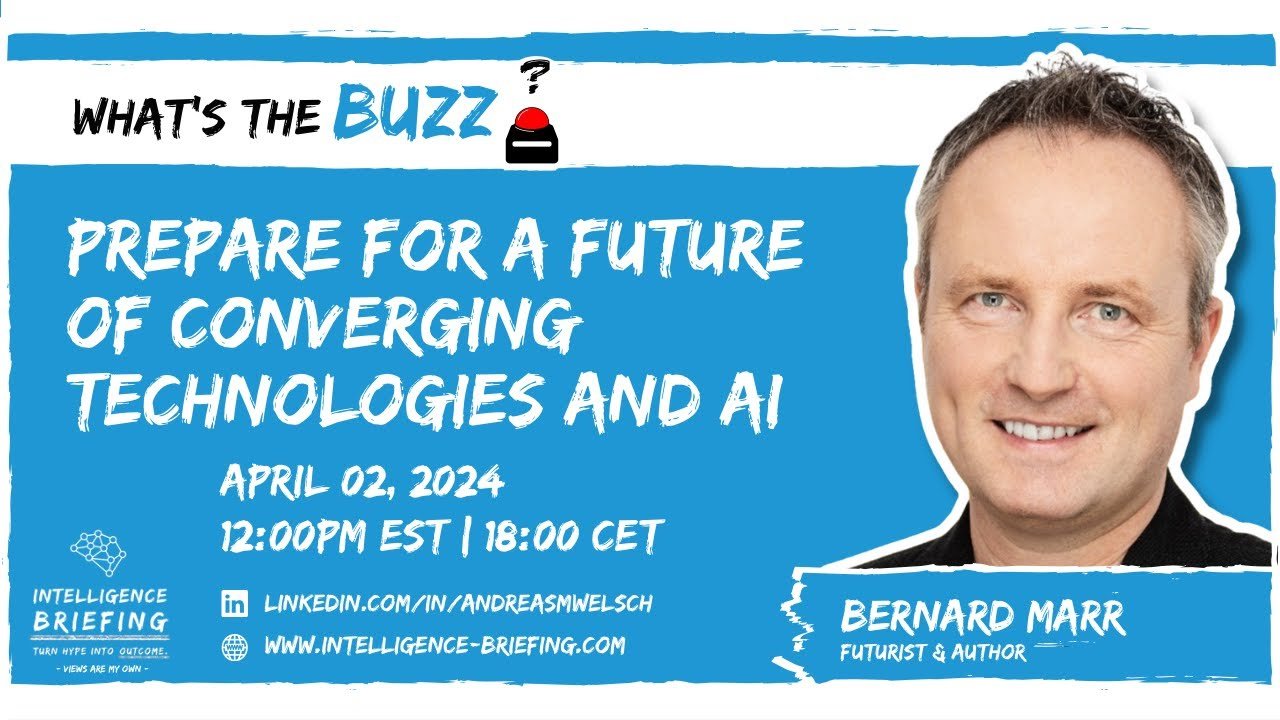
Guest: Bernard Marr, Futurist & Author
Host: Andreas Welsch
Episode: What’s the BUZZ?, Season 3, Episode 10
Published: April 2, 2024
Episode Summary
Bernard Marr, a futurist and author who advises company boards on AI trends, joins Andreas Welsch to answer a question for business leaders: how can they prepare when generative AI, extended reality, quantum computing and other technologies converge? Bernard expects multimodal generative AI to change creative work, shopping and product design, and he describes a fish farm in Norway that uses AI to feed and monitor salmon. He advises leaders to resist the fear of missing out, to test whether their strategy still holds, and then to review their products, services and operations. He names organizational culture, not technology, as the common hurdle, and closes with three points on hype, human-centric design and ethics.
Key Takeaways
- Bernard expects generative AI to become multimodal, generating code, voice, music, images and entire scenes, and says an organization that does not see itself as AI enabled will slowly be overtaken by those that do.
- Bernard describes generative AI, extended reality, quantum computing, blockchain, gene editing and nanotechnology reinforcing one another, which he calls a hyper innovation cycle.
- Bernard advises leaders to step back from the fear of missing out, understand what the technologies can do, ask whether their strategy is still relevant, and then review their products, services and operations.
- Bernard says the hurdle is very often organizational culture rather than technology, and recommends open conversations, encouragement to experiment, and opportunities to learn and retrain.
- Bernard closes with three points: AI is not hyped enough in many cases once it combines with other technologies, the work is human centric, and leaders need to apply it transparently, within regulation and ethically.
Timestamps
- 00:24 Cold open: seizing opportunity as technologies converge
- 00:56 The guest introduces his work and background
- 02:05 Audience shoutout and newsletter mention
- 02:23 Icebreaker game: if AI were a fruit
- 03:58 The next wave of multimodal generative AI
- 07:15 Generative AI meets extended reality and immersive worlds
- 10:03 Converging technologies from quantum computing to gene editing
- 12:54 Linking immersive shopping with the physical world
- 16:08 Opportunities for leaders in traditional industries
- 19:27 How AI is transforming the fishing industry
- 24:14 Culture and people as the real hurdle
- 27:14 Key takeaways for the audience
- 28:52 Wrap-up and thanks
About Bernard Marr
Bernard Marr is a futurist and author. He describes his work as helping companies understand future trends and prepare for them, including work with the boards of companies across industries on what AI means for them.
By his own account, he has written 23 books, including Generative AI in Practice, which covers more than a hundred generative AI use cases, and he does keynote speaking and community building on LinkedIn.
Full Transcript
Read the full transcript
Andreas Welsch: Today we’ll talk about how you can seize the opportunity in your business when multiple technologies start converging, and who better to talk about it than someone who is an expert at doing just that and thinking about what the future holds. Bernard Marr. Hey Bernard, thank you so much for joining.
Bernard Marr: Hi Andreas, it’s lovely to have you with me today. I’m super excited about joining your livestream.
Andreas Welsch: Wonderful. Hey, why don’t you tell our audience a little bit about yourself, who you are and what you do?
Bernard Marr: Okay. I’m Bernard Marr. I’m doing a number of things. I help companies understand future trends and how to get ready for them. I work with boards of companies across pretty much any industry, helping them understand what AI means, what the biggest challenges and trends are that we’re seeing today, how they will influence the industry, and how companies can prepare for this strategically. I also write. I’ve written 23 books. My latest one is called Generative AI in Practice, which looks at over a hundred use cases of how organizations can actually use generative AI and what it means for businesses and different industries. I also do a lot of keynote speaking and community building. I try to engage as many people as I can on LinkedIn. We have a large community and large newsletters on the future of tech and business.
Andreas Welsch: Like I said, I’m really excited you’re making time to be with us today. I’m really looking forward to our conversation. Bernard, should we play a little game to kick things off?
Bernard Marr: Why not?
Andreas Welsch: All right, so let’s see. This one is called In Your Own Words. When the wheels start spinning, you’ll see a sentence, and when they stop, I’d like you to answer with the first thing that comes to mind and why, in your own words. To make it a little more interesting, you only have 60 seconds for your answer. If AI were a fruit, what would it be? 60 seconds on the clock.
Bernard Marr: Very good question. I’m just trying to think of a really versatile fruit that you can use for lots of different things. Let’s say banana, because you can use a banana for lots of different things, and it has huge benefits across the world. It can help feed the world. There are probably better fruit, but that is the one that comes to mind in 60 seconds.
Andreas Welsch: Awesome. Thank you so much. And it’s shipped green, but by the time you use it, it’s probably ripe.
Bernard Marr: Exactly.
Andreas Welsch: We’ve obviously been talking so much about generative AI in the industry, and I feel a lot of the conversation and focus has really been on just one modality. It’s either text or image generation or video generation or synthetic audio. But from what you’re seeing when you’re talking to all these people, taking a look through the looking glass, if you will, what’s the next wave of gen AI driven innovation that we’ll see beyond those first low hanging fruit?
Bernard Marr: Yeah. What I am seeing is that we will see much more multimodal applications of generative AI. For me, it’s really important to understand that AI is not just chatbots, and it’s not just image creation. There’s so much more, because AI, especially generative AI, can generate computer code. It can generate voice and music and images and entire scenes. And this will transform pretty much any creative process, pretty much any industry, and pretty much any organization. The point I’m making is that this transformation will be so big that if you don’t think of your organization as an AI enabled company, you will slowly be overtaken by those who do. The same probably applies for your job. AIs won’t take your jobs, but people who can use AI, and especially generative AI, more efficiently and effectively than you can, they will. So it’s about seeing yourself as an AI enabled person in your job and seeing your business as an AI enabled business. These tools will become much more powerful when we bring all of these different modalities together. A really good example is video game design. In the past, in a multiplayer game, for example, video game designers created the different characters that you encounter in a video game, and they had to script the conversations that you can have with those characters. In the future, video games can be completely transformed, where the AI can generate completely new worlds for you, including those characters, where the dialogues that you can have are AI generated and the music that plays in the background is AI generated. I was at CES in Las Vegas this year, and I was impressed by organizations like Mercedes, who are now experimenting with generating music in your car based on where you’re driving and how you’re driving. It will sense your mood, it will sense the environment, and then automatically use generative AI to compose the right music for you. So it will transform so many aspects of our lives that I’m super excited about all of these modalities coming together into one. The other thing I’m excited about is the fact that AI is just one of a number of hugely transformative technologies that we are seeing today. If we wind the clock back a year and a half, it was all about the metaverse and extended reality. And I feel that there’s a huge possibility here of generative AI to enable this immersive world. If you are a company thinking, I would like a destination somewhere in an online world where I have more than just a flat screen and I have an immersive experience for my customers where they can try on things and try out things, this was super difficult in the past, because you basically needed to attract someone from game design to help you develop those worlds. And now I can type a few sentences into a chatbot and say, please create me a digital headquarter for my metaverse store. It can do this for you, and you can then co-create this and play around with what you want until you’re happy with it. So it will democratize so many different aspects of our lives, whether it is making music, whether it is writing, whether it is designing digital worlds, or even designing real world objects. I was just recently talking to an architect firm about what this might mean for them in the future. And again, I can see a world where you have an app that allows you to design anything. And this app has all the building intelligence built in. It has all the building regulations and all the local laws that you might have to comply with, because if I designed my own house, I would come up with something crazy that maybe would never be allowed. So here you can put some of the constraints on in the app and say, okay, if you want to build a new house somewhere in California, in this place, this is what it needs to look like. And then you can start building it. And then you put your VR headset on and you can walk around it and experience it. And the generative AI will create it for you and create those virtual environments until you’re happy. And all of this for me is super exciting. We could talk about pretty much any industry now and how this merging of these technologies will enable this. I don’t really like the word metaverse. Extended reality is my favorite word when it comes to these immersive digital 3D worlds that we will see more of in the future. That could trigger its own industrial revolution. AI, traditional AI, could trigger another industrial revolution. Then we have blockchain technology that again is transforming lots of different sectors. We have new technologies like quantum computing that will accelerate what we can do with AI. And we have huge innovations in material science and nanotechnology, huge advances in gene editing, for example, and AI is enabling us to do all of this so much better and so much faster. If you think about developing a new drug, for example, first you need to find out some of the gene markers that identify what causes a certain disease. And then you need to find a new medicine that might help you target those causes of this disease or even the genes itself, and that was super complicated in the past, still is, but AI can make this so much faster through simulations. Just one little thing like the protein folding project that Google has done suddenly enabled us to see the shapes of over 200,000 proteins, that previously would have taken us billions of dollars, and it took us five years and a million dollars just to figure out the shape of one protein. And this new insight that AI has given us enabled companies to come up with new coronavirus vaccines, because we could identify those proteins and target them. So it will transform pretty much every aspect of our lives, with all of these technologies merging with each other and interacting with each other: quantum computing making AI faster, AI making digital worlds easier to build, and so on. We create this new environment of hyper innovation, and I believe a new industrial revolution at a scale that we’ve never seen before.
Andreas Welsch: That’s awesome. Thank you for sharing that. I feel we’re so caught up in the here and now, drafting product descriptions and blog posts and whatnot, that those more future looking things are maybe not as apparent to us. So hearing you talk about those and what it has already enabled, like the protein project that you mentioned, the value of that is clearly visible. The other aspect that you talked about when it comes to extended reality, that I find really interesting, is that yes, you want and you need to have a presence in these immersive worlds, but we still live in a physical world. If I try something on in that extended reality, I still want to wear it as a real person. So that connection between that real online immersive experience and the physical world, getting that package delivered, managing payments, getting recommendations, these kinds of things, that’s super fascinating to me.
Bernard Marr: Yeah. And this is actually a really good example that I talk about in my book. Currently, online shopping, especially if you want to buy clothes, is really limited, because you can go to a store, you can see different clothes, and they might recommend stuff to you. But what you as a consumer want to see is, okay, how does the shirt look with these trousers and those shoes? And currently I can’t do that. Even better, will they actually fit me? That’s a huge problem, with massive return rates for online shopping, because people just buy three different sizes and hope that one of them fits, and then they return the other two that didn’t. So with AI, especially generative AI, this will make it so much better. In the future you will have a scan of yourself. You can use your phone to scan your body, and then the AI will know the cut of the actual garment. You can then combine those different garments and see what they will look like on you, so you can try them on virtually on your actual virtual body that represents you. You can combine outfits, and then you can put yourself in a different environment. If you say, I want to buy a suit for a cocktail party, or a dress for a summer party somewhere, you can ask the AI, okay, now put me in this cocktail environment, put me into a summer party. You can then fly around yourself a few times and check yourself out and say, do I look like I want to look? That will again accelerate and improve this whole online buying experience, and make it potentially even better than what we can do in a store now, because in a store you can see yourself in the dressing room. Yes, you can try them on, but hopefully with gen AI and extended reality combining, we will be able to do this even better in the digital world.
Andreas Welsch: I’m always wondering with these scenarios what the haptics are, what the feedback is that we’re used to or that maybe we want to see. I was talking about virtual reality to a group of students that I teach on management information systems the other week. Ikea has this amazing app where you can take pieces of furniture and show what they look like in your room, and you can make them larger and smaller and turn them and everything. It was interesting because even that group of 18, 20 year olds said, yeah, I would still want to see what the fabric looks like if I sit on it. Is it comfortable? So I’m always wondering how we are able to bridge that, or how big of a factor that is. We’ve talked about retail, we’ve talked about immersive worlds, fashion as one of the examples, life science, healthcare. But what are some other opportunities that you see for business leaders in more traditional industries? What can they do? What can they prepare for when all of these technologies converge?
Bernard Marr: Yeah. I think really important is for businesses to take a step back. What I see a lot of is this FOMO effect, this fear of missing out, where organizations say, okay, everyone is now thinking about the metaverse, everyone is now thinking about generative AI, everyone is now thinking about blockchain technology, and we better do something with this. Instead of doing that, step back and look at your own strategy. The first step is to really understand the capabilities of these technologies. And this is where I see my position in the world. I help organizations demystify some of these technologies, explain them in a really easily understandable way, and understand the practical applications of these. And then take a step even further. Once you’ve understood those technologies, instead of starting with your current strategy, take a second and say, is our strategy actually still relevant? If you think about pretty much any industry, say you are an entertainment company that makes news, then this will have real implications for you in the future, because we might have news that is completely personalized for you. I sometimes get annoyed. The app that I’m using for my news understands a little bit about my interests, but every article I read is not personalized to me. It might explain AI, and I understand AI already. I want to know the deeper implications of it. In the future, news will hopefully be able to do that. It will understand what you already know and give you much more relevant content, maybe even in a format that you prefer. If you say, I like to listen to my news, I want to watch it, I want to read it, it can deliver this in whatever format you like. And even if you say, okay, I want my news to be rapped to me, I recently saw something my kids showed me, a guy on TikTok who raps to teach people math. I thought this is quite cool. If you like rap music and this is the way you want to learn stuff, then maybe this is what you want. And if you want your favorite rapper to rap the news to you, maybe even in VR, then we can do that in the future. This obviously has real implications for the strategy of a media company and how it produces content. In the same way, it will transform super traditional industries like fishing. This is an example I talk about when I talk to execs. Fishing is one of the oldest industries in the world. A super cool example is a fish farm in Norway that wanted to use AI to solve two problems. One is that they want the fish all to grow to the same size, and this naturally doesn’t happen, because when you have these fish in the pens in the sea, you normally dump some food in, the fish fight for the food, the stronger ones get more food and the weaker ones get less food, and therefore they grow to different sizes. The other problem is diseases. If you get sea lice, for example, they can spread very quickly throughout the whole pen, unless you find the fish that is infected and take it out. And this was really tricky. So what they’ve installed is a face recognition system for salmon. They use 5G to connect the sea pens to the shore. They now have a feeding system that recognizes salmon based on the spots on their face. They can uniquely identify each salmon, and the system will only issue a feeding pellet a day to a salmon that hasn’t eaten yet. So they have now solved this problem. Every fish now grows at the same rate, to the same size. They also have high definition cameras that use machine vision to identify sea lice. Because the fish swim around in little circles, they’ve created a system with a little narrow bit, and if they’ve detected sea lice on any of the fish, they can take them off into a different chamber and take them out. For me, this is just so cool. But even if you’re not a fish farmer or a fishing company, what do you need to plan for the future? If you’re a fish farm or a fishing company today, you need to have people on board that understand how to use data, because we can now use satellite data and other data to predict a really safe journey. They can predict where the fish will be when we get to the fishing grounds. They use technology like sonar to measure the density of the school before they release any hooks or nets. Thinking slightly ahead, we will have more automation and more self driving ships. The big limitation on fishing boats is that I need to have housing for people, I need to have provisions for people, and they need to come back every now and then to see their family. In the future, we don’t need to do this. We will have completely autonomous fishing boats. So if you plan for the future, this is where you want to go. If you plan even further ahead, there’s already a restaurant in Tokyo that does 3D printing of sushi, and you can even submit your genetic fingerprint to them, and they will then customize the sushi with the right ingredients and nutrients for your body. I can see a world where we won’t need to have fishing boats going out into the sea and dredge the ocean floor and destroy habitats and destroy our oceans, when we can do all of this synthetically. You can 3D print tuna in the same way we can already produce cultured meats. Genetically, they are identical. We just have to figure out how to make them nicely. In the future, my hope is that we won’t have fishing boats, and we will have amazing fish, amazing meat, generated in our homes, on 3D printers personalized to us. We could go through pretty much any industry in the world and think about this. What businesses need to do is figure out the implications for their own strategy, and then look at their own products and services and say, what does this now mean for us? How can I make my services smarter, more intelligent, using AI? And then I need to look at my own operations and think, how can I automate things? How can I augment things to make them better and more efficient? If you do those two things, you will figure out how to use these technologies and make a real difference in your organization.
Andreas Welsch: Thank you so much for sharing. Facial recognition for salmon, I haven’t thought of that yet. Let’s hope it’s GDPR compliant.
Bernard Marr: Yes.
Andreas Welsch: Now, you touched on a number of great points here, and especially what leaders need to be aware of if they want to succeed in the future. What would be some additional advice there? Certainly look at your strategy, but also look at where your future strategy is going to be. What are some other aspects that you’re seeing that you can share maybe in a minute or two here before we get close to the end of the show?
Bernard Marr: Yes. Really important to understand is that very often the hurdle is not technology. The hurdle is very often organizational culture and understanding, everything related to people. When we talk about AI and the huge transformations it might bring, it sometimes instills fear in people. So we need to engage everyone. We have to have open and transparent conversations in our businesses. For business leaders, after they’ve understood this and looked at their strategy, they need to create a culture that is open to all of this, where people are encouraged to experiment with these technologies and use them, where we have open conversations, and also opportunities to learn, because if we don’t do that, people will be left behind, and your organization will be left behind. So we need to figure out what humans will be doing in the future, and how they will share their knowledge and their workplace with intelligent machines. My hope is that all of this will make our workplaces more human, and we can actually bring what makes us truly human: our emotional intelligence, our creativity and creative problem solving, our critical thinking, all of these amazing skills of interpersonal communication, all the skills and things that really truly make us human. We will bring more of these to the table and can outsource things like data analysis and automate some of the things that AI can do really well. For business leaders, it’s important to engage people in this conversation and then give everyone in the organization the opportunity to learn and train and retrain to some extent to be ready for this revolution.
Andreas Welsch: I feel very validated in what I’ve seen firsthand by what you’ve just shared. It’s really a people topic, and that’s, at least for me, one of the key takeaways when I talk to leaders. Like you said, it’s about people, it’s about culture, it’s about enablement, it’s about transparent and sincere communication on where things are going, and helping everybody understand what the potential is, but also what their individual role is. Now, we’re getting close to the end of the show, Bernard, and I was wondering if you can summarize the three key takeaways for our audience today.
Bernard Marr: Yeah. Sometimes we talk about AI as a hugely hyped up tool. I think in some cases it is definitely overhyped, but in many cases it’s not hyped enough, especially when we think about how transformative it will be when it interacts with all these other technologies to create the hyper innovation cycle that we will see. Another key point for me is that this is much less about technology and much more about humans. So engaging people, making it human centric, helping humans to be more human by using this technology, and not less. We’re not competing with them. They are augmenting what we do, and they will give us superpowers. And then another point that I haven’t actually talked about when you asked me the last question is ethics, using this in a way that complies with laws and where we look at potential biases and some of the risks that come with these technologies. Applying it in a way that is transparent and complies with the regulation is really important, and approaching it in an ethical manner is another really important top tip.
Andreas Welsch: Thank you for summarizing that. I think those are really three key points that we all need to be aware of as we’re looking at introducing AI in business, and, to your point earlier, fighting the FOMO a little bit too. So I really appreciate you sharing all of that. Like I said, we’re coming close to the end of the show. Thank you so much for joining us and for sharing your experience with us. It was a really valuable session, looking further into the future of what’s possible. Thank you, Bernard.
Bernard Marr: Thank you very much, Andreas.
Listen and Subscribe
Related Reading
Frequently Asked Questions
What are converging technologies in AI?
Converging technologies are separate innovations that reinforce one another. Bernard names generative AI, extended reality, blockchain, quantum computing, nanotechnology and gene editing. Quantum computing can make AI faster, and AI makes digital worlds easier to build.
Why does multimodal generative AI matter for business?
Multimodal generative AI combines code, voice, music, images and entire scenes in one application. Bernard says it will transform pretty much any creative process and industry, and that organizations that do not see themselves as AI enabled will slowly be overtaken.
How should leaders respond to the fear of missing out on new technology?
Leaders should step back and understand what the technologies can do before acting. Bernard then advises asking whether the current strategy is still relevant, and reviewing the organization’s products, services and operations for ways to make them smarter or more automated.
What is the biggest hurdle to adopting converging technologies?
Bernard says the hurdle is very often organizational culture rather than technology. He recommends open and transparent conversations, encouragement to experiment, and opportunities to learn and retrain, so that people and the organization are not left behind.
How can AI change a traditional industry such as fishing?
Bernard describes a fish farm in Norway that uses face recognition for salmon to feed each fish and machine vision to spot sea lice. He adds that fishing companies need people who understand data, and he expects autonomous fishing boats later.