

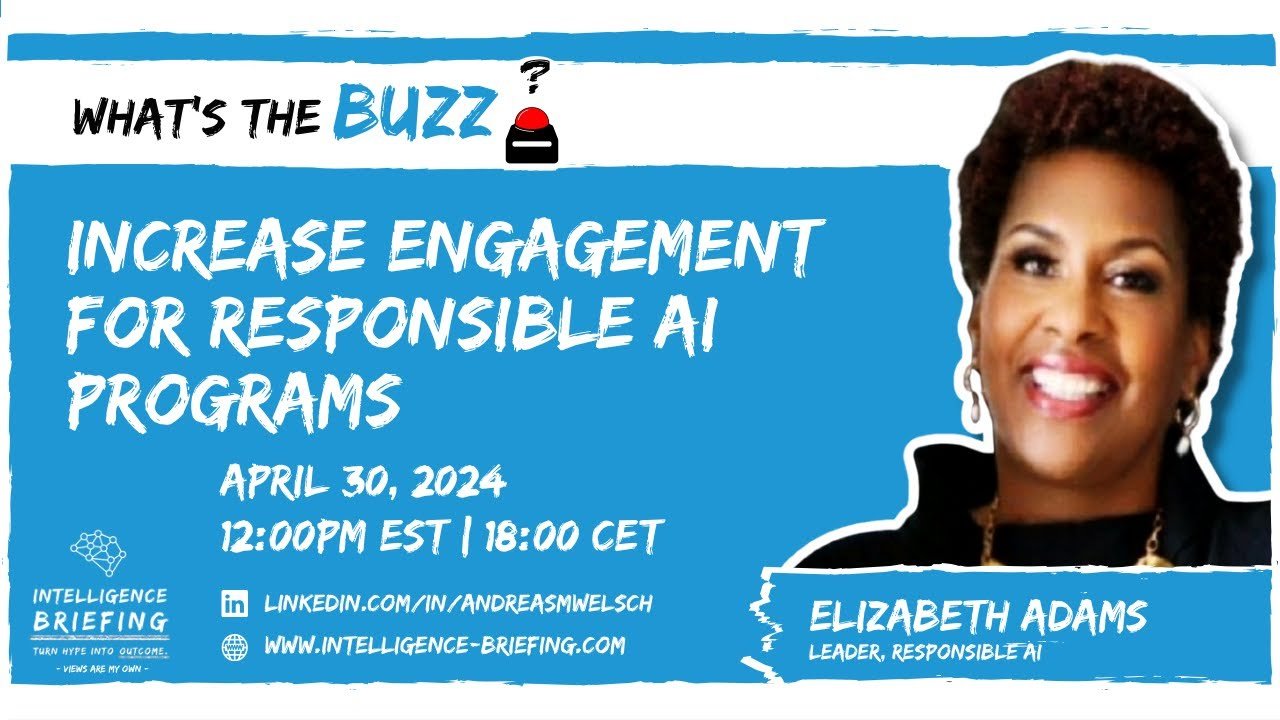
Guest: Elizabeth Adams, Leader of Responsible AI
Host: Andreas Welsch
Episode: What’s the BUZZ?, Season 3, Episode 11
Published: April 30, 2024
Episode Summary
Elizabeth Adams, Leader of Responsible AI, joins Andreas Welsch to answer a question for leaders: how do you increase employee engagement with responsible AI? She draws on her doctoral research, a qualitative study of 60 participants across large and small organizations, academia, industry, government and nonprofits.
Elizabeth explains that employees in organizations where responsible AI is part of the culture can name their AI policies, who is responsible for what, and where the center of excellence sits. Where it stalls, employees lack a vision and fill the gap by learning from generative AI outside of work.
She names two requirements: a clear vision statement backed by activities such as employee handbooks and job descriptions, and a safe place to raise concerns without fear of retaliation. The conversation also covers where AI bias comes from and why the attributes of responsible AI now include attribution, consent, user safety and privacy.
Key Takeaways
- Elizabeth says employees in organizations where responsible AI is part of the culture can name their AI policies, who is responsible for what, and where their center of excellence is.
- Elizabeth calls a clear vision statement critical, followed by activities that support it, such as a stronger employee handbook and a paragraph on responsible innovation in job descriptions.
- Employee safety is a finding of Elizabeth’s doctoral research: employees need to say something is not right without fear of losing their job or being retaliated against.
- Elizabeth describes handling stakeholder claims like technology bugs through a governance board, and advises piloting a small program with the group closest to the biased data because it is hard to scale.
- Elizabeth’s advice for individuals: increase AI literacy, become a champion, be louder about what you find, and raise your hand for opportunities. You do not have to be super technical.
Timestamps
- 00:25 Cold open: employee engagement with responsible AI
- 00:42 Elizabeth introduces her background in AI ethics
- 02:02 Audience shoutout and newsletter mention
- 02:18 Icebreaker game: if AI were a fruit
- 03:58 Responsible AI gaps and evolution with generative AI
- 08:19 Responsible AI in small versus large organizations
- 11:21 Common barriers to effective responsible AI programs
- 14:22 What a responsible AI vision looks like
- 17:06 Audience question on the research sample size
- 18:09 How leaders can drive employee engagement
- 21:51 Audience question on where AI bias comes from
- 26:48 How the need for responsible AI has changed
- 29:34 Key takeaways for the audience
- 31:13 Wrap-up and thanks
About Elizabeth Adams
Elizabeth Adams is Leader of Responsible AI. She describes herself as a responsible AI leader and technologist with a couple of decades in technology, who moved into AI ethics about eight years ago.
She delivered a civic tech project in Minneapolis through a Stanford fellowship, runs her own business, gives keynote speeches and is pursuing a doctorate, and she teaches the LinkedIn course Leading Responsible AI in Organizations.
Full Transcript
Read the full transcript
Andreas Welsch: Today we’ll talk about how you can increase employee engagement with responsible AI. And who better to talk about it than someone who’s doing just that, Elizabeth Adams. Hey Elizabeth, thank you so much for joining.
Elizabeth Adams: Thank you so much for having me. I am delighted to be here today.
Andreas Welsch: Wonderful. Why don’t you tell our audience a little bit about yourself, who you are, and what you do?
Elizabeth Adams: Sure. So I’m Elizabeth M. Adams. I currently bring you greetings from the beautiful city of Savannah, Georgia. I consider myself a responsible AI leader and influencer. I’ve been in the space about eight years now. My background is in technology. I’ve been a technologist for a couple of decades and then pivoted, as I mentioned, to the AI ethics space about eight years ago. Since then I have had a number of successes delivering AI ethics projects. One particular one was in the city of Minneapolis, through a Stanford fellowship I had, where we worked on a civic tech project with citizens and policy makers to understand how to use AI to govern society. I run my own business, I’m pursuing a doctorate, and I do a lot of keynote speeches. So I keep myself really busy, but all things responsible AI mostly.
Andreas Welsch: I’m so excited to have you on, and we were part of LinkedIn’s Creator Accelerator program. I’m excited we finally have the opportunity to do this episode together. Looking forward to learning from you as well. So folks, for those of you in the audience, if you’re just joining the stream, drop a comment in the chat where you’re joining us from. I’m always curious to see how global our audience is. Now, with that out of the way, should we play a little game to kick things off?
Elizabeth Adams: Yes, I’m a little nervous, but yes, let’s go for it.
Andreas Welsch: Alright, perfect. This one is called In Your Own Words. When I hit the buzzer, the wheels will start spinning. When they stop, you’ll
Elizabeth Adams: Oh, Jesus.
Andreas Welsch: I’d love for you to answer with the first thing that comes to mind, and why, in your own words. To make it a little more interesting, you only have 60 seconds for your answer. And again, for those of you watching us live, put your comments in the chat as well. What do you think it is and why? So are you ready for What’s the BUZZ?
Elizabeth Adams: Ready.
Andreas Welsch: Perfect. Then let’s do this. If AI were a fruit, what would it be?
Elizabeth Adams: I would say it would be an apple. The apple was something that Eve took from the tree, and it created all kinds of confusion. Way back when, they were thinking that the apple was this great thing, and now there are challenges with it. So for me, it would be an apple.
Andreas Welsch: Awesome. Wonderful, and well within time. Makes me wonder who would be the snake then? But we can save that for a separate episode. Alright, let’s jump right into our topic. I was pursuing my PhD at one point as well, a couple of years ago, and came across many similar topics around ethics and responsible AI. Back in 2016, there was the case that ProPublica uncovered with COMPAS, the recidivism software that was based on biased data and incorrectly sentenced individuals more based on their ethnic background rather than actual substantive data. Or Amazon, a couple of years later, 2018 or so, scrapping their resume matching tool because there was bias in it and women were disadvantaged, as one example. In light of those examples and probably several others, I’ve seen leaders be quick to put AI ethics and responsible AI programs in place. Committees, policies, the whole nine yards, obviously. But I’m curious, from your research talking to employees and interviewing them, how they are interacting with responsible AI and these policies. What are some of the gaps that you’re seeing? And how is responsible AI evolving now in times of generative AI as a new aspect or dimension to this?
Elizabeth Adams: Okay, that’s a really good question and a good follow-on. Let me back up to say that a few years ago, there were several cases of bias and AI harm that people outside of the technology space and inside the technology space were making organizations and policy makers aware of. You mentioned a couple of cases. There are several others where people are actually advocating for safer, transparent, more responsible, accountable technology. So this isn’t new. While we are talking about responsible AI in 2024, back in 2016 and 2018 it was more ethical AI, principled AI, and it’s had its evolution. Many organizations, for different reasons, have taken on this journey of responsible AI. From my research, in those where employees feel that responsible AI is an integral part of the culture, they can tell you exactly what their AI policies are. They can tell you who is responsible for what in the organization. They can point to where their center of excellence is, where they’re collaborating with their colleagues. They can also tell you that there is a vision for responsible AI, and they’re able to evolve with generative AI. So they have policies, they have procedures, they have frameworks, or they’re adopting a framework or standard from some external organization. Then you have the opposite end, where responsible AI is not integral. For my research, I’ve researched people who are working in the responsible AI space. Some are doing it well, and in other cases responsible AI is stalling. In those cases where I’ve talked to employees and leaders and responsible AI is stalling, it’s because there isn’t a vision. They’re not sure what their role is. They’re not sure what their leader’s role is. It’s maybe something that is in a smaller segment of the organization, maybe just in a technical division, so it’s not across the board. Because of that, employees are using their own expertise and insights by playing with generative AI outside of work and understanding some of the harms. They bring those insights back and inform themselves on how to do it differently, how to be more responsible in the absence of policies and procedures that are across the board. Then you have the group in the middle, where their organization is working on it and they can tell who’s doing what, but maybe not as fast as we would like based on some of the issues that we’re seeing in society.
Andreas Welsch: I see. You point out several interesting things, but the part about employees knowing that there is an AI ethics policy. How do you see that differ between smaller and larger organizations, in terms of capacity, teams, structures and processes? Is AI ethics only something for a Fortune 1000 or Fortune 500 company? Or what does it look like if you’re a smaller company or just starting out?
Elizabeth Adams: Great question. In my research, I interviewed employees at some of the top Fortune 50 companies as well as startups. I really wanted that view of what’s behind the ones and zeros, of what their workplace realities are. What I saw is that smaller and mid-sized companies can be a little more agile in how they’re evolving and modernizing their processes. But there are some larger organizations where, across the board, employees and stakeholders do understand that they are driving a responsible innovation organization. I do see that the smaller and mid-sized ones are a little more agile as something new, a new innovation, a new topic comes about. They’re able to incorporate it differently and more quickly. But there are some organizations that have built in responsiveness. They have built in monitoring and evaluating as part of their responsible AI culture. When they hear something or a policy comes, they’re able to quickly add it into their systems or processes. I also discovered that many of the larger organizations that have gone through digital transformation in the past are able to bring their work forward a lot quicker in terms of how to evolve and enrich their responsible AI program as we are all learning about newer things coming down the pike.
Andreas Welsch: That’s interesting, hearing how you frame being more agile but still being able to incorporate new topics around responsible AI or guidelines that are coming. By the way, I’m taking a look at the chat. From North Carolina to Pennsylvania to Florida, we have a few folks joining here. Rory says that the fruit for him would be durian, the smelliest of all fruits. Spiky on the outside, soft on the inside, but definitely with a distinct taste and smell. Now, you mentioned organizations of different sizes, people being more aware or less aware of what policies exist and who to talk to. What are some of the other barriers that you’re typically seeing in creating effective responsible AI programs?
Elizabeth Adams: I had a list of questions for all the participants, and this also echoes when I was advising organizations. I talk about this in my LinkedIn course, Leading Responsible AI in Organizations. Creating a vision around responsible AI is absolutely critical, so that employees have an idea of how to line up with that vision. How do they make sure that the activities they’re engaged in, the policies they’re developing inside the organization, the product documents, the technical requirement documents, the contracts, line up with responsible AI if there isn’t a vision? That, to me, is absolutely critical. Then you need to make sure that it cascades out across the organization, as well as externally. Some organizations have it as a front-facing statement on their website. Some send it out via email to their stakeholders, through a newsletter or something like that. But employees need to have an idea of why they’re working on responsible AI. They also need, from my experience, an opportunity to have healthy discourse within the organization. That is absolutely critical. Employee safety is one of the findings that has come out of my doctoral research. Employees need to be able to say something is not right without any fear that they’ll lose their job or be retaliated against. If you think about it, employees are the ones closest to seeing when there might be a hiccup or some feature that needs to be changed. That goes across the board. It’s not just the technical teams. I talk to folks in customer service as well, who hear what customers are saying, and they need a loop to take that back into the organization in a very safe manner. So there is healthy discourse and a vision. Employees need to get behind that vision, and leaders as well. That helps in their work in partnership with their leaders, because they’re all driving down the same path. I would say those two things can help fill the gap I’m seeing: a vision, and an opportunity to express what an employee is seeing and feeling as part of their workplace reality and the responsible AI culture, and a place for that.
Andreas Welsch: I’m curious about the part around vision that you mentioned. I feel it’s a word that’s tossed around so easily and people interpret it in many different ways. What does it look like for AI ethics? I’ve seen some companies in the market say, we have guiding principles. We design for people. We minimize bias. We ensure human ownership or agency. Is that it, or is there something else?
Elizabeth Adams: It’s clearly a statement, followed up by an ongoing commitment to ethical practices. You have a larger statement of why you are using AI, why you’re developing AI, why you’re procuring AI, whatever your business model is for needing to use AI or sell AI. It needs to be clear what this vision is. We develop AI for X, Y and Z. We are using AI responsibly for X, Y and Z. Our guiding principles are this because of that. All the organizations I’ve worked with have different ways, so there isn’t a cookie-cutter, one-way approach. Then comes the lining up of practices, the activities within the organization that support it. In HR, it might be beefing up your employee handbook so that as employees onboard or are refreshed about new policies, it’s clear that you are an organization that is driving responsible innovation, and listing out what that means. In the job descriptions, there could be a section. I have an infographic on maybe 30 different job descriptions, where you can add a paragraph so that the employee, leaders, the C-suite, whoever, know exactly what their responsibility is around responsible innovation. So the vision is a clear statement, and then there are activities within the organization that support that vision. I just happened to mention HR; it could be legal, marketing, data science, engineering, wherever. We have a lot of data in our organization. That is part of my doctoral research. These artifacts that guide it, tangible and intangible, policies, procedures, frameworks, standard operating procedures, a charter, should be very clear about what that vision is, how your organization is evaluating and monitoring, and what the ongoing commitment is.
Andreas Welsch: I see Rory is asking, with how many organizations have you worked, have you helped implement responsible AI programs?
Elizabeth Adams: Great question. Before I started my doctorate program, I worked with several large, small and medium-sized organizations. My sample size for my qualitative study is 60 participants. I was hoping for three participants per organization. Some organizations have more, but their roles are not just technical roles. They’re all over: large organizations, small organizations, academia, industry, government, nonprofit. But the criterion was that they had an AI effort.
Andreas Welsch: Now, if you’re in a leadership role and you want to drive more employee engagement and participation in responsible AI programs, clearly it’s important. The examples we talked about at the beginning of the session show what the impact can be if there’s bias in data, if individuals are negatively impacted, if there’s discrimination because of bias in data used to make predictions. We need more engagement. What have you seen work really well for leaders to get that engagement from their employees? Are there things like gamification? Are there quizzes? Are there mandatory trainings? Or are there completely other things that drive employee engagement when it comes to responsibility?
Elizabeth Adams: One organization has an option for how they address stakeholder claims. A stakeholder claim is, I think we should do something different, maybe we should increase our threshold when we’re thinking about our algorithms for certain groups, certain zip codes, or whatever it is. There is a place for that stakeholder claim to be prioritized, in theory by stakeholder identification and salience theory. Either it’s a powerful claim, an urgent claim or a legitimate claim, it’s one of those, but there’s an opportunity for employees to bring their claims forward. Then a governance board or some other group manages these claims just like a technology bug. Someone has a place for it, and it’s separate from the whistleblower option. I know of one organization that has a whistleblower option, so if you’re not listened to, here’s an option for you. But that is not what I’m talking about. I’m talking about a place for employees to raise their concerns. The other thing is having trust that their insights go somewhere, that they’re not just ending up in some box and they don’t feel like they’re listened to. And having an opportunity to have dialogue about their claims. This can be hard to scale, especially in a large organization. So some of what I have advised organizations to do is pilot a small program and see how that works. Pilot it with the group that is closest to the biased data. That’s what I’ve seen in organizations where there is a priority placed on stakeholder claims. That’s one way to get employees engaged. For me, again, it has to be something across the organization, so that the entire organization understands that this is part of our culture. I’ve seen it where people have their OKRs and KPIs, and the leaders are asking their employees to drive toward those without giving them an opportunity to understand how they can partner in responsible AI. That’s why I say it needs to be at the organizational level, because it really depends on what the leaders’ pressing issues are that will guide how employees line up their efforts, if that makes sense.
Andreas Welsch: That makes sense. Thank you for sharing. I’m taking a look at the chat and I see Doug has a question as well. It’s more around bias. Why is there bias? What do you feel is the source of bias in AI? Is it because we ourselves are biased and therefore it manifests itself in data? What are you seeing?
Elizabeth Adams: That’s a good question. Really good question. Obviously there’s bias in data, historical data that has excluded entire groups of people, data that has been used in certain zip codes that again exclude certain people, and people making decisions based on certain groups of people. So there’s historical biased data, and a lot of that can come from systemic inequalities and discrimination perpetuating negative stereotypes. I also think there is human bias. All of us show up to work with our narratives about certain groups of people. I face this a lot in generative AI as I’m playing around with it. It boggles my mind how certain results can come back for things I haven’t even asked for, perpetuating negative stereotypes. My question is always, how is this model trained? What data was it trained on to deliver this result? I get it, but it still boggles my mind that there wasn’t a human annotating or associating the data who could think, there’s something wrong here, this isn’t a result that we should be making public. I think there are many ways to combat it, but obviously historical data excluding experiences, excluding someone’s lived experience in the data, and then training on that data. Or someone thousands of miles away annotating data. I use this example in several of my presentations: two individuals taking a temperature with an infrared thermometer. One is lighter-skinned, one is darker-skinned. For the lighter-skinned person, the computer vision model predicts that the image is a piece of technology. For the darker-skinned person, it predicts that the infrared thermometer is a gun. So someone annotated that data somewhere to help train that model. There are lots of different ways that bias can creep in. And responsible AI is really an ongoing commitment to ethical practices to prevent that in a number of different ways.
Andreas Welsch: That’s an example that I have not come across myself yet, but I think it visualizes very clearly what the impact of biased data and biased output is. I think about then using a model trained for computer vision to detect individuals with an infrared thermometer.
Elizabeth Adams: Yes, for a healthier outcome. In this particular image, what I think about is that I did so much work with the city of Minneapolis around AI surveillance technologies and what should be used to govern society and what shouldn’t. It was very enlightening to see people advocate for what should be basic human rights. They are employees, teachers, engineers, doctors and baristas who were coming down to City Hall in Minneapolis or communicating to city council members about why a particular technology wasn’t good for residents at the time. What was concerning to me, and still is, is how some of these images show up. In this case, the man in the image where the computer vision model predicts he has a gun could be a frontline worker somewhere. Unbeknownst to him, he could be an engineer somewhere. Now his image was scraped off the internet, and he could potentially be considered a menace or harmful to society. There are real consequences to humans. That’s AI harm. But he’s also an employee. That’s where part of my research comes in: how do we engage broader stakeholders in the design and development, in the policy creation, in the frameworks? How do we broaden that representation so that we can catch some of those things before they make their way out into the market?
Andreas Welsch: Maybe if I may pick up the question from Rory and frame it a little differently. A couple of years ago we were looking at statistical models, machine learning making predictions. Now we’re looking at generative AI actually generating information, and, to your point, there are apparently biases in the data and in the models that manifest themselves in the output. What’s the need for responsible AI that you see? Is it the same as three, four, five years ago? Is it greater? In which direction is it going?
Elizabeth Adams: The attributes of responsible AI are growing. A few years ago there might have been nine main ones: transparency, explainability, trustworthiness, auditability, fairness, and so forth. Now we’re seeing attribution as a new tenet or attribute of responsible AI. Consent. User safety is huge. Someone mentioned to me how they feel their parents had been scammed by some AI or generative AI system, so they were concerned about user safety. And then obviously privacy, around using my data to create something, and how we do that responsibly. Those are some of the newer attributes or principles around AI that we need to consider. Policy is always going to be something we need to evolve, and unfortunately policy is reactive. We see something happen, it harms people, and then we do all that we can to advocate for it not to harm people, and policies are passed. But attribution, absolutely. There were several people I talked to who, as I mentioned, play with generative AI because maybe they don’t have a good policy for it in their organization and they want to learn on their own, upskill or reskill. They’re learning that as a photographer, I want my data protected. I want to make sure that there’s attribution, or that there’s consent for my use. So there are lots of newer things, and this isn’t going to change. We’re going to constantly have to be in a state of evolution as new things become available. That is why monitoring and evaluating systems are so important, and being responsive and having a culture that is responsive to what we’re finding.
Andreas Welsch: Thank you for sharing. We’re getting close to the end of the show, and I was wondering if you can summarize the key three takeaways for our audience today, on how they can increase engagement around responsible AI practices.
Elizabeth Adams: If you are at an organization, this is what I did many years ago. I took it upon myself because I was curious. So one, get involved, get engaged, increase your AI literacy so that you can become a champion at your organization. Whether there’s a vision or not, you can do this yourself. This also helps you upskill and reskill. Secondly, start being a little louder about what you’re finding. We need more leaders in responsible AI, and you don’t have to be super technical to be a champion and to be out front. So improve your AI literacy, start being a champion, and then raise your hand for opportunities at the organization. Years ago, I conducted a learning event. It had the Chief Privacy Officer and General Counsel there, and then I was asked to be part of the working group to create the organization’s first AI ethics principles. I had never even thought that might be a career path for me. As we think about the future of AI, there are so many opportunities and careers for us to be responsible and ethical, and to keep on that path to find your specific niche.
Andreas Welsch: Elizabeth, thank you so much for joining us today and for sharing your expertise with us, and thank you to those in the audience for learning with us.
Elizabeth Adams: Thank you.
Listen and Subscribe
Related Reading
- AI Governance for Enterprise Leaders
- AI Leadership Handbook
- Why Governance Is Critical For AI Innovation
Frequently Asked Questions
What do employees need to engage with responsible AI?
Elizabeth names two things: a clear vision for responsible AI that tells employees how to line up their work, and an opportunity for healthy discourse. Employees must be able to say something is not right without fear of losing their job or being retaliated against.
What does a responsible AI vision look like?
Elizabeth describes a clear statement of why the organization uses, develops or procures AI, followed by an ongoing commitment to ethical practices. Activities support it, such as a stronger employee handbook and a paragraph on responsible innovation in job descriptions.
Where does bias in AI come from?
Elizabeth points to historical data that excluded groups of people, systemic inequalities, discrimination that perpetuates negative stereotypes and human bias. Annotation matters too: someone labeled the data that trained the model, and missing lived experience shapes the results.
How can leaders give employees a place to raise AI concerns?
Elizabeth describes one organization that prioritizes stakeholder claims, which a governance board manages like a technology bug. She advises piloting a small program with the group closest to the biased data, because this is hard to scale in a large organization.
How has the need for responsible AI changed?
Elizabeth says the attributes of responsible AI are growing. A few years ago there might have been nine main ones, such as transparency and fairness. Newer ones include attribution, consent, user safety and privacy, and policy tends to be reactive.