

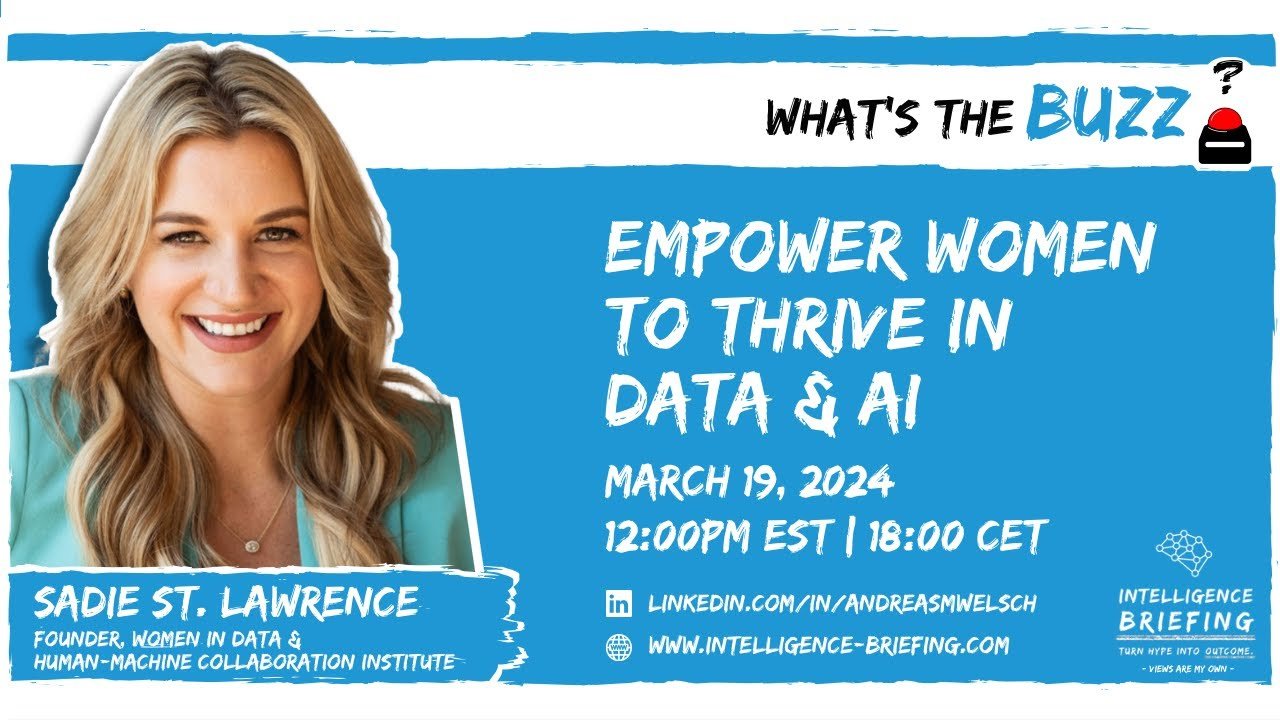
Guest: Sadie St. Lawrence, Founder, Women in Data & Human-Machine Collaboration Institute
Host: Andreas Welsch
Episode: What’s the BUZZ?, Season 3, Episode 9
Published: March 19, 2024
Episode Summary
Sadie St. Lawrence, who founded Women in Data in 2015, joins Andreas Welsch to answer how leaders can empower women to thrive in data and AI. Sadie describes the mid career drop-off she calls the 5-10 years of doom, when women are promoted later than men with the same experience and often take leave to have children. She explains why diverse teams matter for building AI that serves the whole population of users, and what companies can do about it, from paid family leave and pay gap audits to a strategic plan for diversity. The conversation also covers regional differences across the Women in Data chapters and simple ways leaders can create space for people in the minority group in meetings.
Key Takeaways
- Sadie places the biggest drop-off in the mid career stage, which she calls the 5-10 years of doom, when women are promoted into manager and director roles later than men with the same experience.
- Sadie argues that diversity in data and AI matters because the users of AI are the whole population, and diverse minds help build systems that are more flexible and better aligned with human intentions.
- Sadie names paid family leave, a pay gap analysis audited by a second company, and a review of policies, procedures and culture as first steps for companies.
- Sadie recommends treating diversity like a go to market strategy: build a strategic plan and an action plan, gather data and iterate on it.
- Sadie advises leaders to notice who is in the minority group in a meeting, ask those people to share their thoughts, reinforce them by listening and model the response.
Timestamps
- 00:25 Cold open: empowering women in data and AI
- 00:57 Sadie introduces her background and career path
- 02:16 Why Sadie started a women in data community
- 03:50 Audience shoutout and newsletter mention
- 04:06 Icebreaker game: if AI were a bird
- 05:44 Why we need more gender diversity in data and AI
- 09:31 What is holding women back in tech careers
- 12:48 Regional differences across global community chapters
- 14:29 Audience question on actions companies can take
- 16:06 How leaders can support women on their teams
- 18:13 Audience comment on the senior leadership gap
- 19:52 Goals for each level of diversity maturity
- 21:49 Other ways leaders can foster collaboration
- 25:04 Key takeaways for the audience
- 26:45 Wrap-up and thanks
About Sadie St. Lawrence
Sadie St. Lawrence is the Founder of Women in Data and the Human-Machine Collaboration Institute. She describes a path from piano performance and neuroscience into data science, with roles as a research analyst, analytics engineer, data scientist and data science team lead before moving into AI strategy.
She started Women in Data in 2015 to increase diversity in data careers. She describes the community as international, with representation in about 55 countries and over 60,000 members.
Full Transcript
Read the full transcript
Andreas Welsch: Today we’ll talk about how you can empower women in data and AI. And who better to talk about it than someone who’s doing just that, Sadie St. Lawrence. Hey Sadie, thank you so much for joining.
Sadie St. Lawrence: Thanks so much for having me here. It’s a pleasure to have this conversation with you and particularly to talk about it with Women’s History Month going on right now. So very timely conversation.
Andreas Welsch: Hey, why don’t you tell our audience a little bit about yourself, who you are and what you do?
Sadie St. Lawrence: Yeah, so like many people who have gotten into the data and AI industry, I had multiple lives before that. So my background is in piano performance and neuroscience. And you can probably see a few instruments still lingering around me of my past lives that try and sneak in a little bit here today. But I was working in a neuroscience lab and really wanted to get my PhD in the space of studying emotional learning memory. And one day I had trouble euthanizing a rodent and realized that maybe this wasn’t for me, as I think many of us have been in those pivotal moments in our careers. And so I went home and wrote on a piece of paper what I liked about my job and what I didn’t. What I found I liked was all of the analysis and science, and that led me to find the term data science. And so in 2014, I quit my job and started a master’s program in data science and just knew that I needed any job working with data to get more familiar. And so from there, I started as a research analyst and had many different roles in the data careers family. I worked as an analytics engineer and then a data scientist and led a data science team and then moved into AI strategy. And throughout that time, I started to notice something very interesting, which was leaving neuroscience was quite a diverse community. And my first year into the field, I looked around and said, something feels very off. And I realized that was because there are no women in this space, or very few in this space. And at that time, I said to myself, if I’m going to survive in this career, I’m going to need a community. But more importantly, this was 2014, 2015. The field was just starting to grow and blossom. And I said, if we don’t do something now, the prospects of where we’ll be in another 10 years is very bleak. And so I started Women in Data in 2015 with the mission to increase diversity in data careers. And we have been doing that ever since.
Andreas Welsch: That’s awesome. How many members do you have in the community?
Sadie St. Lawrence: We are an international community. We have representation in about 55 countries across the globe in a community of over 60,000 people. So last year I had the opportunity to go and visit different chapters across the globe, and I will say one thing that I learned is the language of data and AI is a common language. And I think it’s a really beautiful thing that allows us to break down borders and get united behind a common mission and goal.
Andreas Welsch: That’s wonderful. I’m so excited. You’re not only championing the cause, but I’ve seen that there’s a need, and I think it’s still a need today. So I’m excited to have you on and have this conversation with you today. Sadie, should we play a little game to kick things off? What do you say?
Sadie St. Lawrence: Yes, I love some fun games.
Andreas Welsch: All right. So this one’s called In Your Own Words. When I hit the buzzer, the wheels will start spinning. And when they stop, you’ll see a sentence. I would love for you to answer with the first thing that comes to mind and why, in your own words. And to make it a little more interesting, you only have 60 seconds for your answer.
Sadie St. Lawrence: Okay. Sounds good.
Andreas Welsch: Are you ready for What’s the BUZZ?
Sadie St. Lawrence: Yeah, let’s do this.
Andreas Welsch: Awesome. So here we go. If AI were a bird, what would it be? 60 seconds on the clock.
Sadie St. Lawrence: The first thing that comes to mind is a parrot. It takes the data of us as humans and repeats what we say, but also comes up with its own interesting words and ways of saying it as well.
Andreas Welsch: Wonderful. And well within time. And sometimes the responses you get, especially these days with Gen AI, are usually pretty spot on and trained and rehearsed, but sometimes they might be completely off as well, like that little parrot too. Wonderful. But if we jump more to the questions that we talked about before, and by the way, for you in the audience, if you have any questions for Sadie, please pop them in the chat as well, and we’ll take a look in a couple of minutes. And take some of them too. You already said that, as far back as 10 years ago where we’re seeing this, I think we’re still seeing a good amount of that today, where the tech industry actually has a reputation for being pretty bad when it comes to diversity. And so I’m wondering from your perspective, why do we need more gender diversity in data and AI?
Sadie St. Lawrence: I think it’s even become more apparent over the past few years with the rise of Gen AI. And what I think that Gen AI really did was bring AI into the common knowledge. I’m sure so many of us who work in the space have calls from our parents who are like, what is this? Can you explain it to me? Our friends and family. And we were very excited because we said, oh my goodness, finally my friends and family have some idea maybe of what I do or at least are curious about what I do. And so if you think of how technology and particularly now data and AI has come and infiltrated in a way every one of our lives, that means that the users of this are the whole population. But when we look at who is building these tools or has the jobs and the economic prosperity from being able to work in this industry, you’re right, it does skew very male dominated. Particularly today, we’re at around 24 in the analytics space where we look at data science. It’s about 15%. Data engineering is about 10%. And then we go down as we look at machine learning and AI, and then obviously the leadership positions, we have roughly 3-5 of female representation. So depending on how you slice the coin there’s a lot of variability of how women are represented in the space, but why it’s so essential is one, what we’re building is applicable to the whole population. So we need the minds of everyone to come in and make sure that it’s inclusive and our products that we’re creating are welcoming to all the users that use it. But more importantly, we are creating in a way the mind of the future, the way that I think of it, a mind that we’re going to rely on quite heavily. And I think what makes our society and us as a human species able to thrive is our biodiversity. The diversity of who we are as humans, the diversity of even our plants and our species that we have. And so as we replicate intelligence in a machine, we want to make sure that diversity is present as well, because it’s going to allow for more flexible systems. It’s going to allow for the AI to be better aligned with human intentions and what we want to see out of it. And not only is it from the standpoint of the end users, but also from making sure that we have diverse minds working on the problem, but also for the long term sustainability. We know that anytime one dominant species takes over in a population, pretty much everyone dies around it. And so we need that biodiversity to be able to survive. And I think we need that thought diversity in artificial intelligence and data to be able to not just survive, but to also thrive as we continue to move forward in this space.
Andreas Welsch: Thank you for sharing that. I think that’s really important to look at it from that perspective too. Because like you said, we are building things that not only serve the population that is working on AI, but that will be used by everyone. Now, I’m curious, going down the path of where we’re not there yet, that there’s a true balance or parity, if you will. What do you see as holding women back in tech careers today, or maybe even the question is who is holding women back in tech careers today? What are you seeing?
Sadie St. Lawrence: When I came into Women in Data, I definitely came in with a mindset from I’m a scientist and I love to solve problems, and so this has been probably one of the hardest problems I’ve ever worked on because it’s what I would call a multi dimensional problem. So there are many factors that are involved in it. But the easiest way to look at it and break it down is people often talk about the pipeline of women getting into the space, and while that is essential of making sure that we have exposure and awareness to young individuals, to know that this is even a career option for them, we’re starting to make some really good progress on that. So where we see women tend to skew in tech roles is really at that individual contributor and that one to five years of experience. And so we need to keep continuing to push forward and providing that exposure and awareness to young girls and let them know of the job opportunities. But where I think that we need to start focusing a little bit more of our attention is in that mid career space, because we see a complete fallout, particularly when we look at the leadership positions, and we know that we have a problem within the mid career. What I call this is the 5-10 years of doom. And it’s essentially when women should be promoted into manager or what’s most important is the director position. And this came from some great research from McKinsey, that women are getting promoted later than men who have the same standing and stats and same level of experience. In addition to that, often at that same time is when women will take a little bit of leave to be able to have children. And so coming back into the industry when you already now are potentially behind from your male counterpart, and you’ve had to take some time off, will leave them in a place where maybe they stop pursuing those additional leadership roles, or will look for other career opportunities. And so what we are dealing with right now is what I would call a really leaky pipeline where while we’re bringing women in, we do not have the support systems with paid family leave, leadership training and coaching and promotion into those leadership programs as fast as we should, which is allowing us to not make much progress overall. And this is really key because particularly at the mid career in the leadership position, this is what also supports those younger individuals as well by one seeing representation of women in this space and by also having those mentors and having that support as well. So for me, it’s really essential that we start to address that mid career problem and I think we’ll start to see a lot of change in this space.
Andreas Welsch: I’m curious, building on that, what regional differences do you see when you go on a world tour when you talk to different chapters? Is it a predominantly US centric phenomenon or situation or is it more European or is it in other parts of the world? And is it similar or what are you seeing in terms of patterns maybe?
Sadie St. Lawrence: Great question. Data and AI is a common language. The one thing that I notice that is very different from where each of us may live is the economics and the social standings and our ideology of women’s progress in each area. And so this differs greatly across the board. Anywhere from simple things of paid family leave being a guarantee in some European countries to not even being talked about in other countries. And so from a global perspective, it does vary greatly by country. But what I would say in particular is still we’re seeing that mid career pipeline is such an issue for multiple factors. One of the factors is just that women are the only ones that can have children. I know they’re trying to come up with some technology to have wombs that are technology driven and can open it up. We’ll see where the world goes in the next five to 10 years. But I think it’s important to recognize also just the key differences that we have and make sure that we have the right policies from our society as a whole to be able to support women in that place. And that varies greatly based on where you live.
Andreas Welsch: If I take a look at the chat, I see one question from Rudy, who’s asking what actions would you suggest for companies to undertake in order to achieve greater parity between genders?
Sadie St. Lawrence: Definitely paid family leave is first and foremost for individuals. I also think it’s really important to do a pay gap analysis and have a second company come in and audit your books and just see how you’re doing. If you’re listening to this call, you probably really love data and AI. And being able to get the data on that is really important to be able to take action. And then the other side of things is really looking at just your overall policy and procedures and culture and way of doing things. One of the things that we find is that women have maybe a different leadership style, and do you have the space for them to express that leadership style within your company? And so this takes a lot of introspection, I would say. It also takes a lot of trust to be able to start to have these conversations in your organization where people feel that they have the space to speak up, and that what they’re going to say is going to be heard and acted on.
Andreas Welsch: That’s great feedback. Perfect. Thank you for sharing that. I’m wondering if you’re a leader of a data team, of a data science team, of an AI team, and you have female team members on your team, what are some things that you recommend that leaders should be looking at to help prepare them either for that step in their career, to give opportunities, to give visibility? What are some recommendations that you have there for leaders?
Sadie St. Lawrence: First and foremost, I always tell individuals to support those that you currently have, and then create that space to make sure that you are taking the time to say, hey, we’re going to actually create a strategic plan and an action plan to be able to increase the diversity in this space. We are all very sophisticated, strategic thinkers, business owners, executives. If we start to treat diversity in data and AI the same way we treat our go to market strategies, our marketing plans, our product execution, we will start to see results in this space because we’ll be able to take that iterative process, be able to gather data, be able to learn from it and be able to start to move forward in the right direction.
Andreas Welsch: Wonderful. I see another good comment in the chat here that I want to read out loud. The person says, hey, there’s also a second gap. When we look at women moving up and moving into leadership roles, that gap is between senior mid level management and full leadership C suite roles that need to be addressed. So the pipeline should be one that supports women from the bottom up, middle up, and top down. I think that’s really succinct and speaks to all the different levels, certainly where diverse representation, also female representation, is much, much needed.
Sadie St. Lawrence: Yes, I completely agree. And as I started off, this is a very multidimensional problem. And so we cannot take a single strategic approach to it. It has to be a specialized approach for different levels and different individuals, and I think it also has to be a custom approach based on your organization as well. Everyone is starting out at a different place. Speaking from the data and AI industry, we know the four levels of your AI journey or analytics maturity. We also need to think about that from a diversity perspective too, and have that introspection to know where am I starting? Because I’m probably not going to jump from level one to level four immediately, but I can get there if I take the small steps and have a strategic plan to be able to achieve that.
Andreas Welsch: What do you see are some good goals on that path moving from one level to the next, if you will, in terms of maturity or in terms of providing these opportunities?
Sadie St. Lawrence: I think level one is really that first introspection of what am I doing to support the women or to support diverse communities that I currently have. From there, that is going to help you a lot to determine what you need to do next, because if you’re leaning into having the space to listen and learn from those, they will tell you what that next step is you need to do. Maybe you’re missing the paid family leave. Maybe you’re hearing from your employees at that level one that they don’t feel like there’s enough support in terms of promotion and moving to leadership position. I think that the second level really comes down to taking what you learn from your current environment and starting to implement some of those policies and procedures. And then on the top tier, it’s not only are we able to, in a way, put our mask on first, take care of our own people, make policy and procedure changes to create a more inclusive environment. But now we’re also able to do that and reach outside of our own internal organization to the outside world. We’re able to support additional communities. We’re able to share insights on how to move women into leadership. We’re able to do case studies and reports. So I think it comes from that internal locus of control to slowly expanding to that outside locus of control.
Andreas Welsch: Thank you for saying that. I think that was very well articulated, the different stages and how you can measure it and what you can do in between. I think that’s awesome. It makes it very actionable and very tangible. Thank you. Now, there are certainly opportunities for one as a leader to foster collaboration, bring in more diverse thoughts. We obviously talk about women in data. But aside from collaborating across different backgrounds and different genders, what are some other ways that leaders can help facilitate collaboration within a company?
Sadie St. Lawrence: Some simple ways are just to make sure that people have the space to speak up in meetings. One of the things that we’ve learned from the research is that there’s a distinct classification of how you speak up if you’re part of an in group or out group. And all that the in group or out group means is, are you part of the majority or are you part of the minority? What we find is that if you’re part of the out group, the minority group, then you’re more likely to hold your thoughts back. You’re more likely to not speak up. You’re more likely to take a passive role. Which is the exact opposite of what we want. We want particularly everyone bringing their diverse thoughts to the table. And so I think it’s important for leaders of organizations to be not only an ally, but also a sponsor and an advocate. To make sure that they’re particularly asking that individual who’s in the minority group to share their thoughts, to reinforce them with listening, and to also model the behavior of what that response is. And so I think that’s a really simple way that individuals can just start today. We all probably have meetings today. We all can easily identify what is the majority group or the minority group. Just last night I was at a tech networking event, and I just took a second to look around and I’m like, there are more men in here wearing plaid blazers than there are women in this room. And the majority group was the plaid blazer group. First of all guys, you can wear something besides the plaid blazer. There are lots of options. I like the sparkle that you have going on. It’s great. But it doesn’t take long to just look around, and we are all women amazing at data to classify and put into buckets. Whatever is the minority group, make sure that those are the ones you’re addressing. Those are the ones you’re creating space for, and those are the ones you’re providing the opportunity for, not just the ones who come and speak up and go after that opportunity because they are the ones who already feel empowered to do that.
Andreas Welsch: That’s really great advice. I think again, especially because each and every one of us can take that into our next meeting, into our next conversation and can apply it. And it also starts with each and every one of us. That’s not just a magical plan in a bunch of check boxes until you reach that goal, but it really comes from within and from all of us. So thank you for sharing that it’s about modeling that behavior. Now we’re getting close to the end of the show and Sadie, I was wondering if you can summarize the top three takeaways for our audience today before we wrap up?
Sadie St. Lawrence: I would say number one, that diversity in data and AI is everyone’s responsibility. And we all have a role to play, from an executive position of not only modeling that behavior, but really looking at what is the culture, what are the policies you have in place? And what is the environment that you are looking to build all the way from the individual contributor role, whether you are in the minority group or the majority group. If you’re in the minority group, it’s time to speak out and to be heard, and you should feel empowered to do that. But if you’re in the majority group, we need people who are those allies, who are those sponsors as well. And then I think the last thing is just that it’s more critical for us now than ever to make sure we’re looking at who is building it and who is the mind behind what I would call the machine. This is something that is going to have a profound impact on all of our lives. It already is. And so make sure that we are taking the time to be thoughtful in this process, to create the space, to create the culture and the environment where really all can thrive, because we all need the biodiversity of one another to make sure that we move forward in a manner that is productive for all society.
Andreas Welsch: That sums it up really well. What a wonderful package and ending. Thank you so much, Sadie. Also thank you for joining us and for sharing your expertise with us today. And we appreciate it.
Sadie St. Lawrence: My pleasure. And thank you for having this conversation and creating the space. And I look forward to connecting with everybody who’s joined today. And if I can be of any help, definitely reach out anytime.
Listen and Subscribe
Related Reading
Frequently Asked Questions
Why does gender diversity matter in data and AI?
Sadie says the users of data and AI are the whole population, so the people building these tools need to reflect it. She adds that diversity makes systems more flexible and helps AI align better with human intentions.
Where do women drop out of tech careers?
Sadie points to the mid career stage, which she calls the 5-10 years of doom. Women are promoted into manager and director roles later than men with the same experience, and many take leave to have children, which leaves some of them behind and less likely to pursue leadership roles.
What can companies do to close the gender gap in data and AI?
Sadie names paid family leave, a pay gap analysis with a second company auditing the books, and a review of policies, procedures and culture. She also recommends a strategic plan and action plan for diversity, treated like a go to market strategy.
How can leaders help people in the minority group speak up?
Sadie says people in the out group, the minority group, are more likely to hold their thoughts back. Leaders can act as ally, sponsor and advocate by asking those individuals to share their thoughts, reinforcing them with listening and modeling the response.