

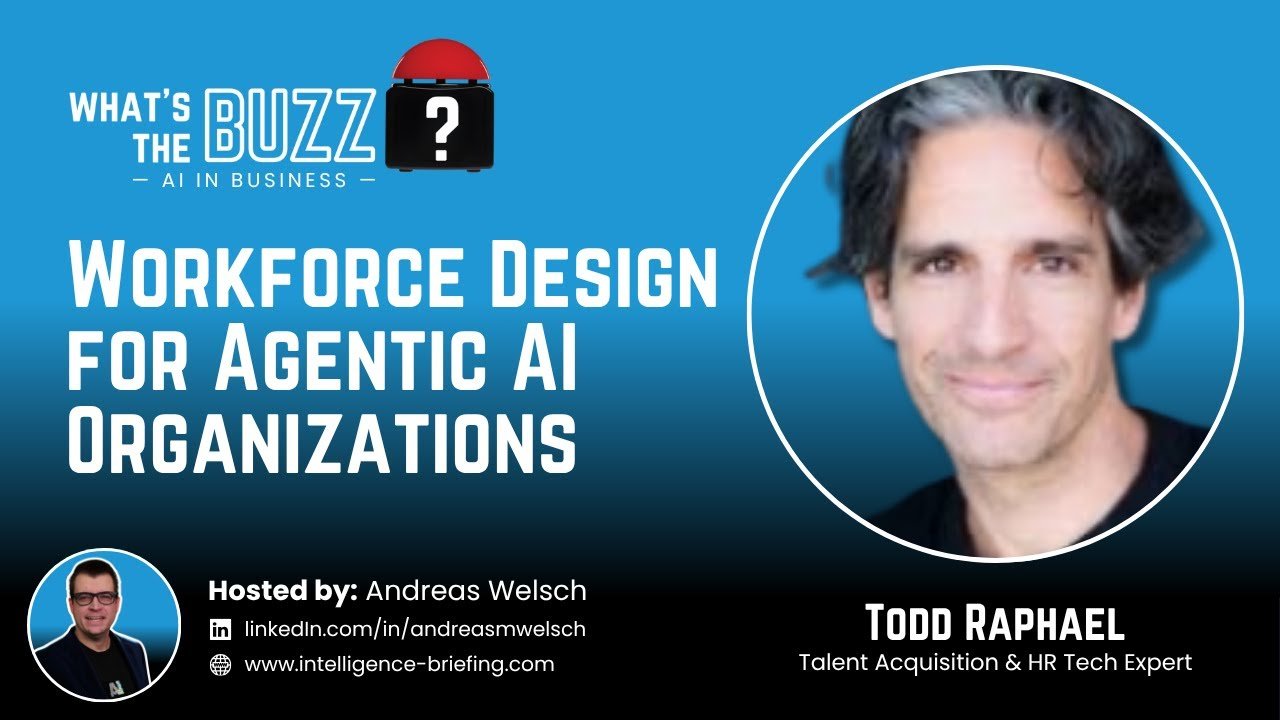
Guest: Todd Raphael, Talent Acquisition & HR Expert
Host: Andreas Welsch
Episode: What’s the BUZZ?, Season 4, Episode 27
Published: December 2, 2025
Episode Summary
Todd Raphael, a talent acquisition and HR expert, joins Andreas Welsch to answer how HR and business leaders should design the workforce for agentic AI. Todd observes that conference demos show how to build an agent but not how it fits into a working day or how to check it months later. He explains why job descriptions and task lists miss intangible work such as relationships and institutional knowledge, which companies often discover only after people leave. He expects hierarchical org charts to matter less as knowledge, experience and connections gain value, and he argues that HR leaders should have a seat in agent decisions because they see the whole employee life cycle.
Key Takeaways
- Todd says the agent demos he saw at conferences covered building an agent but not how it fits into a daily workflow, or how a company knows six months later whether it is biased or accurate.
- He says job descriptions and task lists miss intangible work, such as customer relationships and institutional knowledge, and that companies often learn what someone did only after that person leaves.
- Todd expects the hierarchical org chart to matter less as value shifts to knowledge, experience and connections, and he compares the future to a sports team in which the individual contributors carry the value.
- He argues that HR leaders see the full employee life cycle and hold data, such as how recruiting connects to retention, that makes them well placed to join agent decisions led by IT.
- Andreas notes that businesses often treat agents as a cost exercise and overlook enablement, where the same people become more productive with better tools.
Timestamps
- 00:14 Cold open on agents and workforce design
- 00:48 Welcome and episode theme
- 01:04 Todd on his HR tech background
- 03:48 What happens after agents are built
- 05:59 Managing agents like employees, with codes of conduct
- 07:36 Hidden work missing from job descriptions
- 10:50 Cost cutting versus multiplying your people
- 12:28 What the org chart looks like with agents
- 15:27 Gaining experience while offloading work to AI
- 17:21 Flatter hierarchies and the future of managers
- 20:37 Disney study on the intangible value of jobs
- 23:35 How HR leaders get a seat at the table
- 27:22 Key takeaways
- 29:35 Thanks and wrap-up
About Todd Raphael
Todd Raphael is a talent acquisition and HR expert. In the episode he says he spent more than two decades on conferences and publications for recruiters and HR professionals, then worked at the HR technology companies Eightfold and SkyHive. He now helps HR technology, talent acquisition technology and staffing companies differentiate themselves and communicate what they do.
Full Transcript
Read the full transcript
Andreas Welsch: Hey, it’s the end of 2025 and things are getting real. What actually changes when you bring agents into a business? How do teams need to be set up, and what do HR and business leaders need to get? We’ll talk about all that. So let’s jump right in.
Andreas Welsch: Welcome to What’s the BUZZ?, where leaders share how they have turned hype into outcome. Today, we’ll talk about how to design your workforce for agentic AI, and who better to talk about it than someone who’s actively working in this space: Todd Raphael. Todd, thank you so much for joining.
Todd Raphael: Thanks for having me.
Andreas Welsch: Hey, Todd. Maybe not everybody in the audience is familiar with you or has come across your content. I certainly have, and I’ve been a big fan of the things that you put out for a long time. Why don’t you tell us a little bit about yourself, who you are and what you do?
Todd Raphael: No problem. I spent more than a couple of decades at a couple of organizations, Cranes and then ERE, on conferences and publications for recruiters, HR professionals and others. Then I went to an HR technology company called Eightfold fairly early on and helped grow that marketing department, and grow the organization dramatically over three years. Then I was recruited to go to a competing organization called SkyHive, which sold to Cornerstone OnDemand about a couple of years ago.
Todd Raphael: Over the last couple of years I’ve been helping HR tech companies, talent acquisition technology companies and related companies, staffing companies and so on, figure out how to differentiate themselves, how to communicate what they do, how to explain what they do, create content, work with influencers and that kind of thing. Help them figure themselves out and find themselves and communicate who they are.
Andreas Welsch: Thank you for sharing. I feel a lot of times marketing gets a bit of a bad reputation, and I’ve previously been in marketing myself in my career. But I feel you also get a very good grasp on what’s actually happening in the market. What are different vendors doing, what do buyers actually look for, which is why I’m so excited to have you on the show and learn from your perspective on what you’re seeing.
Andreas Welsch: Todd, it’s the end of 2025. It feels like we’ve talked about AI agents as an industry for, I don’t know, a year or so. It feels like it’s already been a decade in AI years. And it feels like now we’re really at the point where we’re seeing more and more organizations, more and more leaders, more and more HR leaders also come to the table and say, what do we do? We’re spinning up individual proofs of concept and pilots, and we’re working with different vendors to try things out, and I think that’s great. Finally we’re moving towards action. But when I talk to leaders, and when I attend vendor conferences, and it’s probably similar for you as well, it seems that everybody just talks about the building part of agents, and there’s not a lot of talk about what actually happens afterward.
Andreas Welsch: What happens when you bring them to the organization? What happens when they are in production? I’m curious, with all this talk about how your human employees now get agent employees, do we need to draw parallels to how we manage humans as well? Can we apply some of that to agents? What are you seeing?
Todd Raphael: I’ve been to a bunch of conferences these last couple of years, including two recently. There were all kinds of booths having to do with agents and buying agents. At one of them you get to build your own agent right at the booth on a little iPad, and after five minutes you’re done, you’ve got your agent. But there was not a whole lot of explanation of exactly what your day looks like. How does this agent work in your workflow? You get up, you have a job, you find out someone quit, so you have an open job. How do you fill that job using an agent? What do you do? Step A, step B, step C, step D and E. Where is the agent fitting in, and what do they do and what do they not do?
Todd Raphael: And then once that agent’s part of your workflow, your hiring process, what do you do then? How do you know in six months if it’s biased, or how do you know if it’s accurate? It may be perfectly fair but not very accurate. It may not be an improvement over how things were without an agent, or maybe there’s some personalization with the agent that’s no longer working very effectively. Those are, I think, open questions, but certainly there’s not a lot of information about how you spend a day or a week or a month with agents. How does that work in your work life, your job?
Andreas Welsch: I’ve been creating some courses with LinkedIn Learning on the topic of what happens when you bring agents to business, and some of them came out at the end of last year, so very early in the wave. I’m sure things have been evolving, especially as you and your businesses are thinking about this too. My recommendation would be to think about how we use these things once they’re in our business. And I feel with all that focus on building, to your point, there’s not enough conversation about what happens afterwards.
Andreas Welsch: That opens many parallels, in my point of view, to how we work with people. Depending on the role or the company that we run, we want to make sure of background checks, that you are who you say you are. Permissions for your role: you get certain permissions to certain systems, but not more extensive than what you really need. Guidelines. Codes of conduct: I want you to behave in a certain way. I’m thinking about what if technology teams build agents in every different department, or every user builds it slightly differently. Do we need to ground them in some sort of code of conduct, for example? What do you think?
Todd Raphael: A lot of companies I work with are working on talent intelligence or skills intelligence, and they’re taking AI and they’re taking jobs and trying to figure out what tasks and skills are involved in each job. By breaking a job up into tasks and skills, you can help predict the future. You can say, oh, this job, half of it may no longer be necessary to be done by a human, or these two jobs could be melded together into one human in the future. So that’s good. That’s a great, interesting and useful thing.
Todd Raphael: However, the one thing that I think is missing is that a lot of things that humans do don’t show up on a job description or on a list of tasks. They’re not always even apparent. I’ve had the experience, and I’m sure most of our listeners have had this experience, I’m sure you have, where someone leaves and you don’t realize what they were doing until they’re gone. One recent company I worked at eliminated about 35% of the people there, and there was a lot of chatter among those of us who were remaining. We would say to each other, did they know what some of these people were doing? Over the subsequent weeks we found out, no. The company was shocked to find out, each time something would happen, that it was a task done by someone who’s no longer there. Why is that happening? Because it’s very abstract. It’s very intangible. A customer likes an employee a lot, the customer service person, and that doesn’t really show up anywhere.
Todd Raphael: A customer hears Andreas or Todd on a podcast, or a prospective customer does, and becomes the customer. That happened to me at Eightfold. Someone from the military, the Army, heard me on a webinar and contacted me, and I got them in touch with sales folks. Eightfold ended up getting this big contract, called Gig Eagle, for technology that helps find work for Army reservists. These are things that are not always on a job description or a list of tasks. They’re these intangible things that happen over time, where someone takes on things that are human-to-human relationships that are very hard to quantify. I would think that’s a very important thing to consider as you’re breaking down jobs and people into tasks and roles using AI.
Andreas Welsch: I think that’s a really important reminder. In this climate, when you see layoffs and restructuring left and right in many different industries, and tech is certainly leading from what I’m seeing, you do get the feeling that it’s numbers on a balance sheet in some cases. But there’s a lot more, to your point, than the sum of tasks or line items in a job description. Bob and Jane and Sarah do a lot more than these five or 10 bullets here.
Todd Raphael: Think about someone getting their hair done. Could a robot eventually cut someone’s hair? I’m sure. Is that really why someone gets their hair done? Probably not. They do it to talk, to gossip, to pour out their feelings, whatever. Some senior citizens get their hair done every week or every three weeks to get out of a senior citizen home and take a little field trip. It’s something they look forward to. In that example, it’s unlikely that’s on the job description of the person. Yes, there are many other jobs where the human contact is much less important.
Andreas Welsch: A couple of weeks ago I was on a podcast hosted by a successful CEO of a midsize business, and we were talking about agents as well. I said, we’re looking at this right now in business a lot of times as a cost exercise: can I take out cost, move out people, we no longer need them, we have agents that can do the work. But what I feel we’re missing a lot of times is this enablement, this multiplication type aspect. What if we had the same number of people, but with the help of technology they became more productive or more efficient, or they had 10 times better insights and could help us grow the business faster, because they know our industry, they know our customers, they know our products? Why is nobody thinking about that?
Andreas Welsch: The answer that I got really surprised me, because he said, if I don’t need more people, why should I hire them? I don’t hire more than I need. And I said, that’s not the point. The point is, you have people in your business, you’ve already invested in them, so why not give them better tools and better technology to help them be more successful and help your company be more successful? It still baffles me that a lot of times this is the prevailing mindset.
Todd Raphael: Yeah.
Andreas Welsch: We’ve already talked about a few gaps, I would say, in this vision of agents that we see right now. Another one that I’m seeing is that there’s not really an org chart. If we compare agents and humans, or digital workers and human workers, in our human world we have an org chart. We know who reports to whom. We know what the roles and the job functions are, we know what the job descriptions are. And yes, there are even more tasks between the lines that employees do. But for agents, in theory, anyone can spin up their agent or their team of agents. So what do you feel the org chart looks like, or is going to look like, as organizations bring more agents into their business?
Todd Raphael: Short answer: I don’t know. As Peter Capelli, a USC professor I talked to recently, reminded me, every prediction about business is almost always wrong, because you just don’t know what’s going to happen in the future. He gave an example of when people predicted that truck drivers would be obsolete, and we’ve already passed the date. But if I had to predict, which I will: when we think about an org chart, most of us would visualize boxes and lines, like a pyramid, like a hierarchy. I don’t know if that hierarchy really is going to make sense anymore, because what we’re hearing, or what’s been talked about, is that in this new AI world people’s knowledge, their experience, their insight and their connections, those four things I think I listed, are going to be super important.
Todd Raphael: In the current or old world it was how many people you manage. If you manage some people, you can get a raise, and then you can manage some more people with a higher title, then maybe some more people with a lofty title, then you get another raise, and somehow you’re more important because you’ve managed people. What I’m hearing and reading is that your importance is partly going to be based on your knowledge, your experience, your network, your connections, your understanding of an industry and the company. That is not necessarily about how many people you manage or with what titles, which tells me that maybe the hierarchical boxes-and-lines org chart will not be as valuable.
Todd Raphael: Maybe it’ll be more like a sports team, where the manager, the coach in the dugout or on the sidelines, in the case of basketball or football, is not necessarily the highest paid, or the most famous or the most valuable. It’s the individual contributors, the players with their skills and their knowledge. In the case of sports it would be skills, but in the case of corporate life it might be your knowledge and your connections that make you more valuable than, say, a manager perhaps.
Andreas Welsch: A couple of different thoughts are running through my mind as I’m listening to you say this. One is, I wonder how you acquire that knowledge when, as an individual, you maybe do a bit more of that cognitive offloading, relying on AI more and more, and maybe a little too much. How do you gain experience? How do you become more experienced in your role? And eventually, even if it’s a flatter hierarchy, how do you have opportunities and get opportunities to advance when you work with AI as a co-thinker or as a co-pilot? That’s one. A couple more, but.
Todd Raphael: I imagine it might depend on the industry. If you were an expert in medicine or restaurants or retail or whatever it might be, and you came from some background, whether as a nurse or a physician or a consultant or a retail store manager, and you took on a job at some company, your background might vary. But the key here is that you have a network, you have connections, and you have knowledge, you have expertise. You understand the field, the challenges of it, and that kind of stuff. It’s not so much that you are coming to the company to manage a certain number of people with a certain title or anything like that. It’s what’s in your head that’s harder to offload to a computer.
Andreas Welsch: What I think I’m hearing is that, despite all of that technological support at our fingertips and at our availability, prioritize the human connection, prioritize the real-world experiences, because you can take those from task to task, from job to job, and eventually from company to company too. That’s what makes you valuable: your knowledge, your unique combination of skills and network.
Todd Raphael: Yeah.
Andreas Welsch: One thing I’m wondering too: I used to be a manager. At one point I was managing managers who were managing teams. When I read about flatter hierarchies, I put myself back into those shoes from a couple of years ago, and I’d be pretty afraid. I’ve worked so hard to claw my way up the org chart and the hierarchy to get to this position, mid-level, senior-level leadership, and now you’re telling me the company no longer needs me because there are fewer people who manage more agents. Where is that going? Especially when we talk about org charts and flatter hierarchies, is that the reality that you see, that leaders need to warm up to or get more comfortable with?
Todd Raphael: Yes. I see a lot of people out there who are valuable because of their connections, valuable because on social media or in the media or otherwise they can have an influence. I see a lot of individual contributors with a lot of powerful value that maybe is getting hidden because they’re not managing 14 people. They don’t have a lofty title or whatever. But it’s those super connectors, those super knowledge folks, those hidden connectors, hidden sources of knowledge, hidden sources of institutional knowledge of an organization, who are so often underused, underpaid and underappreciated.
Andreas Welsch: It sounds like we need to shift again to impact, as opposed to just being there and doing the work that you’re assigned. What is the impact you’re actually having? Who are you influencing? What are you influencing? More on that side, when agents can take over some of the tasks that we’ve been doing.
Todd Raphael: And so often it’s off the radar screen. I got a note, I’d say it was a few months ago, from someone at Eightfold asking me a bunch of questions about some work that I was doing there that they were now assigned to. I haven’t been there since 2022. I left to go to SkyHive. I’ve been gone three years, and no one knew that I was doing this work that I had taken on out of my own interest. That’s a very tangible example, but there are a lot of relationships and other kinds of things that just fly under the radar, that are very hard to quantify and put your finger on until someone leaves.
Andreas Welsch: It reminds me of some of the things I remember from when I was in corporate. Things that I had done or put in place or put in practice 10 years earlier were still being used by the time I was leaving, with little updates or a little maintenance, even though other people were taking it over. It’s a good point.
Todd Raphael: Just a reminder of this story, and if you’ve been to a lot of human resources, talent and workforce conferences, you’ve heard this story and it’s probably getting really old, and if you haven’t been, it’s probably interesting. I’ve heard this story a few times, but Disney, the company, did this study. They decided they could only put so many eggs in one basket as far as hiring and managing people. Not every single person in the company is the most important person in the company, by definition. So they set out to figure out what the most important jobs in this company are, the ones we really need to focus on, where a slightly better employee is going to make so much difference compared with a slightly worse one, as opposed to jobs where it doesn’t make a ton of difference if someone is a little better or worse at something.
Todd Raphael: Is it the animators? Is it the people who check safety on amusement park rides? Is it an actor? Although I guess that was a bad example, because the safety checkers are probably important. Who can deny that? But anyhow, they came out with the people at Disneyland or Disney World who are dressed as Mickey Mouse or Goofy. The reason they came out with that being the most important job is that those people are the ones who are most often asked: where’s the bathroom? Where’s the shortest line? When’s the sun going to go down on this ride? It’s too hot. Where can we get a water fountain? Customer experience is hugely everything. It’s going to make or break someone’s day, the bathroom, the lines, the water, and yet the person’s job is to dress up as Mickey and run around and do whatever you do as Mickey. It’s a really powerful example of how these things are intangible and offshoots of our regular day jobs.
Andreas Welsch: That’s a great example. I guess I haven’t been to enough HR conferences yet. My assumption was that it’s the experience: you wouldn’t want to have Mickey or Pluto or any of the other characters be in a bad mood, and that’s why it’s important. But certainly the tangible things, where can I get water, matter. Absolutely.
Andreas Welsch: Now, to me it feels like the industry has to stick with the amusement park example, riding the rollercoaster of the AI hype and the agentic AI hype. We’ve quickly accelerated to the peak, where I think we are right now, just before the peak, over the last 12 months or so. But I also see that a lot of the conversation is driven by tech. You have vendors that whisper in your CIO’s ear, hey, come build here, build on my platform, or we’ve built something into our applications that you can use. A lot of times who I’m missing, and who I feel is not part of those conversations, is HR leaders. I think as an HR leader you don’t just need to be in the building. You need to actually have a seat at the table when these conversations are taking place.
Andreas Welsch: How do you recommend HR leaders get involved, when a lot of times it’s the IT or technology department leading these agentic AI initiatives? What do HR leaders need to do?
Todd Raphael: For one thing, in the future these may become one and the same, as has been talked about. You’re managing work. You’re not managing people, you’re not managing computers, you’re managing work. So it might be that in some companies IT and HR become highly intertwined. You’re managing work, whether a person does it or a computer does it or a combination of a person and a computer does it. One answer to your question would be that there may not be this distinction at some point in the future. But ultimately I think that human resources people may be able to see the big picture better than some other people, because they might be able to see the entire life cycle of a person. You know what I’m saying?
Todd Raphael: Let’s say that we are using artificial intelligence to hire people better based on their skills, not based on where they went to college or whether they even went to college. Let’s say they’re going to try to do that and use AI to find skilled people who maybe didn’t go to college, but make sure they particularly don’t ignore those who didn’t go to college. If that’s what is going on, the HR folks might be the ones who best understand how to look at the entire employee life cycle and say, okay, what kind of skills do we need? Not just for hiring, but once these people are on the staff, how might people be upskilled or reskilled? How do we keep these people from leaving? How do we design an organization that makes people really engaged and motivated? Because it’s a two-way street. You can find the best employee ever and they’re just going to lose interest if it’s a poor environment.
Todd Raphael: There are all kinds of aspects to the workplace, from soup to nuts, from start to finish, from identifying a candidate to the time they’re interviewed, assessed, selected, hired, motivated, managed, skilled, reskilled, moved into other jobs, taking on gigs, taking on mentors, in-house learning from a coach in-house. There are so many parts of that, and perhaps human resources folks are well situated to see that big picture. A bit of a long-winded answer, but they also are probably well situated to have data that show some of these things. They might be able to show how recruiting connects to retention. They might be able to say, hey, look, our data show that if you hire this person that you’re saying is great, that person is likely to leave in two and a half months. So let’s hire someone who would be a great employee, meaning they’re going to be great and want to stay. They might have that kind of data that someone else might not have at their disposal, because they might have a lot of workforce-related insights from their technology.
Andreas Welsch: Fantastic. That ties it together so nicely, especially mentioning all the different functions and processes that HR supports, all of them critical, from hire to retire, talent development, succession planning and everything. Wonderful. Todd, I’ve really been looking forward to our conversation. I’ve been looking for someone to have a conversation like this with in the HR space for quite some time, and it’s been a real challenge finding people who are knowledgeable and who have a perspective on this. So I’m super excited that we got to chat today.
Todd Raphael: Me too.
Andreas Welsch: Before we close it, I was wondering if you can summarize the key three takeaways for our audience from today. We covered a lot of ground over the last 25 minutes. What would you say are the key three things that our audience members should know?
Todd Raphael: Learn more about your people and what these true human qualities that they have truly are, not vagaries like empathy, but what they are truly doing for customers, or for bringing in customers, or other things that could be related to technology. What is it they’re doing that’s maybe not apparent, or not on the stat sheet or their job description? Really learn deeply about your people. Number two, use technology as best you can to help plan for the future, to see what computers can do in the future and what people can do in the future. How might we plan our workforce around that? Some jobs may be combined with other jobs. Some jobs can be partially automated. How will that change the job once it’s partially automated? So that is number two: use your workforce planning to think about the relationship between how AI is going to affect computers and people in the future.
Todd Raphael: And then, thinking on the spot here, so bear with me, number three is the two-way street, really the employee life cycle. It’s not something where you can take a sliver and say we’re going to hire people based on skills, not based on their pedigree. You need to look at the entire employee life cycle: hiring, learning, retention, turnover, reskilling, mentors, internal talent marketplaces, so people taking on gigs internally. Look at that entire marketplace and think about how AI can holistically change and improve everything you do with employees from soup to nuts.
Andreas Welsch: Beautiful. Thank you so much, Todd. Thanks for joining and for sharing your expertise with us. Like I said, it was a real pleasure having you on and learning from you, especially as this space is so nascent and emerging yet moving so quickly. I really appreciate having you on today.
Todd Raphael: Thanks.
Listen and Subscribe
- Listen to this episode on Buzzsprout
- Watch this episode on YouTube
- All episodes of What’s the BUZZ? on Buzzsprout
Related Reading
- Agentic AI for Enterprise Leaders
- The HUMAN Agentic AI Edge
- AI Team Integration: Practical Rules for Leaders
- AI and Entry-Level Jobs: Protecting the Talent Bench
- Agentic AI: Scaling, Governance and Workforce Adoption
Frequently Asked Questions
Why do job descriptions miss part of what employees contribute?
Todd Raphael says a lot of what people do never shows up on a job description or a list of tasks, such as customer relationships, goodwill and institutional knowledge. He describes a company that cut about 35% of its staff and then found, one incident at a time, tasks that only departed employees had been doing. In his view that matters when companies break jobs into tasks and skills with AI.
What might the org chart look like when companies add AI agents?
Todd says he does not know, because predictions about business are usually wrong. He does expect that boxes and lines based on how many people someone manages may matter less, while knowledge, experience, insight and connections matter more. He compares it to a sports team, where the individual contributors carry much of the value, and he sees many hidden connectors and knowledge holders who are underused and underpaid today.
Why should HR leaders have a seat in decisions about AI agents?
Todd Raphael says HR leaders can see the entire employee life cycle, from identifying a candidate through hiring, motivation, reskilling and retention, and they hold workforce data that others lack. He gives the example of data showing that a candidate who looks great is likely to leave within two and a half months. He also suggests that IT and HR may eventually converge, because both manage work whether a person or a computer does it.
What should leaders ask once an AI agent is part of a workflow?
Todd says the conference demos he saw explained how to build an agent but not how it fits into a daily workflow. He suggests leaders ask what the agent does and does not do at each step, and how they will know six months later whether it is biased, accurate or still working well. Andreas adds that leaders can borrow human practices such as permissions that match the role, guidelines and codes of conduct.