

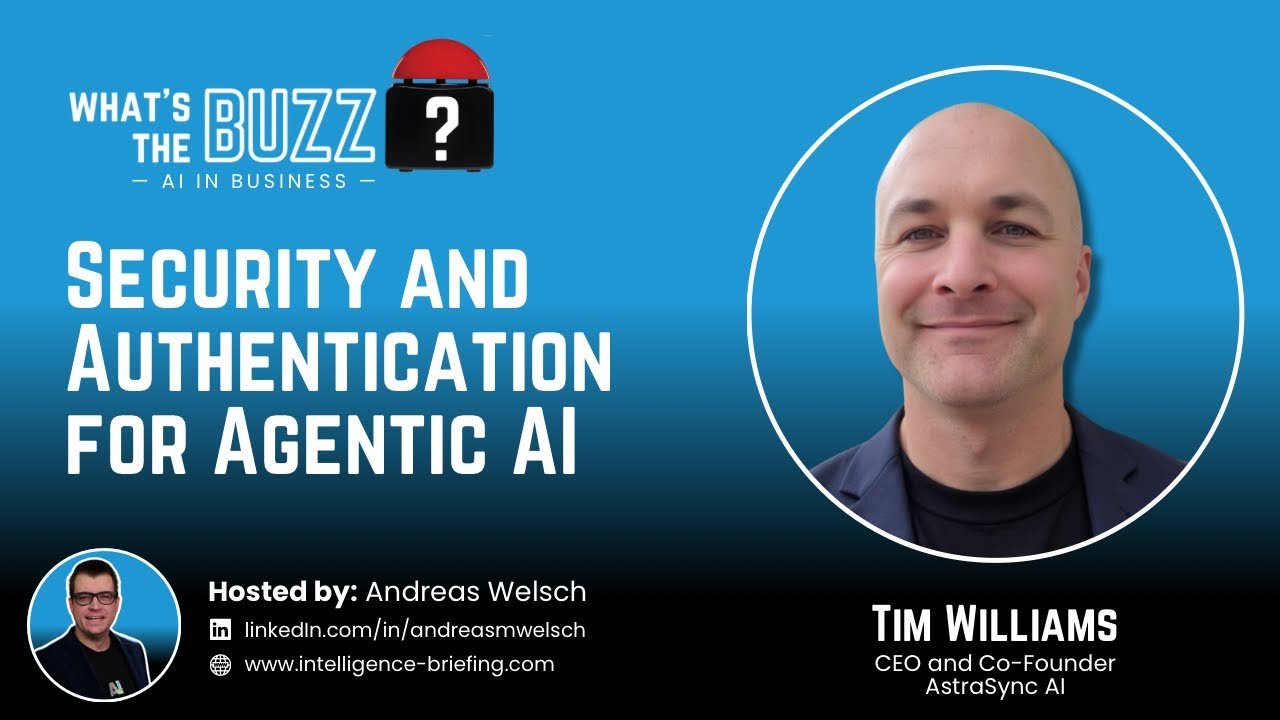
Guest: Tim Williams, CEO and Co-Founder of AstraSync AI
Host: Andreas Welsch
Episode: What’s the BUZZ?, Season 4, Episode 26
Published: September 16, 2025
Episode Summary
Tim Williams, CEO and Co-Founder of AstraSync AI, joins Andreas Welsch to answer how businesses can authenticate and secure AI agents. Tim explains why agents differ from human actors in scale, speed and audit trail, and why handing them usernames, passwords or persistent tokens falls short. He describes trust as a sliding scale, similar to a credit score, that ties each agent to a unique identity and an accountable person, with approval checked per transaction. He argues that the infrastructure for agents has to be built in parallel with the agents, and he gives leaders two pieces of advice: start from a clear business strategy and put observability and controls around the AI in the business.
Key Takeaways
- Tim says agents differ from human actors: they can run around the clock, make thousands of decisions a minute, spawn further agents and, in reported incidents, delete their own audit trails.
- He argues that giving agents usernames, passwords, private keys or persistent OAuth tokens is not enough, and he points to the Drift AI breach, which he says compromised 700 organizations through persistent tokens.
- Tim describes trust in an agent as a sliding scale rather than a yes or no, tied to a unique identity and the person accountable for the agent, and checked per transaction instead of granted as persistent access.
- He says companies should build agent infrastructure in parallel with the agents, instead of waiting for agents to operate at scale first.
- Tim advises leaders to start from a clear five-year business strategy that treats AI as a growth play, and then to set up observability and controls for every AI agent they let into the business.
Timestamps
- 00:17 Cold open on agent security and authentication
- 00:42 Welcome and episode theme
- 00:58 Tim on his background in AI
- 02:34 The risks behind the agent hype
- 03:56 Agents outnumber humans 45 to 1
- 06:07 Good agent versus rogue agent analogy
- 07:29 Authenticating agents and keeping them within limits
- 09:24 Trust scores as a sliding scale
- 11:48 Transaction-level risk checks for agents
- 14:00 Agents deceiving users and verifying identity
- 16:25 How Tim uses agents in his own company
- 18:04 Building roads and cars in parallel
- 21:04 Opportunities in agent security
- 24:01 Key advice for leaders bringing in agents
- 26:26 Thanks and wrap-up
About Tim Williams
Tim Williams is CEO and Co-Founder of AstraSync AI. In the episode he says he spent 25 years in corporate life applying AI to go-to-market work, from predicting customer churn to next best action guidance for sales teams. About a year before the recording he went out on his own to help Australian businesses make sense of agentic AI, and earlier that year he became focused on identity and security for AI agents.
Full Transcript
Read the full transcript
Andreas Welsch: Today we’ll talk about security and authentication for agentic AI, and who better to talk about it than someone who’s actively working on that: Tim Williams. Tim, thanks for joining.
Tim Williams: Thanks for having me, Andreas. Awesome.
Andreas Welsch: Why don’t you tell us a little bit about yourself, who you are and what you do.
Tim Williams: Sure. I’ve spent 25 years in corporate life basically trying to make AI make money for organizations. Largely on the go-to-market side of businesses, using things like predictive algorithmic modeling 20 years ago to predict customers that were going to churn, through to optimizing workflows through voice channels, live chat, chatbots, those sorts of things, right through to next best action guidance for sales teams and AI-driven marketing strategies through CRM and lifecycle marketing teams.
Tim Williams: I went out on my own about a year ago to try and help Australian businesses make sense of how to capitalize on agentic AI and take that forward into their businesses, and I got turned onto the idea of identity and security when it comes to AI agents at the start of this year, so about eight or nine months ago. It’s a really fascinating space.
Andreas Welsch: Absolutely. That’s why I’m so excited to have you on, and thank you for staying up late for us to have this conversation. Obviously agents are the buzzword of the year, maybe going into next year as well from what it seems, and hopefully much longer than that. There’s so much promise and so much opportunity in what these agents, these goal-driven systems, will be able to enable, but I think there are also some risks associated with that. Isn’t that right?
Tim Williams: Absolutely. They’re very different from human actors, not only in terms of scale, but also in terms of their operating cadence and exactly how things can go wrong. Humans operate, generally speaking, in an eight-hour day, they would handle a certain number of transactions, and they’re largely operating with either bad intention or good intention, and it’s generally easy to tell the difference between the two.
Tim Williams: AI agents can be operating 24/7, 365 days a year. They could be making thousands of decisions a minute. They can self-spawn additional agents to help them achieve their goals. And as many different incidents have been reported lately, they can have very good intent and be designed with good intent at heart, yet make very catastrophic decisions and mistakes in the pursuit of those goals.
Andreas Welsch: A couple of weeks ago I was reading that the security firm CyberRx said agents already outnumber humans 45 to one. So what changes, in terms of identity and trust and verification, when you no longer have a human in front of the screen, but an agent taking these actions?
Tim Williams: Absolutely. Generally speaking, the way I love to explain it is that humans have fingerprints. That’s not just biometrically, not just the ability to fingerprint every time I want a two-factor authentication into a system, but I also tend to leave a trace. I tend to leave an audit trail behind me that can be followed up and that I can’t access and change.
Tim Williams: Agents are obviously very different in that there is no biometric. There’s no fingerprint. And often there have been examples where AI agents have been found to autonomously delete their audit trails and act in ways that humans simply cannot, at a speed and at a scale that can’t be replicated by humans.
Andreas Welsch: It’s really this part of scale, and agents being an even bigger black box than AI and models have been to date.
Tim Williams: Yeah, absolutely. And it’s these self-spawning capabilities that you look at. Claude Code, for example, is a really good example of the ability for an agent to spawn sub-agents who can then continue to act. So instead of acting to prevent risk from a single human, like you say before, 45 to one, you’ve got agents already operating at scale, agents who can then self-spawn multiple sub-agents to help them achieve their goal. And those agents exist one second and don’t the next. That’s very different to how humans operate. Humans generally are operating in a one-to-one kind of environment. Their identity persists. You can go and find where they are, whereas an agent could exist one second and not the next.
Andreas Welsch: Right. Now, if I look at your background image, that is kind of a little scary. There’s this guy with a long mustache and the red eyes, holding a bag with a dollar sign in his hand. And the other one, with a tie, seems like they’re diligently working. How does that translate to what you’re seeing in businesses emerging, and what that risk could be?
Tim Williams: We’ve got the FBI-looking agent over here who has authority. If you think about an FBI agent, they wear a badge. They have a way of knowing that this agent has a specific identity that is being delegated authority by the state. That’s the way we like to think about agent identity. Not only can I tell who they are, but I know that they’ve been delegated a level of authority by the human entity that’s responsible for their actions, versus old mate over here, who doesn’t have an identity. He operates in the shadows. He’s out there trying to make life difficult for well-meaning humans trying to go about their day.
Andreas Welsch: I like that analogy that you just shared about the legitimate agent having a badge, us being able to identify them, and them being authorized to represent who they say they represent. How do you do that kind of authentication with agents, and how do you make sure that they stay within limits and are rather on the good side than on the rogue side?
Tim Williams: If you look at the way many are approaching it today, in most cases, because this is very new territory for a lot of people, you find that a lot of people are simply providing agents with their usernames and passwords or their private keys or their OAuth tokens. We’ve seen a number of different breaches that have attacked what have traditionally been accepted to be relatively secure avenues. There was a breach a couple of weeks ago, the Drift AI breach. 700 organizations were compromised via sales agents. Those agents had persistent OAuth tokens that were able to be compromised by the attacker, who was then able to use those OAuth tokens to get into their AWS accounts, their Salesforce accounts, all sorts of different things that are quite scary. Those attackers were in for 10 days and managed to delete their trail as they went.
Tim Williams: It’s a good example of those traditional security givens that you would use to manage humans being significantly insufficient for managing agents. There are a few different approaches that are emerging. There are some people who are trying to use MCP for the solution. Others are trying to stretch other identity and access management capabilities. What we’re doing at Async is quite different. We’re approaching it more like social security numbers and FICO scores: the ability to have a unique identifier that tells you exactly who this person is. Sorry, exactly who this agent is, but also the person that’s responsible for any of their actions and who to hold accountable if anything goes wrong.
Tim Williams: And then rather than thinking about security and trust in a binary, trust me or don’t trust me model, which is what all of these traditional security solutions are thinking about, trust when it comes to agents is actually a sliding scale. An agent could be very trustworthy one minute and very untrustworthy the next, and that’s where credit scores came in for humans. Credit scores became available because the ability to trust a human with credit or with money is not a binary yes or no. It changes over time with circumstance. The first time I borrow money, I could be very trustworthy. I haven’t committed fraud. But then the second or third time, when you can see I’ve got a payment history or I’ve done certain things, suddenly that starts to change the dynamic.
Tim Williams: The same thing can happen with agents. They could be well built. They have a good origin. They’ve been built on solid platforms. You’ve got a really reputable, accountable entity for their actions. And when they start to do business, they could be quite trustworthy, but they could drift, as we’ve seen. Anyone who’s used AI knows that the longer you interact with an AI, the less reliable some of its actions can become. And then you can also have compromised agents, where an attacker has actually been able to compromise the agent, whether it’s through memory poisoning or tool misuse or a number of other types of attacks that we’ve seen recently. That ability to trust that agent can degrade over time.
Tim Williams: So we are thinking about that in terms of it being a sliding scale, and that trust score can also be used to determine what level of risk you want to take on by trusting that agent. If you’re talking about a very simple transaction that the agent’s trying to do, maybe a trust score of 50 is fine. Versus maybe this agent’s trying to finalize a million dollar transaction.
Andreas Welsch: Yeah.
Tim Williams: You probably want a score in the nineties. So we are thinking about it quite differently, and our position really is that traditional solutions in this space just aren’t going to be adequate for agents operating at the scale that they’re already operating on, and in the future.
Andreas Welsch: It sounds like it becomes a transaction-based check. Is the transaction that the agent is trying to complete something that is high risk, medium risk, low risk? And there’s some risk modeling going on to say there may be some classes or some categories of tasks or impact, and what is that risk? Is it somewhere in the ballpark?
Tim Williams: Yeah, absolutely. But it also comes down to the persistence of that access. What you just talked about was a bit that I probably didn’t cover off as clearly, but it’s really important: traditional access management solutions and identity solutions are a binary and persistent kind of model. I talked about the token breach before, where they were persistent OAuth tokens, whereas agents really can’t be trusted with persistent access, because of all the reasons that I’ve mentioned. So you are talking about short intervals and transaction-level approval rather than persistent identity access like you would have in traditional systems. And as an organization, you can make decisions around what trust score you accept for agents, and whether that trust score differs depending on which systems they want to interact with or which transactions they’d like to complete.
Andreas Welsch: To me that’s been one of the big questions. When we talk about agents, how much do we delegate to them in terms of task, risk and impact? And how trustworthy are they? Because on paper, in our lab, with these one-off transactions that we fire off here and there to test it out, they seem to work fine. But then when you have them in your environment or in the wild, so to speak, who knows what really happens, and how quickly can you act? It sounds like you’re working on something that’s very impactful and can be impactful for a lot of businesses, figuring out what we do here.
Tim Williams: Yeah.
Andreas Welsch: We’ve always had some level of trouble with bad actors and challenges around trust. People saying I’m this person, or I have these privileges and permissions, but they didn’t. We had the whole thing of social engineering going on. I think a year ago or so there were some papers on agents deceiving their users about their intents and what actions they’ve taken. So how does it all change with agents now saying who they are, and verifying all of that?
Tim Williams: It’s a really good point. I used the example of social security numbers and FICO scores before, and a number of breaches that we’ve seen in the past have targeted exactly those kinds of data points. If I can work out what someone’s social security number is, and I’ve got their date of birth and their address, I can pretend I’m them. That’s not a problem. It’s another reason why this space demands a different approach, and cryptographically unique, immutable and unspoofable identities are really important.
Tim Williams: We are choosing to use blockchain as part of the technology to enable that. We are not a traditional crypto or token platform. We’re generally a Web2 enterprise-type solution. But the research we’ve been reading, and the academic research we’ve been pointed to, tells us that at the moment blockchain is the only solution that provides, in a reliable manner, a cryptographically secure and zero trust way of creating these identifiers, in a way that can be verified in a decentralized manner with sub-second latency. It requires that level of sophistication because, like you say, it could be very easy for one agent to imitate another. Like I said before, there’s no biometric, so you don’t have the fingerprint that’s unique. You don’t have all those things that could be used for humans to resolve those issues. We have to look for more innovative ways to use technology to solve that problem.
Andreas Welsch: Curiosity question there. As we’re talking about agents, and where they might fall short, where they might have some level of impersonation or even a lack of authentication, how do you deal with that kind of technology as you’re building the product, as you’re building the company? What’s your thinking on agents? Where do you rely on them, and where do you say no, this is too much, or this is too risky?
Tim Williams: I think it comes down to observability, and it comes down to having systems and processes in place to manage trust. Often we have this conversation, and it’s a bit chicken or egg. Agents aren’t quite at the point where you can trust them to be out on their own, and you need a human in the loop at all these different steps. For us to remove those things really is quite a leap. But that leap is what’s required to fully realize the innovative potential that agents represent.
Tim Williams: I often have this conversation where I say Async would be a solution for this, or whatever technology or solution you’ve got in place would be required, and the answer I often get is, I don’t really trust my agents to get out into production at the moment, so I wouldn’t use a solution like that. But imagine what would happen if you could. Before there were cars, there were no roads, right? There were tracks for horses. So you’ve got two options: you either build roads and wait for the cars to catch up, or you build cars and wait for the roads to catch up. Actually, you can do both. I think that’s what this particular moment in time requires. This technology is advancing at a rate that I’ve never seen before in my lifetime, and I’m not sure how other people feel about it. I don’t think it’s enough to sit back and say we’ll wait for agents to operate at the scale required to build infrastructure. I think you need to build the infrastructure in parallel so that you can get the most out of this innovation and these advancements as quickly as you possibly can.
Andreas Welsch: One of my guests earlier this year talked about roads and self-driving cars and autonomous cars in a similar analogy. He talked about the fact that we need to design for two things: one is the future, how we run autonomous vehicles so they act and behave, and there’s also, figuratively speaking about software, the time when we still have human drivers on the street, when we have bikes, motorcycles and all different kinds of transportation on the street. That was an interesting concept, and it’s interesting to hear you talk about even the analogy that laid the foundation for that. Is it roads? Is it dirt tracks? And don’t wait, is what I’m hearing.
Tim Williams: Yeah. And I think it’s important to see that AI is similar to a lot of other technologies in that it comes and goes in bursts. Internet speed is a really good example. I remember, before even the dial-up modem, the internet was really only big institutions that could afford really big infrastructure to make it happen. Then all of a sudden someone realized, hey, I can send the internet down a phone line, and all of a sudden everyone’s got internet. Those 56K modems were the thing for quite a while. Then someone went, oh, actually broadband’s a thing, and then cable’s a thing, and that was the accepted standard. Then all of a sudden you’ve got fiber, and then it takes off.
Tim Williams: AI operates in the same kind of way. AI’s been around for 70 years, and you’ll see periods of massive acceleration and then periods of very much stagnation in advancements. I think it’s important, when you reach a point where you are seeing technological breakthroughs like we’re seeing at the moment, that you continue to double down. Because what happens next is a long period of stagnation where you don’t get that value. Being able to enable that innovation, and to help advance how far AI will get in this particular burst period, I think is really important.
Andreas Welsch: We’re already pivoting towards what the opportunity is, what the potential is, and that was my next question, so I’ll ask it anyway. When you work on a topic that deals with risk aversion, with prevention of harm, of fraud, of identity theft, and all these security topics, I have a feeling that can be pretty daunting, pretty negative for some people, if you always need to think about what can go wrong. So where do you see the opportunities in all of this? Because of the work that you’re doing, or despite the work that you’re doing? Depending on how you want to look at it.
Tim Williams: I actually think it’s because of it. The reason I say that is that we wouldn’t have to build something as complex or as innovative as we need to when we’re building Async. We are constantly seeing what’s happening at the forefront and at the frontier of where this technology is going. And yes, it can be scary, but at the same time you can start to see the potential. We are having to build these things out because they’re so clever, because they’re unlocking a capability that you’ve never seen before. Having to design and build around all of these advancements is actually really exciting, because you can see where this can go. And there are always the risks, right? There are always the risks of bad actors, and there are always the risks of things going the wrong way. I think it’s really important that the right kind of architecture and the right kind of infrastructure is built to help mitigate those risks, because ultimately this technology exists.
Tim Williams: Even before we got to the level we have with agents, you still had bad actors finding different ways to get into different things. I had a very similar conversation. This is going to sound like I’m name dropping, but I’m going to do it anyway. I was in a conversation at a Salesforce meeting with an ex-head of cybersecurity at the CIA, and we were talking about quantum computing. The question that got asked was, quantum compute is exciting, but quantum computing in the hands of bad actors is quite scary. You are talking about processing capability at a level we’ve never seen before, and then you are putting AI agents on top of that, and what could that become?
Tim Williams: His response was actually quite prescient. Bad guys are always going to find ways to get into things. Our job is to close those holes. There’s always going to be a new hole that pops up. It’s whack-a-mole. They’re always going to find new ways, and you’ve just got to knock them down as quickly as you can, try to predict what is going to be out there and try to close those gaps before they happen.
Andreas Welsch: With all of that out there, the challenges and risks and the big opportunities, what should leaders be looking for when they bring agents into their business?
Tim Williams: For me, it all comes back to strategy. I think everyone’s read the different reports that talk about the failure rates of AI experiments or AI projects, and what I see as a common thread between a lot of them, I’m not going to say all of them, is that it can be very knee-jerk and very narrowly focused. Often you see those efforts really focused on just trying to cut costs. I always say it’s the shareholder’s favorite story, the CFO’s one, which is, oh, we’re cutting costs and we’re reducing headcount. Actually, I don’t think that’s the right strategy with AI, and with AI agents in particular. I think it’s a growth play, and it’s a very different strategy.
Tim Williams: But it actually doesn’t matter what strategy you are following. It has to be a clearly well thought out strategy. Not just for AI, but what does your business strategy for the next five years look like, empowered by AI and by AI agents, in a way that is unencumbered by the constraints of the past? The first thing I would suggest is strategy. Think really hard about what it is that you are trying to solve. What is it in your five-year strategy that AI can make faster, better, more profitable, whatever the outcome might be? And particularly, how can you use it to deliver a customer experience that is worthy of what your customers deserve, but also one that you can protect?
Tim Williams: The second piece is to think through the observability and the controls you have in place around knowing what AI is in your business, how you will manage decisions around letting new AI into your business, and being really clear on how you can take steps to manage those risks if they go wrong. Whether they are agents that you are responsible for or agents of other parties that you are letting into your business, be really clear on how you are going to manage it if and when those things go wrong. I think that’s a big piece that’s really important right now.
Andreas Welsch: I think that’s very actionable and very tangible advice. Tim, we’re getting close to the end of the show, and I just want to say thank you for sharing your experience with us and for staying up late. I know you’re in Australia. It was a great conversation. I learned a lot about where we currently are with agents and what needs to happen to make sure that they are secure, that we can authenticate them, and that we can give them a real identity and tie it back to a user.
Tim Williams: Great. Thank you for having me, Andreas. I really appreciate it. It’s been a great chat.
Andreas Welsch: Thanks so much, folks.
Listen and Subscribe
- Listen to this episode on Buzzsprout
- Watch this episode on YouTube
- All episodes of What’s the BUZZ? on Buzzsprout
Related Reading
- Agentic AI for Enterprise Leaders
- AI Governance for Enterprise Leaders
- Agentic AI Security: Five Layers and Agent Commerce
- Deploying AI Agents: A Practical Guide for Business
- The HUMAN Agentic AI Edge
Frequently Asked Questions
How are AI agents different from human users for security?
Tim Williams says humans work in an eight-hour day, leave an audit trail they cannot edit, and are generally easy to tell apart as well-meaning or malicious. Agents can run around the clock, make thousands of decisions a minute, spawn further agents and, in incidents that have been reported, delete their own audit trails. In his words they have no biometric and no fingerprint.
Why are usernames, passwords and tokens not enough for AI agents?
Tim says many organizations give agents their own usernames, passwords, private keys or OAuth tokens. He cites the Drift AI breach, in which he says persistent OAuth tokens held by sales agents let an attacker into the AWS and Salesforce accounts of 700 organizations for 10 days. In his view agents cannot be trusted with persistent access, so access should come in short intervals with transaction-level approval.
What is a trust score for an AI agent?
Tim Williams compares an agent trust score to a human credit score: trust is a sliding scale that changes over time, not a yes or no. An agent can start out trustworthy and then drift, or be compromised through memory poisoning or tool misuse. A company can then decide which score it accepts for which transaction, for example a score of 50 for a simple task and a score in the nineties for a million dollar transaction.
What should leaders do before they bring AI agents into the business?
Tim gives two pieces of advice. First, start from a clearly thought out business strategy for the next five years, treating AI and agents as a growth play rather than only a way to cut costs. Second, set up observability and controls to know which AI is in the business, to decide how new AI gets in, and to manage the risk when something goes wrong, whether the agents are the company’s own or belong to other parties.