

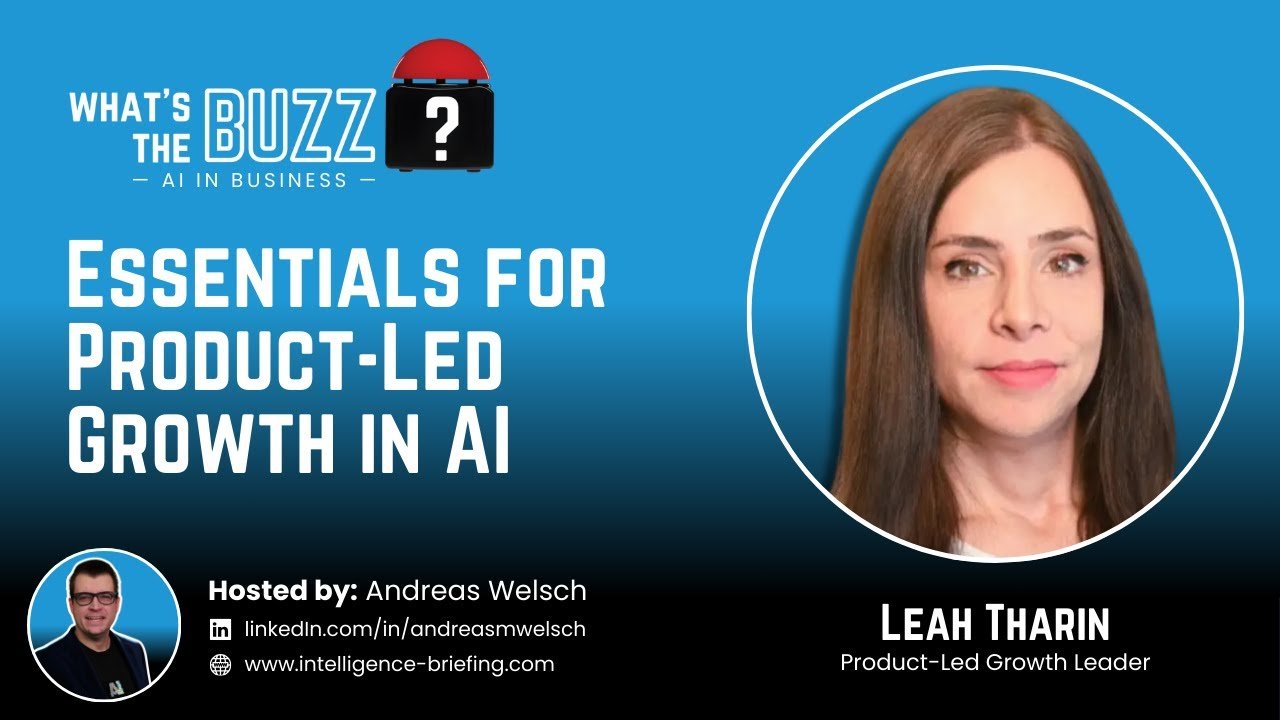
Guest: Leah Tharin, Product-Led Growth Leader
Host: Andreas Welsch
Episode: What’s the BUZZ?, Season 4, Episode 13
Published: April 29, 2025
Episode Summary
Leah Tharin, a product-led growth leader, joins Andreas Welsch to answer a question for founders and product leaders: why do so many AI agent products struggle to find buyers? Leah explains that agents built to replace a single role are siloed solutions, while the largest opportunities in companies are cross-functional.
They discuss how pricing, from outcome-based models to credit-based usage, can help or hurt customer success. Leah also covers human oversight, the state of enterprise data and what founders should do now to make their products usable by agents.
Key Takeaways
- Leah describes many early AI agents as siloed solutions that replace one role, while the biggest opportunities in companies are cross-functional.
- Selling a broader agent changes the buyer from a VP of Sales to the CEO. Leah notes that a product that is hard to explain cannot rely on a freemium, product-led approach.
- On pricing, Leah argues against any model that inhibits customer success: aim at outcomes up market in B2B, keep it simple at the lower end, and avoid long contracts for early-stage agent products.
- Leah says customers will not adopt an agent that could make them look stupid, so the product needs human oversight: automate 80% of the flow and give users 20% control over the output.
- Leah expects enterprise data to be the limit: in her words, it will take another 10 years to get the data infrastructure in place for companies to use agents.
Timestamps
- 00:08 Cold open on AI agents and software growth
- 00:55 Welcome and the guest introduces herself
- 02:31 Icebreaker game: What’s the BUZZ
- 03:03 Icebreaker answer: if AI were a color
- 04:07 Is agentic AI hype or game changing
- 06:18 Why siloed agents copying human roles fall short
- 08:14 Selling agents to the right buyer
- 10:10 Pricing agentic AI and outcome-based models
- 15:32 Credit-based pricing and usage overages
- 18:16 Why agent visions fall flat in practice
- 20:59 Trust, human oversight and not looking stupid
- 22:52 Enterprise data is not ready for agents
- 25:48 The one thing founders should do now
- 29:46 Key takeaways
- 31:06 Thanks and wrap-up
About Leah Tharin
Leah Tharin is a product-led growth leader who speaks on stages internationally about product-led growth. She describes a following of about 60,000 on LinkedIn.
Leah says she has worked as a product manager, including at companies such as Smallpdf and Microsoft.
Full Transcript
Read the full transcript
Andreas Welsch: Today, I have a special guest who helps share more about what the fundamentals are when you want to take your product further and scale.
Andreas Welsch: Leah Tharin. Leah, thank you so much for joining.
Leah Tharin: Thank you for having me. It’s very cool to be here.
Andreas Welsch: Why don’t you tell our audience a little bit about yourself, who you are and what you do.
Leah Tharin: Hi, my name is Leah. I have a self-inflated ego on LinkedIn. So that means about 60,000 followers that I have built up with a lot of sweat by pretending to be really smart about product-led growth.
Leah Tharin: I’m on stages internationally, at least on planet Earth, to talk about this quite a lot. I’ve been a product manager myself, and I’ve been with companies like Smallpdf, which is probably the most knowledgeable one, and Microsoft as well. But that was way, way back in the day. I talk a lot about product-led growth, and I try to talk about everything that I do very specifically, clearly, without jargon.
Andreas Welsch: Wonderful. In preparation I said I’ve been following your content for a while and I think you share it with an edge. I think that’s very refreshing and unique in a sea of people who claim to be influencers, who claim to be knowledgeable, but are oftentimes just regurgitating things.
Andreas Welsch: So that’s why I’m super excited to have you on. Thank you for making the time.
Leah Tharin: Thank you for having me.
Andreas Welsch: Leah, what do you say? Should we play a little game to kick things off?
Leah Tharin: I think we absolutely should. Hit the buzzer!
Andreas Welsch: Perfect. So when I hit the buzzer, you’ll see a sentence and I’d like you to answer with the first thing that comes to mind and why. To make it a little more interesting, you only have 60 seconds for your answer. For those of you who are watching us live, drop your answer in the chat as well, and why.
Andreas Welsch: So are you ready for What’s the BUZZ, Leah?
Leah Tharin: I am super ready.
Andreas Welsch: Alright, good. Here we go. If AI were a color, what would it be? 60 seconds on the clock. Go.
Leah Tharin: Should I give you the correct answer? Because there’s only one correct answer for this one.
Andreas Welsch: Absolutely. There’s only one.
Leah Tharin: Any color that LSD can also produce.
Leah Tharin: So that means all the colors of the rainbow, because whenever leaders are talking about AI, they’re starting to hallucinate as well. I’ve been raising money around AI, and I get a lot of pitch decks with AI in them as well. So that’s why I’m saying all the colors. I would say that’s pretty accurate.
Andreas Welsch: I love that. That’s awesome. Yes. It sometimes feels like you’re on a trip. You just know if it’s a good one or a bad one.
Leah Tharin: Yeah. And it’s never the same color that it was a second ago.
Andreas Welsch: That too. Just don’t stare into the sunrise with your eyes open. It can be blinding.
Andreas Welsch: Now you already mentioned that you get a lot of pitch decks. You talk to a lot of startups, and I see a lot of startups that are jumping onto this agentic AI hype train. What do you think? Is it just opportunistic? Is it truly game changing? Does the world need more AI agents?
Leah Tharin: I think it’s always funny, because I think I’m the only person on the internet who does not know what an AI agent really is. Everybody has slightly different definitions of what the term is, and we’re really good at inventing new terms in this industry.
Leah Tharin: You know that, right? But I think, okay, about two or three years ago, I was talking about this with Kieran Flanagan, where we talked about how AI will get to a point where it does not need an interface anymore to operate a product. And I think that’s a fair summary of what an agent can do.
Leah Tharin: I want to say move the mouse, but metaphorically speaking, it could move the mouse and it can take some of your tasks. Now that’s already the case with some LLMs. But I think the point here is that it can navigate interfaces or systems in some way that automates something that has not been automated before.
Leah Tharin: So without going too much into detail, I think we all have a rough idea that we’re talking about the same kind of deity here. I think we are still in a very early stage. That’s not a very hot take. But what’s important is that whenever you have a technology jump like this, and this one is probably a little bit unprecedented,
Leah Tharin: you usually have an early segment and then a late segment, the longer-term segment, and then there are people who are selling shovels in any gold rush. Everybody’s saying, what’s the mantra on the stock market? Sell on the news or what, yeah. I’m not good at the stock market, but I think it goes in the same direction. So right now we have a lot of early hype, which is not very sustainable. And you can see this when you look at investors and how they think about the investments they make in these companies.
Leah Tharin: I’ll give you a specific example. Let’s say you have an AI agent that says, hey, you can replace a BDR, an SDR, with whatever agent we have. It can make the calls, it can handle all the outgoing email conversations and so forth. What this is missing, as usual, is that these are very siloed solutions.
Leah Tharin: So it’s, oh, we’re trying to replace a salesperson. We’re trying to replace a designer. We’re trying to replace my wife when she’s making a restaurant reservation. And this is going about it the wrong way, but it’s a very natural thing, because you’re always trying to replace what has been there before in one kind of person.
Leah Tharin: So to answer your question, finally, I think it is a hype when it comes to the long-term value. But there are some really good integrations that are also going to come. And I do think it’s going to change the space dramatically. But AI as a whole, and I do not know whether we actually need the term AI agents, but for the purpose of this, yes. So yes and no.
Andreas Welsch: And sometimes that’s the answer, too. That just speaks to the complexity and the newness of things as well. I really like what you said about how we look at something that we know we can grasp and we say, let’s see how we can make that better, faster, cheaper with the help of a new technology like AI.
Andreas Welsch: What I also think we’re missing, if we primarily take that approach, is the much, much bigger potential. If we actually sit down and start to rethink, is this not only a way that we can automate, but is it even the best way to begin with? And I think many organizations, whether it’s the one adopting the technology or the ones building it, are struggling there as well, because it’s so big and so broad on one hand, but also so difficult to conceive and then to implement if it’s such a radical change.
Leah Tharin: What’s interesting about this is, let’s say you have this agent again, the automated BDR, and let’s just say it is satisfactory. Good. To whom would you sell this agent? You would usually sell it to a VP of Sales, or a CRO.
Leah Tharin: But let’s say now you really have this fantastic idea, an AI startup that makes selling a product so much better that it not only covers what the SDR does, but also the usage metrics from the product and everything else that you also need. To whom do you need to sell this agent now? Now you need to sell it to the CEO. So now you have changed the audience that you’re selling this entire thing to, the complexity of what it is, and your entire thing starts to fall apart a little bit.
Leah Tharin: So I think one of the challenges is this incredibly difficult shift. There’s one thing about something being possible, but the second thing is, how do we sell it to the market? Because if it’s hard to explain, you cannot do a PLG solution anymore.
Leah Tharin: Product-led growth is just having a freemium and saying, hey, just try it out a little bit. People do not understand what the context of it is.
Andreas Welsch: Yes. And I think, to your point, who do you sell it to if you sell it to the VP of Sales, but the solution largely makes them redundant, or makes a large portion of the team redundant?
Andreas Welsch: What’s the incentive to do this if you are losing your kingdom and your castle? That’s always the argument.
Leah Tharin: Yeah. It’s like, we get you out of a job.
Andreas Welsch: That’s the scary side of things for many people as well. Is this going to replace me?
Andreas Welsch: But the part that you mentioned about packaging and pricing, who do you sell this to? I was recently teaching a course on maven.com about how you actually price your AI solutions, and I’m running another cohort early in June to build the monetization model. I think, to your point, many organizations, many startups, are approaching it as, here’s a task and this can be replaced with AI, or here’s a human equivalent that can do similar things.
Andreas Welsch: But I think what we’re missing in many cases is more outcome-driven monetization. We always need to caveat this: ideally I can give you some technology that delivers a predictable outcome or predictable quality. So from transactional pricing or user-based pricing to outcomes, that ranges as wide.
Andreas Welsch: But I’m wondering what you are seeing. What are companies missing today when they price their agentic AI solutions?
Leah Tharin: So what you’re asking is, in some ways, where do companies leave money on the table? That’s one way to look at the problem. And the other one is, how do you set yourself up for long-term success?
Leah Tharin: On the second question, I have no idea, because nobody knows where this market is going. That’s the first thing. The second thing is that I do not believe in any pricing model or monetization strategy where what you charge the customer inhibits their customer success in some way.
Leah Tharin: Let me give you an example. Let’s say ChatGPT, or whatever you’re using as your favorite LLM, did not cost you $20 a month, or whatever the subscription price is now, but 50 cents per chat. Just 50 cents.
Leah Tharin: What this does is encourage some really shitty practices. That’s why you get messages internally from companies: hey, write everything into one prompt, don’t use it for your personal shit, and so forth. We start to design systems around the monetization models of the products that we are using.
Leah Tharin: That is problematic, because you’re stopping the customer from being successful. A customer is very glad to pay you for something like a share, as we do with sales, if the outcome is proven at the end of it.
Leah Tharin: But this is quite hard to crack, because we also need to be honest. I have a couple of people who always come with evergreen ideas, like, hey, I want to make a platform where we facilitate the selling of cars.
Leah Tharin: This always works until the moment people can start to abuse the system, go outside of the system, and you’re not getting a sales commission anymore. This is a challenge that has always been there. So in theory it is correct that you should charge towards the outcome if possible.
Leah Tharin: So if a deal is closed, then you also get a share. But how do you make sure this is actually happening? Ironically, this is not that big of a problem in B2B, because in B2B there’s just not that much fraud. They’re not going to short-charge you too much. So the further up market you go, try to be on the outcome as much as you can.
Leah Tharin: And on the lower end, try to keep it simple. Do an average. Define some borders where you say, look, if you fire off a hundred thousand chats per day, then you know you’re not going to use our stuff anymore. But keep it simple in the lower market.
Leah Tharin: And if you go up market on the B2B side, try to target it towards the outcome. The other thing you need to understand for enterprise solutions, and I’ve seen some that are coming that are quite exciting, is that you probably need to explain the solution to these customers as well.
Leah Tharin: So it’s not always as easy as, hey, we’re going to replace your salespeople. Let’s say you have Salesforce and you’re a huge company, and we’re now bringing this entire thing into that. If I’m Salesforce and I’m trying to sell you an agent that helps to sell on top, you understand that, oh shit, that means we’re even more locked in to Salesforce.
Leah Tharin: So be careful with the monetization and the packaging that you have. It sounds like a nice thing, locking in your customers, but don’t lock them in just because you can. Only do it if you really have to, to get to the value of whatever your agent solution is.
Leah Tharin: What I mean with that is that it should behave more or less independently, and not just from your own product platform. I hope that makes sense. It is a very confusing space.
Andreas Welsch: It certainly is. And it’s very nascent. It’s just emerging. Different companies are probably throwing spaghetti on the wall and seeing what sticks at this point. That’s the impression I get as well. And there was so much good information, so much meat in what you shared over the last couple of minutes.
Andreas Welsch: I remember about two months ago, almost, at the beginning of March, Sam Altman sent out this tweet: hey folks, hello world, we’re thinking about changing the monetization model of ChatGPT from $20 a month to credit-based. So you buy some credits and then you use them. Exactly what you shared. And I think that sends a very troublesome signal to the market and to your customers. OpenAI probably went in with a $20 price point because in most of the Western world, $20 a month is something that you can pay. It is reasonable and doesn’t break the bank or your budget.
Andreas Welsch: But then when you look at the additional features that OpenAI has added, models that are more capable, that are probably more energy intensive and resource intensive, in research and this and that, then $20 per user per month might not be the ideal price point anymore if your costs exceed it and the usage exceeds it.
Andreas Welsch: So it can get tricky, and the usage is hard to forecast as well, if you have a good product.
Leah Tharin: I can give you a pricing model that I think is quite clever in this regard. A company that does this really well is Buzzsprout. Buzzsprout is not an AI company in any way.
Leah Tharin: But it is a podcasting platform where you upload your files and then they’re distributed to other places. What you get with a subscription is a specific limit. If you go over it, you are not blocking the users at all. You get charged a specific fee per gigabyte that you go over.
Leah Tharin: And I think that’s good practice. We do not want to stop the users from doing something, but with the subscription you get a very hefty base quota. The problem is, as we said before, what is a successful chat with an LLM? Are we going to charge you when it’s hallucinating data? How would you know whether something is good or not?
Leah Tharin: So the challenges are going to remain for sure, but I think keeping it simple is probably an art going forward. Just one final point on this. There is probably no one in the world right now who thinks that any of the solutions we have are not going to fundamentally change.
Leah Tharin: So all of this is in big flux, and we don’t even have any good solutions so far. Do not try to lock in customers with your early-stage solution with yearlong contracts. It’s not going to work, because your customers are not stupid. Nobody is going to commit to a two-year plan on an agent where they think, you know what, I don’t know whether in three months OpenAI is coming out with another model that is going to beat you. That’s an important one as well.
Andreas Welsch: Plus, if you’re a vendor and you need to change your pricing model, you have some customers that are grandfathered in with their plan and you need to figure out how to migrate them. Do they want to keep it? If it’s a three-year or five-year contract, that can get pretty difficult as well.
Andreas Welsch: Let’s say you’ve built your AI product, your agent, and you ask your sales rep to pitch it and sell it. What’s the next step where that vision of changing the world with agents keeps falling flat for most companies? What are you seeing? Where are we on the maturity curve, and is it more like the internet of the nineties, or is it completely different?
Leah Tharin: I think there are two major points here.
Leah Tharin: The first one is that in almost every consulting client that I have ever worked with, and I’m working mostly on product-led growth, AI is also a topic that’s coming up, but I’m not an AI leader specifically. The principle is always the same. The biggest opportunities that we have in companies nowadays are by and large cross-functional. If you need to optimize something, it’s not a problem that we need to solve inside of sales or marketing or product alone.
Leah Tharin: It’s usually cross-functional, in the sense of, hey, sales is not talking to product. Sales is using their own tools. I almost wish swearing right now. Every silo, every f silo, is using its own tools. Sales is using HubSpot for their data stack. Marketing uses Google Analytics. I don’t know why in 2025, but hey, I’ve seen it too. Product is using Amplitude or whatever. Everybody has their own tools.
Leah Tharin: The problem is that the customer doesn’t care about this, and they land in all of these individual tools at a different time because the workflows are different. So if the opportunities are cross-functional and you’re going out there and selling silo solutions, as we said before, replacing your salesperson, replacing this, that cannot be a winning strategy going forward. I think the first, most important point is that you have to show the value of the cross-functional journey.
Leah Tharin: Because if this automated SDR makes it harder for someone from support to call them up and figure out, hey, what did we actually talk about in this particular call, what did you actually promise to them, then you start to create cross-functional problems rather than solving them.
Andreas Welsch: It reminds you of the time before a lot of that technology emerged, when people were talking to each other and had spreadsheets and these things. In a way, similar.
Leah Tharin: Yeah, 100%. And maybe to your second question, on where we are, is this the same as the two-thousands or the nineties? I’m a big fan of understanding the jobs to be done from people. What is the job that someone wants to do with whatever they’re doing in their life? And there’s always this one job in every sales conversation, whenever you’re talking about, hey, we want to get a new product into our life, whether in business or in consumer life.
Leah Tharin: If you make someone look stupid, or they think they could start to look stupid because of something you’re selling them, they’re not going to adopt it. They’re not going to pay money for it, and they’re not going to use it. For example, if you say, hey, you can click this button and I’m going to send Andreas an email automatically where I’m just saying thank you,
Leah Tharin: I want to see that email.
Leah Tharin: I’m not trusting my AI yet to just do it without me having any oversight. And that’s a very important one. Whatever flows you’re building, you need to make sure that there is a human element of control in terms of quality. It doesn’t matter how good your model is.
Leah Tharin: It’s not about whether your model is good enough. It is: can you overcome the distrust that people still have, of course rightfully, by the way, to automate 80% of the flow while giving them 20% of excellent control over the output? Because that’s what this is about. You do not want to make someone look stupid, otherwise your pitch is going to fail.
Leah Tharin: And I think that has been the same in the two-thousands and the nineties. If you start to introduce more stuff, you always need to make sure that the people who are working with it also appear professional. And on this entire curve, we have the same challenge that we had back then. Enterprise data is not ready. Whatever you’re thinking about with your AI, what it’s going to do, it’s going to take us another 10 years to get the data infrastructure in place for all these B2B companies to use your agents. And an agent without access to data is useless anyway.
Andreas Welsch: Lots of powerful things. The part that AI needs data and that your data still isn’t where it needs to be is one that I keep coming back to as well. To me it’s mind-boggling that, again to your point, we’ve been talking about this since the early two-thousands, and yet there were always more important things to do or shinier objects to pursue than getting your fundamentals and your foundation in place.
Andreas Welsch: Where I see the opportunity now is that AI can be the hook, if you will, to say we need to do a phase zero, which is getting our data in order to do phase one. That takes courage and it takes budget and it takes expertise as well.
Leah Tharin: I’m 100% with you. I just think people really underestimate how hard it is to get your stuff under control, specifically the data. The big difference from back then is this. Let’s say you have a sales department of 300 people. You need to have a very specific infrastructure that is capable of servicing these people. These people do not talk to each other as well. They may be on the same team, and you have an entire organization managing all of this.
Leah Tharin: If you have an agent solution for something like this, the throughput doesn’t matter in the same way. Whether an AI can make a phone call, or write an email, is not dependent on how much you’re using it. The bandwidth is more compute power than anything.
Leah Tharin: So there’s a big difference, and there is a cost argument in there, in that existing companies have data stacks built for humans and their limitations. For instance, access control. Why do we have master branches and forks and everything? Because people are messing with this shit constantly.
Leah Tharin: And that’s going to change in ways where I’m not sure existing companies can really fix their existing data stack to make it compatible with AI agents, or whatever the future is going to be. The requirements are going to be so different that it’s probably easier to build it up from the ground new.
Andreas Welsch: I think that’s a very important and powerful message. The systems that were built for humans might not be the same ones we need to operate AI and agentic solutions. But I’m wondering, specifically from your experience working with a lot of founders and a lot of product leaders, what’s the one thing they need to do right now when it comes to AI and when it comes to agents?
Leah Tharin: I’m going to start with a very basic mistake that Canva is making right now. If you go to Canva’s pricing page, for instance, and Canva is touting that they are a very forward-thinking company, in the HTML you cannot see all the features.
Leah Tharin: So if an agent or an LLM goes in there to research their pricing, it has to expand the boxes that look nice to the human eye but are not very helpful for a bot. Now you can say, oh, maybe it’s going to find it in the code eventually, or it’s going to expand them and so forth. You need to start to expose your stuff not just to human users. And we’re not just talking about an API, we’re talking about actual websites, because what agents are doing is imitating human behavior, as we just said before.
Leah Tharin: So that’s the very first one. We will have some kind of, I don’t want to call it search engine optimization, but agent optimization. There are also going to be some shitty behaviors that we see already. An LLM cannot differentiate between a review site that says Andreas is awesome, whether that’s a true one or a false one. So we start to have programmatic false review pages come up and so forth. That’s not a tip, by the way. Don’t do that. I’m just saying you need to expose your stuff to agents and make sure that it can be used there.
Leah Tharin: And then the other thing, on pricing: make sure that you have fail-safes. What you definitely do not want, if you have usage-based pricing, is no access controls where companies can decide, hey, let’s treat this like an ad budget. Don’t spend more than a hundred dollars, and give me a warning rather than just spending over this.
Leah Tharin: So this also needs to be baked in. And realize that if you’re selling AI agents, I highly recommend using them for yourself as well. Try to figure out an organizational structure first, and what your data infrastructure actually means, rather than just going to companies and hoping that they can figure it out themselves.
Leah Tharin: Some AI agent solutions that we see right now have to include help with setting up the data infrastructure in their offering, which sometimes means warm bodies, engineers who help these companies facilitate this so they can see the value. Leaving that just to the customer and their data team is usually a very bad approach.
Andreas Welsch: So what I’m hearing a little bit is, eat your own dog food.
Leah Tharin: 100%. It’s mind-boggling to me how people think, oh my God, my idea is the shit. It’s important that founders think that, don’t get me wrong. But to really understand what the challenges are, you also need to drag these out into the light.
Leah Tharin: There’s a good book about this that has nothing to do with AI, which I just forgot the title of. It’s a sales book. The point is that in a good negotiation, you want to highlight the negative points before the customer comes to the objection by themselves.
Leah Tharin: And that’s what you should do with AI agents as well.
Andreas Welsch: It sounds like on one hand there’s a lot of opportunity and promise. On the other hand, everybody’s still figuring out what it actually means for them and their business. But it’s important that you do start to figure it out, work with your customers, and see and learn what resonates with them. What is it that they actually need? How are they planning and using it? That informs your product, your marketing and your sales strategy. Now Leah, we’re getting close to the end of the show, and I was wondering if you can summarize the key three takeaways for our audience today.
Leah Tharin: You are not just selling a product. I think you’re selling a solution into an existing data stack that is probably a mess. That’s the first one. Second, monetization will hurt, but make sure that you align yourself as much as you can with the customer’s success. A good monetization model is one where you maximize your own gain, but also maximize the gain of your customer.
Leah Tharin: That’s a very classical ideal customer profile thing. It never works if it’s out of balance, so don’t try to fleece your customers that way. And the other thing is that one of the reasons so many of these AI agent companies, the smaller ones, are not getting investments is that they focus too much, early on, on silo solutions.
Leah Tharin: So try to think cross-functionally as much as you can, within the constraints that your customers have, and you have a really good chance in the market.
Andreas Welsch: I love that. That’s awesome. Super actionable and practical advice. Leah, thank you so much for joining us and for sharing your expertise with us today.
Leah Tharin: Thank you for having me.
Listen and Subscribe
Related Reading
Frequently Asked Questions
Is agentic AI hype or a game changer?
Leah answers yes and no. She sees a lot of early hype that is not sustainable when it comes to long-term value, but expects some very good integrations to come and expects the space to change dramatically. She also notes that everybody defines an AI agent slightly differently.
Why do siloed AI agents struggle to sell?
Leah says agents that replace one role, such as an SDR, a salesperson or a designer, miss that the biggest opportunities in companies are cross-functional. A broader agent also changes the buyer from a VP of Sales to the CEO, which raises the complexity of the sale.
How should companies price agentic AI products?
Leah does not believe in a pricing model that inhibits customer success. She suggests keeping pricing simple at the lower end of the market and targeting outcomes in B2B up market. She cites a podcasting platform that charges a fee per gigabyte over a generous quota instead of blocking users, and advises against long contracts for early-stage agent products.
Why does human oversight matter for AI agents?
Leah says people will not adopt, pay for or use a product that could make them look stupid. She advises automating 80% of a flow while giving users 20% control over the output, because the barrier is distrust, not model quality.
What should founders do now to prepare for AI agents?
Leah recommends exposing products to agents, not only to human users, for example by making pricing details visible in a page’s HTML. She also advises building fail-safes such as spending limits, using agents internally first, and helping customers set up the data infrastructure they need.