

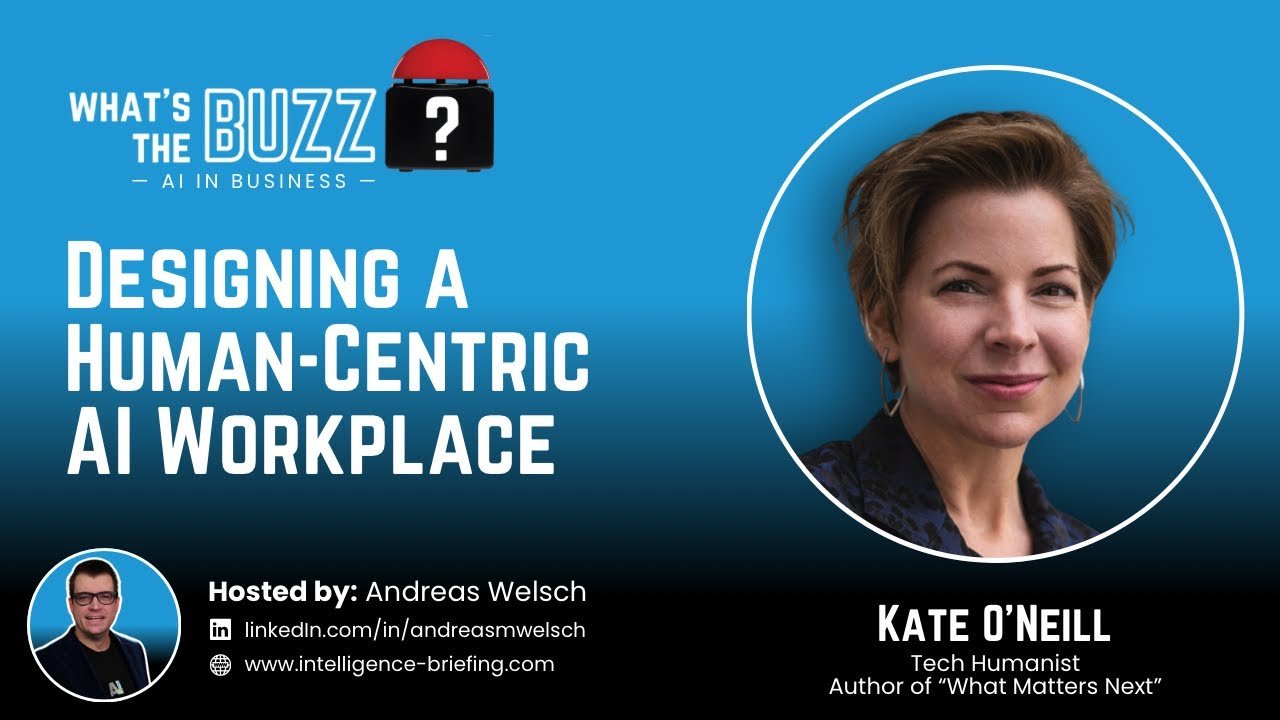
Guest: Kate O’Neill, Tech Humanist and CEO of KO Insights
Host: Andreas Welsch
Episode: What’s the BUZZ?, Season 4, Episode 3
Published: February 4, 2025
Episode Summary
Kate O’Neill, Tech Humanist and CEO of KO Insights, joins Andreas Welsch to answer how leaders can keep human-centric values at the center as AI and agents enter the workplace. She argues that a blended workforce of people and bots calls for a different kind of leadership than business school taught, and that reskilling belongs at the management level as much as at the entry level.
Kate names clarity and future readiness as the skills leaders need, and she cautions against judging success only by profit and efficiency. The conversation also covers using AI for sustainability goals and why she expects jobs to keep changing rather than disappear.
Key Takeaways
- Kate says a blended workforce of people and bots needs a different kind of leadership, and that reskilling belongs at the senior and management level, not only at entry level.
- Kate names clarity as a leadership skill: setting a clear direction and making expectations, and each person’s contribution to the greater picture, understood by people and by machines.
- Kate argues that a business cannot be future proof, only more or less future ready, and that leaders need better forecasting from the signals in culture and trends around them.
- Kate says profit and efficiency are the easiest metrics, but culture, morale, talent retention and trust in the marketplace decide success over the long run.
- Kate expects jobs to keep changing, with individuals, businesses and governments each responsible for reskilling, and she points to state programs that partner with local libraries, naming Nevada and Nebraska as examples.
Timestamps
- 00:00:14 Introducing AI without alienating your people
- 00:00:49 Kate O Neill joins the show
- 00:02:41 The book What Matters Next
- 00:04:53 Icebreaker: if AI were a book
- 00:06:11 Leading a blended human and AI workforce
- 00:10:52 Trust, empathy and clarity in leadership
- 00:14:35 Keeping human values as AI enters the workplace
- 00:19:44 Making sense of fast-moving AI news
- 00:21:04 Using AI to solve human problems at scale
- 00:24:04 Will agents do all the work
- 00:27:06 Key takeaways
- 00:28:10 Where to learn more
- 00:28:27 Wrap-up
About Kate O’Neill
Kate O’Neill is a Tech Humanist and CEO of KO Insights. She describes her work as the intersection of technology and human experience, a focus of nearly three decades that includes being one of the first hundred employees at Netflix. Her recent book is What Matters Next, which she launched the week before this episode.
Full Transcript
Read the full transcript
Andreas Welsch: Today, we have an exciting episode for you. I’m joined by Kate O’Neill, Tech Humanist. Kate, thank you so much for joining, and for those of you in the audience that don’t know Kate yet, maybe you can introduce yourself.
Kate O’Neill: Thank you, Andreas. It’s so lovely to be here. I love what you’re doing with the show. I am Kate O’Neill. I’m the tech humanist, as you said. My work is around the intersection of technology and human experience, and that has been my focus in the technology space for coming up on three decades now. So emerging technology, different platforms. Some of the highlights of my career: I was one of the first hundred employees at Netflix, which was a really great and formative experience, but I’ve also been in healthcare and around education, around services, all kinds of different industries. And then as a consultant and advisor for the last really 15, 20 years, it’s really been a little bit of everything. Most of my work now is writing, research, and speaking. I’m doing a lot of keynote speaking, but I do some advisory and consulting as well. And it’s so fun, so interesting. And I know, Andreas, you have a background that is very diverse also, so you know how interesting it is to be able to apply the insights from one area to another as well, right?
Andreas Welsch: Absolutely, and I think that’s one of the great opportunities of our times, right? The background and skills that we have, we can augment with AI and see how AI applies to it, and bring context to others who are in the same situation with similar issues. Kate, excited to have you with us.
Kate O’Neill: Thank you.
Andreas Welsch: I know we’ll talk a little bit about a project that you’re working on as well. Maybe you want to share a little bit about that before we get started, too.
Kate O’Neill: The biggest project I have currently in front of me is that I just launched a book last week called “What Matters Next? A Leader’s Guide to Making Human Friendly Tech Decisions in a World That’s Moving Too Fast”. I know that has to resonate with a lot of the folks who are watching this, right? The world does seem, to many people, to be moving way too fast. And what I hear most from leaders, and you probably hear this as well, is that decisions are just so challenging these days because of the amount of technology, the amount of change within technology, the scale and scope of technology and the ramifications and consequences of those decisions. So this book attempts to deconstruct that and offer some frameworks and practical guidance for people to make better decisions in that context.
Andreas Welsch: That’s awesome, and I think that’s exactly what we need. I was just posting about this in my newsletter this morning. Looking at the news over the last three, four weeks, it feels like there’s one big news theme with every cycle, right? Hey, we know how to get to AGI, and we have our own definition of it. Hey, by the way, now we’re investing 500 billion in Project Stargate to make AI run and serve us even more. Then the next week it’s SaaS, software as a service, is dead. There’s a new model and it turns everything upside down. So I think things are moving incredibly fast, like you said, so definitely some guidance on how to see this through and sift through all these news items that are coming my way is super important. Now, folks, for those of you in the audience, I’m always curious how global our audience is. If you want to put in the chat where you’re joining us from today, that would be awesome. And also, if you have any questions for Kate, please feel free to put them in the chat as well and we’ll pick them up in a couple of minutes. Kate, in good tradition, it wouldn’t be called “What’s the BUZZ?” if there wasn’t the buzzer in the game. I’m curious, what do you think: if AI were a “…”, what would it be? You have 60 seconds that I’ll put on the clock, and I’m really curious what you think. Let’s see here. If AI were a book, what would it be? Oh, fitting.
Kate O’Neill: Yes, it is fitting. It seems like it would be an encyclopedia, because it is all encompassing and it has the potential to be used in any number of ways to expand the knowledge and expand the thinking of the people who are using it. We’ll come back to this theme probably a lot in our discussion. But I’m a real big believer that the promise of AI is how it augments human intelligence. And so I’m going to go with the ultimate reference volume, the encyclopedia.
Andreas Welsch: Awesome. I love it. I’m always amazed what my guests answer, because those questions are actually answered on the spot. We didn’t talk about what that would be, but thank you for coming up with an answer. We certainly have prepared some questions to guide our conversation today. And I’m curious, what do you see? A couple of weeks ago we saw that the likes of Salesforce, Marc Benioff, or even Meta, Mark Zuckerberg, said that for managers, this is the last time that they will manage an entirely human workforce. And so the AI community has been quick to point out that’s already the case, right? We are using AI very widely. Zuckerberg said, hey, we are going to use AI a lot more for development, for coding. Eventually AI will code. So what do you make out of all this news? What’s real and what do leaders need to know?
Kate O’Neill: I love the point that it is not exactly new to think of a blended workforce, right? We have been using various kinds of automation and even increasingly intelligent automation for decades. You could think back to the automation within factories going back a century and a half or so. So it’s not a new phenomenon, but I think we know that the spirit of what Marc Benioff meant was probably more about the evolution of that: the challenge of leading this increasingly richly diverse workforce, in terms of the kinds of capabilities of AI and of bots within different environments. And then what humans are expected to contribute and the value that people can add in these kinds of blended environments. So that’s going to require a different kind of leadership than what we’ve been asking of leaders up till now, right? The people who have gotten their MBA or gone through business school in decades past were never given a proper education that prepares them for today. They don’t know how to do this. And one of the things that has struck me for the last few years, something I wrote about in “A Future So Bright”, which is the last book I had before “What Matters Next”, is that we really have let down leaders by not helping them manage appropriately in remote and virtual settings. You come from a tech background as well. So much hand wringing over how you manage programmers and lines of code, right? Are we counting lines of code? And anyone who has done any programming knows that the number of lines of code you write is not equivalent to the elegance of your solution. Very often the most elegant solution is actually shorter. You’ve done a much more efficient job. You’ve figured out a way to trim some of the looping, or you’ve gotten things to make some internal sense and have some integrity in ways that aren’t about the length of the code. And it’s really hard to manage that, just as it’s hard to manage the productivity of a writer or any other kind of knowledge worker. So the gap in leadership around those skills has already been making itself apparent, particularly in the last five years around the COVID timeframe. But I think as we see increasingly virtual and remote teams, despite the come-back-to-office trend over the last couple of years, we’re still seeing a lot of companies embrace remote, virtual and distributed teams. And we just don’t have the leadership skills for that. And now when you think about the blending of increasingly automated systems and services and bots of various kinds and algorithmic optimization and AI, we’re just not set up for it. So what I think we are looking at is a real opportunity for retraining and reskilling at the management level. So much of what we talk about when it comes to reskilling for digital transformation is people at the entry level or low-level skills, and it’s actually, in some ways, even more relevant to think about reskilling at the senior and management level, so that people are adequately prepared to lead in these changing environments.
Andreas Welsch: Now, that really resonates with me. I’ve led teams and organizations in remote settings during the pandemic, which was incredibly hard, just being virtual. And I think it takes a different kind of leadership, and it takes a different kind of empathy all of a sudden, and trust, right? I think they’re very valid concerns. If I don’t see this person in the office every day, how do I know that they’re doing what they’re telling me they’re doing? You can measure the output as one example, but I think it also needs a lot more empathy. Now, when you bring AI and AI agents into that workplace, we need that same kind of trust and understanding as well. Are these agents doing what they’re supposed to? And I think leadership and management is a lot more than whether they are doing what they’re supposed to. So, just as an aside, but I think if we’re not adequately prepared today to work with humans, we’ll have a real challenge working with more AI.
Kate O’Neill: It’s such a good point. And I wanted to add to what you’re saying. Trust and empathy are indeed critical skills. But one of the other skills that we haven’t been clear about is the skill of clarity, right? It is the skill of being clear and crisp about what you expect of your team. You have to be able to set a clear direction, make expectations understood, and make sure people know what other people are doing and how their work contributes to the greater picture. That is very much a part of what matters next. One of the things that I think leaders struggle with is vision casting, the future visioning that they need to do, because they feel like the future is so ambiguous and there’s so much uncertainty. There seems to be this sense that it’s almost easier to run in a state of near blindness: we’re just going to operate as we’ve been operating, and as big important things become known, we’ll deal with them as they occur to us. That’s not going to work. We absolutely need to be doing our best at understanding how to use signals in the culture and the trends around us and externalities to make better forecasts and do better future casting. This is one of the themes that I come back to a lot in the book. We use this term a lot in business, “future proof”, like we want to future proof the business. And I think that’s a very silly term, actually, because we cannot be future proof. We can only be more or less future ready. So what we’re asking of leaders now is to be more future ready by creating clearer visions of what you’re trying to achieve, and by using better strategic skills to understand what the unique challenges of your workplace are, what the systems are that you’re working with, and how to make that as clear and as directed for both people and for machines that are part of that blended workforce.
Andreas Welsch: The timing of what you just said couldn’t be better, right? It’s early February that we’re live here, and many organizations, many leaders, are going through goal planning. What are we going to do this year? How are we going to measure what we are doing? So I think the skill of clarity, of vision setting, where are we going, why are we doing this, connecting what your team does to this larger objective, is critically important. It always has been, but now, as we bring in more technology, how do we factor that into it as well? So I’m curious: how can leaders ensure, as more AI enters the workplace, that those human-centric values are not completely neglected or thrown out the window, because we all of a sudden prioritize even more so profits and productivity, right? We have agents. They work 24/7. They don’t take sick days, maybe a little maintenance here and there. But we get constant output. We get a constant, high level of quality. How do we make sure that we keep people front and center? And how do you see leaders shape this?
Kate O’Neill: This again, I think, comes down to leaders with the clearest vision, because it’s very easy as a leader to focus solely on profit and efficiency. That’s truly the easiest thing in the world. That’s what all of the signals from business and the market will tell you are important, but those are not going to be the only metrics by which you can gauge success over the long run. Anyone who has been in business long enough knows that you end up eventually having to deal with cultural issues and morale issues and talent retention issues and things pertaining to trust in the marketplace: how your brand is perceived, whether consumers actually want to come back and deal with you again if they had a bad experience with you the first time. So there are many signals that need to be blended as part of a holistic understanding of what effective strategy is and what effective business management is. It’s going to be tempting for people to use productivity and efficiency as their gauge. It’s especially going to be tempting in a political environment where we’re dealing with a lot of deregulation and a lot of emphasis on growth and acceleration, and the downscaling of what government looks like. Everything that’s going on with not only the Trump administration, but a lot of governments around the world taking this cue and doing very similar kinds of downscaling activities where they’re very inwardly focused. This is a trend that I think we’re going to see for the next few years in the US under the Trump administration. I think we’re going to be seeing this for probably the better part of the next decade, playing out in various ways across the world. And it’s really important that people are prepared for that, and that leaders themselves are prepared for that, because you’re going to need almost an arsenal of motivations and skills at your disposal to be able to have conversations with your leadership team, with your board, with a stakeholder or anyone who has a role in directing what the company determines to be success. And that needs to look like empowering humans. It needs to look like making sure that we’re using AI and agents and the technologies at our disposal to create thriving and amplify human potential, and to look at what our company exists to do and what it exists to do at scale, in ways that are about how it aligns with the people inside and outside of the company. And how can we make sure that we’re using technology to amplify and accelerate that alignment, as opposed to merely amplifying and accelerating the output and effectiveness of the company itself? This is just a shift. All of these things are good vision casting, clearer thinking, better strategy, and that future readiness. I think that is missing from the larger business discourse, especially now. And so I am pleased to be part of helping bring that focus with this book. And I think it’s so important that people are able to have that perspective in business.
Andreas Welsch: Now, there are so many great points in what you just shared, right? From what you can do individually to where things are moving in the U.S. and globally, most likely, over the next couple of years. And I think it continues to be a very dynamic environment. If I talk to leaders, I see that they’re wondering, how do I make sense out of all that? How do I use technology with purpose for achieving better business results? And as fluffy and corporate as that might sound, at the end of the day, I think we need better results. So for me, that was part of the reason to write the AI Leadership Handbook.
Kate O’Neill: Oh, yeah. Let’s hold our books up.
Andreas Welsch: And give people some practical advice: how do you do that, and how are others doing it? But I’m curious, what gets you excited among all those news items, right? Just last week we had DeepSeek. It sent markets into a sell-off and a little bit of a turmoil. The week before we had the 500 billion dollar investment in Stargate. Do we still need that? Is that relevant? DeepSeek, what’s happening with my data? Can I trust this? Are there any guardrails? Does it say things that it’s supposed to or not supposed to? So many bits and pieces of news that it’s really hard for many leaders to understand what really matters. So I’m wondering, what matters next?
Kate O’Neill: I’m glad you’re wondering that. What I would say is that at the moment it is chaos, and I think it is really hard, and I think we’re not going to see that slow down anytime soon. So one of the skills I think leaders need to cultivate is the art of curation, finding their most reliable and most important sources, so that they know what information they really need to rely on and what they can just let wash over them as ambient information that maybe they’ll pick up little bits and pieces of. But what I’m excited about is that we see hints of a trend around how we could use AI and other exponential technologies for solving human problems at scale. I know that doesn’t seem like it’s the majority focus, but I’ve been on this problem for years. In 2019, before we were ever talking about large language models with ChatGPT, I led a panel at AI COP25, the climate change summit for the United Nations, and it was composed of tech leaders from around the world talking about how we can use AI to fight climate change. That conversation, already in place by 2019, has only accelerated. Obviously, we know even more since 2019 about the harms that the climate catastrophe is wreaking on the world, and we know how urgently we need to focus on that. So what I see happening is that we look at things like the large language model frontier model war and Stargate as part of that acceleration. But then you also look at DeepSeek, and I know there’s been back and forth about how efficiently they actually built the model, but there is some indication that they were able to be much more efficient, at some level of engineering, than what a lot of the current frontier models are using in terms of compute and energy resources. There’s a very good chance that we are going to see drastic, radical changes in the efficiencies that models are getting in the coming years, and I hope what we’re going to see is those models also being applied to sustainable development goals-related types of problems. How can we create more efficiency in our energy sourcing? How can we create more alignment with projects that are making fresh water more available in places, and managing the drought in other places? There are so many different ways to intervene in the urgent and important issues around the climate crisis, and AI actually has an incredible role to play if we’re going to use it correctly. And doing so with energy efficient compute is, I think, a really important step in that. So I take a bit of encouragement from that trend over the last couple of weeks of news.
Andreas Welsch: I love it. And I think it will spur even more innovation when technology becomes available to an even broader and wider range of companies in many different sectors and different parts of the world. When the cost of that technology keeps coming down, I’m very hopeful there as well. Now, I’m curious, what do you think? Where is this all going? Are we all going to sit on the beach with a cocktail and let the agents do the work?
Kate O’Neill: No. Any time we use that sort of Keynesian view of market productivity, where we say, oh, we’re going to make it possible that humans won’t have to work, I think what we’re overlooking is that it isn’t only about technology or about efficiency. It is really about capitalism, and capitalism won’t let us do that. So at the moment, that’s not the model we all operate under. I think what we’re going to find much more likely over the years to come is that our jobs, just as they have been changing for decades, are going to continue to change. And it’s going to be up to individuals to keep re-educating themselves and stay current with some familiarity with the tools. It’s going to be up to leaders at the business level to make sure that they’re upskilling and reskilling their teams and creating appropriate pathways for people into increasingly sophisticated jobs. And it’s going to be up to government leaders, which I know is not very encouraging right at the moment, but I think we’re going to have to face a moment where government leaders create pathways for people to reskill and upskill appropriately. We can see this happening at state levels. There have been some great cases in the U.S., and I think Nevada and Nebraska are two examples, where the state put together programs that partner with the local libraries and with a database of jobs and the skills required to fulfill those jobs. And so people who find themselves put out of work by automation or by AI, or by different kinds of disruption in the marketplace, can go to the library and look for the kinds of jobs that are available and the skills it will take to fulfill them. And those skills are actually available to them in courses. So it’s a wholesale, holistic kind of opportunity for people. I think we need to see a lot more of that, and that really can happen at almost any level. It’s a lot of disruption and change and evolution, but I think the opportunity is so vast, and it’s so important for us to stay focused on how much opportunity there is to fulfill human potential at a level that we have not been able to until this point.
Andreas Welsch: So that was my dream of sitting by the beach.
Kate O’Neill: Yeah, you can sit by the beach if you want to.
Andreas Welsch: Yeah, with my laptop probably.
Kate O’Neill: I’ll support you. I’ll cheer you on.
Andreas Welsch: No, awesome. Hey Kate, we’re getting close to the end of the show and I was wondering if you can summarize the key three takeaways for our audience today.
Kate O’Neill: If I summarized the points I really want people to focus on, it’s that human-centered innovation is key no matter how much AI evolves. I really want people thinking about how we’re centering humanity and human potential in all of this. I’d really love to see us stay focused on the sustainability of this progress. How can we not only use our compute power most efficiently, but how can we make sure we’re in alignment with the most sustainable goals, those UN sustainable development goals for a start? And then how can we make sure that we’re evolving leaders to the level that we need them to be, to direct all of this for us and lead us toward this better future that we could potentially have if we make the right choices on the way there.
Andreas Welsch: Kate, it was great having you on the show. Thank you for sharing your experience and your insights with us.
Listen and Subscribe
Related Reading
Frequently Asked Questions
What is a blended workforce?
A blended workforce combines people with automation, bots and AI agents. Kate notes the idea is not new, since companies have used increasingly intelligent automation for decades, but leading people and machines together asks for skills most managers were never trained in.
Why does Kate say a business cannot be future proof?
Kate calls “future proof” a silly term because no one can prepare for every outcome. She says businesses can only be more or less future ready, which means setting a clear vision and using signals from culture and trends to forecast.
Which skills do leaders need to manage people and AI agents?
Kate and Andreas point to trust, empathy and clarity. Kate adds vision casting, strategic skills to understand a workplace’s systems, and reskilling at the management level so leaders can direct both people and machines.
How can leaders keep human-centric values when AI agents work around the clock?
Kate says leaders need the clearest vision, because profit and efficiency are the easiest metrics. She advises blending signals such as culture, morale, talent retention and trust, and using technology to align the company with the people inside and outside it.
Will AI mean people no longer have to work?
Kate does not expect it. She expects jobs to keep changing, with individuals keeping their skills current, businesses upskilling and reskilling teams, and governments creating pathways, as some US states have done with library-based programs.