

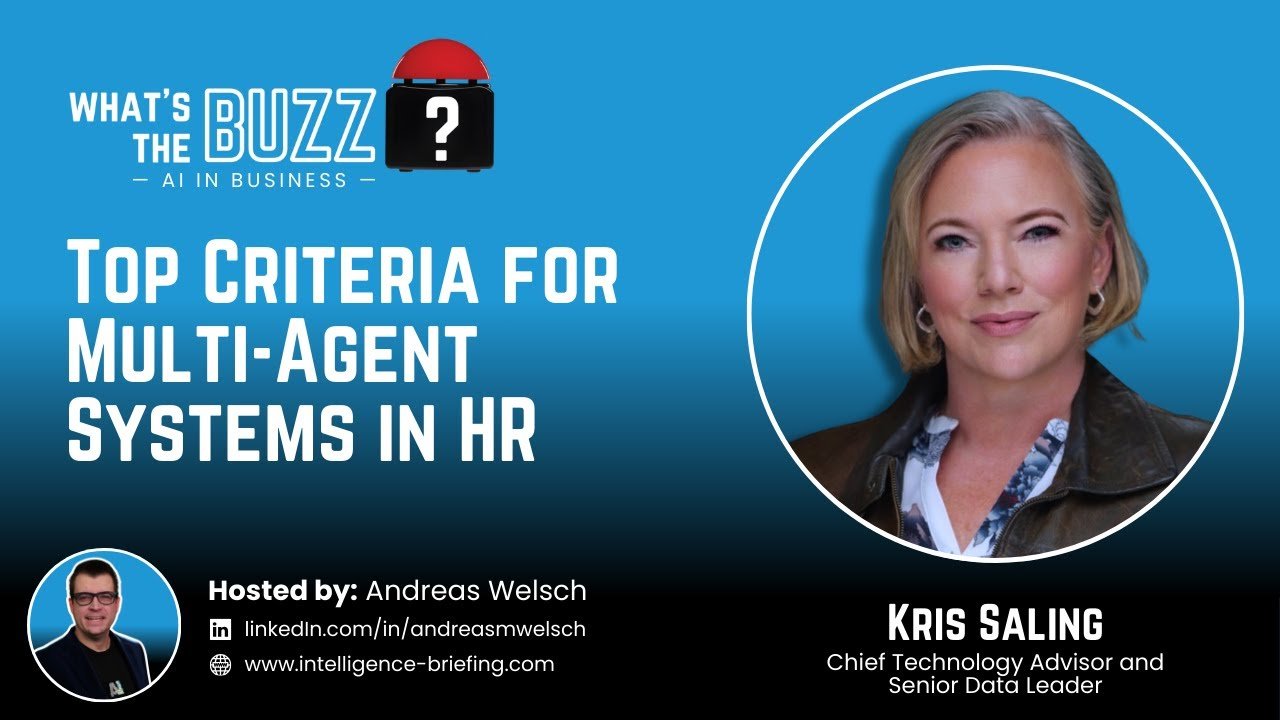
Guest: Kris Saling, Senior Data Leader and Chief Technology Advisor
Host: Andreas Welsch
Episode: What’s the BUZZ?, Season 5, Episode 10
Published: May 27, 2026
Episode Summary
What criteria decide where multi-agent systems belong in HR? Kris Saling, Senior Data Leader and Chief Technology Advisor, joins host Andreas Welsch to answer that question. Saling said the views shared are personal opinions and not official Army opinion.
Saling said AI is a means rather than an end, so leaders should separate what a tool does from what it is for, tie it to business objectives and outcomes, and review how the underlying workflow has to change before buying anything. Saling described using a ring-fenced AI tool to extract draft workflows from SOPs, regulations and policies, then measuring reduction in time and cost avoidance, with paperwork and email pile-ups as favorite targets for an agent.
To decide how many agents to use and how granular to go, Saling uses a framework of eliminate, simplify, automate and elevate. Saling called RPA an unsung hero in the AI space, said a principal agent with a separate supervisory agent is easier to troubleshoot than one complex program, and named ease of finding what went wrong as one criterion.
On governance, Saling wants logs and metadata that show when an agent was built, by whom and when it was last curated, plus the equivalent of a blue checkmark for validated agents, while giving builders a sandbox. Saling also said organizations have to teach domain knowledge alongside AI skills, build skills inventories and career pathways, and keep elevating people into work that humans do best.
Key Takeaways
- Start with what AI is for. Saling said AI is a means rather than an end. Leaders should tie any technology to business objectives and outcomes, and look at how the entire workflow needs to change, not just buy the tool.
- Use eliminate, simplify, automate, elevate. Saling said to eliminate tasks that do not need doing (some are statutory and stay), simplify with a view on who actually needs to see a task and who is the human in the loop, and only then automate. Saling said automation can be RPA, which does not need to be intelligent.
- Keep agents easy to troubleshoot. Saling said one criterion is how easy it is to find which part of a task went awry. Saling prefers a principal agent and a separate supervisory agent over one complex program, so each can be troubleshot on its own.
- Make agents visible and validated. Saling said the logs and metadata should show when an agent was built, by whom and when it was last curated. Saling wants the equivalent of a blue checkmark for an agent that is validated and recently curated, which falls off when no one validates it, and a sandbox for people who build their own.
- Teach the domain, not only the tool. Saling said organizations focus on AI and tool education and forget domain education, especially as AI automates the rote tasks through which people used to learn the system. Skills inventories and career pathways let people decide their next move rather than have it decided for them.
Timestamps
- 00:00:13 Why multi-agent systems in HR, and what happens when you introduce them
- 00:00:45 Welcome and Kris Saling joins
- 00:01:20 Saling describes the role and the personnel domain of about 1.1 million people
- 00:03:05 If AI were a sports car: fast, and in need of deliberate instruction
- 00:04:56 AI is a means rather than an end: what it does and what it is for
- 00:05:56 Using a ring-fenced AI tool to extract draft workflows for business process review
- 00:08:03 How many agents to use and how granular to go
- 00:08:47 The eliminate, simplify, automate, elevate framework
- 00:09:52 RPA as the unsung hero, and a principal agent with a supervisory agent
- 00:12:19 An undocumented legacy tool and what it signals for agents
- 00:13:05 How risk grows as agents are added to a multi-agent system
- 00:14:27 A validation checkmark for agents that are curated and reviewed
- 00:15:32 Governance without stifling innovation, and a sandbox for builders
- 00:18:17 Why domain education matters when AI automates the toil
- 00:19:44 Job descriptions for agents and digital employees
- 00:20:50 HR at the table, talent management and the Waze model
- 00:24:20 Autonomy and agency in talent management, and the Army as a net exporter of talent
- 00:25:21 Saling’s three takeaways: foundations, governance and the human element
About Kris Saling
Kris Saling is a Senior Data Leader and Chief Technology Advisor. In the episode, Saling described being a career Army officer who works for the Assistant Secretary of the Army for Manpower and Reserve Affairs, the closest the Army has to a Chief Human Resources Officer, covering talent acquisition, training and personnel files for about 1.1 million people.
Saling said the job is to bring new technologies, AI and partnerships into the personnel domain, that Saling has worked in the space for the Army for about 10 years, and that the views shared in the episode are personal opinions and not official Army opinions.
Full Transcript
This is a lightly edited transcript.
Read the full transcript
Andreas Welsch: Everyone’s talking about AI agents. Individual ones, multi-agent systems where agents work with each other. But the question is what actually happens when you want to introduce that into the HR landscape. Today we’ll talk about just that. So stick around for more.
Andreas Welsch: All right, welcome back for another episode of What’s the BUZZ, where leaders share how they have turned AI hype into business outcomes. Today we’ll talk about the top criteria for multi-agent systems in HR, and I couldn’t be more excited to welcome my guest, Kris Saling, to the show. Kris, thank you so much for being with us today.
Kris Saling: Well, thank you so much for having me. I’m really excited about this topic. It’s going to be fun.
Andreas Welsch: Fantastic. We’ve been following each other on LinkedIn for a long time, and I’m really excited that you are taking time out of your busy schedule to be with us today. But maybe for those of our audience members who are not familiar with you yet, can you share a little more about yourself, who you are and what you do?
Kris Saling: Sure thing. I’m Kris Saling. I’m a career Army officer. I work for the Assistant Secretary of the Army for Manpower and Reserve Affairs, who is basically the closest that we have to a Chief Human Resources Officer for the Army. And that means we’re responsible for how we manage the talent acquisition, the training, the personnel files, everything for about 1.1 million people. So it’s a significant lift, and my job is to bring new technologies and AI and partnerships into the personnel domain, and it keeps us pretty busy because we’ve got a lot of stuff to manage.
Andreas Welsch: I’m sure. Wonderful. But I also know you’re sharing your personal opinions and experiences with us today. I know you’ve been in the data and AI space for a long time, so I’m very thankful again to learn from you and bring your expertise to our audience.
Kris Saling: I appreciate you bringing that up, because I’m sharing my own personal opinions and my personal background. This is not any official Army opinion, but I’ve been working in the space for the Army for about 10 years, and that’s been enough to accumulate a fair bit of research.
Andreas Welsch: Fantastic. I’m sure a lot has happened in the last 10 years, looking at emerging technologies.
Kris Saling: Oh yeah.
Andreas Welsch: It keeps emerging, right? That’s the exciting part about it.
Kris Saling: Faster and faster. That trajectory is just whoo.
Andreas Welsch: Crazy, yeah. So folks, if you’re in the audience, put a comment in the chat where you’re joining us from. I’m always curious to see how global our audience is. And if you’re looking to learn more about how you can empower and encourage your team members to use AI without creating slop or low-quality content, consider picking up a copy of my new book, The HUMAN Agentic AI Edge, on Amazon and any online retailer. Fantastic.
Andreas Welsch: All right, Kris. Should we play a little game to kick things off in good fashion?
Kris Saling: Sure.
Andreas Welsch: All right. So it wouldn’t be called What’s the BUZZ if there wasn’t a buzzer. I’ll play a little clip and you’ll see the wheels start spinning, and when they stop, I’d love for you to answer with the first thing that comes to mind and why, in your own words. To make it a little more interesting, you only have 60 seconds for your answer. So are you ready?
Kris Saling: Yeah.
Andreas Welsch: Okay, here we go. So if AI were a sports car, what would it be? 60 seconds on the clock. Go.
Kris Saling: So that’s probably your Ferrari, your Formula 1 racer. It’s got a lot of ability to get you from A to B really quickly, but it’s one of those things where you need a little bit of instruction and foundations in how these things operate to drive safely. A few years ago I would have just said plain out a car, but right now this is a speedy, high-performance car that needs very deliberate instruction and handling to be able to use it safely, and we have a lot of possibilities of, you know, parking it in the storefront if we don’t do it properly.
Andreas Welsch: I love that. Perfect answer, right? So, high speed, also high risk, but if you are the first across the finish line, big returns and lots of champagne.
Kris Saling: Absolutely.
Andreas Welsch: Love it. Wonderful. But obviously we’re not here to just talk about cars. The other exciting part of our conversation is how we bring AI, and agents especially, into organizations, whether that is in the public sector or the private sector. I think there are some things that are pretty similar. And I know you’ve been working on some of these things, specifically when it comes to agentic systems, multi-agent systems in the HR domain. But I’m curious, what are you seeing? What are some of the foundations about workflows, about how work is done, that you need to be aware of to decide where agents even make sense?
Kris Saling: I think that’s the biggest thing that I caution people on when they’re looking at integrating any kind of AI into their workflows. It’s a means rather than an end, and I think so many people will sit there and say, “Well, we need AI.” Well, to do what? So what does it do? What is it for? I separate out those questions as I’m talking to my senior leadership and my decision makers, because even if they understand what it does, the what-it’s-for part is tying everything that we bring in, in terms of technology, not just AI, into our business objectives and outcomes. How is it going to get us from here to that outcome? How is it going to do it quickly, safely, effectively? And then what needs to change about that underlying workflow for it to happen effectively? I think a lot of what we need to do as we’re incorporating agents is not just buy the tool, but look at that entire workflow and see how it needs to change.
Andreas Welsch: That isn’t always easy, right? The workflows differ by department, by team, by company. Some things obviously are standardized. Thinking of recruit to retire, that is a big process. But how do you then decide where it makes sense to put an agent in…
Kris Saling: Well, that’s one of the things, too. The minute you start talking about business process review, everybody rolls their eyes and groans, like, “Oh, it takes so long. It’s so hard.” But guess what? There’s an AI for that. So you can take your business SOPs, and in our case Army regulations and publications and policies, and obviously we want to make sure it is an appropriately ring-fenced AI tool that we’re using. We don’t want something open source to leak all of our information into the outer beyond, but we do have tools developed that are contained that we can do this with. We can extract those workflows, at least in a draft that people can edit, so they’re not going in filling out timesheets, “How much time did you spend on this? What did you do?” They have a starting point that makes it a whole lot easier to tweak and edit and say, “Okay, this step is out of line. I really do this.” You can get those things done a lot faster. Then you’ve got a starting point, which I’ll take and feed into an AI tool and say, “Here is the workflow. What are all the different tasks? And give me an estimate on my reduction in time, increase in efficiency.” We’ve got a number of different metrics that we use in this space to figure out what it is we want to do. Sometimes it’s reduction of time. Sometimes it’s cost avoidance. So if I have a human doing it, how many times does a product get sent back for revision? Whereas if a machine does it, it fills it out in the right place, it goes forward, and then we start looking at where the paperwork piles up the most. And it can be virtual paperwork, too. Where do the emails pile up? Where is something sitting in someone’s virtual inbox, in a CRM, waiting to be staffed the most? Those are usually my favorite targets to integrate an agent into the mix.
Andreas Welsch: So I’ve been attending a number of conferences, and I’ve talked to many peers in the industry who are bringing agentic AI into their organizations. The thing that I’m always wondering about, especially when I hear vendors talk about all the amazing things that agents can do, is how do you decide how many agents you need, what they work on, how granular you go? I’m not seeing a lot of conversation there or a lot of information being shared. So I’m curious, what are you seeing? We do a process review, we know we want to put agents in some places, but how granular do you get, for example?
Kris Saling: One of the things I like to do as we’re fielding several multi-agent platforms in the Army right now is break down the tasks, because not everything needs to be intelligent. One of the first things I do is use a framework that we call eliminate, simplify, automate, elevate. So I try to eliminate tasks where we really don’t need to do them. And again, you can use AI for the research. What is the provenance of this task? Why am I even doing it to begin with? Sometimes it’s statutory, there’s law involved, we have to do it. So okay, leave that alone. Other times it’s an artifact of something that was never really polished off, or we mark it as something that we look at for elimination once we integrate AI into the mix. Simplify the process as quickly as possible. This could be something like a RACI chart: who’s responsible, accountable, who actually needs to see this? Who is my human in the loop that needs to review the outcomes and critically evaluate them? Then we go to automation. And I deliberately use “automation” because a lot of times, unless folks are working in the space that you and I are working in, they can mean “I need a very intelligent system of agents, maybe 16 different agents working together on a very complex task,” or this could just be RPA. It doesn’t really need to be intelligent. RPA is kind of my unsung hero in the AI space, because I look at a lot of these processes and functions, and they just need to get done. I don’t need to spend the time and the energy and the money on a complex agent. But then it goes from there. How complex is the task? Does it make more sense for the guardrails to have one agent doing all the work, or do I add one principal agent and then a supervisory agent that comes back through and cleans it up afterwards? Because for me at least, in the workflows that I use to build these, it’s easier if it’s separate, because then I can troubleshoot the functions in one and troubleshoot the functions in the other, and I’m not troubleshooting an incredibly complex program. And just for background, I’m a mathematician. I am a brute force coder at best when it comes down to it. I like to keep my workflows simple. So that’s one criterion I use: how easy is it for me to go in there and figure out what part of the task went awry?
Andreas Welsch: That makes a lot of sense. And especially encapsulating or compartmentalizing what the functions are that this agent does, defining it at a level where it’s not too expensive or too complex, so that it doesn’t get confused, but you can troubleshoot it, too. I think that makes a lot of sense. I’ve been approaching my latest builds in a similar way too, to say, “This is the one function that you’ll do,” or “Here are the different tasks and tools that you have.” But to your point, if there are defined roles, it gets easier to troubleshoot or even to test things in isolation.
Kris Saling: I think that’s something, too, that we want to think about for our future workforces. Because if you’re building these things, testing these things and operating these things, you’ve got to be cognizant of your time. How much time do you want to spend making sure this works, or can you add in another helper agent that can help you with that? Because I think we talked a little bit about the workforce earlier, the large development teams of the past are kind of a luxury. We’re not going to be able to have them, either because of demand signals out in the workforce or just scarcity of being able to grow some of these capabilities.
Andreas Welsch: So about 8 or 9 years ago, I was working with a Fortune 100 company, a big company in oil and gas, and I was very surprised when we looked at some of the finance processes. They said, “Oh, and we have this little custom-built tool here that a contractor built for us 15 years ago. We’re not really sure what it does. The person has moved on. The documentation got lost somewhere, but we cannot touch or replace this because we’re too concerned that if anything changes, we’re not able to pay our bills.” It’s like, “Oh wow. Okay, a multi-billion dollar company with something that critical.” I’m getting flashbacks of the intern-developed apps and things that are floating around in corporations that nobody really knows anymore how they were built or where the source code is, and that we might be running into something like this over time with agents as well.
Kris Saling: We deal with that a lot.
Andreas Welsch: Right? So I’m curious, how do you see not just the governance and the rigor of building and documenting agents, but more so when you add more and more agents to make a multi-agent system, how do you think about risk when it’s not just additive, but grows exponentially with every agent that you add to the equation?
Kris Saling: Yeah, I think it’s similar to what we did with a lot of our code when generative AI first came out. I thought that was wonderful, because I could go into my code, and I wrote it 2 years ago; I code totally differently now than 2 years ago. “Comment this for me. Figure out what each of these modules are so I can swap them out.” I see us doing a lot of that, too. I’ve got a multi-agent system: “Agent, go inventory all my agents. Go find everybody, find their core task.” And I think that’s where we really have to get into the individual data, the logs, the metadata, the kind of routine boring information that should be captured in the background, and just ask, “When was this thing built and by whom? When was the last time it was curated?” We started doing that a few years ago with different data intelligent catalog platforms. They could tell you the last time the data was curated. It allowed people to rate systems. That’s one thing I do want for agents as we start fielding them more throughout our organizations. I want to know what the equivalent of the blue meta checkmark is for an agent that has been validated and recently curated. And I want that to fall off if nobody has validated this agent or if it hasn’t been curated. I want to know that somebody has taken a look at it, a mechanic has looked under the hood, they’ve tweaked all the things, it’s good to go, or this is use at your own risk.
Andreas Welsch: I think that’s so important, and when we see a revival of citizen development, like “build your own agents,” I feel that in many ways challenges exactly that: the governance structure, knowing what is actually happening in my own environment, who’s built what agents, what they have access to, what kind of data they process or might inadvertently expose, things like that.
Kris Saling: Yes.
Andreas Welsch: I think especially to get to more of that enterprise-grade, hardened environment and governance, that’s the next level of orchestration and governance solutions that we need to see pretty quickly to keep pace with the deployment of agents.
Kris Saling: One of the things we want to do is figure out the balance where we don’t stifle innovation, because now that everybody can develop these tools, you’re going to get some great ideas, and that’s really the common currency right now. It’s not necessarily the technical acumen, because you can develop that. You can have your AI come in and either do some of the work for you or come up with a training plan for you. It’s the what-it’s-for piece, and I love seeing, especially on the Army side, what soldiers are developing. At the same time, I want them to have a sandbox to do it, and the ability for me to come in and say, “This is great. Your answer goes off here. It should be here. Let me help you figure out the right stuff to do to either tweak the model or get the right data to use in your model so that you can move over here into the validated side.”
Andreas Welsch: So I’m absolutely with you, right? Governance, as soon as you start mentioning that term, people go like, “Whoa, whoa, whoa, you’re bogging me down. It’s red tape. It’s policies.”
Andreas Welsch: Yes, right? But at the same time, to your point, you need to strike that balance between knowing what is happening and giving people guidance, but at the same time embracing and encouraging that level of innovation, because at the end of the day, the people that are closest to the work also see where the issues are, and they very likely come up with solutions for it if they know enough about the technology and what it can do.
Kris Saling: And if they know about the domain side. This is one of the arguments we have right now, too. I come back to the analogy that AI is a car a lot, because you need folks who understand how it works from a mechanical standpoint, not maybe from an engineering-from-scratch standpoint, but how much domain knowledge is sufficient for you to be able to build a good and useful tool? Somebody who has just driven a car a few times probably isn’t necessarily going to be the person you want building another one. Although they are a good test market to tell you what features it needs to have. And I bring that up just because we’ve had people who have built decent tools, but they’re foundationally erroneous, just because they’ve been a user of the domain system that they’re trying to improve. They don’t understand all of the foundational underpinnings. And that’s kind of a challenge. I love their initiative, but how do we get them the right level of understanding of the system?
Andreas Welsch: I think that’s so key. How do you do that? Do you have some formalized training programs? Do you have office hours? Do you have town halls? How do you source information, and at the same time stay only an arm’s length away if they need help?
Kris Saling: Yeah, I wish I had a good answer for that. We’ve talked about this a little bit too. We focus so much on providing the AI education and the tool education that we’ve really kind of forgotten that we need to provide the domain education too, especially where these AI tools are taking over from where people were getting that domain education to begin with. And they get it, unfortunately, by doing the toil. By doing the rote boring tasks that build up your understanding of the overall system, and then you know, okay, this is why we do it, and once we automate it away, you understand what went into that automation. But if that automation is there instantaneously, or it’s already there when you get there, how do you understand those foundations?
Andreas Welsch: So in a way, it’s kind of like we still teach the foundations of electricity to an electrical engineer, even though we just plug a device into the socket, right? We still need to understand physics or chemistry to be able to work at higher levels of it.
Kris Saling: Yeah, there’s a little more on the input and output and all these things that we need to understand. It just goes input, output, into a black box. There’s logic that went into the building of the box. How do we see that and understand it in a way that provides that kind of domain expertise that I think we’re really going to be thirsty for in coming years?
Andreas Welsch: Now, obviously a lot of that innovation when it comes to agents, when it comes to multi-agent systems, is similar to how we think about humans, how we think about human teams. In my book, I make the case that you need to have a job description for your agent. It’ll need to abide by some kind of code of conduct, whether it’s values or professional standards, think about IFRS or similar ones. You need to tell them what tools are available, what data is available, what other agents are available to collaborate with, and how to find them. So that’s how I usually think about them: as digital employees, just in that sense of governance, guardrails, guidelines, similar to humans. At the same time, they’re just a piece of software, so you’re still responsible for the decisions and actions that it takes.
Kris Saling: Yes.
Andreas Welsch: But from an HR point of view, how do you see that? It’s evolving rapidly. We’re talking about hybrid workforces of humans and systems, or humans and AI. But a lot of times I see HR isn’t even at the table. What are your observations?
Kris Saling: We are constantly fighting to be at the table on the HR side, because it’s just like, “Well, that’s the human side. You’re just doing the transactional human work.” Well, we need to be doing more than that. We need to be doing full spectrum talent management, which I separate out from HR, because HR has your transactional functions. You’re making sure people get managed, they’re paid, their documents are correct. We want to make sure that we are developing our workforce, that we are categorizing and reevaluating, that it becomes a continuous evaluation of the skills inventory and the requirements of the job. That way we can make more effective pivots, more effective matches. And we can create tools. I call this our Waze model for talent management. Again, a lot of analogies with cars. Because with Waze, you give it your data and it tells you how to get from point A to point B, using the rest of the data repository and what it gets from the Department of Transportation, more effectively. I want to create tools like that for my employees, so that they’re not just filling out another skills assessment, filling out another preferences survey. I want them to be able to see, here are the things I can do, here are the jobs out there that I’m qualified for as I grow my career through this organization, or in the cases where I see some of my tasks getting automated, I need to figure out what my next progression is. Well, let’s do this. And that also gives you a way to use the tools and benefits you offer as a company and say, now I’m not just giving you CPE credits. I’m not giving you certification or certification funding. I’m not providing all these other things. This is how you use it to get to that next goal.
Andreas Welsch: I think that’s so important right now, because I see in the private sector a lot of talk about, “Hey, we cut off the bottom, we give that to AI, we don’t need entry-level people or roles. AI will do all of that.” And then some organizations are already waking up to the fact that, oh boy, we need to build a talent bench. Who’s going to succeed our senior leaders and experts that are in these roles now once they move up and out? But at the same time, there’s not a lot of clarity on what it takes to become more senior and an expert now that AI supposedly can cover the bottom part of it. That’s where I think what you’re sharing is so important. Yes, part of your work will eventually be delegated to AI and to agents, but what is that other part that we want to help you qualify for and learn about and become more proficient in? So again, you have a 100% role, not just a 60% or a 50% role.
Kris Saling: No, exactly. I think we have to be more flexible in the way we think about careers, and everything’s going to be evolutionary. The job that you take is not going to be the same job a couple of years down the line. It’s going to be very different. Your task load is going to evolve. You’re going to be partnering with automation more than you thought you would. You might have a totally different role that you’ve moved your way into. But I think doing the skills inventory and providing these different pathways that people have in order to grow makes it a decision on their part rather than a decision that’s made for them as these tasks are getting automated away.
Andreas Welsch: Sounds like in a lot of ways, when you have ownership of the decision and of your own destiny, it feels a lot better, because you feel a lot more in control rather than something happening to you. It’s happening with you, or because of you, or because of your own initiative, right?
Kris Saling: In all of the talent management efforts I’ve been a part of on the Army side, we’ve really prioritized autonomy and agency. It might sound counterintuitive in the military, but we are an all-volunteer force. Everybody has raised their hands and signed up to do this. And retaining our talented workforce means they’re continuing to volunteer. So we want them to continue to volunteer for things that are good fits, for opportunities they see as beneficial, and for things that will make them good citizens whenever they finally depart service. As I’ve said often, both in official and unofficial capacity, the Army is a net exporter of talent. After a certain amount of time, whether it’s their initial term of service or a career where they retire from service, we are giving people back to the American community. And our goal is not to just keep people forever. It’s for them to go out and be massively successful contributors to the American workforce. The more we can give them to be able to do that, the better off we all are.
Andreas Welsch: That makes a lot of sense. And I think especially in this time when there’s change, when there are opportunities to evolve and make the next career step as you progress. Now, Kris, I can’t believe that we’re almost at the end of the show. It feels like time has gone by so quickly. But I was wondering, before we wrap up, if you can summarize the key three takeaways for our audience today.
Kris Saling: I think the key takeaways are that the foundations still matter. You brought it up with how we teach physics and electricity. We have to think about the foundations from all the different aspects of our business and the aspects of the technology, and how we are going to incorporate a baseline understanding of this. The other is, this is a fast car. It’s moving quickly. If we understand how to drive it appropriately, it’s going to be great. And we have to realize that there are a lot of other cars on the road and we have to be able to play well with them. I think that comes in from the governance aspect, because everybody kind of goes, “Ah, this is bureaucratic.” It’s the traffic laws. It keeps us from crashing. And then I think the last piece is the human element. Everybody worries that we’re going to have these fleets of agents that are going to take everything. We also thought once upon a time that everybody’s jobs were going to go away because we implemented machinery in manufacturing. And some of your older audience will remember all the effectiveness that email was going to give us, because you weren’t traveling from desk to desk. It just made more work. So our work is going to evolve. AI is going to take our tasks. I don’t think it’s going to take our jobs, as long as we’re able to keep using that eliminate, simplify, automate, elevate framework, and we keep elevating our human workforce into the work humans can do and getting rid of the other things that keep us from doing that work humans can do.
Andreas Welsch: I love that. So encouraging and powerful to come back to our human capabilities, and to determine what it is that makes us really good and makes us really human at what we do as well.
Kris Saling: Exactly.
Andreas Welsch: Kris, thank you so much for sharing your expertise with us. It was a pleasure having you on. I learned a lot about how to think about multi-agent systems, how it evolves, how it involves HR as well. And I hope you and the audience are taking away a lot of good learnings as well.
Kris Saling: Awesome. Thanks so much for having me. This was a really fun conversation.
Andreas Welsch: Awesome. Thank you so much. And folks, see you next time for another episode of What’s the BUZZ. Bye-bye.
Listen and Subscribe
- Watch on YouTube
- Listen on Buzzsprout (show page)
- Listen on Apple Podcasts (show page)
- Listen on Spotify (show page)
Related Reading
- Agentic AI for Enterprise Leaders
- AI Governance for Enterprise Leaders
- The HUMAN Agentic AI Edge by Andreas Welsch
- Human in the Loop vs On the Loop: The Agentic AI Edge
- Agentic AI for the Workforce: AI Leadership Lessons
- AI and Entry-Level Jobs: Protecting the Talent Bench
Frequently Asked Questions
What is the eliminate, simplify, automate, elevate framework?
Saling described it as the framework used to break down tasks before deciding what needs an agent. Eliminate tasks that do not need to be done, after checking why each exists, since some are required by law. Simplify the process, for example with a RACI chart and a named human in the loop who reviews outcomes. Then automate, which Saling said can mean RPA rather than an intelligent agent, and elevate people into the work humans can do.
Where should an organization start with AI agents in HR workflows?
Saling said to start with the business objective and the workflow, not the tool. Saling uses an AI tool to extract a draft workflow from SOPs, regulations and policies, measures reduction in time and cost avoidance, and then looks at where paperwork, email or items waiting in a CRM inbox pile up the most. Saling called those usually the favorite targets for an agent.
How many agents does a multi-agent system need?
Saling said it depends on how complex the task is and whether the guardrails call for one agent or several. Some work needs only RPA, while a complex task might involve a system of many agents. Saling’s preference is a principal agent plus a supervisory agent that cleans up afterwards, because the functions can be troubleshot separately.
How can an organization keep track of many AI agents?
Saling said to capture logs and metadata in the background that show when an agent was built, by whom and when it was last curated, and compared this with data catalog platforms that show when data was last curated. Saling wants a visible validation mark for agents that have been reviewed and recently curated, and a sandbox where employees can build before moving into the validated side.
What is the Waze model for talent management?
Saling used the name for tools that let employees see the jobs they qualify for and how to reach their next goal, in the way Waze uses a driver’s data and other sources to route from point A to point B. Saling said the aim is to avoid more skills assessments and preference surveys, and to show how training, certification and other benefits connect to a person’s next step.