

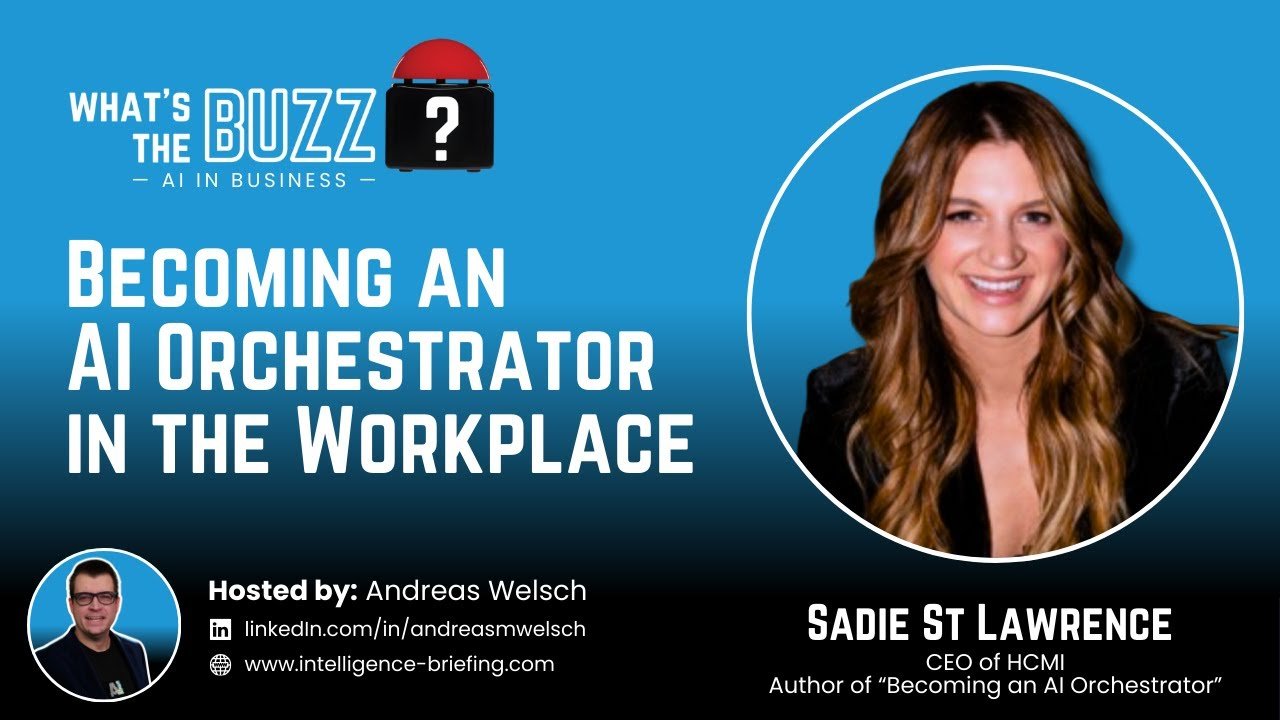
Guest: Sadie St Lawrence, CEO of Human Machine Collaboration Institute
Host: Andreas Welsch
Episode: What’s the BUZZ?, Season 5, Episode 4
Published: February 18, 2026
Episode Summary
Work is shifting from doing to orchestrating AI. Sadie St Lawrence, CEO of Human Machine Collaboration Institute, joins host Andreas Welsch to explain what becoming an AI orchestrator means in the workplace and what leaders should do first.
St Lawrence said work is moving from doing to asking, from editing to narrating and from playing to orchestrating. Even individual contributors have to think like a manager, because AI is at their fingertips. She compared AI to a symphony in which the human is the conductor, and said deep expertise still matters.
Managers and individual contributors make opposite mistakes, St Lawrence said. Managers do not try AI enough themselves, and individual contributors have little experience delegating. For leaders who are unsure where to start, she advised getting hands on the keyboard and then thinking in systems, so the tech stack supports the business strategy.
The conversation also covers her book Becoming an AI Orchestrator, why people’s concerns tend to fade once they use AI themselves, and her company’s work with the city of Rancho Cordova and Nvidia on an AI and robotics ecosystem for small and medium cities.
Key Takeaways
- Work shifts from doing to orchestrating. St Lawrence described a move from doing to asking, from editing to narrating and from playing to orchestrating. She said everyone, even an individual contributor, has to think like a manager and a leader.
- Expertise matters more, not less. In her conductor analogy, St Lawrence said AI gives you a first rough draft, and getting to a masterpiece takes deep expertise. She said AI is not replacing people. It forces them to be smarter and go deeper into their subject areas.
- Managers and contributors need each other’s skills. St Lawrence said managers should use their skill at telling people what to do on AI. Individual contributors, used to being given tasks, have to learn how to delegate.
- Start by using it, then think in systems. St Lawrence said nobody needs technical expertise to begin. She then pointed leaders to how data is collected, stored and governed, and fed to the AI model, with a tech stack that mirrors or supports the business strategy.
- Using AI yourself reduces the threat. St Lawrence said that when people start using AI themselves, the threat typically goes away, because they see how intelligent and yet how silly some of the models are.
Timestamps
- 00:00:12 Work is changing and we will all become AI orchestrators
- 00:00:48 Welcome and Sadie St Lawrence joins
- 00:01:28 Her new book, Becoming an AI Orchestrator
- 00:02:58 Dictating the book instead of typing it
- 00:05:07 If AI were a band: a symphony with the human as conductor
- 00:06:24 The conductor analogy and why deep expertise still matters
- 00:09:32 How work shifts from doing to asking and from playing to orchestrating
- 00:11:31 Two mistakes: managers who do not try AI and contributors who do not delegate
- 00:13:50 Where leaders start: hands on the keyboard, then systems thinking
- 00:15:30 An engineering firm where the knowledge sits in people’s heads
- 00:17:05 Tech debt, tool sprawl and architecting the tech stack
- 00:18:33 What is in the book and how to scale from yourself to your community
- 00:20:34 People who do not want to become AI orchestrators
- 00:23:23 Corporate AI lags what is available on the market
- 00:24:09 The strawberry example and thinking models
- 00:24:52 Hugging Face hallucination rankings as a benchmark
- 00:26:26 AI in the physical world: AI and robotics ecosystems for small and medium cities
- 00:30:14 Three key takeaways
About Sadie St Lawrence
Sadie St Lawrence is CEO of Human Machine Collaboration Institute. In the episode she said she has worked in AI for 10 years, and that she has released her first book, Becoming an AI Orchestrator, a business professional’s guide to leading, creating and thriving in the age of AI.
She also said her company has partnered with Nvidia and the city of Rancho Cordova to start building an AI and robotics ecosystem as a flagship model for small to medium cities.
Full Transcript
This is a lightly edited transcript.
Read the full transcript
Andreas Welsch: We all know work is changing, but we’re not really sure how and how exactly we can adapt. But one thing’s for certain, and that’s that we’ll all become AI orchestrators pretty soon. Today, we’ll talk about what that actually means and how work is changing and how leadership is changing. So, let’s jump right in.
Andreas Welsch: Hey, welcome back for another episode of What’s the BUZZ, where leaders share how they have turned AI hype into business outcomes. Today we’ll talk about how you can become an AI orchestrator in the workplace. And I’m so excited to welcome Sadie St Lawrence to the show. Sadie, thank you so much for joining.
Sadie St Lawrence: Thank you so much for having me. I think this is the second time being on the show, so it’s great to be back. I love watching these. I love hearing what you’re doing and the conversations that you curate. So, it’s an honor to be here.
Andreas Welsch: Wonderful. Thank you so much. Now, the title of the episode, we didn’t choose that by accident. You have some news to share. Maybe jump into that, and maybe also share a bit about who you are and what you do for those of our viewers and listeners who might not be familiar with your work yet.
Sadie St Lawrence: Yeah, thank you. I just released my first book, Becoming an AI Orchestrator, a business professional’s guide to leading, creating and thriving in the age of AI. And I have so much respect now for anybody who’s written a book. Yes, you have your own copy. Great product placement and timing. I know you’re on your second book now, so I have so much respect for anybody who’s written one book. It’s definitely, I would say, a labor of love, but also so fun to be able to put all your thoughts, particularly around AI, when it’s such an exciting time in this space and there’s so much to talk about.
Andreas Welsch: Wonderful. I’m looking forward to diving in. I’ve already read a couple of pages since it arrived in the mail the other day. But I also feel it helps you articulate and clarify your thoughts at a time when it’s so easy to just delegate to ChatGPT and Copilot and Claude and whoever else, say, “Do this work for me.” But actually sitting down and thinking about how do I structure this? Is this really what I want to say? What are some other or additional angles? I think that really sharpens one’s perspective as an author as well.
Sadie St Lawrence: I would say a lot of people came out and said when ChatGPT came out that writing a book was dead and there’s no point to writing it. I think the exact opposite. If you go through it, you realize that none of these tools will write a whole book for you. While they are helpful agents, it is still you who has to author it. And then you have to find your own workflow. For me, what I ended up doing, a lot of it was actually dictating the book through my mic. I just felt like it was the easiest way to make it still sound like me and my voice. And for me personally, I found out that I can talk a lot faster than I can type. So being able to get a first draft out on paper by using this big podcast microphone worked really well for me. You are pretty much reading a book that I just spoke into this microphone.
Andreas Welsch: You can definitely hear that voice and your tone in there for sure. Folks, if you’re in the audience and you’re just joining, please drop a comment in the chat where you’re joining us from. I’m always curious to see how global our audience is. And like Sadie said, I have some tiny or bigger news to share as well, and that’s that I’m working on my second book. It’s called The HUMAN Agentic AI Edge, and it’ll be out at the end of February. So make sure to get a copy of that on Amazon. That’s all about how you can empower your team members, how you can empower your peers to use AI responsibly. And responsibly in the sense that you don’t just create the first draft and send it off and say, “Hey, can you take a look at this?” And then the recipient says, “Oh, well, come on. They just created it with AI, but didn’t really spend a lot of time getting this from good to great.” So how do you actually do this? How do you do that as a leader to empower and encourage your team members to use AI well? But enough about that. Back to our episode and into our topic. Sadie, should we play a little game to kick things off?
Sadie St Lawrence: Yes. I love these games.
Andreas Welsch: Okay, so here we go. If I press the buzzer, you’ll see a sentence. And I’d love for you to complete the sentence with the first thing that comes to mind and why in your own words. To make it a little more interesting, you only have 60 seconds for your answer. Are you ready for What’s the BUZZ?
Sadie St Lawrence: Yeah, I’m ready. Let’s go.
Andreas Welsch: Okay, so here we go. If AI were a band,
Sadie St Lawrence: Where would it be, or who would it be? Okay. Well, this is perfect, because I just wrote a whole book on AI orchestration. So it has to be a symphony, because we, the humans, are the conductor and AI is all of the instruments in the symphony. So it plays many different roles, everything from the violin to the trombone to the cello. It would definitely have to be a symphony.
Andreas Welsch: I love that. I’ve been waiting for someone to give that answer, because I’m a musician, too. I play percussion and keyboards and a bunch of other instruments. So
Sadie St Lawrence: You are AI. I was always wondering if you really were AI.
Andreas Welsch: I hope I just embody it in some place. But also hopefully there’s a lot of human intelligence left as well, at the end of the day.
Sadie St Lawrence: We’ve met in person, so I know you already had AI, but
Andreas Welsch: But it does take a lot of orchestration, a lot of conducting and making sure that all the different players, all the different pieces, all the different parts come together.
Sadie St Lawrence: Well, for sure. Yeah, I think my favorite part about the orchestration and conducting analogy is that if you know music, you realize that the conductor is typically one of the older people in the orchestra. And the reason why, I read somewhere, is that there typically isn’t a conductor who’s under the age of 40, just because of the amount of time it takes to truly learn and understand the music and to be able to lead something like a symphony. And I love this analogy so much because it just goes to show the same thing: when working with AI, you still have to have all that background knowledge. You have to have all that skill. It’s not farming it off to AI. It is there just to assist you and to help you. But in my opinion, for some areas you almost have to be more knowledgeable and more skilled than you were before, because it will give you that first rough draft, right? Which is where basic skill is needed. But really to get it to that masterpiece, you have to have that deep expertise. And so that’s one of the reasons why, if you know music and understand, you’ll get the nod. I think it is such a great way to think about AI: it’s not replacing us at all. If anything, I think it’s forcing us to be smarter, better, and go deeper into our own subject areas.
Andreas Welsch: And I think in music and in work as well, to pivot a little more toward the work side, for those of you who maybe enjoy listening to music more than making it. Yes, it’s obviously gotten a lot easier even to create music, and all these AI music generators are equivalent to creating text and copy with the text generators. But like you said, there is an art and a skill still to creating something, to putting thought into it, to putting your expertise into it, to doing research. And yes, AI helps you do the research faster, whether that’s at work or for a school project or for a college project, but you still need to have enough of that expertise. But I’m wondering, what are you seeing in your work with different organizations? How is work changing when, yeah, sure, we can delegate to an agent, we can delegate to AI, or we can orchestrate them? How is work changing?
Sadie St Lawrence: Yeah. So, back to the idea of the orchestrator, you have to have a very clear idea of what you’re trying to do and what you want to achieve. I’m old in AI, right? I’ve been in this field for 10 years. So 10 years ago, when we were talking about big data and giving people access to some of these models, the fear was, well, how will anybody know it’s the right result? Because we understand that any machine learning algorithm is going to spit out an answer regardless of whether the answer is correct or not. You will get an answer. And so there’s a lot of fear around that, because people who are not skilled in a particular subject matter of expertise may take that to be true. And these models have gotten much better at looking like they’re true, right? But on the flip side of that, it just goes to show how much we need to have deep area of expertise and a true vision for how we’re looking to use these models and, most importantly, what we’re looking to create. And so how I see work changing is really shifting from doing to asking, from editing to narrating, from playing to orchestrating, moving into a role where everyone, even if you’re an individual contributor, has to level up in the organization to almost think as a manager, because you won’t have somebody now who’s just distilling a task for you and giving it to you. I could do that easier now with AI. So you need to think like a manager. You need to think like a leader wherever you’re at in the organization, even as an individual contributor, because we have AI at our fingertips today.
Andreas Welsch: That resonates so deeply with me. I’ve been thinking about this over the summer as well. I was giving some talks, keynotes, one for the Project Management Institute in July, and we were talking about how does work change, how do you need to change, and what it came down to for me was how do you delegate. In many cases, if you’ve been a leader in a business before, it’s becoming second nature. Maybe you’ve been fortunate to attend some leadership trainings, becoming a first-level leader, becoming a middle-level leader. But in all of these meetings and trainings, what they hammer in is, think about delegation. What is the objective? What do you want the outcome to be? What is the context? What other people, resources, information does the individual need to work with? How do you measure the output? What does good look like? And what does a timeline or a deadline look like, by when you need it back? And I feel a lot of these things we’re now seeing as users, as professionals, as individual contributors using these tools were probably more formalized frameworks for managers and leaders thus far. Now you need to know that too, right?
Sadie St Lawrence: Yeah. And what I would say is I see two mistakes. One is a mistake from managers not trying AI enough themselves and giving it to their teams to try, when it’s like, no, you’re great at telling people what to do, so tell AI what to do, right? Put that skill to use. And then I see the mistake from the individual contributors on the flip side of, you don’t have any experience delegating tasks, right? You’re used to being given things, and so you have to work on the opposite side, which is, how do I delegate work, right? And so it’s a funny world where both almost need to flip roles for a little bit. I know sometimes I’ve done work swap roles, where you do somebody else’s job for a little while. So I think we need to see more of that from a management and individual contributor standpoint, just so that it will get us more used to working with AI from that perspective as well.
Andreas Welsch: Yeah. I’ve been seeing this lately in my work with manufacturing companies, specifically smaller, mid-size companies where the founder and owner are the same person, and even many of the managers were promoted to a managerial role because of their expertise. We’ve seen this for a long time. Expertise as a stepping stone into management, not necessarily people skills, not necessarily the coaching aspect, not necessarily the more modern aspects of leadership. And I think there it’s incredibly hard for many leaders and business owners to acknowledge, “Hey, here’s something new that I don’t fully understand, that I don’t fully know. I’m not the technical expert in this topic, but it’s really important for our business to embrace it, to learn more about it, for our team members to learn more about it and to create that kind of culture and change,” right? What are you seeing there, and what’s your advice for leaders who know, “I actually should be doing something more with AI, but I’m not really sure where to start or how to start because I’m not the expert myself”?
Sadie St Lawrence: Yeah. So, first I would say get your hands on the keyboard. You don’t have to use a keyboard. You can use your cell phone. You can talk to it. But start using it yourself, because it will open up your mind to the art of the possible. And this is not something like it was in the days of big data or switching to social media or Web 2.0, where you need to have that technical expertise. Nobody needs technical expertise. So that’s first and foremost. And then second, from a business perspective, you have to start thinking about this from a systems mindset. And I think this is going to be one of the most in-demand skills come the next decade, just because we need to make sure that we’re establishing the systems to fully implement AI into our business. So everything from how we’re collecting data in our products and services, how we’re storing and governing that information, and then how we feed this into the brain, the AI model, so that we can intelligently use that back in our business. And so I see a lot of executive teams looking to use AI but haven’t set up that systems-thinking mindset and really don’t know the layers of their business from a technology perspective. And to me, you should have your tech stack mirror, or at least support, your business stack, your business strategy. And so if you haven’t taken those key steps where you have evaluated and said, “Does this tech strategy, does our tech stack mirror what our business strategy is and support our long-term growth from a systems perspective?” then you’re going to probably be left behind in the AI race or be spending a lot of time trying to catch up.
Andreas Welsch: I have a great example. At the beginning of last year I met with the C-suite leadership team of an engineering firm here in the northeast in the US. They’ve been in business for 60, 65 years roughly. The CEO has been with the business for about 45 years of his career, and they were looking to bring more AI into the business. So they gave a bunch of people Copilot. They built a little community around it. But then they wanted to learn more about how they can use AI in other parts of the business and use it more strategically. “We would love to do win-loss analysis and figure out where we won, where we’ve lost and why, and if we’re overpricing, underselling,” these kinds of things. So we started talking about what kind of data do you have? How do you do that today? It came down to, “Well, I asked Paul, who’s always worked on these projects, and Paul will tell me.” And I said, “Well, what do you do if Paul is unavailable?” “Well, then I asked Jenny and maybe she knows.” So, where does it exist in your employees’ minds? And that’s something that I see a lot. On one hand there is the recognition and realization that we need to do something with AI, but to your point, the foundation is not necessarily there, because previous waves of technology were delayed, were maybe not categorized or recognized as being important. So many need to put that foundation in place as well.
Sadie St Lawrence: Yeah, and I think beyond even that, individuals are still doing the work, right? We have things in spreadsheets, or we have a ton of tech debt. What I’ve seen is also overspend on a lot of technology, where you’ve bought 10 different solutions that kind of do the same thing, and so now you have data siloed in multiple places. And so maybe you’ve tried to stay current with each of the technology trends, but you’ve never had an enterprise architect or a chief architect to really architect that strategy. And so for me, it always comes down to first architecting: what does the tech stack actually look like? And you’d be surprised how many times I’ve talked to CEOs and they’re like, “Wait, this is all the technology we have and this is how it connects?” And I’m like, “Yeah, no one’s ever shown this to you.” They’re like, “No.” And they start pointing to things and realizing, “Oh, I get why this doesn’t work.” And so I’m again a big fan of a picture is worth a thousand words, and I love taking what is in a digital world and putting it in a physical world. Hence maybe writing a book. That was so fun, because all the things in my brain have to now get down on a physical piece of paper. So
Andreas Welsch: So can you talk to our audience a little bit more about Becoming an AI Orchestrator? What else will they find in the book?
Sadie St Lawrence: Yeah. So it really came from actually three years ago is when this started, and I just noticed how much myself was changing in the way that I was working and the mindset shift that I needed to get there. And so this really starts from the beginning, which is how do we start to think about these systems, what is the history of AI, most importantly what are its capabilities today, and how do we update our mindset in terms of using these capabilities. So it’s all about going through essentially the 10 different ways that I use it in my workflow and then how do we make sure that we’re using that responsibly? How do we put our own mask on first and then how do we scale it up to our team? So again, I’m a big fan of, before I have anybody do anything else, I need to do that myself, and then scaling it up to my team, to my organization, and most importantly ending with our community and giving back to the community through helping bring others along in this space as well.
Andreas Welsch: Perfect. And where can people find Becoming an AI Orchestrator? I think you may have a new subtalent of holding up products. I haven’t known this about you, but you’re very good at it. There we go. I love it.
Sadie St Lawrence: I have one of my own copies too, of the first one, the AI Leadership Handbook. You can find it, probably the easiest place is on Amazon, but if you just search for it, you can find it in all the major book publications.
Andreas Welsch: Awesome. Thank you for sharing more about that. And I’m wondering, as more technology enters the workplace, as more companies are thinking about how can we use AI, how can we use agents, how can we help our team members build agents, probably not everybody is so excited about it. I see a lot of confusion. I see a lot of concern. Not just in the US. I do a good amount of work in Europe and in Germany as well. And I’m wondering, what do you do with people who don’t want to become an AI orchestrator, who are pretty happy with what they’ve been doing for the last 10, 15, 20 years?
Sadie St Lawrence: Yeah. So, I’m a big fan of not giving people advice unless they ask for it, right? So anybody who doesn’t want to become an AI orchestrator, don’t read the book. No, I’m just kidding. But I’m not trying to convert anybody who doesn’t want to. What I do try to help people understand is, again, getting your hands on the keyboard is so essential. To be honest with you, I give talks all across the world, and just as I’m sure you hear a lot of questions regarding safety and ethics of these models, to be honest, I can tell a lot of the questions haven’t come from a place where they’ve used some of the most recent models or understand what’s been done. It’s coming from an old news article, right? And again, this is our job, to stay up to date on this type of stuff. So I completely understand that everyone else maybe is not reading the news articles daily on this. But what I found with individuals is typically when they start using it themselves, the threat goes away, right? Because they realize how intelligent but yet how silly some of these models are, right? Yes, it has passed these scores, but it’s locked in a box, right? And unless you prompt it, you aren’t going to get anything out of it. And so I think for me it always comes down to how do we enable people, how do we train people, and how do we get more diverse people to the table using these tools, because they’re going to have different interpretations of it, they’re going to find new use cases for it, or they’re going to find problems with it. And so for me, it’s all about how do we get good people in the game, doing good things, and testing and prototyping, versus reading a news article and never trying it for myself.
Andreas Welsch: I think that’s really good advice. Whether you’re a leader, whether you’re a professional, hands on the keyboard or on the phone, try it out. There’s hardly an excuse anywhere. Most of the tools are free, at least to get started. But you said something
Sadie St Lawrence: In my car now, you know. I drive a Tesla, and they put Grok in my Tesla. And so it’s one of my favorite ways, like, I’m driving home and I can brainstorm or prototype, and then go from my car, doing hands-free talking, back to my computer when I get in the office and have my full chat already worked through. So you have no excuse anymore. You can do it in your car. I did see that one of the car companies was looking at adding Microsoft Teams into their car, and everybody hated that. So maybe not everything in your car is a good idea.
Andreas Welsch: Well, yeah, that’s for sure. But you said something earlier that I think was very relevant. You said an old news article. AI is advancing so quickly. Last month I gave a workshop at a financial services institution, and the AI leader said, “Hey, when you come in, can you tell our people that corporate AI is very, very different from what’s actually happening out there?” So it’s very regulated. It’s very much boxed in, like you said. It’s probably three months, six months behind what is actually out there in the market. Can you show us some examples so people understand it’s not just transcribing meeting minutes and writing better emails?
Sadie St Lawrence: Yeah, I think one of them that gets brought up a lot is how it can’t count the Rs in the word “strawberry,” right? And so again, that depends on which model you’re using and whether you’re having it think or not. It just goes to show that you have to also be somewhat educated. I don’t think you need to get a degree in this, right? But maybe take a workshop on it, right? Or go listen to one of your talks, where you talk about, hey, this is why you want to use a thinking model versus a non-thinking model. It’s those types of things where it’s like, yes, it can actually count the number of Rs in the word “strawberry,” but you have to make sure you’re using the right model to do that. The other one that I love to look at as well is the leaderboards on Hugging Face, which are really great. If you go to Hugging Face and just type in “hallucinations ranking,” it ranks all the models daily in terms of the hallucination percentage. I always find that really fascinating to share with people, because I have screenshots with timestamps from three years now, and just to see how it’s continually got cut in half, cut in half, cut in half, and also how more models have come into the game. So I leave all the screenshots that I have from these benchmarks in my presentation just to be like, 2023, 2024, 2025, and everybody’s like, “Wow, it’s literally doubling every year or getting cut in half every year.” And so again, have some benchmark that you can go to so that you can measure against yourself what’s changing as well.
Andreas Welsch: Now, there’s obviously so much happening in the space. If we talk about the news for a second, it’s crazy how much new information comes out, how many innovations come out. It’s dizzying following all of that and trying to make sense of it. But one of the exciting things that I know you’re not just talking about, but actively working on, is how do we bring AI into the physical world? Can you talk a little bit more about that as the next frontier, if you will, of what’s on the horizon and what’s already real today?
Sadie St Lawrence: Yeah, so this started a little over a year ago. I started to notice there were a lot of pieces in the local city that I was a part of that had the potential to take advantage of the AI wave but weren’t playing well together or didn’t have the vision for how that could happen. And to me this was really concerning, because I grew up in a small town in Iowa, and I saw something happen to my small town in my 30-some years of existence, where it wasn’t able to transform and keep up with the times from a technology and economic perspective, and that town has pretty much disintegrated, right? And so I have, I would say, a soft spot in my heart for how do we bring not just the coast of the United States to lead the way in technology, but really all the parts in the middle, the small towns, the medium towns, because I truly believe this technology is life-changing, but most importantly economically changing for a lot of people. And so we did some research at HMCI, the company that I lead, which is how do we bring small to medium cities along to take advantage of what’s happening in AI and robotics. And so we designed a couple of different models. One is an intelligent revenue reinvestment model that takes the power from data centers and reinvests it back into the community through workforce research and infrastructure. And then we designed a framework to build out AI and robotics ecosystems. That framework is built on three pillars: one is sustainable infrastructure, one is workforce and education, and one is innovation of research. And we were lucky enough to get the eyes of Nvidia on our work. And they said, “Hey, we’re over here building AI factories, right? But those AI factories need to go into communities, and to have it in a community, you need to have more than just a data center supported. You need to have people and you need to have innovation and you need to have sustainability,” the three areas that we designed. And so we were fortunate enough to get a partnership with Nvidia. We were fortunate enough to find a local city, the city of Rancho Cordova, to join in partnership. And so this year we got started on building the first-ever AI and robotics ecosystem as a flagship model for small to medium cities in partnership with Nvidia. So very excited about that.
Andreas Welsch: That sounds really exciting, especially bringing all these different aspects together, bringing different parts of the ecosystem together, and also doing something meaningful, something measurable in helping where the opportunities are. So fantastic to hear that.
Sadie St Lawrence: Yeah, we’re really excited. And as with anything new, it goes through an iterative process of testing, learning and building out models that are scalable. And so I really hope that this is a model that many cities can take and implement, and that way we can have more individuals involved in the AI economy.
Andreas Welsch: It would be wonderful to have you on for another episode, maybe later in the year, to hear how things are going. I think especially when there’s so much talk about AI in business, in society, it’s still constrained to systems, to apps on your phone, to things in the cloud. Bridging that space into the physical world, I think, is really exciting and is the next wave that we’ll be seeing. I’m convinced. Sadie, we’re getting close to the end of the show, and I was wondering if you can summarize the key three takeaways for our audience today.
Sadie St Lawrence: Yeah, I would say number one, work is changing. It’s going to continue to change, but this is your opportunity to lead. There’s never been a better time to step into the role as the conductor, as the orchestrator. So take advantage of this technology boom, this technology shift, and step into your role as an AI orchestrator. The second thing that I would say is it’s also a time for leaders to think more deeply about their business, their tech stack and really make sure that they are thinking from a systems-thinking perspective, as that’s going to be what enables them to achieve their business strategy goals. And the last point I would just say is everyone has a seat at the table in the AI economy, and I’m really excited to see what happens with our work with the city of Rancho Cordova and Nvidia, and would love to have more people be a part of it. So I’m always open to others reaching out for collaborations.
Andreas Welsch: Fantastic. Sadie, thank you so much for being on the show today and for sharing more about what it takes to become an AI orchestrator. I need to hold it up into the camera one more time.
Sadie St Lawrence: I’ve got to pay you now for this, because your product placement is too good.
Andreas Welsch: Always at arm’s length to show it. So, folks, I hope those of you in the audience enjoyed the conversation as well. Make sure to follow Sadie on LinkedIn and connect with her there. There is so much good information that you create and put out there. I know you’ve been instrumental in helping women get more access to education and connection around data and data science. So take a look at Women in Data as well. And yeah, again, thank you so much. I learned a lot. It’s always exciting seeing how things are progressing and moving, and hopefully you and the audience are thinking about how can I become an orchestrator as well, and what does that mean? So
Sadie St Lawrence: Awesome. Well, thanks so much for having me. Always a pleasure chatting.
Andreas Welsch: Fantastic. See you next time for another episode of What’s the BUZZ? Bye-bye.
Listen and Subscribe
- Watch on YouTube
- Listen on Buzzsprout (show page)
- Listen on Apple Podcasts (show page)
- Listen on Spotify (show page)
Related Reading
- AI Leadership for Enterprise Leaders
- Agentic AI for Enterprise Leaders
- AI Team Integration: Practical Rules for Leaders
- Agentic AI: Scaling, Governance and Workforce Adoption
- How Leaders Adopt Agentic AI Responsibly
- The HUMAN Agentic AI Edge by Andreas Welsch
Frequently Asked Questions
What does it mean to become an AI orchestrator?
St Lawrence said work is shifting from doing to asking, from editing to narrating and from playing to orchestrating. An orchestrator needs a clear idea of what they want to achieve and thinks like a manager. In her analogy, the human is the conductor and AI is the instruments in the symphony.
Where should leaders start with AI if they are not technical experts?
St Lawrence said to start by using AI yourself, on a keyboard, a phone or by voice, because it opens up the art of the possible and needs no technical expertise. Then leaders should think in systems: how data is collected, stored and governed and fed to the AI model, with a tech stack that mirrors or supports the business strategy.
Do you still need deep expertise when AI does the first draft?
Yes, St Lawrence said. AI gives a first rough draft, which is where basic skill is needed, but getting to a masterpiece takes deep expertise. She said AI is forcing people to be smarter and go deeper into their own subject areas.
What should leaders do about people who do not want to use AI?
St Lawrence said she does not try to convert anyone, but she has found that the threat typically goes away once people use AI themselves. She added that many safety and ethics questions come from old news articles, and that the aim is to enable and train people and bring more diverse people to the table.
How is AI moving into the physical world?
St Lawrence described her company’s research on bringing small to medium cities into AI and robotics. Its framework rests on three pillars: sustainable infrastructure, workforce and education, and innovation of research. She said the company has a partnership with Nvidia and the city of Rancho Cordova to build a flagship AI and robotics ecosystem.