

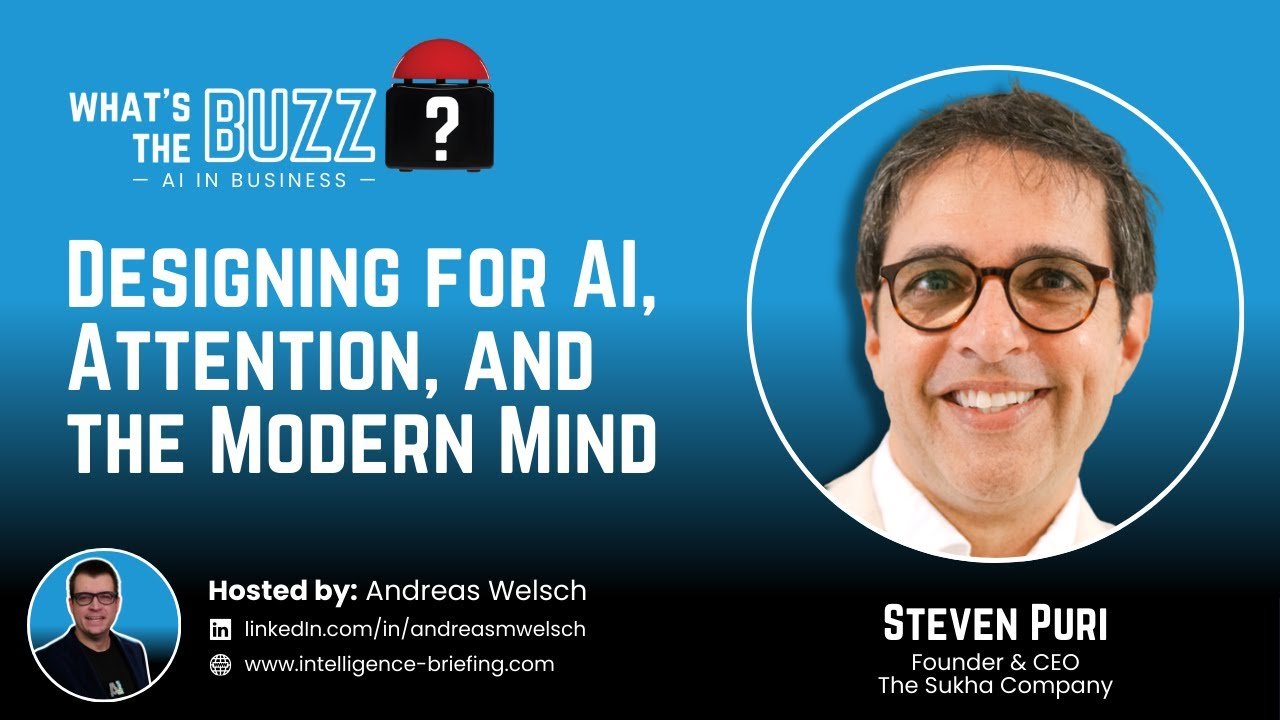
Guest: Steven Puri, Founder & CEO of The Sukha Company
Host: Andreas Welsch
Episode: What’s the BUZZ?, Season 5, Episode 5
Published: March 4, 2026
Episode Summary
Steven Puri, Founder & CEO of The Sukha Company, joins host Andreas Welsch to answer a question many professionals now ask: how do you stay valuable and focused when AI takes over more of the work? Puri said the conversation about junior jobs has changed. Engineering managers and team leaders who once asked about hybrid and remote work now ask whether they still need junior developers.
Puri said the bottom of the career ladder is disappearing because coding assistants and LLMs handle menial work well. He also said the same tools magnify what one person can do, so a junior can build an app or a company without joining a large firm. Welsch added that many leaders have not worked out where senior talent will come from once the bottom layer is removed.
Puri described LLMs as probability machines that match patterns. Deep work, the kind where a person decides the direction of a company or creates something new, remains white space for humans. He explained flow states using Mihaly Csikszentmihalyi’s research and told the story of screenwriter Ron Bass, who protected his mornings for writing.
Puri offered a simple exercise: draw a grid of mornings and afternoons for a week or two and note what you did and how you felt. He also described the cold start problem and a change his team made in the Sukha app, showing only the top three tasks in a session. Puri said members were 77% more likely to finish all three.
Key Takeaways
- The bottom rungs of the ladder are going, and tools let juniors try more. Puri said LLMs do menial jobs well, so those entry-level jobs are disappearing in large companies. A junior can use AI to try out ideas of their own, with very low cost and very low risk.
- Deep work is where humans still beat LLMs. Puri called LLMs probability machines that do pattern recognition. Shallow work, such as drafting a reply to an email, suits an LLM. Deep work on the direction of a company or something never seen before is still white space for humans.
- Flow states are a repeatable way to do your best work. Puri described Mihaly Csikszentmihalyi’s research. In flow, people lose track of time, distractions fall away, they work faster than expected and feel uplifted instead of depleted.
- Learn when you do your best work. Puri recommended a paper grid of morning and afternoon, Monday through Friday, kept for one or two weeks, noting what you did and how you felt. The pattern shows when to do deep work and when to answer email.
- Show only the top three tasks. Puri said a long task list can be paralyzing. In the Sukha app, showing only the top three tasks in a session made members 77% more likely to finish all three. His company also blocks 9 to 11 for flow.
Timestamps
- 00:00:12 Opening: AI, jobs and the modern mind
- 00:00:51 Welcome and Steven Puri joins
- 00:01:33 Steven Puri introduces himself: film studios, venture and three tech companies
- 00:03:02 The What’s the BUZZ game: if AI were a color
- 00:04:43 Will AI cut entry-level jobs?
- 00:07:11 Quarterly pressure and the missing pipeline for senior talent
- 00:09:26 The bottom of the ladder is cut while tools magnify one person
- 00:10:57 Use AI for more than a Google search
- 00:12:10 LLMs as probability machines, and deep work versus shallow work
- 00:16:19 What a flow state is
- 00:19:15 Screenwriter Ron Bass and knowing your chronotype
- 00:20:51 A paper-and-pencil exercise to find your best hours
- 00:23:10 Quiet evenings as Andreas’s flow state, and how to prioritize
- 00:24:50 The cold start problem and procrastination
- 00:27:16 Why a long task list paralyzes, and showing only the top three
- 00:30:19 Steven’s key takeaways
- 00:32:14 Wrap-up and thanks
About Steven Puri
Steven Puri is Founder & CEO of The Sukha Company. Puri said he has been a senior executive at two motion picture studios, has raised over $20 million of venture and has run three tech companies, with one successful exit and two failures.
Puri lectures about how humans develop habits for sustainable high productivity. He said he runs a community around sustaining high performance, built around the focus app his company created.
Full Transcript
This is a lightly edited transcript.
Read the full transcript
Andreas Welsch: There’s so much talk about what AI can do and will do, what it does to humans, to jobs, how we even qualify, how we become more proficient in our work. Lots of questions. Today, we’ll see if we have some answers for you. So stick around as we talk about how we can design for AI, attention, and the modern mind. Let’s get started.
Andreas Welsch: Hey, welcome back to another episode of What’s the Buzz, where leaders share how they turn hype into tangible outcomes. Today we’ll talk about how to design for AI, attention, and the modern mind. And who better to talk about it than somebody who specializes in exactly that, Steven Puri. Hey Steven, thank you so much for joining.
Steven Puri: I appreciate you having me. I hope this is one of the more engaging and maybe actionable episodes.
Andreas Welsch: I’m pretty sure we’ll have a good conversation. We’ve already talked quite a bit before we went live and I’m really looking forward to your perspectives, what you’re seeing and where things are going. So, Steven, not everybody knows you. Why don’t you tell the audience yourself who you are and what you do?
Steven Puri: Okay. For those playing along at home or driving their car, here is the very short version of why this may be interesting to listen to me. I am one of the few people you’ll meet who has been a senior executive at two motion picture studios. So I’ve worked with a lot of high-performing creative minds. I’ve also raised over $20 million of venture. I’ve run three tech companies, one successful exit, two failures. The parallels, the lessons from seeing both the technical side and the creative side, how humans develop habits for sustainable high productivity, have been really interesting to me, and that’s what I lecture about a lot.
Andreas Welsch: Awesome. Wonderful. I’m sure there’s lots to cover, especially having been a leader myself. I see leaders facing new and different challenges, but we’ll get into that in a little bit. Folks, for those of you in the audience, I’m always curious to see how global our audience is. Please put in the chat where you’re joining us from and let’s see which parts of the world you are tuning in from today.
Steven Puri: I just added to the chat. I’m in Austin, Texas. I just put that.
Andreas Welsch: Oh, yeah. Right. Beautiful city. I was just there a couple of weeks ago. One of my favorite places to visit. Next time we should catch up, too.
Steven Puri: Now that we know each other, yes, of course, you’ll have to come.
Andreas Welsch: Exactly. So, folks, if you’re looking to learn how you can turn technology hype into business outcomes, take a look at my book, The AI Leadership Handbook. That’s on Amazon and any good bookstore where you can find modern non-fiction literature. Now, Steven, in good old fashion, I would love to play a little game to kick things off. I was wondering if you’re up for What’s the Buzz? What do you think?
Steven Puri: How could I not be? How could I come here and not be up for it? Let’s do this. Come on.
Andreas Welsch: Wonderful. So, here we go. If AI were a, let’s see, if it were a color, what would it be? 60 seconds on the clock.
Steven Puri: Okay. That’s a really interesting one. For a color, I would say it is a blue turning into a yellow.
Andreas Welsch: Okay. And why is that? Why is it blue turning into a yellow?
Steven Puri: Oh, you said one question, now it’s two questions.
Andreas Welsch: Yes. Yes.
Steven Puri: You want to know why? Because it is that feeling at dawn when everything is blue and you’re trying to understand what the day will be like and it’s just starting to become yellow.
Andreas Welsch: That’s awesome. I love it. So much about a day starting, about things building and some of the curiosity of what this will bring and where things are going.
Steven Puri: I know, right? I actually didn’t write that. It was on my ChatGPT screen over here. So I just read it off the screen, you know.
Andreas Welsch: No, no, no. But we’ve started talking about this whole notion of where things are going, and I think maybe starting at where things are is a good point to extrapolate from. What I’m seeing is definitely a lot of conversation in the media, in the news, and in some of the work that I do as an adjunct professor, where students say, “Well, professor, do you think I’ll still get a job once I graduate? Will there be a junior job for me?”
Andreas Welsch: All the talk about entry-level jobs being cut to a good degree, in part due to AI, also some of the microeconomic trends. But what are you seeing in the conversations that you’re having, knowing that you talk to many people in different industries as well?
Steven Puri: Straight up, you are addressing the biggest issue. I run a focused community. A lot of the lessons are around how you as a human can sustain high performance, how you can be healthy and mindful with your performance, perform well, and if you’re a leader, how you create those conditions for your team to do that. That’s a lot of the last seven years, building community around this app that we built. Now I’ll tell you, five or six years ago the engineering managers and team leaders that were reaching out to me wanted to have conversations about hybrid and remote, and how you have people focus when they’re distracted with other things, not just being in an office. But those conversations have changed this year into what you brought up: do I need junior developers, do I need to teach young people these skills, because we have coding assistants, we have copywriting being done by LLMs. It is real how it’s transforming the workplace. So you have some senior people who are guiding LLMs, whether it’s in engineering, writing or design, but that bottom of the ladder is disappearing in front of our eyes.
Andreas Welsch: To me the question is why. From an operational point of view, from a financial point of view, I can see that it makes sense to ask where we can reduce our cost. But what many leaders that I talk to and organizations that I see have not figured out yet is what happens once we remove that layer at the bottom of the organizational pyramid, if you will. What comes after that? How do new hires, what is the pipeline for senior people, for experienced people?
Steven Puri: Andreas, I completely agree with you, and we do live in a world where a public company has the pressure every quarter to increase shareholder value. It’s unreasonable to expect that a public company is really planning for deep, long-term future gains. The CEO, the C-suite, they know they’re there for a couple of years. The tenure of a CEO has gone far down. You don’t have people running companies with a view of 10 years from now when I’m still CEO, like Warren Buffett, “I’m 9,000 years old, I’ve been doing this since dirt was young.” Now you have CEOs who say, “Maybe I have 8 to 12 quarters in me, and let’s just goose the short-term results because of shareholder value.” So yeah, that means RIFs, and that means no attention paid to where we get the senior people five years from now. Not relevant.
Andreas Welsch: A couple of weeks ago I was on a podcast run by a successful entrepreneur, and he said, “Look, I don’t want to hire more people than I need to.” That doesn’t mean you need to hire more people than you need to, but also just thinking about where I can take out cost, where I can take out resources, sounds like a very shortsighted view, especially in light of what you said about having a quarterly view instead of a multi-year, decade-long view. So I’m struggling with this question right now of how new hires, how recent graduates become proficient and move into a senior role. I also think what’s missing in a lot of these discussions is what the new requirements are in a senior role. If a senior role means working more with AI, monitoring and guiding agents to some extent, that’s one of the big pieces we need to define. But then what is the work of a junior person, how can we grow them to become senior, and a senior to become an expert, and so on? This all goes up the hierarchy.
Steven Puri: So let’s think about two things that are happening. One thing is, let us name any established old-school tech firm. IBM, Hewlett-Packard, been around for 500 years. They, like you said, have a very established ladder. This is how young people come in. This is how we train them. We groom them. They go through these steps. They end up in a senior position. Right now, those companies are saying, “Oh my God, our bottom line is so much better if we just cut the bottom of the ladder away. Why pay for these junior people? Just have a coding assistant, just have a design LLM, a generative tool.” At the same time that’s happening, you also have this rise of tools that magnify the effects of one person. So suddenly the young 21-year-old version of Andreas could say, “Wow, using these tools I can design and code most of this myself. It magnifies my efforts 10x. I don’t need to hire all these people and raise all that money.” So maybe, and I’m not saying this is what’s going to happen, just a thought, at the same time the bottom of the ladder is gone in large companies.
Andreas Welsch: It just shifts, right?
Steven Puri: Yeah. You can get experience because now you don’t need to be in a large company in order to create an app, a company.
Andreas Welsch: Yeah. I think that’s one of the big opportunities in learning how to use the tools and how to use them well. In many of the trainings that I give, one of the key things to get across is to use it for more than a Google search. When I see leaders, executives and professionals come up with their own ideas, like, “I ask you to analyze this data and look at it through the lens of a customer or of a real estate developer, and give me the pros and cons for why they might want to negotiate differently than what we are proposing,” that’s when I think it clicks, and that’s when I see people getting what this wave of AI is about and what it offers. And to your point, combine that with the ability to create applications, to create digital products much more easily, within a couple of days, a couple of weeks. Yes, fine, pull in some expertise on your security and data privacy things by all means, but building the app much more quickly is absolutely within reach. Then focus on what you’re good at, or learn it.
Steven Puri: Let’s think about this, because those two letters that appear multiple times in your camera feed are often just conflated with LLMs. To be very reductive, LLMs are probability machines. They’re predicting, not just Google autocorrect suggesting the next letter is S. It’s saying the next idea, the next word is this, and I’ll string it together. It seems like thought, but it’s not deep thought. It’s pattern recognition and matching. So here’s the thing. What is still interesting about human thought? There is an element of creativity, of deep work, that you don’t really get from an LLM. We’re approaching that sort of asymptotic plateau where you can keep tuning it, but it’s not going to cross over this line and suddenly turn into Picasso or Einstein. So what does that mean for humans? This idea that you are trading your energy in the day, whether it’s physical or mental energy, into valuable work. As Cal Newport has written, deep work is a powerful thing when you do something more valuable than what an LLM can do. If your job is to shuffle reports and put a TPS report in your manager’s inbox every week, that’s great for an LLM. That’s shallow work. But the deep work, where you think about the direction of your company, or the opportunities in the world, or how you could create something that hasn’t been seen before, that’s still an opportunity, that’s still white space for humans. That’s a lot of what I focus on with Sukha, our company: the tools to do that deep work in a repeatable, sustainable way, because that you can still do better than an LLM.
Andreas Welsch: It’s so important these days, when not only do notifications pop up every other minute, every other second, but sometimes you feel like a little puppy: oh, look at this, look at that, oh, I could do this, and five minutes later I think, what did I actually want to do? Getting distracted so easily, but also through the headlines, through all the noise in the tech space. Obviously everybody needs to make a big splash. Everybody needs to talk about how awesome they are, how they are using the funding to develop groundbreaking, world-changing, transformative, supercharged products. That’s fine. We get it. If you’ve been in the space, you know what I’m talking about. But where does this end? And how do you claw back that time? How do you set these boundaries to say, “Okay, this is what I focus on, this is what I can control”? Maybe in some respect that is my time and where and how I spend it, so I can do deep work. I think that’s one of the…
Steven Puri: Andreas, here you’re speaking to my heart, and obviously I have stories and anecdotes to back up some of these principles that come from very talented people in film as well as people in tech. If you are looking at the modern workplace and asking where you fit in, and you don’t want to be replaceable by an LLM, then I agree, you need to be doing the deep work that an LLM can’t do. It can do the shallow work. Draft a stupid response to this email, which we’ve seen. So if you’re going to learn about yourself, to develop that self-awareness to ask how you optimize the thing that you do uniquely, there are some established techniques. And by the way, I’m a big proponent of flow states. I know there’s probably a sizable cohort of listeners who are very into flow states, since it’s very popular right now. There may be some who are not as familiar, so if it’s fair, let me take 30 seconds to make sure I define what I mean by flow state.
Andreas Welsch: By all means.
Steven Puri: There was a Hungarian-American psychologist, Mihaly Csikszentmihalyi. He had a thesis. He said if you talk to high performers in very different disciplines, athletes, artists, scientists, inventors, they talk about these highly concentrated states. They go into the states where they do the thing that makes them famous, and they talk about them in very similar ways. And he asked, what’s up with that? What is this phenomenon? So he did the research, and at the end of it he wrote the book Flow. It’s the seminal work on this, and it is where we get the term flow state. He said the most amazing thing. He said he chose this word because it was the most beautiful metaphor for what he found, which is that we are all on the river paddling ourselves forward. But if you align your boat with the current, it carries you. It magnifies your efforts. You go further and faster. And he said these high performers have figured out how to do that repeatably. It’s a fantastic book. We don’t have time to go into all the details, but he said flow states are a thing where you lose track of time. You’re not staring at the clock. Distractions fall away. You do your best work. You do it faster than you think you will. In the end, you feel uplifted as opposed to depleted. These are really important things if you want to have that consistent practice of outperforming other people and outperforming LLMs. So I say all this to say there are techniques to get into a flow state, and there are ideas around self-awareness of how you work, where you can optimize. If you want, we can go into some of those. Where would you like to go?
Andreas Welsch: The part about how you find your flow when you are asked to work with technology, or when you want to work with technology and you know that it can do the menial parts, the repetitive things, the shallow work like you said. Maybe the high cognitive load work is left for you to do. There are times in our day, times in our week, when we enjoy the high cognitive load and being challenged and doing something unique and great and putting all your thought and energy and knowledge and passion into it. And there are others where we’re quite happy that all we need to do is reply and say yes, tomorrow 3 p.m. works. So how do you balance that? How do you find your flow when work all of a sudden becomes primarily high cognitive load and might become more stressful?
Steven Puri: Let’s talk about this. I’m going to tell you a story and then we’ll talk about the principle. When I was coming up in film, years ago now, there was a famous screenwriter, his name is Ron Bass. He wrote My Best Friend’s Wedding and Rain Man and all these movies in the 80s and 90s, early 2000s. He was famous, or infamous, for not talking to his family in the morning. He’s not the dad who’s going to say, “Who wants pancakes and who needs a ride to school?” He said, “I can’t talk to you, because as soon as we start talking, I can’t hear my character voices in my head. That’s what I get paid $1 million, $2 million a script to write. That’s why Julia Roberts says yes to my scripts, or Tom Cruise.” And his family, of course, at $1 to $2 million a script, said, “Dad, you go write, we’ll make the pancakes.” And he knew that in the afternoon he was very good with interactive work. If he had studio meetings to go over notes, or meetings with other writers or collaborations, that was afternoon for him. The thing he was very self-aware about is called chronotype. There’s a name for that. He said, “My awareness of what times of day I’m most adept at doing something helps me contain that and be very productive in these windows.” So when you ask how we find the time to do the deep work that really moves us forward, and at other times the shallow work, where I want an hour of mindless returning emails or whatever, here is an easy exercise to understand this about yourself. You can take a piece of paper and a pencil. You don’t need anyone’s app. You don’t need anything sophisticated. Draw a simple grid, morning and afternoon, Monday through Friday. You can do this for one week or two. Just jot down what you did and how you felt. This morning I wrote blog posts, smiley face. Tomorrow afternoon I debugged this feature, frowny face. I’m going to tell you, it is surprising. Do that for a week or two and you will see the pattern, and you’ll say, “Man, I should always be returning email right after lunch. I should be writing original things, code or prose, whatever, in the morning.” It is so clear. Then once you do that, you can start to say, “So my natural rhythm is such that I should be doing deep work in this window.” And then you say, “Let me optimize the deep work. What are all the conditions precedent I can set to do it well?” Or if you’re a team leader with a bunch of people, still real humans, not replaced, you’re trying to give them those conditions, and you get a sense of how to do that.
Andreas Welsch: I think that’s a really good suggestion and a really good exercise. I’ve noticed this about myself. Say you set a goal for yourself.
Steven Puri: Yeah.
Andreas Welsch: I’m independent, so it’s a little easier to set goals for myself, what I do in a given day or what I want to accomplish in a week. But then something else comes up. A customer calls and says, “Hey, can you help me with this?” Or something is really urgent, or there’s a great opportunity to respond to a journalist about being featured in an article, but you have to do it by the deadline or else the window closes. So I’ve noticed about myself that when these opportunities or situations happen, I get more tense, because the thing
Steven Puri: More tense?
Andreas Welsch: Yeah. I get more tense because I know there’s this thing in the back of my mind that I want to do today, and it’s already 12:00 and I haven’t done it yet. So I know that I will go through that exercise for the next week to figure out when my
Steven Puri: I’m so curious what you find.
Andreas Welsch: So, one thing I already know about myself is that once the house is quiet in the evening, once it’s super quiet, that’s when I’m most productive.
Steven Puri: When the four- and six-year-olds are asleep.
Andreas Welsch: Yes. When everybody is asleep, the best thing is just a computer screen and everything is dark. That peace and quiet is my flow state, because otherwise during the day there’s always something popping up, something shiny to look at or go after. So that part I already know. But optimizing the morning, optimizing the afternoon, that’s definitely something I’ll look at for myself.
Steven Puri: I have a question for you.
Andreas Welsch: Go ahead.
Steven Puri: How do you prioritize what you do when you have that time? You say, “Tonight I will have focused flow state time.” How do you determine the priorities for what you do?
Andreas Welsch: Good question. Mainly it’s what needs to get done, the urgent. But then it’s what I like to do, and that’s the conflict between urgency and interest in that moment. Sometimes, if interest is a little more dominant than urgency, I go to bed thinking, okay, of the things I really wanted to get done today, what did I get done? Well, I didn’t do that. What do I do? I remind myself, but you did all of these other great things that bring you joy and make you happy, and you were following your passion in that moment, and that’s good too, having the flexibility and the time to do that. So sometimes it takes a little bit of reasoning with myself to get to that point. But anyways, how about you?
Steven Puri: One thing I found, and I’m actually going to speak about something I do wrong or that’s hard for me, is that I procrastinate. I call it the cold start problem. When I dug down and asked why I do this, for example, Andreas, tomorrow at 9:00 a.m. I really want to finish coding this feature we’re working on. Oh, and I want to write a blog post about the new feature. And at 9:15, I will still be checking emails. At 9:30, I’ll be quickly scrolling through the news to see if there’s anything important that I need to know. It is procrastination. Let’s call it what it is. I’m guilty. And I notice that the effect of that is felt at the end of the day, when it’s like, “Oh man, I was busy all day, but I didn’t get that feature finished.” That frustrated me, because that turned into the conversation you don’t want to have: “Laura, tonight let’s make dinner quick, because I have to get back and I’m trying to finish something before tomorrow morning.” And I hate that thing of, after dinner, let me try and work. I’m going to get up early tomorrow and try to finish today’s work before I start tomorrow’s work. Have you ever told yourself that lie?
Andreas Welsch: Occasionally.
Steven Puri: Yeah, maybe. Okay. So I have done that. Here’s what I found. It traced back to my task list. We’re going full circle back to what we were talking about a moment ago. I realized that my procrastination at 9:00 a.m., why I wasn’t actually starting, had a lot to do with my task list in one of two ways. Either there was something on there that was more of a goal. It was so big it was not a task. It was not a discrete “in 30 minutes you can do this, in 70 minutes you can do this.” It was “write my book” or “code some new feature.” That’s an 18-hour task, with QA and everything, and it needed to be broken down. Or second, my task list was so long that it was almost paralyzing. There were 17 things, and they all needed to get done. You said you prioritize urgent and interesting tasks. So sometimes I would be looking at 17 tasks and thinking, “Oh, that needs to happen. Oh, and I do need to pay a tax bill. Oh, and I do need to reply to that email about being on Andreas’s podcast.” So I’ll tell you one little hack that I came up with. When I’m saying, “This morning, these are the three things I really need to do today, anything else is icing, these three have to get done,” then when I start a session, I have everything but the top three hidden. We implemented that into Sukha, the focus app that we built. We said, “We’re going to experiment with this, guys. As soon as you start your session, and we help you get into a flow state, the music plays, it blocks your distractions, stuff like that, we’re going to show you only the top three things in your task list. This is what you need to get done in the session.” What’s interesting is this: our members were 77% more likely to finish all three than when they previously could see their whole task list. Same tasks, same people, same general stuff. But it was that sense of, “Oh, suddenly this is not paralyzing.” That’s a weird mental hack that I didn’t realize until I thought, “I can’t stand seeing that whole list anymore.”
Steven Puri: You were about to say something a moment ago. What were you going to say?
Andreas Welsch: No, no, no. Sometimes I’ve tried something similar, to say what the big three things are, or even the little three things that I need to do.
Steven Puri: What are the three?
Andreas Welsch: To feel a sense of accomplishment by the end of the day. And to your point, if I do four, five and six, that’s great. And sometimes there are just little things, to your point, paying a bill or replying to an email that you’ve started to think about but haven’t fully thought through or articulated. These are the things that, if they pile up, at some point really become urgent and important, to use that analogy. So figuring out that optimal rhythm for me, what the things are to prioritize. Maybe coming back to technology, I think on one hand it gets more important to do that when it gets easier to delegate some of the shallow work, like you said. But on the other hand, there’s still a good amount of work left for us in any given day. So how do we prioritize that? How do we find the balance between, hey, cool, I don’t need to do that anymore, I have more time for this, or now I have too many things over here that I need to do? How can I give more to AI, to software, or just space it out differently? But we’re getting close to the end of the show, and Steven, I was wondering if you could summarize the key takeaways for our audience today, when it’s all about how we can design for AI, attention and the modern mind.
Steven Puri: Okay. So, let me share some things that highlight a couple of points. You and I are in agreement, as many people are right now, that the talent development ladder is broken, because many of the bottom rungs are gone now. They are done very well by an LLM that is just a probability machine. It’s not incredibly creative, but it works for those menial jobs. So the opportunity then is, I am a junior engineer, copywriter, designer. I’m not going to go into a large established company where those jobs are gone. I can leverage the LLM to try out ideas of my own and get experience directly, with very low cost and very low risk. So that’s interesting: these jobs are gone, but maybe you can actually try more, which is very cool. Another thing is that the value of deep work, what humans are still doing better than an LLM, has gone up. Now if you can have that idea, come up with that idea and say, “This would change my life, our lives, the world,” you can execute it with much more facility than before. So develop a smart practice around how your brain works. What time of day is best for you to do deep work? How can you block distractions? How can you set up the right conditions for you to have those moments of wow? And it’s not going to happen every day. Like in my company, we block 9 to 11 just for flow. There are some days nothing great comes out of it, but other days it does. So developing that respect for your brain and flow states and deep work is really important in a world where LLMs are eating the bottom layer of the workplace.
Andreas Welsch: Wonderful. Thank you so much for sharing that. I know today’s conversation was not the traditional AI governance, program management, stakeholder management type of thing.
Steven Puri: Should we talk tokens, inference? Should I have said compute? Nope.
Andreas Welsch: But I think it’s incredibly important to think about these aspects when change gets faster than ever. Work just seems to pile up and get more. Do more with less, all the empty phrases that we’ve heard and that many of us experience in our daily lives and work. So Steven, I’m very thankful and appreciative of your perspective and of you sharing with us what you see and what you recommend. Just thank you so much for joining.
Steven Puri: Thank you for having me, and for those who are listening, I hope this has been entertaining and maybe informative.
Andreas Welsch: Wonderful. All right, folks. See you next time for another episode of What’s the Buzz? Bye-bye.
Listen and Subscribe
- Watch on YouTube
- Listen on Buzzsprout (show page)
- Listen on Apple Podcasts (show page)
- Listen on Spotify (show page)
Related Reading
- AI Leadership for Enterprise Leaders
- AI and Entry-Level Jobs: Protecting the Talent Bench
- Agentic AI for the Workforce: AI Leadership Lessons
- The HUMAN Agentic AI Edge by Andreas Welsch
Frequently Asked Questions
What is deep work, and why does it matter more with AI?
Puri described deep work as the thinking that goes into the direction of a company, the opportunities in the world, or creating something that has not been seen before. He said an LLM is a probability machine that does pattern recognition, so it suits shallow work such as shuffling reports. Deep work is still white space for humans.
What is a flow state?
Puri defined a flow state using Mihaly Csikszentmihalyi’s research. People lose track of time, distractions fall away, they do their best work faster than they expect and feel uplifted instead of depleted. Puri said high performers in different fields describe it in similar ways.
How can you find the time of day you do your best work?
Puri suggested a paper grid with morning and afternoon, Monday through Friday, kept for one or two weeks. Note what you did and how you felt. The pattern shows when to schedule deep work and when to handle email. He pointed to screenwriter Ron Bass, who was aware of his chronotype.
What happens to junior roles when AI does entry-level tasks?
Puri said the bottom rungs of the talent ladder are going in large companies because LLMs handle menial jobs. He also said a junior can use AI to try out their own ideas with very low cost and very low risk. Host Andreas Welsch raised the open question of how new hires become senior if that layer disappears.
Why show only the top three tasks?
Puri said a task list can be paralyzing when it holds goals that are too big or too many items. In the Sukha app, showing only the top three tasks in a session made members 77% more likely to finish all three, with the same tasks and the same people.