

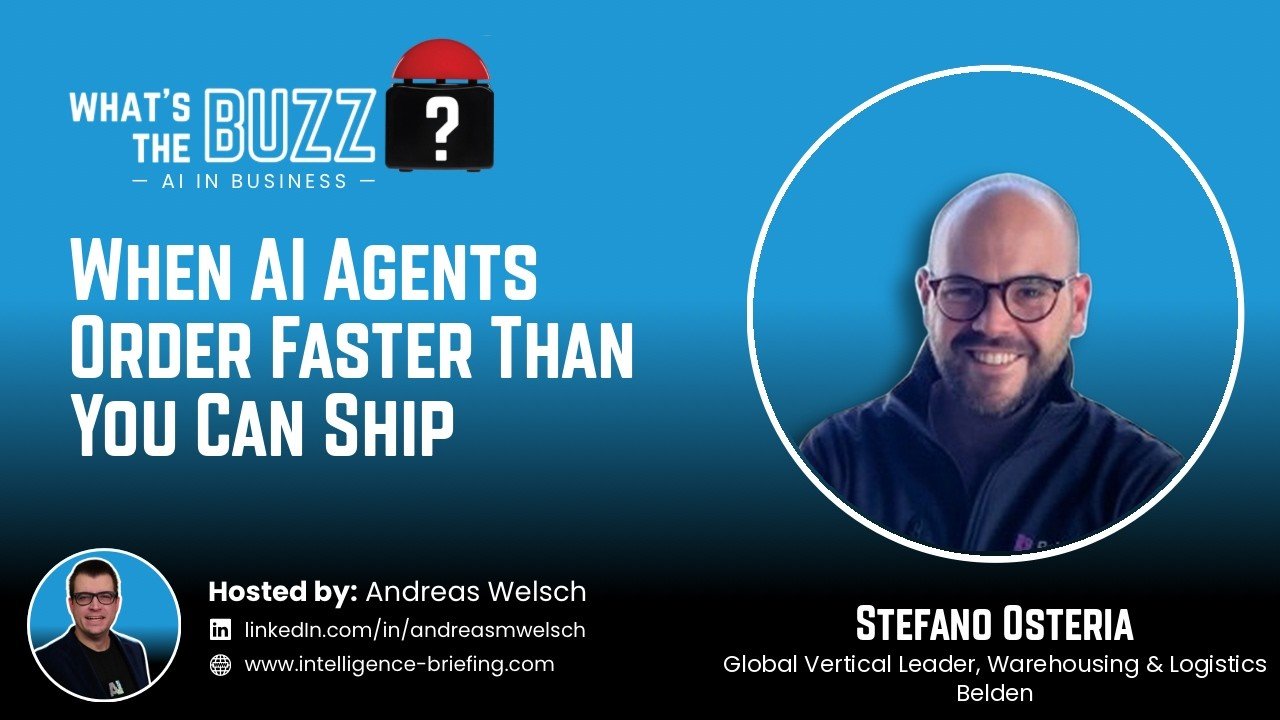
Guest: Stefano Osteria, Global Vertical Leader, Warehousing and Logistics at Belden
Host: Andreas Welsch
Episode: What’s the BUZZ?, Season 5, Episode 23
Published: November 10, 2026
Episode Summary
AI agents can create demand faster than operations can deliver it. Stefano Osteria, Global Vertical Leader, Warehousing and Logistics at Belden, joins host Andreas Welsch. Stefano explains what leaders should do about it.
Stefano describes an agent that links raw-material purchasing to the sales demand forecast. With clear governance, that agent can lower inventory and speed up the reaction to demand. Without governance, a hallucinated demand forecast can reach suppliers as a hallucinated order.
Stefano also names two barriers to automation: isolated plant systems and mismatched industrial protocols. Amazon’s delivery expectations, Stefano says, put service level agreements at the center of warehousing.
Stefano closes with three takeaways: govern agents, make software and machines interoperable, and set clear expectations for automation projects.
Key Takeaways
- Agents that follow fixed rules make demand easier for manufacturers to forecast, Stefano expects. Standard products with no differentiation will converge on one price. An agent can always find the best product.
- Clear governance lets an agent lower inventory. On the B2B side, Stefano says the real change happens. An agent that buys raw materials against the sales demand forecast brings the benefits of lean manufacturing. It also reacts faster to demand. Reacting too fast can put suppliers in danger or force a company to keep backup suppliers.
- Governance prevents hallucinated orders. Without it, a hallucinated demand forecast can pass to suppliers as a hallucinated order. Stefano cites a Harvard Business Review article that advises treating an agent like an intern. Start with basic actions. Add more freedom as you learn to govern the agent.
- Systems have to talk before agents can act. Stefano says an API is not enough. Without a data layer that stays consistent, the manufacturing execution system works on wrong data. Machines from different builders also define variables in different ways.
- Automation fails when the outcome is unclear. Stefano advises breaking a big problem into steps and finding where the most time is lost. Then hand that specific outcome to an automation vendor.
About Stefano Osteria
Stefano Osteria is Global Vertical Leader, Warehousing and Logistics at Belden. His work increasingly covers warehousing, logistics and material handling applications.
In this role, Stefano works to understand where the market is going. Stefano also tracks what customers are trying to implement in their operations to deliver faster.
Full Transcript
Read the full transcript
Andreas Welsch: So AI agents, personal assistants, agentic commerce, everything has been dominating the news, but what really happens when your customer’s agents start doing business with you, whether it’s B2C or B2B? How can you keep up with that demand? Today we’ll talk about that. So join me for this conversation.
Andreas Welsch: Welcome back for another episode of What’s The Buzz?, where leaders share how they have turned AI hype into business outcomes. Today we’ll talk about what happens when your AI agents create demand faster than you can actually deliver it, and I’m so excited to have an amazing guest with me today, Stefano Osteria from Belden, who’s going to share more about that and what you need to know if you’re a business leader, if you’re a manufacturing leader, and all of a sudden your customers start approaching you with agentic AI generated requests.
Andreas Welsch: Stefano, thank you so much for joining.
Stefano Osteria: A pleasure to be here, Andreas. Thanks for having me.
Andreas Welsch: Wonderful. Hey, Stefano, maybe you can introduce yourself briefly for the audience, if anyone doesn’t know you yet.
Stefano Osteria: Of course. And I bet that there are a lot of people out there that do not know me yet.
Stefano Osteria: So a pleasure to be here. I’m Stefano Osteria, working at Belden since already five years now, and I’ve always worked in the industrial automation space over the past five years, in the warehousing and logistics and material handling application more and more. At this moment in time, I’m working as a global vertical leader for the industry warehousing and logistics.
Stefano Osteria: What does it mean? I am doing my best to understand where the market is going, and what our customers are trying to do and to implement into their operations in order to deliver faster and faster, in order to meet the increasing demand from any kind of customers in terms of on-time delivery.
Andreas Welsch: So you said
Stefano Osteria: That’s what I’m doing.
Andreas Welsch: That sounds like a very interesting and challenging and exciting task, especially knowing that there are so many changes happening across any industry and especially industrial automation as well. But I do have a question for you.
Andreas Welsch: Obviously I have a few, but this one starts with, we’ve seen recently consumer grade vendors like Meta, like OpenAI, come out with their personal assistants, Muse and Dots, and Microsoft is following along with making Copilot better and all these kinds of things. And I’m starting to see examples in my social media feed where people said, “Hey, I used my personal assistant and it saved me $250 because it canceled all these subscriptions,” or, “I’m automating how I do my grocery shopping.
Andreas Welsch: I no longer need to do that myself, and my personal assistant does that.” But I also know on the B2B side, there’s a lot of work happening on automating some of these transactions. What are you seeing? Where are the B2C and B2B agents similar, and where are they vastly different, especially from a B2B point of view?
Stefano Osteria: So one thing regarding what I understand so far on how you can build an agent. First of all, the agent needs to be trained in order to really perform the task that you want it to do. So it is not that easy to think about an extremely well-performing agent for a B2B organization. So let’s start first on a B2C kind of relationship, where the agent can simply automate, based on some rules, what kind of grocery you have to buy, what kind of subscription you want to delay, anything like that, as you mentioned.
Stefano Osteria: And in this kind of option, I don’t think that we will be able to foresee any major changes in the entire logistics behind that. Probably all the producers, all the suppliers could have a better forecasting demand, because if the order is always scheduled in the same way, maybe I can forecast better as a manufacturer.
Stefano Osteria: And the second point that I think could impact is we will see
Stefano Osteria: and increasing differences regarding high-end products that make a specific differentiation in some way. For example, I don’t know, a specific training course or a specific outfit that you want to buy, something like that, where it can capture an extremely targeted group of people in a specific target way.
Stefano Osteria: And on the other side, you can have all the standard things where the differentiation around the products is not there anymore, and we will see that the price will probably be the same everywhere.
Andreas Welsch: Mm-hmm.
Stefano Osteria: Because with an agentic AI, you can always find where is the best price.
Andreas Welsch: So we… Yeah, go ahead. Keep going.
Stefano Osteria: No, I was saying that on the other hand, on the B2B, that’s where the magic can happen. If you can really enable your agentic AI to understand what are the interdependencies in your upstream and downstream processes. What do I mean with that? Imagine that you are a manufacturer and you can link, in a really, really strong way with a clear governance, your agentic AI to buy your raw materials to the demand forecast that you are receiving from your sales department.
Stefano Osteria: If you will be able to do that in an extremely effective way… By the way, you can do that. There are already a lot of companies that are doing that. You can reduce the level of inventory that you need to have at your facility. That’s one point. The second point, you can really unlock the potential of a lean manufacturing process most of the times.
Stefano Osteria: And the third point, you can react faster on the changes that might happen on the demand. What happens if you act too fast on the changes that are happening on the demand? You put your supplier in danger most of the times, or maybe you need to have backup suppliers for the same raw material.
Stefano Osteria: So it’s a really interesting topic, and there are many different strategies that the companies are taking in order to implement this kind of AI usage.
Andreas Welsch: Mm-hmm. So when you say you’re putting your supplier in danger or you need to have backup suppliers, I’m assuming that means because if you have a surge in demand and all of a sudden your order from your supplier exceeds their capacity to produce, then that’s difficult, right?
Andreas Welsch: You don’t get the right quantity of units or items that you need, and you need to look at additional suppliers, right?
Stefano Osteria: Completely agree, and that’s one of the most interesting points regarding how you set up your agentic AI to perform the orders and to track the orders on your behalf.
Stefano Osteria: It all goes back to what kind of governance do you implement into this agent. Recently, I read a beautiful article in the Harvard Business Review that explain how you should treat an agent AI as some sort of intern and allow the agent to do extremely starting actions, so basic actions, and along the way learn how you can govern the agent while giving the agent more and more freedom to act on your behalf, and how you can or you have to train your agent to have a better and better context around its surrounding.
Stefano Osteria: It was a really interesting article that explained what kind of strategy you can put in place in order to really let your agent grow as an employee in your company.
Andreas Welsch: I’ve seen similar examples in other parts of the business from finance to HR and sales, and I think they do this really well to say, “Look, first of all, you need to become more comfortable and more knowledgeable in what that agent can actually do, and you need to develop the confidence that it can actually do what you want it to do.”
Andreas Welsch: And then once you see that, you can increase the level of automation, the level of complexity of the tasks that it can take over. So great to see that here on the supply chain and logistics side as well. Now you talked about the changes in demand, in ways that you as a business can use agents to procure and purchase raw material from your suppliers.
Andreas Welsch: But how do you keep that demand from your customers and the supply in lockstep? And I think that’s probably not an easy question from what I already gathered when we were backstage. But if you could, I’ll ask it anyways because it sounds like there are some changes happening.
Stefano Osteria: There are a lot of changes happening. The most important aspect to take into consideration is how well your company integrates the different digital systems. What do I mean with that? I’ll try to make a super, super easy example. I build mobile phones. I need a thousand components for each phone.
Andreas Welsch: Mm-hmm.
Stefano Osteria: If I put all the suppliers into the same system, into the same MAS system, I can control the suppliers that are coming.
Stefano Osteria: So I can really think about implementing an agent that can scout my inventory level and understand when to order in an automatic way. That’s one step. That’s really the basic step. The magic happens if I can link this inventory control that I put together with the demand forecasting that is happening on the sales side, and it’s not…
Stefano Osteria: It’s happening in recent years that this link is becoming more and more automatic, shortening the amount of people that are looking at this correlation between the sales leaders of the company and the operational leaders of the company that have to validate a demand forecast. If you are able to shorten this sales cycle, you can implement some governance in order to make decisions in a really fast way.
Stefano Osteria: What are the downsides of it? If you do not have a clear governance in place, you can maybe take a hallucination of the demand forecast that already happened in an automatic way and transfer that as a hallucinated order to your suppliers. And someone will risk
Andreas Welsch: Mm-hmm.
Stefano Osteria: So that’s the beauty of how complex, as well as how many opportunities you can have in front of you, if you put together the perfect governance in place.
Andreas Welsch: What does that look like in reality? I’ve been working with a number of manufacturing leaders here in our organizations in the US, and typically when it’s about AI, when it’s about technology, the feedback I hear is, “Yeah, but we have razor-thin margins. We can’t invest in this,” or, “We have 20 different systems and different equipment and assets and machines, and they don’t talk to each other.”
Andreas Welsch: Is that just something that’s unique to the companies that I’ve been working with, or the region over here in the US? What are you seeing there? How realistic is it to get to this point where you have this unified governance and a more unified manufacturing execution system?
Stefano Osteria: It’s extremely common to have companies that have isolated systems that work in silos. And that’s a heritage that is coming from the past, because in the past, every kind of automated system, whatever it might be, could have been a piece of software, could have been a packaging machine, has always been designed as, I need to build something that is able to transform always the same input into always the same output.
Stefano Osteria: Yeah. Now with AI and machine learning, the game is changing completely, because the idea is to build a complex system that can have variable input, understand what’s the variance among these inputs and automatically reassemble itself in order to generate always the best possible outcome in an automatic way.
Stefano Osteria: And that’s a paradigm shift, because in order to allow that to happen, you have to put all your systems in coordination together and in communication together. And that’s the problem of interoperability that can happen at the machine level as well as at the system level.
Stefano Osteria: Most of the times, at the system software level, a lot of people think it can be easier because maybe it’s just a matter of building a different API in order to let two software speak to each other.
Andreas Welsch: Mm-hmm.
Stefano Osteria: It’s not completely true, because if you do not create a layer, specifically a data layer that does not change in all those passages around different software, you can easily mess up your data, and then you start your
Stefano Osteria: You allow your system, manufacturing execution system, to work on wrong data. That’s one of the first critical points I see. Yeah. The second one is at the machine level.
Andreas Welsch: Mm-hmm.
Stefano Osteria: If all of your machines speak a little bit of a different language in terms of industrial protocols, maybe the machine builders that build the machine for you define the variables in a different way compared to another machine, how can you put all of those things together?
Andreas Welsch: Yeah.
Stefano Osteria: Not an easy challenge, but if you crack it, oof.
Andreas Welsch: It sounds like there’s a lot of work to be done for sure, but also a lot of benefits to derive from that. I have a question for you. I was at a manufacturing expo earlier this year and one of the big name vendors had one of the industrial robots on display, and it could drive underneath a car, pick it up, move it from one location to the next.
Andreas Welsch: They put some objects in front of the robot as it was moving, and it stopped, and it navigated around them, and it was checking if they’re still there on its way back, and all these things. And I’m thinking, we’ve talked on the show in the last couple episodes more about how do you become discoverable?
Andreas Welsch: How does your business, your products become discoverable from marketing, from a paid media point of view? Then we talked about how do you pay for these products when your agents shop. Now we’re talking about demand, but I’m also thinking about almost the last part of this process, the fulfillment, the warehouse, the logistics.
Andreas Welsch: What are you seeing there as we’re chatting a little bit about this? You said, “Hey, that’s a closed system.” So maybe you can talk a bit more about that, how this on one hand is connected to your demand, supply, and then if optimizing your warehouse is the first step that you should take, or if there are others that might make more sense.
Stefano Osteria: It’s one of the possible steps.
Andreas Welsch: Mm-hmm.
Stefano Osteria: What do I mean with that? It’s extremely easy to say that Amazon came and changed the expectation at the consumer level, because now with Amazon, you can easily expect to have the delivery of your products in one or two business days. And that is setting a little bit the expectation everywhere.
Stefano Osteria: Now, one of the most critical points in warehousing and logistics, generally speaking, is something called a service level agreement. What does it mean? It means how fast you can deliver the products that I ask you, where I ask you to deliver that. In order to do so, all the third-party logistics companies are trying to work at increasing their economy of scale.
Stefano Osteria: What does it mean? Most of the times, manufacturer. Let’s take a stupid example. For example, Nike builds the shoes. They have a really big warehouse where they make the shoes, but it’s not the warehouse where the shoes depart from a customer order. Most of the times, there are 3PL company that supports Nike in having a distributed across the geography.
Stefano Osteria: It could be US, it could be Europe, it could be whatever. They have a distributed storage of goods in many different warehouses that are not owned by Nike. So that’s the idea of economy of scale that now we are seeing. It’s increasing more and more, and that’s another complexity that is adding to how you can align demand forecast and actually fulfillment.
Stefano Osteria: Because if you are extremely good in not only forecast how many products you have to buy, but also where those products need to be shipped, you can maybe anticipate the shipment cycle and deliver better service to your customer
Andreas Welsch: Question for you. Does it come down to something like your traditional ABC analysis?
Andreas Welsch: What are my fast-moving goods? What are the slow-moving goods? And where do I need to have them?
Stefano Osteria: Exactly. That’s exactly the same part. But what I think is increasing extremely fast now is the possibility that you can expand your logic of where do I have to store those goods, also in third-party warehouses.
Andreas Welsch: Yeah.
Stefano Osteria: So you have unlimited opportunity in front of you in order to serve your customers in the fastest way possible.
Andreas Welsch: I can tell you, you’re getting me excited about all of this, getting products even faster. But I’m sure on the other side of that conversation, there are manufacturing and logistics leaders wondering how can we keep up with this and how can we do all of that?
Andreas Welsch: What are you seeing in your conversations with manufacturing leaders, with warehousing logistics leaders, and what do you recommend they do at this point when we already know that there is going to be more automation in the way that our customers reach out to us, in the way that we need to anticipate what that demand looks like, not just three or six months from now, but next week and in a couple of days?
Stefano Osteria: That’s a really, really complex question. I can try to give you my
Andreas Welsch: Yes. Yeah
Stefano Osteria: idea. And my idea has been shaped by the fact that most of the times, myself and also the company I’m working for are more in contact with the machine builders and system integrators of this world who put together the automated system for the end user.
Stefano Osteria: And one of the
Stefano Osteria: complexities most of the times I hear is, I have these projects that I have to deliver for this specific end user. I have to put together this complex level of automation, but the outcomes that I have to deliver are not super clear. And that’s exactly where I think everybody can improve a little bit better in defining clear expectations against the projects that they’re trying to implement.
Stefano Osteria: Trying to simplify that with a really stupid example. Let’s go back to the Nike example of before.
Andreas Welsch: Mm-hmm.
Stefano Osteria: I want to improve the throughput of my shoes from the factory to the customer. That’s a massive fraud problem. You cannot solve it all at once. You have to define step by step what you need to improve and where you can have the best improvement.
Stefano Osteria: What do I mean with that? Maybe analyzing this entire chain, you can evaluate that the actions where you lose the most amount of time is in actually understanding where the shoes are located in your warehouse and how you label that with the correct shipment address and put it outside your warehouse for the third-party logistics company to pick it up.
Andreas Welsch: Mm-hmm.
Stefano Osteria: And that’s exactly the moment where you have a clear outcome that you can assign to an automation vendor and explain to them, “Look, I analyzed my entire shipment process, and I understand that that’s a specific point I have to improve. Can you help me to do that? Yes or no?”
Andreas Welsch: Mm-hmm.
Stefano Osteria: Most of the times, this request is not super clear, and that’s where automation fails, or when automation investments do not deliver according to the expectation that was promised at the beginning.
Andreas Welsch: So it sure sounds like a complex problem to tackle, especially when there are so many moving pieces and knowing that demand can be variable or seasonal and all these kinds of things. But like you already said earlier, it sounds like an exciting problem to figure out as well. Stefano, we’re getting close to the end of the show, and I was wondering if you can summarize the key three takeaways for our audience today.
Andreas Welsch: I know we’ve covered a lot of ground, but what are three things people should take away from our conversation?
Stefano Osteria: From my point of view, the main tricky takeaways are that if you want to improve your, let’s call it supply chain generally speaking, by using an AI agent, the first really important point to figure out is how you can govern your agent.
Stefano Osteria: And my easy suggestion to do that is to start small, and then you can increase the level of governance as you increase the complexity of the task that you allow your agent to perform. The second takeaway is in terms of interoperability among different software and different machines in your manufacturing.
Stefano Osteria: Because if you can really put together the information that is coming from different software and different machines in real time, you can unlock the power not only of AI, but the power of autonomous improvement. And the third point is how you can create a clear expectation, because to
Stefano Osteria: Nowadays with AI, we have a tremendous additional power that we have never had the possibility to implement before in creating
Stefano Osteria: unstructured rules to have optimized outcome
Andreas Welsch: Yes
Stefano Osteria: And that’s the first time that we are able to do that, where you can put together many different inputs. And the more inputs you put into a coordinated process and coordinated flow, the better improvement you can get with AI at this moment in time.
Stefano Osteria: But it’s not that easy to do that while maintaining a clear level of expectation on what you want to improve and how you can maintain a clear level of governance in order to understand who makes what kind of decision, what kind of agent makes that specific decision, how you can scout for a hallucination when something happens because of AI.
Stefano Osteria: So those are, from my point of view, the three main points.
Andreas Welsch: Awesome. Wonderful. Thank you so much for sharing. I really enjoyed this conversation with you and learning so much about how agents create demand, things we should be looking for, like the hallucinations and double-checking before we start acting on this and start requesting more supply.
Andreas Welsch: And then how all of that also connects to the logistics, to the warehousing side, and what some of the challenges are along the way for business leaders, for manufacturing leaders to tackle head-on as well. Stefano, again, thank you
Stefano Osteria: It was a pleasure
Andreas Welsch: for sharing your expertise with us. Yeah.
Stefano Osteria: Thank you very much for having me, Andreas, and I think that some of the points were of interest.
Andreas Welsch: Oh, I am sure. So I can’t wait for the audience’s feedback and questions as well. And yeah, if you haven’t connected with Stefano yet, please go look him up on LinkedIn and connect with Stefano there as well. So thank you so much for joining, and see you next time for another episode of What’s the What.
Andreas Welsch: Bye.
Listen and Subscribe
Related Reading
- AI Governance for Enterprise Leaders
- Agentic AI for Enterprise Leaders
- Always-On Agents
- Agentic Commerce Infrastructure: 4 Questions for CX Leaders
- Agentic AI in CX: Preparing for Agentic Commerce
Frequently Asked Questions
How can AI agents create demand faster than a business can fulfil it?
An agent that buys raw materials against the sales demand forecast can raise orders faster than operations can respond. Stefano Osteria describes this link. It can lower inventory and speed up the reaction to demand. Orders can then rise faster than suppliers, warehouses and people can respond. Reacting too fast to demand swings can put suppliers in danger.
Why does governance matter when AI agents place orders?
Clear governance keeps an agent from passing errors to suppliers. Stefano says that without it, a hallucinated demand forecast can reach suppliers as a hallucinated order. Stefano points to a Harvard Business Review article that advises treating an agent like an intern. Start with basic actions. Add freedom as you learn how to govern the agent.
Why do isolated systems hold back AI agents in manufacturing?
Many plants run isolated systems built to turn the same input into the same output, Stefano says. At the software level, an API is not enough. A data layer that stays consistent is also needed. At the machine level, different industrial protocols and variable definitions get in the way.
Why do automation projects fail to deliver the expected results?
Automation fails when the outcome is unclear. Stefano says machine builders and integrators often must deliver projects with unclear outcomes. Stefano’s advice: break a big problem into steps and find where the most time is lost. Then hand that specific outcome to an automation vendor.