

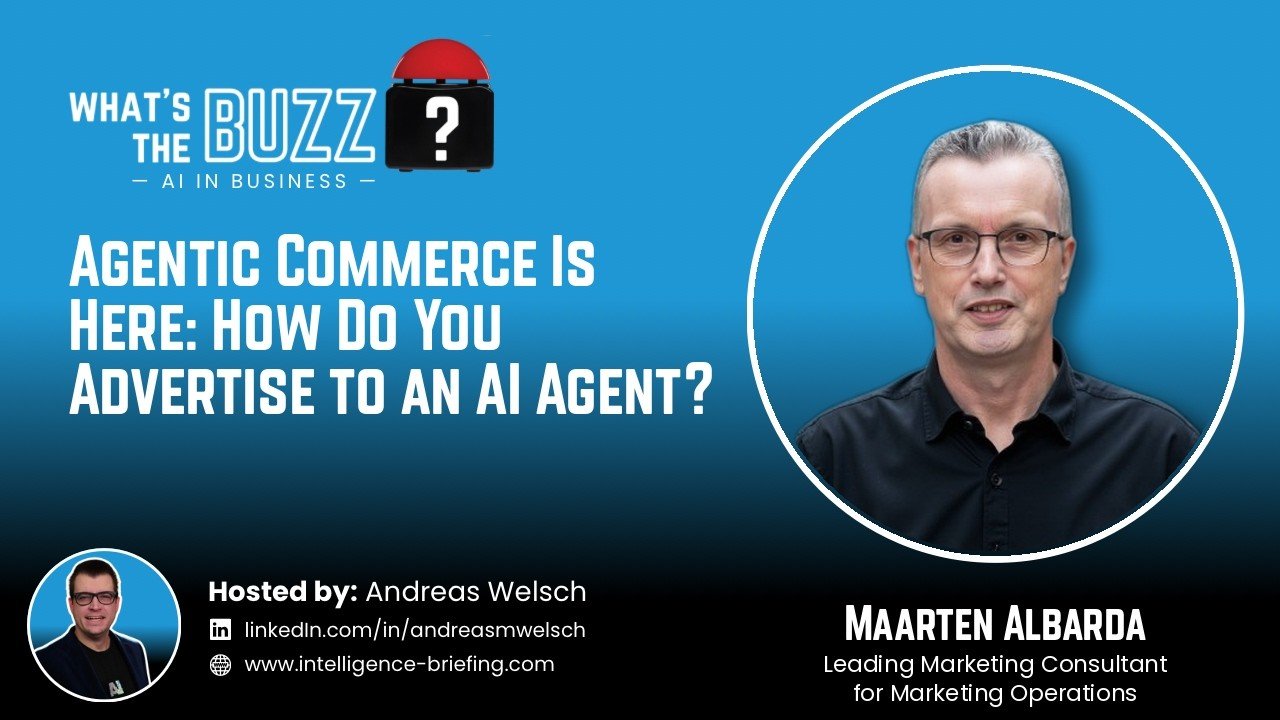
Guest: Maarten Albarda, Marketing Expert for Leading Marketing Teams
Host: Andreas Welsch
Episode: What’s the BUZZ?, Season 5, Episode 20
Published: September 30, 2026
Episode summary
More and more shoppers ask an AI assistant for the best option and take the answer it gives them, and agents are starting to recommend and buy on our behalf. In this episode of What’s the BUZZ?, host Andreas Welsch and Maarten Albarda, Marketing Expert for Leading Marketing Teams, work through how marketing has to change when AI agents shop, recommend and buy. Albarda focuses on the process, structure and agency ecosystems behind good marketing. He argues that the time to learn is now, that every AI change should deliver an outcome at least as good as before, and that advertisers should find out which sources each AI model relies on for their category.
Key takeaways
- The time to learn is now, but the payback is not guaranteed. Albarda said what you learn today may not be what matters tomorrow. It is still far easier to learn now than to unlearn and relearn five years from now, and it makes you a better user of AI either way.
- Judge every AI change by its outcome. Albarda’s test is that the result is at least the same as before, and if it is not better, it should be cheaper or faster. He hears AI anxiety from CMOs and CEOs and said the right pace is the one your organization can absorb, because “it’s quite easy to break an organization with too much too soon.”
- The savings have not reached advertisers yet. Agencies have always sold human time, and agents that plan and optimize media mean fewer people and fewer hours. Albarda said clients are not yet seeing that in their agency contracts, and advertisers are starting to ask what outcome they are buying instead of paying for the process.
- Hourly-rate businesses change fastest. Albarda sees the same shift in legal, consulting and financial advice. He expects services built on selling hours to feel the biggest impact over the next five years.
- AI search may be hurting traditional search more than reported. Albarda said each platform reports only on itself, so independent numbers are scarce. He expects the impact is bigger than we are told, because most people see an AI-generated answer first, often on a phone, and may go straight to a retailer app.
- Find out how AI sees your brand. Ask the same question in GPT, Gemini and Claude and the answers and their sources differ. Albarda’s first step is to buy a tool that shows which sources each model values for your category, then work out how to show up in that conversation.
What leaders can do now
- Link every AI initiative to a business purpose and measure a before and after, so you can show the outcome is the same or better.
- Use a tool to find the sources GPT, Gemini and Claude rely on for your category, then plan how to show up in them.
- Ask your agencies how AI savings are passed on, and move toward paying for outcomes.
- Albarda’s closing line: “don’t do AI for AI’s sake.”
Timestamps
- 00:01:27 Maarten Albarda introduces himself and the “how” of marketing
- 00:04:12 How will advertising change when agents influence what we buy?
- 00:05:40 AI in marketing: the “what” and the “how”
- 00:10:46 Is now the time to learn, or is it too early?
- 00:12:18 What has to change in a marketing organization
- 00:16:05 Are agencies passing on AI savings to clients?
- 00:20:36 Why hourly-rate service businesses change fastest
- 00:22:09 Discovery through AI assistants and how AI sees your brand
- 00:27:36 Albarda’s three takeaways
Full transcript
This is a lightly edited transcript. Filler sounds and repeated words are removed, and the wording is otherwise as spoken. Timestamps link to the video.
Read the full edited transcript
Andreas Welsch: So we know agents are here. Agentic commerce is probably coming. It’s, just emerging. But a big question that’s looming is, how do you actually advertise to an agent to get it to recommend, the products and services that you sell? Today, we’ll tackle that. I’m super excited to have an awesome guest for you, so let’s jump right in. Welcome back for another episode of What’s the Buzz?, where leaders share how they have turned hype into outcome. Today we’ll talk about how you can actually advertise to an AI agent, and we’re seeing agents act on our behalf, and, shop and make purchases on our behalf. And who better to talk to about it than someone who’s already thinking about this, Martin Albarda. Martin, thank you so much for joining.
Maarten Albarda: Very happy to be here.
Andreas Welsch: Awesome. Hey, we’ve, we’ve known each other for a while, but I thought I’d love to introduce you, to our audience. Actually, I would love to give you the floor to introduce you to our audience who might not know you yet.
Maarten Albarda: Sure. I fear that this podcast is gonna sound a little bit like a J- like how a joke start, right? A German and a Dutchman walk into a room, or into a podcast in this case. so yeah, I’m originally from Amsterdam. I’ve lived in the United States, twice actually, but this time since, 2005. My wife is from the DC area, which is why I’m here. I came here for work. I have, about 14 years on the agency side, Leo Burnett, McCann Erickson, and J. Walter Thompson. and then after that I worked for the Coca-Cola Company for 10 and a half years, in first Japan, then in Germany. And I always say for my sins I ended up in Atlanta at the global headquarters. did that for, almost four years and then, a former boss of mine at the Coca-Cola Company had joined Anheuser-Busch InBev, and he asked me to join him there when Anheuser-Busch InBev became Anheuser-Busch InBev. And, worked there for, almost four years on, setting up their whole integrated marketing process and structure and ecosystem. And that has also been my last job at the Coca-Cola Company. And then when I left, I, talked to a couple of people, and, basically came to the conclusion that this whole area that I call the how of marketing is a, or was at that time, a severely underserved area within the marketing sort of ecosystem. So lots of marketers think about when to advertise, where to advertise, how much to advertise, to whom, we want to advertise, et cetera, and then they spend very little time and effort on, and how do we organize ourselves to actually make that successful or make that work really well. And so that’s where I worked. I helped set up a global consultancy, that focuses exclusively, on that, called Flock Associates. I’m still a small shareholder in that business, but, as of about 2015, I decided to, No, it’s actually a little later. I think ’16 maybe, but anyway, decided to become a gun for hire, so I still do, projects for Flock as and when, but also have my own clients and businesses and basically focus on projects that bring me, equal amounts of, challenge and joy, and they’re all focused on the how of marketing. So marketing process, structure, organizational model, agency ecosystems, capability building, agency evaluations, everything to do with the infrastructure that you need to do good marketing.
Andreas Welsch: So
Maarten Albarda: that’s it.
Andreas Welsch: Awesome. I’m, I’m so excited to have you on the show. Usually I talk to IT leaders, to AI leaders, to business leaders, but I haven’t had as many conversations on the marketing side. But I feel this is getting a lot more important these days because I’m starting to see the chatter, about agents shopping on our behalf, whether that is in, B2C scenarios or in B2B, where I think there’s even more potential, as well. And so one of the things I’m- I’ve been thinking about is, you know, we see so much advertising. We’re inundated with advertising wherever we go, from the minute you wake up and you open, your web browser and the ads are there, to the second you maybe turn on your free music streaming service and hear little ads, sign up for this, watch this, listen to that. your AI as- assistants, like ChatGPT now have ads included. A couple weeks ago OpenAI said, “Hey, this is a $1 billion business now, 200 days in, into the business since we’ve launched it.” So there’s obviously a lot of opportunities. There’s already a lot of noise, and I’m wondering how is it going to change because eventually businesses will want to influence these agents that make recommendations to a user or that maybe even act on a user’s behalf. How… What are you seeing there? I know you’re at the leading edge talking to so many different agencies and working with so many different clients.
Maarten Albarda: So two things. First of all, yes, it is growing, and yes, it is growing fast. By the way, that $1 billion that ChatGPT had in their latest earnings call was derived from advertising. they got dinged for that by the market. They said the market was expecting more, so that n- and the eMarketer has predicted that- the, with the $1 billion being behind their target, they will not, reach their target for the year, and they’re, that’s also why the market gave them a little bit of a hard time on that. So apparently a billion dollars is not enough. but just to illustrate it, yes, it is growing fast, right? at the same time though, it is still small compared to everything else, right? The brick-and-mortar are still really important. real advertising, and with real advertising, I mean, you know, the advertising on more traditional channels, and I, includes social media and search, and et cetera, into that because that is, normal channels nowadays, but it’s still far more important than AI advertising. But it takes a lot of oxygen, A, because it is new and different, and B, because it is growing very fast, and because it has big implications, right? For me, AI in marketing is two things, right? There’s AI in marketing in terms of expression of brands, right? So AI to create content, AI to write, text, AI to, work on things like finding new target audiences or using it to test, ads with synthetic audiences, et cetera. So a very… That’s all in the what I’m creating, but AI also plays a role in the how I create it, right? So work processes, agents that can do buying, media buying for you, agents that can do optimization for you, agencies that can, place, creative for you, et cetera. So just like in the real world, there’s the what and then there’s the how, and AI plays a role in both, and that’s why there’s quite a bit of attention to it. In the what, obviously because there is You know, there’s the what I sort of characterize as the best of times and the worst of times, right? Because there’s obviously a lot possible and so you see and you hear more and more about how AI is being used and the most visible thing is probably in creative. But, think about dynamic pricing, right? a bunch of airlines have already talked about that they would like to… And also retailers, that they would like to dynamically price and probably use AI tools and agents for that sort of, analysis on how to dynamically price, a product, which is a marketing tool. but so the biggest visual thing is usually the creative side, right? . That, you know, oh, that’s an AI ad, and now as a consumer I’m gonna say that is terrible, right? I hate that. Whereas, you know, if you use AI and now you can fly a jet through a field of unicorns, right? In order to do that in the past it was a little bit more dis- difficult than it is, with Yeah with, nano bananas, or whatever. So that gets a lot of attention. But the how is probably far more impactful on consumers, but that is not what they see, right? but it is how it gets to them. and that is also important because most money is spent on the how, not so much on the what, right? I mean, I spend a lot of money on media and creative and whatever, but I also spend a lot of money on the infrastructure and the people and the tools and the tech that get me there. And that whole part is obviously much less visible and maybe a little less, sexy, than the thing that people ultimately see. But those two worlds together make up the AI world of marketing.
Maarten Albarda: And that’s why it gets so much oxygen at the moment because it impacts how we do it and what we make.
Andreas Welsch: So let me ask you there, to me, and maybe I’m, I’m a bit too optimistic, it seems like we’re almost in the same situation like you were 25 years ago, with the internet. If you’re early on, if you build a website, if you have a presence, if you re-architect or transform your processes, whether it’s marketing or other parts of the business, you can prepare yourself for this vision, for this idea of agents transacting on your customers’ behalves, whether that’s again B2C or B2B. How are you seeing this? Are we that early? Is it comparable or are these totally two separate pair of shoes
Maarten Albarda: in that sense? No, the time to learn is now. but what you’re learning today, the, as they always say, right, performance of the past is no guarantee for the future. So what you’re learning today is not gonna be necessarily what is gonna be important tomorrow. but now is the time to learn for sure, because if you have to unlearn and relearn stuff five years from now, it’s far more difficult to do that than it is, today. but I don’t know because the whole space is moving so fast. I don’t know that what you learn today is gonna be, let’s say, payback ROI, payback valuable tomorrow. Yeah. But it is gonna be learning and understanding and be better users and, appliers of AI, going forward.
Andreas Welsch: So let’s, let’s maybe jump back a little bit to the how. We’ve talked a bit about the what, but the how side. What has to change within a marketing organization to prepare for that future, especially if you’re not so certain what that payback is going to be and when that payback is going to happen, if some of the technologies, the protocols, the infrastructure underneath changes, maybe some players might change too. how do you need to adapt your marketing operations to prepare for this future of an additional entity in that advertising or buying process?
Maarten Albarda: About six months ago, I attended a really good, webinar that was presented by a guy called Andreas. I can’t remember exactly what his last name was. but it inspired me, to really think that through and to, reach out to you and obviously we now work on some, on s- on a couple of things together. but what that sort of helped me to do was to understand exactly what you’re talking about, right? Because what needs to change The somewhat daunting answer is almost everything.
Maarten Albarda: but at the same time, not all at once and not all, like, just, you know, ju- throw everything out and start over and, because I think the most important thing that stays true throughout, however, whatever pace of change you’re gonna choose, what stays true is that the ultimate outcome of what you change within your process and whether you just change one little bit of workflow or th- or in-house your complete sort of creative production with AI, generated creative, I don’t care what it is that you choose, as long as you keep in mind that the outcome of that, what you’re changing is a- is at least the same or better than what you had before.
Andreas Welsch: Yeah.
Maarten Albarda: Right? So, and that is always true of whatever investment you make, right? So I feel like there’s a lot of AI anxiety. I hear CMOs and CMO- CEOs talk about, you know, are we doing enough or are we moving fast enough? And the answer is you need to move at the pace that is right for your organization because it’s quite easy to break an organization with too much too soon. but at the same time- It’s not so much whether you do not enough or too much. It is very much like, is what I’m doing gonna give me a better outcome, a better result of this thing that I’m changing than what I had before? And if it’s not better but at least the same, then there should be another benefit. Then it should be either cheaper or faster or something like that, but there should be a benefit because just doing it for doing sake is not a good thing.
Andreas Welsch: Now, you know, you already talked about the marketing operations side, but you also said a lot of work obviously happens together with agencies who have even, larger teams or more creative resources and so on. in my previous, marketing leadership role, I saw that too working with agencies on some, you know, creative assets, on some, promotional videos, on some, inspiring videos and things like that. But since I left the corporate world more than two years ago, obviously things have changed a lot more. I’m, I’m assuming they’ve, they’ve gotten even faster, a faster pace. Agencies are looking for ways to integrate AI. Doesn’t have to be agents, but AI as a tool. Maybe they’re incorporating it in parts of their platforms, and through all of this, they must be able to compress the time to deliver, results and, maybe even reduce the number of resources and the capital needed to deliver these results. But one thing I’m, I’m wondering, are they actually passing on those savings to their clients? Or if you’re in a marketing leadership role and you are thinking about, “Well, what agencies, should we be working with or how can we evaluate the ones that we’re working with?” What are the questions you should be asking your agency when it comes to their AI use and the savings they pass on to you?
Maarten Albarda: It’s, it’s a really good question and, our clients seeing Financial or yeah, fiscal benefits yet? I think not yet.
Maarten Albarda: I think s- the agency’s currency has always been human capital.
Andreas Welsch: Yes.
Maarten Albarda: Right? Of course, they had a MacBook or the whatever, right, to work on. But the… Leo Burnett, the man who started the agency in the middle of the, 1928 huge financial crisis, he was declared crazy to starting an agency at that time. but he obviously was quite successful at it. And, he always said that the biggest asset of the agency walked in the door between 8:30 and 9:00 and walked out the door between 5:30 and 6:00. And that used to be true. Obviously, in an age of AI, I think that is still true, but it is obviously fewer people potentially, right? Because- … if you had a whole marketing, or let’s look at media. If you had a whole media department of people that put together schedules and did placements and optimized media, I mean, the, their go-tos were Excel and lots of phone calls and whatever, right? And a lot of that can and will be, and is in the process of being automated, right? If you listen to Meta or to, Google, they all have their own sort of call it end-to-end platforms.
Maarten Albarda: And their pitch to especially small and medium-sized businesses is, “Give us all your money. Tell us what you need, and it will do everything else,” right? “We’ll create it. We’ll, we’ll place it. We’ll optimize it. We’ll report it to you. We’ll…” All that stuff, right? And, for, let’s say- lower midsize to really large advertisers, that is not interesting because you don’t want to give all that responsibility away. and y- and you want to be an- fiduciary responsibility to be in control. But it is undoubtedly true that those people that do that for you on the agency side, it’s gonna be fewer people, right? And they probably spend less time. And now as an agency, when I’ve always made my money by selling hours, time, people times, hours times whatever, right? The full-time equivalents, all that kind of stuff, that model is changing dramatically. And so agencies are struggling with that. Advertisers are struggling with it as well because they also do not know, okay, so if I had, I’m making it up, 10, media, planners, and they had Excel, and now I have five media planners and they have agents that do a lot of the work, how do I calculate the value of that? And so- Right.
Andreas Welsch: Yeah …
Maarten Albarda: what is changing is that m- advertisers are beginning to think about, well, what am I buying? What is the outcome of that process? And I’m- I’ll pay for that- Perfect. Yes … rather than paying for the process itself. but that is a hard and difficult transition, and so we are literally at the beginning of that transition now. but that is how this is having, already having an impact. But like I said, those benefits are not being seen bottom line in your agency contracts or, financials today. On the agency side, yes, but, as a client, as an advertiser, I think very few are beginning to see that. And agencies are beginning to understand that they need to know how do I charge for that, right? And how do clients pay for that.
Andreas Welsch: So in many ways, I see similarities to the IT consulting, space where you’ve, you’ve charged based on hours or different rates based on seniority and- Yeah talents. and what I think I’m hearing is today your price might still be fixed in, whether technology or AI or some kind of, or a lot of it is used is not really passed on to you as a, as an agency customer. But eventually you will ask, “Well, what am I buying?” Because you as an agency are improving your business, so you need fewer resources. It’ll be cheaper for you- Yeah … to produce it. So I want to see, some of that or have a piece of that pie. Yeah. Makes sense.
Maarten Albarda: It’s the same with legal, industry. It’s the same with the consulting business. It’s the same for, financial advisors. There’s, … All those kind of service industries that were built on hourly rates- Yeah they are changing the fastest in that respect, and will see the biggest impact over the next five years.
Andreas Welsch: So pivoting maybe a little bit to something, more neutral, than other than, you know, people are going to be impacted, we need fewer, people to do a task. Coming back to the how side of how can we prepare for this future when there are eventually going to be agents that shop on your behalf. I mean, it sounds like it’s down the road, two years, five years, 10 years, but I think many of us using Claude, Copilot, ChatGPT, Perplexity, Gemini, what have you, already use these tools and ask for, you know, for the top five products to solve this problem. So in a way, even if not the final transaction, the checkout is happening with an agent, but the discovery already happens, through an agent. Google has seen, some impact to their search traffic, because of AI. Obviously, they’ve made a lot, made a lot of changes with AI mode and, all of these things. But from a marketing point of view, how can you address this part today that people are using AI assistants or agents to gather information as the first step?
Maarten Albarda: Yeah, I think that is a good example of where it is sort of you need to explore and discover now because it is still relatively easy and, low threshold to get in and to learn. Yeah. But if you need to catch up two, three years from now, it’ll be, it’ll be much harder. . I think Google… So Google reports on Google, right? So we have not a lot of independently verifiable information that says how is search doing or what is the impact of AI search on regular search. because each of these organizations are walled gardens. So GPT only reports on GPT, Google only reports on Google, et cetera. My instinct or my hunch, my expectation is that the impact is actually bigger than what we’re being told at the moment.
Maarten Albarda: As… I’m not sitting here to sort of… That’s not a conspiracy theory, but it’s really more because I think every person that searches for anything on their phone or on their computer, but mostly on their phone, and they use Google, they get an AI generated answer first, right? Yeah. Everybody does. That’s the case for almost everybody. Now, you as a person may then choose to not look at that or scroll further and look at other answers as well. But humans, especially humans conditioned on the usefulness and simplicity of a Google search, right, will look at it and say, “Oh, well, there’s the answer.” the best peanut butter or the tastiest, strawberries are, you buy in August, or the best peanut butter is from this or the whatever, the least scratchiest toilet paper is it, whatever you might be searching for. Right. But, you know, it’ll be right there and it’ll be packaged in a little paragraph, and I read it, and now I know an answer, right? And there might be a link to something, but that link might lead me straight to, you know, the Walmart app to go and buy it, or the Amazon app or whatever it might be. So I think the impact is maybe bigger than what is being reported so far because Google obviously needs to build their own sort of, rebuild their own infrastructure. Marketers need to rebuild their own infrastructure. There are a number of tools now on the market, that can help a marketer to understand how your current, how your brand is currently being seen by, AI, right? And so if you, I’m making it up, if you say- Is, choppier than regular milk, right?
Andreas Welsch: Yeah.
Maarten Albarda: But if you ask that question from GPT, ask the question from Gemini versus Claude, you get a different answer. And the sources that they use to create that answer also varies. I mean, there’s al- there’s overlap between them, but they, but it varies, right? And so that answer will be slightly different. And you as a marketer can find out, okay, so what influenced that answer from Claude? What influenced that answer from GPT? What influenced that answer from Gemini, et cetera. And it’s important to look at that because now you can see that, oh, those are sources that Chat or Gemini or Claude really values for this answer, which is important to me because I make chocolate milk. so now I can figure out how to insert myself better in that conversation to maybe over time influence the answer. So that is something real that you can do and probably should do now is step one, figure out who are those sources. You need to buy a tool for that. There’s tools on the market for that, and I would, you know, urge you to comparison shop because there are different providers. but do that now and then start thinking about, okay, so if those are the top 10, top 20, top 50, whatever sources that are being, used to provide an answer to people that ask a question like that to Gemini, and if it is important for me to be more visible or be higher ranked in that conversation, how can I insert myself in that conversation?
Andreas Welsch: I think that’s, that’s really exciting. That’s, that’s really the next frontier, the next stage of, being discoverable. We’ve, we’ve obviously talked in the industry about search engine optimization for the last, what, 20, 25 years. now we talk about generative engine optimization, answer engine optimization, and a lot of that might be rather blurry or nebulous, but I think when you make it so concrete like you just did to say there are tools, you can figure out what is the search intent now on the, agentic or AI assistant platforms, and where do you show up? Do you show up at the top, at the bottom, and how can you influence that? I think that’s, that’s one very actionable thing, especially if you’re in a marketing leadership role or a CMO listening to this. but Maarten, we’re getting close to the end of the show already. I can’t believe it. I’m, I’m having so much fun learning so much from you, what you’re seeing in the industry. but before we wrap up, I was wondering what are some of the key takeaways that you, would want our audience to take away from our conversation today?
Maarten Albarda: I mean, the first thing is don’t do AI for AI’s sake, right? I kind of started with that. do it because it’s gonna serve a purpose, and that purpose needs to be linked to what you’re trying to accomplish as a business or as a brand, right? And so if it can play a role there in either the what or the how, then by all means explore that and now is a good time to do that. but don’t do it because you feel anxiety because everybody else is talking about it. feel anxiety because you’ve discovered an opportunity and you haven’t maybe gotten really into that opportunity yet. number two is do it for an outcome that is at least the same or better, right? We talked about that. there’s no point in doing all of that effort and then coming out with a mediocre result, right? you can ask your agency for a mediocre campaign, and it’s probably, easier to do that than to try and do it with AI, right? It’s, it’s… That’s not a lot of effort. But it should be at least the same result or a better result than what you had before. And better can be faster or cheaper or, more integrated or more highly, sort of strategized. It can be a whole number of things, but you need to determine what that better, should look like. and then the third thing is to really put some metrics around it because if you don’t do it just for AI’s sake, and if you do it for better outcomes, then have a before and so that you can compare your after, right? So have some diligence and some, real, facts around, okay, so what is it that would tell me that, hey, this is now, this has gone better or faster or cheaper or all of the above. so that would be my third thing.
Andreas Welsch: Awesome. Wonderful. Thank you so much. I think they’re, they’re, excellent. They resonate with me because I usually talk about making it measurable and, not doing AI for AI’s sake as well. So great to hear that from your perspective, as a marketing leader and as recommendations for those, listening and being in similar roles. Martin, I can’t believe we’re at the end of our 30 minutes. I’m so thankful for, your time and all your insights that you shared. I’ve, I’ve learned a lot, and I hope you in the audience, have done the same.
Maarten Albarda: Thank you very much.
Andreas Welsch: Wonderful. Folks in the audience, I’m looking forward to seeing you again for the next episode of What’s the Buzz? And again, Martin, thank you so much for your time. Bye-bye.
Maarten Albarda: Thanks.
About Maarten Albarda
Maarten Albarda is a Marketing Expert for Leading Marketing Teams. On the show he said he is originally from Amsterdam, has lived in the United States since 2005, and spent about 14 years on the agency side at Leo Burnett, McCann Erickson and J. Walter Thompson, followed by 10 and a half years at the Coca-Cola Company in Japan, Germany and Atlanta, and almost four years at Anheuser-Busch InBev setting up its integrated marketing process and structure. He now works on what he calls the how of marketing: process, structure, organizational model, agency ecosystems, capability building and agency evaluations.
Listen and watch
- Watch on YouTube
- Listen on Buzzsprout
- Listen on Apple Podcasts (show page)
- Listen on Spotify (show page)
- Read the newsletter issue on Substack
Related reading
- Agentic AI in CX and agentic commerce
- The five security layers of agent commerce
- Agentic commerce and CX infrastructure: the questions to ask
- Agentic AI for Enterprise Leaders
- The HUMAN Agentic AI Edge by Andreas Welsch
- Always-On Agents by Andreas Welsch (forthcoming, Early 2027)
Frequently Asked Questions
What does it mean to advertise to an AI agent?
Albarda said discovery already runs through AI assistants, so advertising to an agent starts with knowing which sources GPT, Gemini and Claude rely on when they answer a question about your category. He recommends a tool that shows those sources, then a plan to show up in them.
Are agencies passing on the savings from AI?
Not yet, according to Albarda. Agencies have always sold human time, and agents that plan and optimize media mean fewer people and fewer hours, but clients are not seeing that in their agency contracts. Advertisers are starting to ask what outcome they are buying.
How fast should a marketing team adopt AI?
At the pace your organization can absorb, Albarda said, because it is quite easy to break an organization with too much too soon. He judges each change by its outcome: at least the same as before, and if not better, then cheaper or faster.
Is AI search affecting traditional search?
Albarda expects the impact is bigger than reported. Each platform reports only on itself, so independent data is scarce, and most people see an AI-generated answer before any other result, often on a phone.