

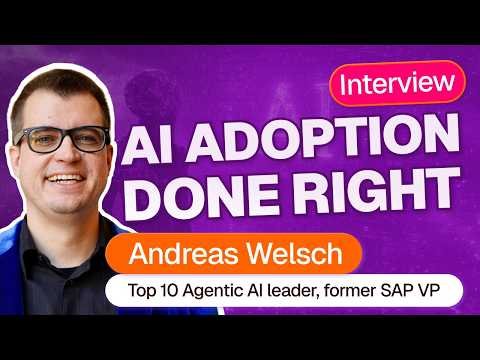
Enterprise AI adoption is easy to announce and hard to deliver. Handing every employee a Copilot or ChatGPT license and calling it a strategy is a common first move — and, on its own, an incomplete one. On a recent episode of the Augmented U podcast, host Jan Štihec sat down with Andreas Welsch, founder and Chief Human Agentic AI Officer of Intelligence Briefing, to unpack what actually separates organizations that turn agentic AI into measurable business value from those still stuck in pilot purgatory.
The conversation, produced in partnership with enterprise AI platform Shelf, covers the gap between AI-first ambition and AI-native reality, the recurring roadblocks that stall adoption, and how leaders should think about human-AI collaboration once agents start operating inside real workflows.
What follows is a structured breakdown of that conversation for CIOs, CHROs, and business leaders who need a workable path from experimentation to enterprise-wide AI adoption — not another hype cycle.
Executive Summary
- Rolling out one AI tool to everyone is not an AI strategy on its own.
- Organizations need an interim “AI-ready” phase before AI-first or AI-native.
- Platform lock-in is real; choose deliberately since switching is costly.
- IT-business friction, shadow AI, and overconfidence remain the top barriers.
- Human-AI collaboration requires controlled autonomy, not full delegation.
Key Takeaways
- Being “AI-first” or “AI-native” is an attainable end state, but organizations cannot flip a switch to get there overnight.
- Leaders need hands-on experience with AI tools themselves, not just awareness of the headlines, to make informed decisions and lead by example.
- Generative AI has democratized access to powerful tools, which raises the stakes on governance, data security, and compliance.
- Shadow AI emerges when approved tools lag behind what employees want to use, pushing sensitive data onto personal accounts and devices.
- Overly optimistic leaders who act on AI outputs without verification set a precedent that erodes diligence across their teams.
- AI adoption should move from personal productivity gains to team-level and business-function-level redesign, not stop at the individual.
- Because large language models are probabilistic rather than deterministic, organizations need a different working model — one built on controlled autonomy and human judgment.
What is AI Adoption?
AI adoption is the process by which an organization moves from isolated experiments with AI tools to structured, business-aligned use of AI and agentic AI across teams and workflows. It goes beyond distributing licenses for a chatbot or copilot; it requires governance, workforce upskilling, and a clear line from technology use to measurable business outcomes. Effective AI adoption treats readiness as a prerequisite, not a formality — organizations become “AI-ready” before they can credibly call themselves AI-first or AI-native.
Beyond the Copilot Rollout: Why “Giving Everyone AI” Isn’t a Strategy
Welsch opens by naming a familiar pattern: a leader is asked “what is our AI strategy?” and answers by pointing to a Copilot or ChatGPT rollout. That, he argues, is not the whole story. The bigger ambition many organizations set — becoming “AI-first,” where everything starts with AI — is achievable, but not as a single leap.
Key Insight: Distributing an AI assistant to every employee is a deployment, not a strategy. Real AI adoption connects tool access to defined business outcomes, governance, and workforce capability — the throughline explored further in Moving from Agentic AI Adoption to Impact.
The AI-Ready Bridge: From Ambition to AI-Native Reality
Between “we rolled out a tool” and “we are AI-native” sits an interim state Welsch calls AI-ready: a workforce that understands the available tools, knows how to use them, and is fluent in the risks and opportunities involved. Getting there is not a switch-flip — it is a deliberate capability-building phase.
Leadership has to model that behavior, not delegate it. Welsch is direct that even with calendars full of back-to-back meetings, leaders need hands-on time with the tools themselves — testing where AI works well, where it doesn’t, and building the judgment to lead by example.
Choosing an AI Platform Without Locking In Blind
On tool selection, Welsch pushes back on the idea that the underlying models matter more than the workflow: most major AI platforms are excellent at working with language and increasingly capable at agentic tasks. The differentiator is the business value an organization is trying to unlock, not which lab built the model.
He flags a practical constraint many leaders underweight: switching AI platforms is expensive. Custom GPTs, agents, and integrations built on one platform have to be rebuilt and retested elsewhere. For a midsize or large organization, that makes an AI assistant decision closer to an ERP or office-suite decision than a quick tooling swap — and, per commentary Welsch cites from a Gartner Data & Analytics Summit, AI assistants are becoming a new, budgeted cost of doing business.
The Real Barriers: IT-Business Friction, Shadow AI, and Overconfidence
Asked what’s preventing successful adoption, Welsch separates the barriers that predate generative AI from the ones it created. The old friction persists: when a technology team dictates how the business should run, business leaders become defensive and go around IT to buy their own tools. What’s changed is that generative AI has removed the technical barrier to entry — anyone can use it, which shifts the primary risk toward governance, security, and compliance.
Key Insight: Blocking AI access outright does not remove risk — it relocates it. Employees with personal devices will use personal AI accounts for company data, creating exactly the shadow AI exposure that formal governance was meant to prevent. That governance-first framing is developed further in AI Governance for Agentic AI in Enterprises.
A second recurring barrier is leadership overconfidence: acting on AI-generated answers without verifying them sets a cultural precedent that spreads through the team. Welsch also points to a scale shift — before generative AI, adoption conversations centered on optimizing business processes; today they start at the individual level, with personal productivity, before scaling out to the team and the business function.
From Personal Productivity to Business Function Impact
The individual-to-organization progression matters because it defines where leaders should focus their attention. Welsch recommends an explicit, recurring dialogue with direct reports: how are you using AI, and for what? If a practice is working for one person, the leadership question becomes what’s stopping the rest of the team from adopting it as a shared standard.
That same discipline — surfacing what individuals have already learned and translating it into team-wide practice — is also where AI-driven “workslop” creeps in if quality controls lag behind adoption speed, a risk covered in How to Prevent AI Workslop and Retain Human Judgment.
Human-AI Collaboration: Controlled Autonomy and the Probabilistic Shift
On human-AI collaboration, Welsch positions himself between the market’s hype and its doom-and-gloom, favoring a pragmatic middle: the goal is making AI genuinely useful, which depends on the quality of the repeated user experience, not just the first one.
Key Insight: Traditional automation is deterministic — the same input reliably produces the same output. Generative AI is probabilistic: the same prompt can produce different results. Organizations need to explicitly reinforce this distinction, especially for employees new to the technology, because it changes how much authority should be delegated versus retained.
Welsch calls this balance “controlled autonomy” — giving AI more latitude in some areas while keeping humans in the loop where judgment, accountability, and risk matter. He connects it to a workforce-planning concern: as some leaders slow entry-level hiring on the assumption that AI will absorb that work, organizations risk losing institutional knowledge that is far harder to rebuild than to retain. That tension between automation and human judgment runs through AI Leadership in the Age of Agentic AI: Governance, Upskilling, and Better Workflows.
Leadership Implications
- Treat AI-readiness as a formal phase, not a rollout milestone. Build workforce fluency in tools, risks, and opportunities before declaring AI-first status.
- Govern before you restrict. Pair an approved-tool strategy with clear guardrails rather than blanket bans, which push usage underground into shadow AI.
- Model hands-on use at the leadership level. Judgment about what to trust, delegate, or verify comes from direct experience, not secondhand reporting.
- Choose AI platforms as a multi-year commitment. Budget for switching costs and treat the decision with the same rigor as a core enterprise system.
- Protect institutional knowledge during workforce changes. Slowing entry-level hiring on the assumption AI will absorb the work risks a talent and knowledge gap that outlasts any short-term efficiency gain.
Why This Conversation Matters
This exchange lands squarely in the gap most enterprise AI coverage skips: the space between announcing an AI strategy and actually operationalizing one. For CIOs and CTOs, it reframes platform selection as a governance and switching-cost question rather than a capability bake-off. For CHROs and business leaders, it puts workforce upskilling and institutional-knowledge retention on equal footing with tool rollout metrics. Welsch’s framing of AI-readiness as a distinct, necessary phase — grounded in his work advising Fortune 500 leadership teams — gives listeners a structured way to sequence adoption instead of chasing a single “AI-first” announcement. Related thinking on sequencing that transition is explored in Agentic AI Leadership: From Pilots to Value.
Conclusion
The throughline of this conversation is that AI adoption is a sequence, not an announcement. Organizations that skip the AI-ready phase — workforce fluency, governance, platform discipline, and controlled human-AI collaboration — tend to confuse deployment with strategy. Leaders who invest in hands-on experience, name the real barriers (IT-business friction, shadow AI, overconfidence), and build a working model around controlled autonomy put themselves in a far stronger position to convert agentic AI into durable business value.
Related Reading
- Moving from Agentic AI Adoption to Impact
- AI Governance for Agentic AI in Enterprises
- How to Prevent AI Workslop and Retain Human Judgment
- AI Leadership in the Age of Agentic AI: Governance, Upskilling, and Better Workflows
- Agentic AI Leadership: From Pilots to Value
- Busting Agentic AI Myths: How AI Readiness Enables “AI-First” (The AI MEMO)
Original Source
Frequently Asked Questions
What does it mean for an organization to be “AI-ready”?
AI-ready means a workforce understands available AI tools, knows how to use them, and is fluent in the associated risks and opportunities — the necessary bridge before an organization can credibly call itself AI-first or AI-native. It is a capability-building phase, not a one-time rollout. Related terms: AI maturity, AI readiness assessment, workforce AI fluency.
Is giving employees access to Copilot or ChatGPT the same as having an AI strategy?
No — tool access alone is a deployment step, not a strategy. A full AI adoption strategy connects tool use to specific business outcomes, governance guardrails, and workforce upskilling, rather than stopping at license distribution. Related terms: AI strategy, enterprise AI rollout, AI tool deployment.
What is shadow AI and why is it a governance risk?
Shadow AI is employee use of unapproved AI tools or personal accounts for work tasks, often to work around restrictive policies. It creates data privacy, security, and compliance exposure because sensitive information can leave the organization’s controlled environment entirely. Related terms: shadow IT, data loss prevention, AI security policy.
How should leaders choose between AI platforms like Copilot, Claude, and ChatGPT?
Leaders should treat the choice as a multi-year commitment rather than a quick swap, since custom agents and integrations built on one platform require significant effort to rebuild elsewhere. Prioritize the business value and workflow fit over which underlying model is technically superior. Related terms: AI platform selection, AI vendor lock-in, enterprise AI tooling.
What is the difference between AI-first, AI-ready, and AI-native?
AI-ready is the interim capability-building stage where a workforce is trained and equipped; AI-first is an organizational ambition to start every initiative with AI; AI-native describes an organization that has fully operationalized AI into its processes. Readiness precedes both, since the transition can’t happen overnight. Related terms: AI transformation stages, AI maturity model, agentic AI adoption curve.
Why is human-AI collaboration described as “controlled autonomy”?
Controlled autonomy means giving AI systems more latitude to act in lower-risk areas while keeping humans directly involved wherever judgment, accountability, or risk is high. It reflects the fact that generative AI is probabilistic, not deterministic, so outputs need review rather than blind delegation. Related terms: human-in-the-loop, AI governance framework, agentic AI oversight.
What are the biggest barriers to successful enterprise AI adoption?
The most common barriers are friction between IT and business teams over who drives adoption, shadow AI created by overly restrictive policies, and leadership overconfidence in acting on unverified AI outputs. Addressing all three requires governance paired with enablement, not just tooling. Related terms: AI adoption barriers, AI governance gaps, enterprise AI risk management.
Why does reducing entry-level hiring because of AI carry risk?
Slowing entry-level hiring on the assumption that AI will absorb that work risks losing institutional knowledge that is difficult and slow to rebuild once experienced talent has left. The workforce implications of AI efficiency gains need to be weighed against long-term knowledge continuity. Related terms: workforce planning, AI and layoffs, institutional knowledge retention.
How can leaders build their own AI literacy?
Leaders build AI literacy through direct, hands-on use of AI tools on real tasks — not just reading about AI — to understand where it performs well and where it falls short. That firsthand experience is what allows leaders to model responsible use and set an accurate tone for their teams. Related terms: AI literacy for executives, hands-on AI training, AI leadership development.
What should leaders do first to start AI adoption in their organization?
Leaders should start by assessing where their organization sits on the AI-readiness spectrum, establish approved tools with clear governance, and open a recurring dialogue with teams about how AI is already being used informally. This surfaces existing best practices before scaling them organization-wide. Related terms: AI adoption roadmap, AI governance checklist, enterprise AI strategy first steps.