

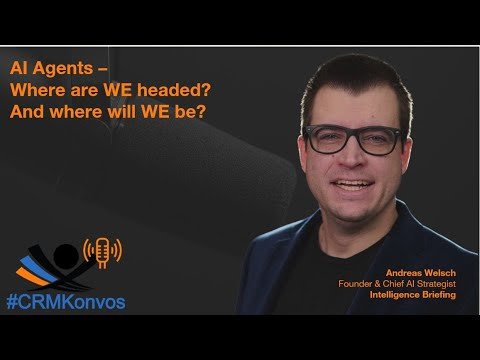
IB YouTube Embed: No valid YouTube URL or video ID provided.
AI leadership is quickly becoming less about chasing hype and more about building organizational capability: governance, upskilling, workflow design, and trust. In a wide-ranging conversation on CRMKonvos, AI leadership expert Andreas Welsch discussed why many organizations still struggle to translate excitement about generative AI into measurable, responsible outcomes.
What does practical AI adoption require? In Andreas Welsch’s view: align AI with business objectives, train people to judge output quality rather than only write prompts, teach ethics through real failure cases, and set guardrails and human oversight for agentic AI, while keeping dependable automation such as RPA for execution.
Welsch, founder and Chief AI Strategist at Intelligence Briefing and author of AI Leadership Handbook, focused on the practical realities leaders face: experimentation without losing control, ethics without slowing progress, and automation without eroding accountability.
The discussion also explored agentic AI, the emerging idea of AI agents that can break goals into tasks, coordinate across “virtual teams,” and execute workflows with increasing autonomy, raising questions about risk, transparency, and workforce transformation.
Executive Summary
- AI leadership requires more than tools: alignment, governance, and workforce enablement.
- Welsch deliberately wrote his book without AI to preserve authentic authorial thinking.
- Upskilling must teach output quality judgment, not just prompting mechanics.
- Agentic AI increases power and uncertainty, making trust and guardrails essential.
- RPA remains relevant because enterprises still need dependable, auditable automation.
Key Takeaways
- Welsch emphasized that readers “want to hear from the author,” not an AI-generated surrogate.
- Enterprise adoption was moving from hype to experimentation, training, and practical evaluation.
- Many users, especially students and newcomers, overestimate output quality without a strong reference frame.
- Ethics education must include bias, hallucinations, and concrete failure examples to build awareness.
- Agentic AI will likely evolve from single-task automation into “virtual teams” that coordinate across functions.
- Trust will determine how much autonomy leaders are willing to delegate to agents, and when to “claw back” control.
- HR is often missing from agent design discussions, despite agents needing behavioral alignment with company standards.
What is AI leadership?
In this conversation, AI leadership refers to the organizational capability to guide AI adoption responsibly and effectively, balancing strategy, governance, workforce enablement, and measurable business impact. Andreas Welsch described AI leadership as moving beyond “shiny objects” toward methodical decisions: aligning AI with business objectives, training people to evaluate outputs, and establishing guardrails so automation does not amplify risk, bias, or internal politics.
Why writing without AI mattered
When asked how much AI was used to create AI Leadership Handbook, Welsch stated that no AI was used in the writing process. The rationale was straightforward: when an author presents concepts, strategies, or frameworks, readers expect the author’s reasoning, not an AI system’s synthesized approximation.
Welsch also argued that leaders must be able to articulate their thinking without depending on tools. If “the lights go out” and a model is unavailable, leadership communication still has to work, especially in real-time settings such as executive conversations.
Key Insight: Welsch’s decision not to use AI in authorship reinforces a core AI leadership message: organizations can adopt AI broadly, but leaders still need independent clarity of thought. Over-reliance on tools risks weakening strategic communication when immediacy, judgment, and accountability matter most.
From hype to practical AI adoption: what is realistically possible
Welsch acknowledged that hype remains in the market, even as organizations increasingly test what works. In his view, many large organizations are investing in training and upskilling so employees can learn to use tools such as copilots or internal “sandbox” versions of large language models.
A major shift is behavioral: traditional enterprise software trained users to fill fields and click buttons in defined workflows. Generative AI introduces open-ended interaction without clear boundaries, making experimentation and critical evaluation part of day-to-day work.
Welsch noted that basic outputs can sound fluent yet remain generic. Meaningful value requires connecting outputs to organizational data and context, and evaluating whether the result is “good,” specific, and usable.
Key Insight: In Welsch’s view, practical enterprise value comes when generative AI is made concrete, tied to company context and data, and when users are trained to judge output quality. Without these steps, AI often produces “nice” language that fails to move real business metrics.
Why is AI upskilling more than prompt training? It is learning quality control
Drawing from hands-on labs with undergraduate business and supply chain students, Welsch highlighted a gap leaders should not ignore: professionals often have stronger intuition about what makes an output useful, while less experienced users may accept outputs as “good” without critique.
In professional settings, Welsch observed that experienced users can articulate why an output fails: too vague, missing examples, irrelevant, or unclear. That evaluative skill becomes a key workforce capability as AI becomes embedded across work.
This is where AI upskilling must mature: beyond tool familiarity and toward critical review, validation against known references, and understanding limitations before outputs flow into customer-facing work, decisions, or automated actions.
How should leaders teach AI ethics? Tangible examples, not abstract principles
Welsch argued that AI ethics must be integrated into any AI education, not treated as an optional module. In his teaching and advisory work, he emphasizes bias, hallucinations, and factual inaccuracies, plus how to spot them and why they matter.
He referenced public examples where AI-generated guidance was nonsensical or risky, such as suggesting non-toxic glue in pizza sauce so cheese does not slide off, or recommending people eat rocks for minerals. Welsch also cited research examples of bias, such as associating “doctor” with male and “nurse” with female.
Key Insight: Welsch’s ethics approach is practical: show real, memorable failures so people build an internal “reference frame” for skepticism. When leaders normalize the idea that AI can be confidently wrong, organizations are more likely to verify outputs against ground truth and reduce downstream harm.
What is agentic AI in an enterprise context? Powerful automation with trust and guardrails
Welsch described agentic AI as software given a goal that can divide work into subtasks and execute them, potentially as “virtual teams,” such as a marketing team of agents creating briefs, ad copy, and creative direction. Over time, he expects interdepartmental agent interactions, analogous to marketing coordinating with finance on budget.
However, he emphasized the then-current need for humans in the loop to provide feedback, approve actions, and correct misunderstandings. Welsch expects more autonomy over time, but sees trust as the gating factor: leaders must become comfortable delegating limited agency while retaining oversight and veto power.
He also highlighted governance questions leaders must answer: if an agent is told to optimize revenue, how is customer satisfaction protected? How is ethical conduct embedded? Does the agent “know” the code of conduct and what it must not do?
“My bot vs your bot”: politics, incentives, and transparency
In a discussion about organizational dynamics, Welsch acknowledged that agents may become extensions of individuals and teams, optimizing for local goals in ways that resemble workplace politics. If data access differs, or if teams try to “tell different stories,” organizations could see a new variant of old conflicts: “my bot says X, your bot says Y.”
At the same time, Welsch argued that agents could also increase transparency. Unlike the human mind, which rarely documents motivations and steps, agent systems can keep logs of interactions, subtasks, and decision paths, potentially enabling more auditable collaboration and better governance.
Key Insight: Welsch’s view balances risk and opportunity: agentic AI can amplify internal misalignment, but it can also surface hidden process realities through logging. For AI leadership, this suggests governance should focus both on preventing “optimization gone wrong” and on using transparency to harmonize work across teams.
Do enterprises still need RPA if they adopt agentic AI?
Welsch agreed with the argument that agentic AI does not replace foundational automation and data work. Traditional automation approaches, rules and robotic process automation (RPA), remain valuable because they are dependable and repeatable. Enterprises often need systems that do exactly what they are told, every time.
In contrast, generative AI introduces uncertainty: leaders must ask how to detect when an agent “goes off the rails,” and how to prevent errors such as misposting funds to the wrong account. Welsch suggested a hybrid direction: multimodal AI can recognize changing interfaces or interpret unstructured content, while RPA workflows execute reliably once the correct information is identified.
This combination supports workforce transformation without eliminating control: adaptive AI for interpretation and reasoning, paired with auditable automation for execution.
What role should HR play in agent design? Why HR cannot be missing
Welsch identified a recurring gap: AI pilots and rollouts often proceed without HR involvement, even though organizations are effectively building digital “replicas” of human work. These systems must behave ethically, align with code of conduct, and follow domain rules (for example, finance standards).
He described an opportunity to create uniformity across departments, rather than finance, procurement, and IT building agents with slightly different interpretations of acceptable behavior. In a world where some employees use AI heavily and others resist it, Welsch suggested performance systems must evolve toward output, results, and impact, rather than measuring work by tool usage.
Recruiting and AI: the resume arms race and the need to re-vet
On hiring, Welsch referenced earlier research with recruiters who believed final decisions must remain human, particularly to assess cultural and personality fit. He also acknowledged the growing “cat and mouse” dynamic: job descriptions are often generic, candidates optimize resumes at scale, and screening tools can be gamed, including through prompt injection-like tactics embedded in documents.
The result is a risk of spiraling inefficiency: more applicants, more automated screening, more inflated resumes, and a higher chance of hiring mismatches. Welsch suggested that organizations may need additional vetting beyond resumes, such as assignments or case studies, and leaders should build feedback loops when hires do not match claimed capabilities.
In this view, AI leadership in HR is not about automating more steps. It is about redesigning the process so that speed does not eclipse correctness and fit.
Leadership Implications
- Start with strategy, not tools: define business objectives, measurable KPIs, and why AI is the right lever.
- Build governance for autonomy: set guardrails for agentic AI goals (revenue, customer satisfaction, ethics, code of conduct).
- Upskill for judgment: train teams to evaluate output quality, spot hallucinations and bias, and verify against trusted references.
- Keep humans in the loop by design: design escalation paths for exceptions, VIP customers, or high-risk decisions.
- Modernize incentives: move performance discussions toward results and impact, not tool usage or activity metrics.
Why this conversation matters
This discussion took place in a public, executive-oriented video conversation where practitioners challenged common assumptions about AI. Instead of treating generative AI and agents as inevitable shortcuts, the dialogue emphasized the work that AI leadership still requires: clarifying business goals, validating outcomes, managing risk, and preparing the workforce.
For CIOs, CTOs, and CHROs, the relevance is direct. Agentic AI increases the surface area of operational and reputational risk, while also offering new forms of automation. Welsch’s contributions connect these opportunities to governance, training, and organizational design, core levers of workforce transformation.
The conversation also reflects themes in Welsch’s broader work: learning from successful AI projects, avoiding “shiny object” distractions, and treating responsible AI adoption as a leadership discipline rather than a software rollout.
Conclusion
AI leadership was entering a more demanding phase: leaders are expected to move past hype and deliver practical, responsible adoption. In Andreas Welsch’s view, this requires disciplined strategy alignment, governance that anticipates agent autonomy, and workforce enablement centered on critical evaluation and ethics.
Agentic AI can accelerate automation and reshape workflows, but it does not remove the need for dependable execution, auditable controls, or thoughtful process design. The organizations that treat these requirements as leadership priorities, not implementation details, will be better positioned for sustainable workforce transformation.
Frequently Asked Questions
What should executives focus on first in AI leadership?
AI leadership should start by clarifying business objectives, measurable KPIs, and decision rights before selecting tools. Welsch emphasized strategy alignment, stakeholder agreement, and the ability to stop projects when value is not materializing.
This reduces “shiny object” pilots that fail to scale and strengthens accountability from day one.
How does Andreas Welsch define the practical value of generative AI?
Generative AI becomes practical when outputs are specific, relevant, and connected to organizational context and data. Welsch noted that early outputs often sound fluent but remain generic, requiring more sophistication to make results usable.
This is where enterprise integration and evaluation skills matter as much as model access.
Why is AI upskilling more than prompt training?
AI upskilling must teach employees how to judge output quality, detect vagueness, and validate against trusted references. Welsch contrasted professionals, who critique relevance and specificity, with less experienced users who may accept outputs as “good.”
Organizations need this judgment capability to prevent errors from entering workflows and decisions.
What is agentic AI in an enterprise context?
Agentic AI is software that receives a goal, breaks it into subtasks, and executes work, potentially across multiple “virtual team” roles. Welsch described marketing and interdepartmental scenarios where agents coordinate, such as marketing asking finance about budget.
It increases automation potential but also raises trust, governance, and escalation design requirements.
Do enterprises still need RPA if they adopt agentic AI?
Yes. Welsch supported the idea that RPA remains valuable because it is dependable and repeatable. Agentic AI can interpret unstructured information and adapt to uncertainty, but enterprises still need auditable automation for execution and control.
A hybrid approach can pair multimodal interpretation with reliable workflow execution.
How should leaders handle AI hallucinations and bias risks?
Leaders should train teams using concrete examples of hallucinations and bias and require validation against ground truth. Welsch emphasized ethics education that includes failure cases, helping users recognize that confident-sounding output can still be wrong.
This builds organizational skepticism without blocking experimentation and innovation.
Can agentic AI amplify organizational politics?
It can. Welsch noted agents may become extensions of individuals or teams, potentially optimizing for local goals and creating “my bot vs your bot” conflicts. Differences in data access or agendas can shape outputs, similar to conflicting spreadsheets.
At the same time, agent logs may increase transparency and enable better governance.
What role should HR play in agent design and governance?
HR should be involved because agents must align with codes of conduct, ethical standards, and desired workplace behaviors. Welsch observed that HR is often absent from AI pilot discussions, even though workforce transformation is directly affected.
Cross-functional alignment can prevent fragmented “department-by-department” definitions of acceptable agent behavior.