

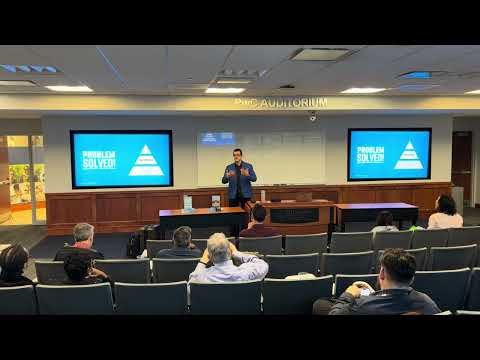
Agentic AI is advancing faster than most organizations can responsibly adopt it. In a live talk at DataPhilly, “Defining Your Human Agentic AI Edge Operating Model” (transcript adapted here), Andreas Welsch, an AI leadership expert, described how the widening gap between what’s possible and what’s deployed is creating both opportunity cost and new governance risk.
An agentic AI operating model is how an organization runs AI agents and copilots in daily work: which tools are approved, what agents may access, how they are monitored, who is accountable, and how quality is ensured. In Welsch’s view, this operating model, not more tools, decides whether agentic AI creates value or creates shadow AI and AI workslop.
Welsch’s focus is not “more tools.” It is the operating model: what changes when AI agents and copilots become part of daily work, how leaders set expectations, and how organizations avoid low-quality AI output (what he calls “AI workslop”) from clogging communication and decision-making.
He also highlighted a predictable but under-managed outcome of “AI-first” mandates: shadow AI. When employees are told to use AI before approved tools and guardrails exist, they often turn to personal devices and paid consumer subscriptions, bringing company data with them.
Why this conversation matters
This talk was delivered to an in-person audience and designed to be interactive, including quick polling on which assistants people use at work. The setting matters: it reflects what many executive teams are seeing: AI adoption is already happening at the edges, even when the enterprise operating model has not caught up.
For CIOs, CTOs, CHROs, and business leaders, Welsch’s message connects three themes that often get treated separately: agentic AI, governance, and workforce transformation. The core question is simple: what must change in leadership expectations, workflows, and accountability when agents can produce outputs at scale?
Executive Summary
- AI capability is accelerating faster than organizational adoption can keep up.
- “AI-first” mandates can unintentionally drive shadow AI and data risk.
- Agentic AI requires an operating model, not just tool rollouts.
- “AI workslop” shifts labor to managers who must verify low-quality output.
- Leaders should set expectations, target recurring tasks, and encourage hands-on experimentation.
Key Takeaways
- Organizations face a growing “availability vs. adoption” gap that expands opportunity cost.
- Shadow AI emerges when employees use consumer tools with company data to meet AI-first pressure.
- Personal productivity gains are real, but leaders should not lose sight of operational and strategic value.
- AI can make information generation cheap; the scarce resource becomes attention and validation.
- Low-quality AI output (“workslop”) can flood inboxes and create a new managerial burden.
- AI agents can be treated like digital employees for management purposes, but remain software with human accountability.
- Human value shifts toward purpose, quality, and impact, supported by judgment and prioritization.
What is an agentic AI operating model?
Agentic AI refers to AI systems designed to take on tasks or goals with a degree of autonomy, often coordinating steps and tools rather than producing a single response. In Welsch’s framing, the leadership issue is not whether agents exist, but how organizations run them: what they are allowed to access, how they are monitored, who is accountable, and how quality is ensured. As agents become more capable, the operating model (governance, expectations, and human oversight) becomes as important as the underlying technology.
Why is enterprise AI adoption falling behind AI innovation?
Welsch argued that the velocity of AI innovation is outpacing organizational capacity to adopt. Missing AI news for a day can feel like falling behind by weeks, while internal rollouts rarely happen at that cadence.
The practical result is a widening gap between what is available and what organizations can safely operationalize. Welsch described this as an opportunity cost: value exists, but the enterprise cannot capture it quickly enough.
Key Insight: The adoption bottleneck is rarely model capability. It is organizational throughput: how fast leaders can align tools, data access, policies, and ways of working without creating uncontrolled risk.
How do “AI-first” mandates lead to shadow AI?
Welsch noted that leaders increasingly announce “AI-first” expectations. In some cases, the message is blunt: use AI, or exit the organization.
He warned that this can trigger shadow AI. If approved enterprise tooling is not yet rolled out, employees still have access to AI on personal devices, including paid subscriptions. Under pressure to comply, they may paste company data into consumer tools to deliver results faster, creating an immediate governance, legal, and IT risk.
Key Insight: Shadow AI is often a leadership and rollout sequencing problem, not an employee intent problem. When expectations outpace enablement, people improvise, especially when the productivity upside is obvious.
What people actually use at work: copilots, Claude, and shifting preferences
In his interactive polling, Welsch asked audiences which AI assistants they use at work. The responses he described showed a tight race among tools, with Microsoft Copilot and Claude prominent and Gemini and ChatGPT also present.
Welsch said that, across multiple audiences over roughly nine months, he has observed Claude gaining share while ChatGPT appears to lose share. He also noted Copilot’s strong prevalence in business settings.
For executives, the implication is not “pick a winner.” The implication is governance clarity: what tools are approved, what versions exist (web vs. work), what data is allowed, and whether employees can build agents.
Example: how a plant manager used an AI agent to find operational savings
Welsch shared an example from a large international manufacturing client. Leaders were asked to identify one task in their role and apply what they learned about AI agents between training modules.
A plant manager exported data into Excel from multiple systems (ERP orders, finance, manufacturing execution, and logistics). He gave the files to a Copilot “researcher” agent and asked it to identify patterns and provide recommendations.
The agent found that certain customers placed multiple small orders of the same product each week. That pattern increased changeover costs (material changes in machines) and transportation costs (more trucks and deliveries). The team used the insight in a quarterly business review to discuss consolidating orders into weekly batches, potentially paired with shipping discounts, reducing operational cost.
Key Insight: AI can put analytics-like capability into non-technical hands. In Welsch’s example, a plant manager without a data science background surfaced actionable patterns that previously might have required an analyst for days.
From personal productivity to business differentiation
Welsch observed that many enterprise AI deployments start in the “inner circle” of individual productivity: meeting summaries, turning documents into slides, shortening text, and formatting content.
He acknowledged the value: it democratizes access and improves AI fluency across the business. But he cautioned leaders not to stop there. Historically, data and analytics have driven team efficiency and operational performance (finance close, sales execution, process improvement) and also enabled differentiated products and services.
For executive teams, that means building a roadmap that moves beyond “everyone has an assistant” to measurable operational outcomes and customer-facing value.
What is the “AI workslop” problem, and why does it appear when information becomes cheap?
Welsch argued that generative AI has made information generation easy. The new bottleneck becomes verification and attention.
He described a common workflow: an employee uses AI to draft a report, then pushes the validation burden to someone else: “Can you take a look?” A senior manager in one of Welsch’s trainings reported receiving frequent AI-generated meeting summaries and action items immediately after meetings, even when a weekly one-on-one already existed for updates.
Welsch connected this to a broader content problem visible on platforms like LinkedIn, where AI drafts posts and other AI tools generate replies, driven by optimization for reach and engagement rather than substance.
Key Insight: “AI workslop” is not just low quality content: it is a workflow failure. When AI makes drafting effortless, leaders must deliberately redesign expectations so validation does not become the new hidden tax on management time.
Hallucinations are not theoretical: professional failures still happen
Welsch cited widely reported examples where professionals relied on AI-generated citations that were not real. He referenced a 2023 legal case where lawyers submitted ChatGPT-generated case citations, and the court found multiple citations did not exist.
He also referenced later reporting (including The Guardian) indicating similar issues continued beyond the “early days.” Welsch’s point: hallucinations and fabricated citations are not confined to one profession, and they remain a real operational risk when AI outputs are used without validation.
Should AI agents be treated like digital employees?
Welsch discussed marketing claims that present agents as “digital employees” that can replace roles. He asked a direct question: should leaders view agents as digital employees?
His conclusion was a “dual lens principle.” Agents can be treated like employees in the sense that they need management structures: guardrails, governance, job descriptions, performance metrics, and clarity on collaboration with other agents. But they remain software, and accountability sits with the people who build and operate them.
Welsch also highlighted that incentives work differently. Humans respond to employment consequences and personal stakes. Agents do not “care” if shut off. Leaders therefore need to think about incentives and oversight in ways that align with organizational goals rather than vanity metrics like reach and engagement.
Key Insight: Treating agents as “digital employees” can help leaders borrow proven management concepts (roles, standards, oversight). Treating them only as employees is dangerous, because responsibility cannot be delegated to software.
What human value remains at work? Purpose, quality, and impact
Welsch described growing anxiety in the job market and cited public comments that suggest entry-level roles may shrink. He argued this shifts a fundamental workplace question: if agents can perform certain tasks faster and cheaper, how is human value defined?
In his discussion with audiences, themes emerged: judgment, prioritization, friction from differing viewpoints, innovation, and people doing business with people. Welsch also raised a concern: if organizations cut off entry-level opportunities, how will professionals accumulate the experience required to develop judgment over time?
His leadership conclusion was that value shifts toward purpose, high-quality outcomes, and real-world impact. The governance takeaway is equally important: how much should be delegated to AI, and when should humans stay “in the loop,” especially where legal, financial, or reputational risks exist?
Leadership Implications
- Set expectations for AI use: Encourage AI usage while making clear quality and accountability remain human responsibilities.
- Reduce shadow AI risk through enablement: Publish approved tools, versions, and data rules so employees do not improvise with consumer apps.
- Start with recurring tasks, then expand: Use repeatable workflows to build fluency, then pursue operational efficiency and differentiation.
- Design validation workflows: Prevent “AI workslop” by clarifying when summaries are needed and what must be verified before sharing.
- Define oversight levels by risk: Keep humans closer to the loop for high-stakes domains (legal, finance, reputation).
How can leaders put an agentic AI operating model into action? Three steps
Welsch closed with three practical steps leaders can implement immediately.
1) Set team expectations for AI. Leaders can explicitly encourage AI use while stating that using AI does not remove responsibility for high-quality work.
2) Pick a recurring task. Rather than waiting for a “perfect” use case, teams can target regular activities (status updates, summaries, routine analysis) and apply AI to improve speed and consistency.
3) Experiment hands-on. Welsch emphasized that direct practice is the fastest way to learn where AI works well, where it fails, and what people need to know to use it responsibly.
Conclusion
Agentic AI is no longer a future concept; it is already shaping how work gets done, and how risk enters organizations. Welsch’s core message is that success depends less on mandates and more on operating model design: expectations, governance, oversight, and workforce enablement.
Leaders who address shadow AI, redesign workflows to prevent AI workslop, and build practical fluency through recurring tasks will be better positioned to capture AI’s value while protecting quality, accountability, and trust.
Frequently Asked Questions
What is the biggest leadership risk with “AI-first” mandates?
The biggest risk is triggering shadow AI: employees use personal AI tools to comply before approved enterprise tools exist, potentially exposing company data. Without governance clarity, well-intended productivity efforts create legal, IT, and reputational exposure.
Welsch described this as a predictable outcome when expectations outpace enablement.
How can organizations reduce shadow AI quickly?
Organizations reduce shadow AI by publishing what tools are approved, which versions are available, and what data rules apply, then reinforcing those expectations in teams. Clarity on “what’s allowed” prevents employees from improvising with consumer subscriptions and company data.
Welsch emphasized that confusion often starts with basic awareness gaps.
What does Andreas Welsch mean by “AI workslop”?
“AI workslop” refers to low-quality AI-generated output that adds noise rather than value, often flooding inboxes with summaries, action items, and drafts that require others to validate. It shifts effort from producing content to filtering and verifying it.
Welsch linked this to workplace workflows and to social content optimized for reach.
What operating model changes when agentic AI is introduced?
Agentic AI introduces operating model needs such as governance, defined access to knowledge sources, collaboration rules between agents, oversight, and accountability. Leaders must also design incentives and validation workflows so agents don’t optimize for the wrong outcomes.
Welsch compared these needs to HR-like management structures.
How should leaders decide when humans must stay “in the loop”?
Human-in-the-loop oversight should increase as risk increases, especially legal, financial, and reputational risk. Delegation level depends on what can go wrong if an agent misbehaves and how quickly leaders can detect and correct errors.
Welsch shared an example of an autonomous inbox-cleanup task deleting messages until power was pulled.
What is a practical first step for enterprise AI adoption?
A practical first step is selecting a recurring task and experimenting hands-on with an approved assistant or agent. Repetition builds real fluency: teams learn where AI helps, where it fails, and what validation steps are necessary for quality.
Welsch recommended starting small but not losing sight of broader value.
How can leaders prevent AI from increasing email and meeting noise?
Leaders prevent noise by setting explicit expectations: when summaries are required, what qualifies as urgent, and what can wait for regular check-ins. Without norms, AI makes it easy to send more content, transferring filtering work to managers.
Welsch’s example described excessive meeting outputs sent immediately after meetings.
What human value remains distinctive in an agentic AI workplace?
Human value becomes more about purpose, quality, and impact, supported by judgment, prioritization, and the ability to navigate people dynamics. Welsch also noted the importance of “friction” from differing viewpoints and the continued reality of people doing business with people.
He raised concerns about how people develop judgment if entry-level roles shrink.