

Agentic AI changes what AI does inside an organization — from tools employees use to systems that observe, decide, and act on their own. That shift introduces a new class of governance, accountability, and workforce questions that Generative AI has never forced leaders to answer.
This page explains what agentic AI means, where it creates real business value, and the operating model leaders need to deploy AI agents responsibly at enterprise scale.
What is Agentic AI
Agentic AI describes AI systems that operate with a degree of autonomy — perceiving context, making decisions, and taking action on behalf of users or organizations, often across multiple steps and without human intervention at each step.
This is a meaningful shift from generative AI, which produces content on demand but does not act. An agentic AI system, given a goal, can break it into subtasks, call tools or APIs, sequence work, adjust based on feedback, and complete a process end-to-end.
For enterprise leaders, the distinction matters because agentic AI crosses a threshold that generative AI never does: AI now influences or drives operational decisions. That raises new questions about accountability, oversight, workforce roles, and governance that technology-first deployment strategies cannot answer alone.
From Generative to Agentic — What Actually Changes
Most enterprises are currently operating under a generative AI mindset: employees use AI tools to produce outputs, and humans remain firmly in the loop for every decision. Agentic AI breaks that assumption in five specific ways.
1. From “tool” to “actor”
Generative AI is a tool an employee uses. Agentic AI is an actor within a process. That changes who (or what) is responsible when outputs shape business decisions — and how leaders need to think about delegation, oversight, and accountability.
2. From “one-shot” to “multi-step”
Generative AI responds to a prompt and stops. Agentic AI plans, executes, observes results, and adjusts across many steps. Errors compound across steps if not caught; trust in agent outputs has to be earned over time, not assumed at deployment.
3. From “visible” to “embedded”
Generative AI outputs appear on a screen where a human reviews them. Agentic AI embeds into workflows where action happens before anyone reads an output. Governance checkpoints that worked for generative AI (review before use) don’t apply — agentic AI requires monitoring, not just review.
4. From “employee productivity” to “process transformation”
Generative AI improves the speed of individual tasks. Agentic AI restructures the processes themselves. That has workforce implications — some roles change, some contract, some emerge — that generative AI rollouts rarely confronted.
5. From “does it work?” to “can we trust it?”
Generative AI’s value question was technical: Is the output accurate? Agentic AI’s value question is organizational: can we trust this system to act inside our business? The difference is what agentic AI leadership has to address.
Four Governance Risks Every Agentic AI Deployment Introduces
Deploying agentic AI without a governance operating model surfaces four distinct risks that Intelligence Briefing has identified across Fortune 500 advisory engagements. Each risk is preventable with deliberate governance design — and each is dangerous when ignored.
Drift
Drift occurs when an agentic AI system operates on stale training data or outdated context and diverges from current organizational intent. The outputs remain confident even when they no longer reflect the current direction. In fast-moving situations, drift can quietly reroute decisions before leaders notice.
Mitigation: explicit update discipline, sign-off cadence, and monitoring of agent-driven outputs against current organizational signals.
Encoded Executive
Encoded Executive is the structural question of ownership and stewardship when AI systems encode executive preferences or decision patterns. Once leadership thinking becomes reusable through AI, it stops being a personal leadership style and becomes a corporate asset. Organizations need to decide who controls that institutional knowledge when leaders transition.
Mitigation: governance policies for AI-encoded leadership representations, including transition protocols and update authority.
Synthetic Leadership Access
Synthetic Leadership Access is the cultural risk when AI proxies substitute for meaningful human engagement. Employees may get redirected to an AI proxy when they want a human conversation. Even if responses are fast and consistent, this can erode trust, especially in high-stakes or sensitive situations.
Mitigation: explicit decisions about where synthetic access is appropriate and where human engagement must remain available.
AI Slop / Work Slop
AI Slop describes low-quality outputs from AI systems used without structure, standards, or oversight. With agentic AI, the risk compounds: agents may produce high volumes of outputs, and slop becomes a scaling problem rather than an individual-tool problem.
Mitigation: quality standards, output monitoring, and governance checkpoints designed for the volumes Agentic AI produces.
These four risks are the practical translation of “what changes when AI becomes agentic” into governance questions leaders can actually answer. Intelligence Briefing’s advisory engagements start here — by identifying which of these risks apply to each agentic AI deployment and designing the specific controls each one requires.
The Operating Model for Accountable Agentic AI
Every Intelligence Briefing advisory engagement uses the HUMAN Agentic AI Edge Operating Model—the proprietary framework for building accountable, AI-ready teams that integrate agentic AI with human judgment without sacrificing quality or trust.
The model addresses the core gap most enterprises face: how to preserve accountability, quality, and trust as autonomous agents take on more decision-influencing work. It covers operating principles, role design, governance checkpoints, measurement frameworks, and the cultural shifts required to maintain quality as AI assumes greater responsibility.
The full framework is published in The HUMAN Agentic AI Edge — Andreas Welsch’s best-selling book based on interviews with 50+ AI leaders and experts — and is standard in every Intelligence Briefing engagement.
Recent Articles on Agentic AI
-

Agentic Commerce: The Four Infrastructure Questions CX Leaders Can’t Postpone
Agentic commerce means AI agents, not people, will soon shop and transact on your…
-
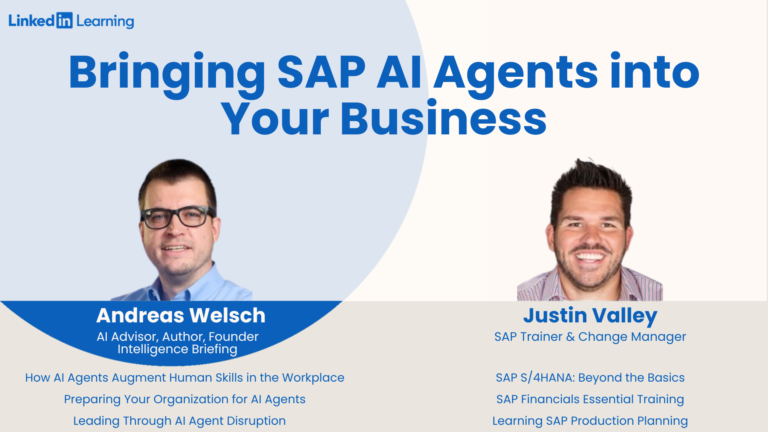
Agentic AI in SAP: Leadership Lessons for Adoption
Navigate SAP Joule and AI agents with KPI-led pilots, governance for trust, and workforce…
-
Agentic AI Leadership: From Pilots to Value
Explore how leaders turn agentic AI from pilots into value, manage governance risk, and…
-
Agentic AI: The Operating Model Leaders Need
Navigate agentic AI with governance, oversight, and workforce practices that reduce shadow AI and…
-
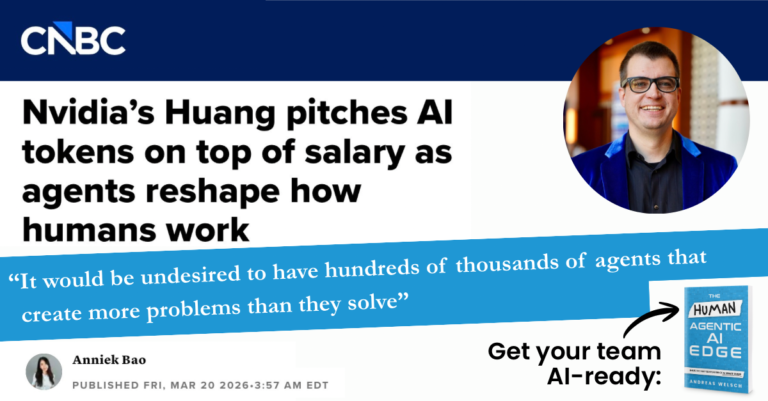
Agentic AI in the Workplace: Why Using More ‘AI Tokens’ Alone Won’t Guarantee Project Sucess
Assess Nvidia’s AI tokens idea, AI agent workforce impact, and the governance and workflow…
-
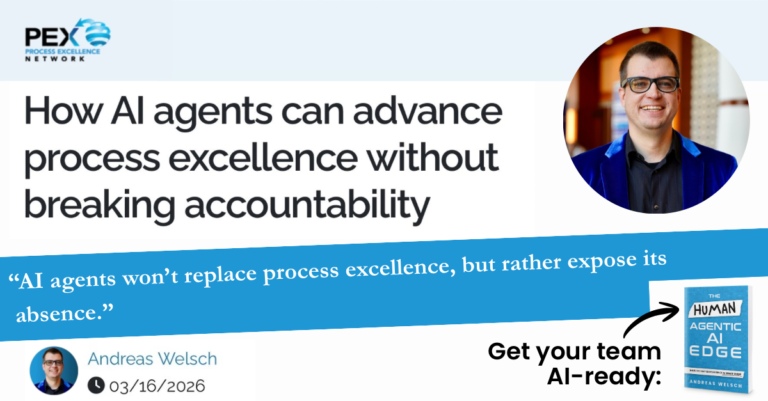
Agentic AI for Process Excellence: Scale Automation Without Losing Accountability
Strengthen process excellence with Agentic AI using clear roles, guardrails, escalation thresholds, and ownership…
-
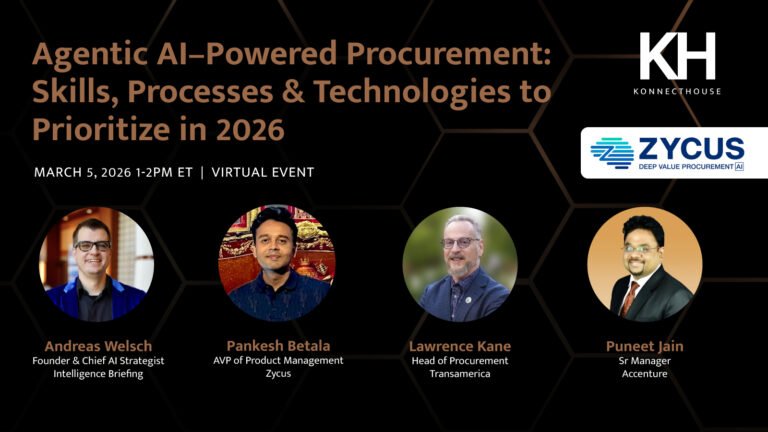
Agentic AI: What Procurement Leaders Should Prioritize for 2026
Agentic AI is moving procurement beyond simple automation into workflows that are more complex,…
-

Why Agentic AI Won’t Bring The “SaaSpocalypse” Overnight
Andreas Welsch explains how agentic AI reshapes Enterprise SaaS: disruption risk, outcome-based pricing, governance,…
-

Avoiding “AI Workslop” and Designing Accountable Work
Avoid AI work slop by redesigning work, decision rights, and governance as agentic AI…
-
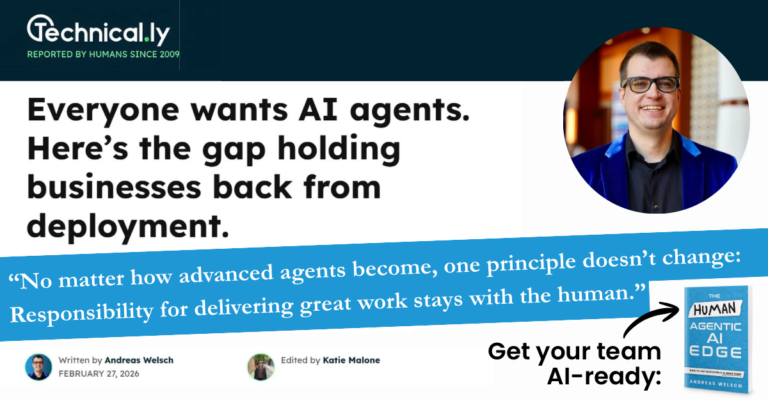
Closing the Gap Holding Businesses Back from Deploying AI Agents
AI agents are becoming a frequent topic in boardrooms and technology roadmaps. However, many…
-
Agentic AI and the Human Edge
Agentic AI adoption, shadow AI risks, human-in-the-loop governance, and the four A’s for accountable…
-

Agentic AI: Practical Strategies for Scaling, Governance, and Workforce Adoption
Agentic AI is moving beyond proof-of-concept pilots into operational deployments.
From Agentic AI Strategy to Accountable Deployment
Understanding agentic AI as a concept is the start. Deploying it inside a real enterprise — with real governance, real workforce implications, and real accountability — requires applied work.
The HUMAN Agentic AI Edge
The HUMAN Agentic AI Edge publishes the complete operating framework — operating principles, role design, governance checkpoints, and the four governance risks in depth. Required reading for any leader whose organization is deploying agentic AI.
Read The HUMAN Agentic AI EdgeAI Advisory Services
AI Advisory Services help enterprise leaders design agentic AI governance specific to their organization’s risk posture, workforce structure, and deployment roadmap. Advised by 2x best-selling AI author Andreas Welsch with frameworks proven at Fortune 500 scale.
Book an Agentic AI Discovery CallCertified AI Leader™ Program
The Certified AI Leader™ Program includes dedicated content on agentic AI operating models, governance risks, and the leadership practices required to deploy AI agents responsibly. Tier-appropriate training for executives, business-unit leaders, and functional owners.
Explore the Certified AI Leader Program“What’s the BUZZ?” Podcast
“What’s the BUZZ?” — the Intelligence Briefing podcast — features regular conversations with AI leaders and practitioners on agentic AI deployment, governance, and workforce impact. Available on Apple Podcasts, Spotify, and YouTube.
Listen to What’s the BUZZ?