

Why the “AI Unemployment” Story Isn’t Written Yet
AI leadership is increasingly being tested by a narrative that sounds inevitable: widespread AI-driven unemployment.
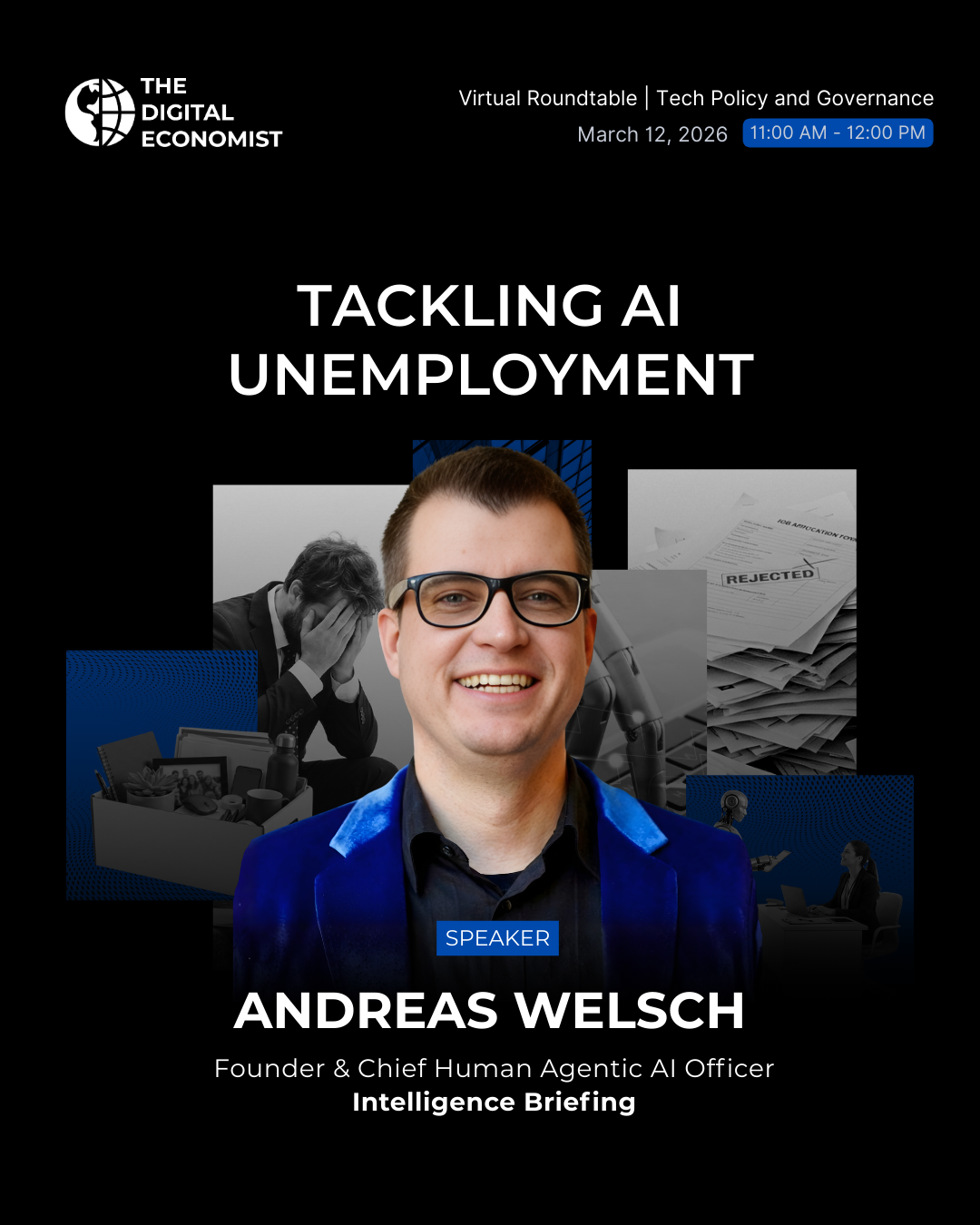
Andreas Welsch, an AI leadership expert, argues that this narrative is not destiny. Leaders are shaping what the future of work will look like—through choices about operating models, talent pipelines, and how responsibly AI is brought into business and society.
This article is based on a panel discussion titled “Tackling AI Unemployment,” hosted by The Digital Economist think tank. Welsch’s core message is pragmatic: AI is an opportunity, but only if leaders avoid short-term optimization that undermines long-term capability and culture.
Executive Summary
- AI unemployment is a narrative leaders influence through choices and priorities.
- Cutting entry-level roles can weaken future succession and product/customer knowledge.
- Entry-level work shifts from research to synthesis and recommendations.
- Pairing juniors with seniors enables learning in both directions.
- Over-delegating to AI risks “never-skilling” and capability loss.
Key Takeaways
- Leaders have a “special and important role” in shaping the AI-era workforce, not just reacting to it.
- Public examples show diverging strategies: layoffs to “improve with AI” versus rebuilding entry-level pipelines.
- Organizations risk eroding the future talent bench if entry-level roles are reduced too aggressively.
- AI changes the entry-level skill window: less gathering, more synthesis, preparation, and recommendations.
- Mentoring and reverse mentoring can accelerate adoption while preserving experiential knowledge transfer.
- Job rotation, stretch assignments, projects, shadowing, and job swaps should return as development mechanisms.
- Responsible AI adoption includes moderation and awareness of “never-skilling” at individual, team, and company levels.
What is AI leadership?
AI leadership is the executive practice of shaping how AI is adopted in the business—deciding where it is applied, how work changes, and what guardrails protect people, customers, and society. In Welsch’s framing, it is not only about productivity and cost. It also includes workforce transformation choices, such as redefining entry-level roles, building a sustainable talent bench, and ensuring the organization retains knowledge rather than delegating it away.
Leaders are writing the AI employment story
Welsch challenges a common assumption: that AI-driven unemployment is an inevitable outcome. The outcomes depend on leadership decisions about operating models, workforce plans, and how AI is integrated into real workflows.
He positions himself as a “techno pragmatist,” emphasizing inspiration and opportunity without losing sight of responsibility. That dual lens matters because the same technology can drive either long-term capability building or short-term workforce reduction.
Key Insight: Welsch reframes “AI unemployment” as a leadership decision surface. The story is shaped by choices about which roles are redesigned, which are eliminated, and whether the organization invests in developing talent for AI-augmented work rather than optimizing only for near-term cost.
What CEOs are signaling: contrasting moves in the market
Welsch points to recurring news coverage of CEOs describing workforce reductions tied to AI, including references to Jack Dorsey at Block and to leaders at Atlassian making similar announcements. He notes that observers may draw conclusions about financial motivations, including stock performance and business pressure.
He also highlights IBM as a counterexample of a strategy shift over time. Welsch references a prior statement from CEO Arvind Krishna about replacing thousands of back-office roles with AI and automation, followed by a more recent message from IBM’s CHRO: the company is tripling entry-level hiring to build a sustainable talent bench.
The implication is strategic: organizations still need successors who understand products, industry context, and customers. Relying on external hires alone can be expensive and uncertain, particularly when retention and cultural fit are not guaranteed.
From pyramid to diamond to “spear”: why operating models matter
Welsch suggests that traditional organizational pyramids may evolve into different shapes over time—moving toward a diamond, a kite, and eventually a spear. In his view, one driver is the perception that fewer entry-level roles are needed as AI handles more routine work.
That evolution creates an immediate governance and strategy question for executives: if the “bottom” of the organization is thinned, where does the next generation of leaders come from?
Key Insight: Reducing entry-level roles can unintentionally break succession, internal mobility, and institutional knowledge transfer. Welsch emphasizes that AI-driven redesign must account for the future leadership pipeline, not just present-day efficiency, or the business may pay later through costly external hiring and weaker continuity.
Redefining “entry level” in an AI-augmented workflow
Welsch frames the shift as a change in the entry-level skill window—not a simple elimination of junior work. He describes a classic flow of work: gather information, synthesize it, prepare a decision, then take action.
If AI supports research and information gathering—finding sources and accelerating discovery—then the human contribution at entry level may move up the value chain. The emphasis becomes synthesizing inputs, preparing decision-ready material, and making recommendations.
This is a workforce transformation point, not just a tooling discussion. It requires role redesign, capability planning, and explicit training paths so early-career talent can learn how to produce judgment-oriented outputs rather than only compiling information.
Pairing juniors with seniors: mentoring and reverse mentoring
Welsch identifies one practical mechanism for building these capabilities: pairing entry-level professionals with senior individuals who can share experience and knowledge.
At the same time, he notes a reciprocal dynamic similar to reverse mentoring. Senior professionals can learn about new technology and new ways of working from juniors who may be closer to emerging tools and practices.
Key Insight: Pairing is not only a development tactic; it is a risk control for AI adoption. It helps ensure that AI-accelerated outputs still reflect context, product knowledge, and customer reality, while also accelerating change management through shared, cross-level learning.
Bring back job rotation, stretch assignments, shadowing, and swaps
Welsch argues that established HR concepts should return “on the table” now. He calls out job rotation, stretch assignments, and project-based experiences that expose people to other parts of the business.
He describes formats ranging from a couple of days of shadowing to months-long rotations and even year-long job swaps. The aim is to help the workforce learn outside its comfort zone, connect the dots across functions, and build broader business understanding.
In an AI-enabled environment where some tasks become automated, these programs can help employees shift toward higher-value work rather than being displaced by narrow role definitions.
Don’t stop at “better emails”: aim AI at strategic differentiation
Welsch’s plea to leaders is to look inside the organization and recognize the value of existing talent and experience. In his framing, simply “cutting the bottom” to reduce costs optimizes for the status quo—but does not prepare the organization for a brighter future.
He urges leaders to widen the AI agenda beyond superficial productivity gains such as writing better emails or summarizing meeting minutes. The more strategic question is what the team uniquely does—and what differentiates it.
That shift aligns AI adoption with business strategy: increasing productivity can free capacity to build new products, expand capabilities, and pursue outcomes that matter competitively.
Upskilling, reskilling—and the risk of “never-skilling”
Welsch closes with a caution that complements upskilling and reskilling: “never-skilling.” If too much is delegated to AI, people may not build or retain foundational knowledge.
He frames the risk at multiple levels—individual, team, and company. When knowledge creation and retention weaken, decision quality, resilience, and long-term capability can decline, even if short-term outputs look faster.
His guidance is straightforward: AI is a great technology, but like anything, it should be used in moderation. Responsible adoption means knowing what must remain understood, owned, and accountable by humans.
Leadership Implications
- Design AI workflows intentionally: shift entry-level work from gathering to synthesis and recommendations, not elimination by default.
- Protect the talent bench: ensure succession and product/customer knowledge pathways remain viable amid automation.
- Institutionalize pairing models: formalize senior-junior teaming to transfer context while accelerating new ways of working.
- Re-enable development mechanics: use rotation, shadowing, stretch assignments, and swaps to build breadth and adaptability.
- Govern for capability retention: monitor “never-skilling” risks so critical knowledge is learned and retained, not outsourced to AI.
Why this conversation matters
This transcript-style conversation speaks to an executive audience navigating workforce transformation under AI pressure. It addresses the tension between cost-focused moves and sustainable operating models, using real company examples discussed by Welsch to illustrate different approaches.
For AI leadership, the relevance is immediate: adoption decisions shape culture, capability, and risk. The conversation pushes beyond tool adoption into how organizations train people, redesign entry-level pathways, and preserve the knowledge needed for future leadership continuity.
These themes connect to Welsch’s broader focus on turning AI and Agentic AI from experimentation into measurable outcomes while preserving human accountability and responsible use.
Conclusion
AI leadership is not only about deploying technology; it is about shaping the workforce and operating model that will carry the business forward. Welsch’s perspective reframes AI unemployment as a narrative influenced by executive choices.
Organizations that redesign entry-level roles toward synthesis and recommendations, invest in pairing and rotation, and manage “never-skilling” risks will be better positioned to capture AI-driven productivity without sacrificing the next generation of leaders.
FAQ
1) What is AI leadership in the context of workforce transformation?
AI leadership is how executives decide where AI changes work, roles, and accountability while balancing opportunity with responsible adoption. In Welsch’s view, it includes protecting the talent bench, redesigning entry-level work, and avoiding capability loss from over-delegation.
It goes beyond tools to operating model and people strategy decisions.
2) Will AI eliminate entry-level jobs?
AI may reduce some entry-level tasks, but Welsch argues the outcome is not predetermined; leaders shape the story. He describes a shift in the entry-level skill window from information gathering toward synthesis, preparation, and making recommendations.
The key is redesign and training, not removal by default.
3) Why can cutting entry-level roles create long-term risk?
Cutting entry-level roles can weaken succession and institutional knowledge, because fewer people learn products, customers, and industry context over time. Welsch highlights the need for a talent bench as senior leaders move up and out, avoiding expensive and uncertain external hiring.
This is a strategic workforce risk, not only a headcount decision.
4) What does Welsch mean by organizations moving from a “pyramid” to a “diamond” or “spear”?
Welsch suggests organizational shapes may evolve as AI changes how much junior work exists—moving from pyramids toward diamond, kite, and eventually spear-like models. His caution is that fewer entry-level roles raise the question of who will become future leaders.
Operating model change must include pipeline planning.
5) How should entry-level roles be redesigned for AI workflows?
Welsch describes work as gathering information, synthesizing it, preparing a decision, and taking action. If AI supports research and source-finding, entry-level roles should increasingly focus on synthesis, decision-ready preparation, and recommendations rather than compiling information.
That shift requires explicit training and supervision.
6) What is “never-skilling,” and why does it matter?
“Never-skilling” is the risk that employees do not build knowledge because too much is delegated to AI. Welsch warns this can reduce what individuals, teams, and the company actually retain, creating hidden capability and resilience gaps despite faster outputs.
Responsible AI adoption includes moderating delegation and protecting learning.
7) How can leaders train early-career talent for synthesis and recommendations?
Welsch points to pairing entry-level professionals with senior individuals who share experience and context. He also notes reverse mentoring effects, where seniors learn new technologies and ways of working, creating a two-way learning loop that supports AI adoption.
This makes development practical and workflow-embedded.
8) Which HR programs does Welsch recommend revisiting now?
Welsch recommends bringing back job rotation, stretch assignments, and projects, including short shadowing experiences and longer job swaps. These programs help employees learn outside their comfort zone, understand other parts of the business, and connect dots across functions.
They become more important as AI reshapes task boundaries.
9) Where do many organizations under-apply AI today?
Welsch cautions against limiting AI to narrow productivity wins like writing better emails or summarizing meeting minutes. He urges leaders to focus on what teams do that differentiates them strategically, and how AI-driven productivity can enable new products and outcomes.
This frames AI strategy around competitive advantage.
10) What is the responsible AI adoption posture implied in this conversation?
Welsch describes a techno-pragmatist posture: pursue opportunities while bringing AI into business and society responsibly to avoid harm and risk. He also emphasizes moderation, ensuring humans retain knowledge and accountability rather than outsourcing understanding to AI systems.
This supports sustainable AI governance and adoption.