

Agentic AI: What Procurement Leaders Should Prioritize for 2026
Agentic AI is moving procurement beyond simple automation into workflows that are more complex, unstructured, and outcomes-driven. In a market filled with hype and noise, leaders still need a practical way to separate measurable value from aspirational demos.
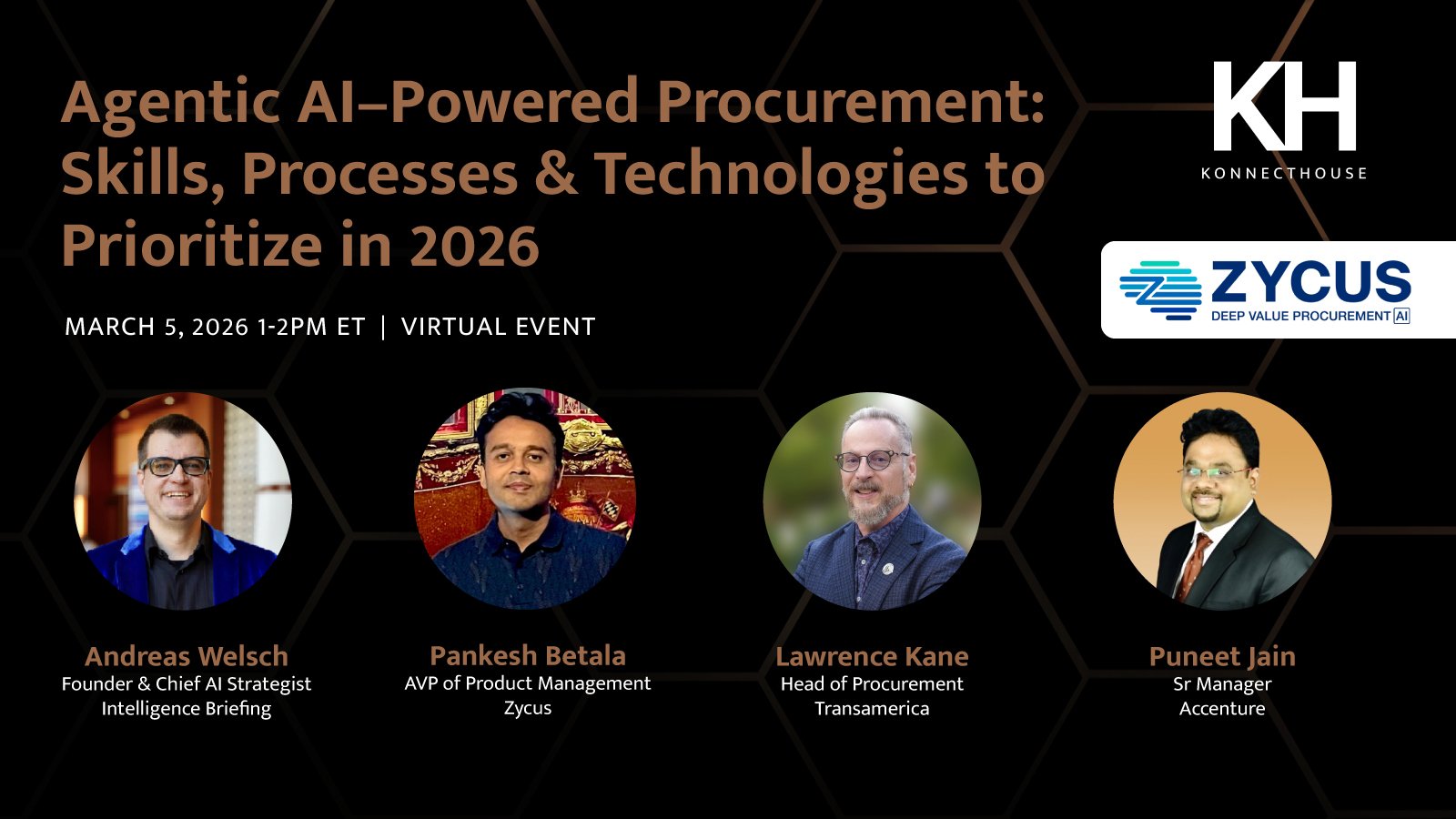
This article is adapted from a webinar conversation led by Andreas Welsch, an AI leadership expert and advisor to senior business leaders, on “Agentic AI-Powered Procurement Skills, Processes, and Technologies to Prioritize in 2026.” The discussion focused on where value is already being realized, how roles are evolving, and which technologies and governance practices matter most.
For executives, the central challenge is no longer “should AI be explored?” It is how to design responsible adoption—balancing speed, risk tolerance, data readiness, and human accountability—while transforming the procurement operating model.
Executive Summary
- Agentic AI can accelerate complex procurement work beyond rules-based automation.
- Revenue impact may outweigh back-office efficiency gains in some organizations.
- Data quality and metadata readiness are critical foundations for reliable agents.
- Governance determines acceptable autonomy, oversight, and certifications required.
- Procurement skills shift toward AI literacy, strategy, and business partnership.
Key Takeaways
- Andreas Welsch emphasizes starting with the business problem, then working backward to technology.
- Welsch highlights an inflection point: software can be delegated more autonomy for complex tasks.
- Welsch recommends calculated experimentation—explore, test, and then decide based on risk appetite.
- Welsch frames a “dual lens”: treat agents like digital employees for processes, but as software for accountability.
- Welsch notes pricing models are not standardized yet (outcome-, agent-, or token-based approaches exist).
- Welsch points to persistent AI project underperformance as an adoption and operating-model issue, not only a technology issue.
What is Agentic AI?
Agentic AI refers to software systems that can execute tasks with more autonomy than traditional automation, often handling multi-step workflows that include planning, retrieving information from multiple sources, and completing actions across tools. Andreas Welsch describes it as a shift toward delegating “more autonomy” and “more agency” to software so it can help complete work that is complex and unstructured—beyond repeatable, rules-based automation.
Why procurement leaders are paying attention to Agentic AI
Procurement has long been judged on cost savings, but the conversation underscores a broader value agenda—revenue enablement, speed-to-market, compliance, and risk reduction. The webinar positions Agentic AI as a lever for measurable improvements across the source-to-pay lifecycle, provided leaders focus on the right use cases and safeguards.
Key Insight: Andreas Welsch highlights that the core leadership problem is discernment: separating hype from what is real and measurable. Agentic AI can create genuine business value, but only when it is tied to business objectives, grounded in reliable data, and governed to match regulatory and risk requirements.
Where organizations are already seeing measurable value
The conversation highlights value opportunities that extend beyond procurement’s internal efficiency. One example described involves accelerating decision cycles by having Agentic AI pull data from multiple systems, collate it, and support faster human decisions with safeguards in place.
In addition to revenue-enabling scenarios, the discussion identifies traction across the end-to-end source-to-pay process, including sourcing automation, supplier onboarding and risk management, invoice ingestion and matching, and agent-assisted spend analytics for identifying and executing savings opportunities.
Key Insight: The most compelling early wins are often not “procurement makes procurement better,” but “procurement helps the company perform better.” The discussion contrasts internal efficiency benefits with revenue impact and speed-to-decision improvements enabled by agents—when privacy, security, and human oversight are designed in.
Agentic AI workflows that are most ready today (and why)
The panel discussion points to four major areas where Agentic AI workflows are gaining traction across customer priorities: (1) sourcing automation to reduce indirect spend, (2) supplier onboarding to improve compliance and reduce risk, (3) invoice-to-pay automation including ingestion and matching, and (4) spend analytics agents that propose savings opportunities and execution plans.
Importantly, the conversation frames adoption around business goals rather than a single metric like savings. Organizations may prioritize automation, compliance, risk reduction, or cost reduction depending on strategy and risk tolerance.
Key Insight: Agentic AI value is not one-size-fits-all. The same workflow category (e.g., invoicing) can require different levels of autonomy depending on risk tolerance. This is why governance and workflow design—especially where to keep humans in the loop—become differentiators.
Supplier risk: what agents can evaluate
Supplier risk in the discussion is treated as multi-dimensional and configurable. Examples include screening for sanctioned suppliers and identifying vendors with data privacy issues. The conversation also notes that risk categories can include financial, operational, and ethics-related considerations—selected based on the buyer’s industry and use case.
This configurability matters: a software vendor relationship may emphasize security and privacy over operational supply chain risk, while other categories may need broader operational resilience signals.
Data readiness: why “bad data means bad decisions faster”
A recurring theme is that agents still require “good data, fresh data, complete data, accurate data.” The discussion offers a practical illustration: supplier master data variations (multiple spellings and formats for the same supplier) can distort spend analytics and supplier rationalization decisions.
The conversation also highlights how contract lifecycle management (CLM) implementations can be used as a catalyst to ingest, cleanse, and enrich contract data with metadata—enabling faster search, compliance checks, and policy reviews that previously took months.
Key Insight: Data cleanup is difficult to fund as “infrastructure,” so leaders often need to bundle data readiness into a broader business case (e.g., CLM). The discussion emphasizes fit-for-purpose sequencing: if data cleanup is required for outcomes, it should be treated as an essential program component, not an optional pre-project.
AI governance and certifications: start with risk tolerance
The webinar discussion does not prescribe a single universal certification set. Instead, it emphasizes that required security accreditations and certifications depend on the industry and regulatory burden (e.g., stricter requirements for government organizations). A governance process is presented as the prerequisite to decide acceptable controls, oversight, and evidence needed to proceed.
The conversation also raises broader governance topics: intellectual property rights in training data, evolving legal interpretations of AI-generated outputs, and real-world safety risks from autonomy. These concerns reinforce that governance must be cross-functional—spanning procurement, information security, technology, privacy, and legal.
Key Insight: Governance is not a documentation exercise; it is the decision system for autonomy. It defines risk tolerance, evidence requirements (including certifications), human-in-the-loop rules, and review cadence—especially as laws, models, and business conditions change.
Human vs. agent: the accountability line procurement cannot cross
Andreas Welsch introduces a practical stance: agents can be treated like “digital employees” for process design (e.g., procedures, delegation, trusted data grounding), but they remain software. The human organization retains responsibility for outcomes.
The discussion also distinguishes levels of autonomy: some workflows are suitable for copilots or assistants, while others may allow more autonomy—especially where risk is lower. Complex, high-stakes work (for example, contract negotiation beyond price-only scenarios) is positioned as needing humans in the loop.
How to decide autonomy level: complexity and risk tolerance
The conversation offers two practical decision levers for autonomy: workflow complexity and risk tolerance. Complex workflows (for example, contract renewal involving multiple parties and steps) are better served by copilots that provide strategy suggestions rather than executing end-to-end actions without review.
Conversely, in low-risk scenarios such as tail-spend sourcing with limited downside, organizations may tolerate higher autonomy. For invoicing, the discussion emphasizes lower error tolerance and stronger oversight expectations.
Pricing models: why value-based outcomes resonate
Andreas Welsch notes that pricing models vary by vendor and use case—some charge by outcome (e.g., successful process completion), others by agent subscription, and others by tokens/characters. The discussion indicates there is no standardized pricing model yet, unlike traditional “seat-based” software.
The conversation also highlights that outcome- or value-based pricing can align better with what executives measure: savings achieved or time converted into cost. This makes it easier to tie investment to business metrics.
Workforce transformation: how procurement skills are changing
The discussion frames a shift away from tactical operational work—especially “non-value-added but necessary” tasks—as agents absorb more of that load. Procurement roles are described as moving toward strategy, business partnership, and being “smart enough to ask the right question” of AI systems.
Skill themes include AI literacy, effective prompting, understanding governance boundaries (what data can be exposed and what cannot), and the ability to connect enterprise strategic goals to procurement actions and supplier capability enablement.
Leadership Implications
- Anchor Agentic AI to business outcomes: Follow Welsch’s guidance to start with the business problem and work backward.
- Build governance before scaling: Establish cross-functional AI governance to define risk tolerance, oversight, and evidence requirements.
- Design for data readiness: Treat data cleanup and metadata enrichment as part of the program business case, not a side project.
- Match autonomy to risk: Use workflow complexity and error tolerance to decide between assistant, copilot, or more autonomous execution.
- Upskill the function: Prioritize AI literacy, prompt competence, and strategic business partnership as operational work is delegated to agents.
Why this conversation matters
This webinar conversation is relevant to CIOs, CTOs, CHROs, and procurement leaders who are translating AI experimentation into operational reality. It frames Agentic AI as a workforce and operating-model change—not just a technology upgrade.
Andreas Welsch connects procurement adoption to broader AI leadership themes: starting with business objectives, designing governance around accountability, and preparing teams for role evolution. The discussion is especially timely for 2026 planning because it addresses where measurable value exists today, where humans must remain accountable, and why data readiness and governance are prerequisites for scaling.
Conclusion
Agentic AI is reshaping procurement by enabling more autonomous execution across sourcing, onboarding, invoicing, analytics, and contract-related work. The path to value in 2026 runs through disciplined AI leadership: business-first prioritization, strong governance, data readiness, and workforce upskilling.
As Andreas Welsch emphasizes, organizations can delegate work to agents, but they cannot delegate responsibility. Procurement leaders who operationalize that principle will be best positioned to scale Agentic AI safely and competitively.
Recommended Resources (Links)
Internal (Intelligence Briefing):
- Intelligence Briefing – AI leadership insights
- AI governance guidance
- Agentic AI coverage
- AI strategy and operating model
- Newsletter for executives
External references:
- NIST AI Risk Management Framework (AI RMF)
- OECD AI Principles
- ISO/IEC AI standards (ISO/IEC JTC 1/SC 42)
FAQ
1) What is Agentic AI in procurement?
Agentic AI in procurement is software that can execute multi-step sourcing, supplier, contract, invoice, or analytics tasks with more autonomy than traditional automation, while still requiring governance and human accountability. It helps handle complex, unstructured work across source-to-pay.
In the webinar, Agentic AI is positioned as enabling delegation of more “agency” to software for tasks previously too complex for rules-based automation.
2) How should leaders choose Agentic AI use cases?
Leaders should choose Agentic AI use cases by starting with a clearly defined business problem and working backward to the required data, workflow, controls, and technology. This approach increases measurable value and reduces “pilot-to-nowhere” risk.
Andreas Welsch explicitly emphasizes business-first framing before selecting technology.
3) What procurement workflows are most ready for agentic automation today?
The most ready workflows discussed include sourcing automation (especially tail spend), supplier onboarding and compliance checks, invoice ingestion and matching with human exception handling, and spend analytics that identifies opportunities and flags inconsistencies for review.
Adoption readiness depends on risk tolerance and complexity.
4) Why does data quality matter so much for Agentic AI?
Data quality matters because agent outputs depend on input accuracy, completeness, freshness, and relevant metadata; poor data produces poor decisions faster. Duplicate supplier records, missing metadata, and outdated information can distort spend analytics, compliance checks, and automated workflows.
The conversation highlights cleansing supplier names and enriching contract metadata as foundational steps.
5) How long does data cleanup and taxonomy work take before Agentic AI deployment?
Data cleanup time varies by data volume and starting quality, but the webinar includes an example of roughly five to six months spent cleaning data and enriching metadata before agentic AI development. Legacy systems and missing metadata can extend timelines.
Leaders are encouraged to bundle data work into a broader business case rather than funding “infrastructure” separately.
6) What certifications or accreditations are recommended for Agentic AI security?
No single certification is universally recommended in the discussion; required accreditations depend on industry, regulatory burden, and organizational risk tolerance. Governance should determine what evidence is needed, which may include information security frameworks and AI management standards.
The Q&A references SOC 2 and mentions ISO 42001 as a suggestion from participants.
7) Should procurement teams treat AI agents like digital employees?
Procurement teams can treat agents like digital employees for process design—such as delegation, procedures, and trusted data grounding—while still recognizing agents are software and humans remain accountable for outcomes. This helps structure work without transferring responsibility.
Andreas Welsch describes this as a practical “dual lens” for operating model design.
8) How much human oversight is needed for Agentic AI?
Human oversight should be highest early in deployment and may decrease as confidence grows, but “set and forget” is not recommended. Regulations, business conditions, and model behavior can change, requiring periodic QA checks, monitoring, and potential workflow rollback.
The discussion suggests aligning oversight cadence to risk tolerance and the volatility of the operating environment.
9) Can Agentic AI negotiate contracts end-to-end?
The webinar suggests caution: agents can support contract work by interpreting redlines against playbooks and accelerating analysis, but end-to-end autonomous negotiation is not positioned as broadly appropriate. Complexity, legal risk, and accountability requirements typically keep humans in the loop.
Price-only scenarios (e.g., certain auction dynamics) are presented as more suitable for automation than broader legal terms.
10) How are procurement skills changing with Agentic AI?
Procurement skills are shifting from operational execution to AI literacy, prompting competence, awareness of governance, and strategic business partnerships. As agents absorb repetitive work, teams need stronger capability in asking the right questions, interpreting outputs, and aligning procurement actions to enterprise strategy.
The discussion also highlights security awareness about which data can be exposed to AI systems.