

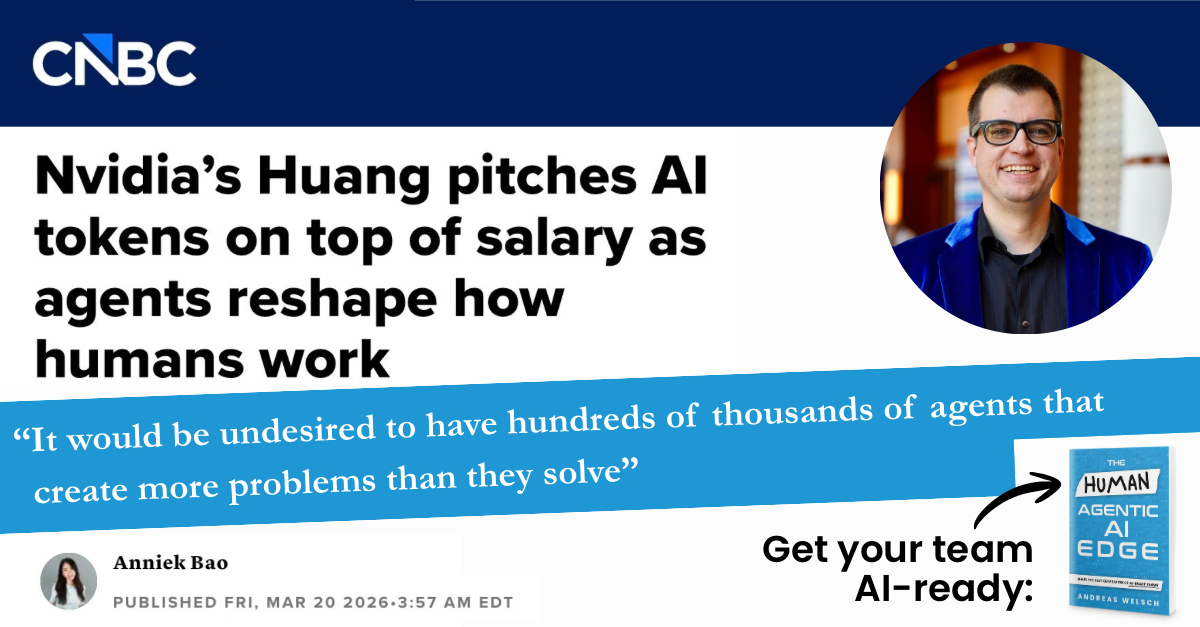
Original source: Nvidia’s Huang pitches AI tokens on top of salary as agents reshape how humans work (CNBC)
Agentic AI in the Workplace: Why Nvidia’s ‘AI Tokens’ Idea Forces a New Leadership Playbook
Agentic AI is moving from experiments to operating-model decisions, including how companies budget productivity and redesign work. A CNBC report describes Nvidia CEO Jensen Huang proposing “AI tokens” for engineers on top of base salary, effectively funding AI agent usage as a productivity multiplier.
For CIOs, CTOs, and CHROs, the leadership challenge is no longer whether AI tools exist, but how to govern agentic AI at scale—so that “digital employees” accelerate outcomes without creating uncontrolled operational risk.
The coverage also highlights the tension between optimism about productivity and rising concerns about displacement, reskilling, and the fragility of real-world AI adoption. Andreas Welsch, an AI leadership expert and author of The Human Agentic AI Edge, is quoted warning that most AI projects have failed in recent years and that large-scale agent deployment can backfire if not managed well.
Executive Summary
- Agentic AI heightens displacement risk, especially for entry-level “stepping-stone” work.
- Welsch cautions that 80%–85% of AI projects have failed since 2018.
- Leadership focus shifts to governance, workflow design, and workforce enablement.
Key Takeaways
- Andreas Welsch emphasizes that integrating AI into corporate workflows may be harder than building the technology.
- Welsch warns that deploying “hundreds of thousands of agents” can create more problems than solutions without control mechanisms.
- Welsch identifies early displacement risk in work involving data analysis, document processing, information comparison, and drafting initial reports.
- Welsch’s cited failure rate (80%–85% of AI projects since 2018) signals execution risk that leadership must actively manage.
- Welsch’s comments imply agent scale should be matched with accountability, monitoring, and operational readiness.
- Welsch’s viewpoint aligns with a practical adoption stance: outcomes depend on workflow integration, not hype.
What is Agentic AI?
Agentic AI refers to software systems (“AI agents”) that can execute complex, multi-step tasks autonomously with minimal user input. Agentic AI is a workforce multiplier: engineers oversee fleets of agents that use tools and computing resources to complete work. This autonomy is a distinguishing point because it increases AI’s potential to substitute parts of human labor—raising both productivity upside and governance, safety, and workforce transformation challenges.
Agentic AI and the “talent paradox”: reductions vs. scarcity
The report describes a “talent paradox,” citing Mercer Asia: 98% of C-suite executives expect AI to lead to headcount reductions over the next two years, while 54% cite talent scarcity as their top macro challenge. It also cites that around 65% of executives expect 11% to 30% of their workforce to be redeployed or reskilled due to AI by 2026.
Entry-level work is highlighted as particularly exposed because AI can eliminate “stepping-stone” tasks historically used to train new workers, potentially widening the skills gap even as demand for AI-literate workers accelerates.
Key Insight: The “talent paradox” makes AI leadership an operating constraint, not a side initiative. If entry-level tasks shrink, leaders must redesign career pathways—otherwise the organization may reduce costs in the short run while undermining the long-term talent pipeline.
Where displacement hits first: Welsch’s warning on vulnerable tasks
Andreas Welsch, an AI leadership expert and founder of the consultancy Intelligence Briefing, is quoted identifying roles involving data analysis, document processing, information comparison, and drafting initial reports as “first in line” for displacement.
This is not an abstract claim in the coverage; it is a specific description of work patterns that map cleanly to what AI systems and agents already do well: processing large volumes of information, generating drafts, and comparing alternatives quickly.
For CHRO and functional leaders, that implies the near-term workforce transformation focus should be on job redesign and reskilling in the teams that currently perform these activities at scale.
Execution risk: why agentic AI adoption fails in practice
The report includes a sobering statistic from Welsch: roughly 80% to 85% of AI projects have failed since 2018. In the same context, Welsch cautions that it would be “undesired to have hundreds of thousands of agents that create more problems than they solve.”
The implication for AI strategy and AI governance is direct: scaling agentic AI without consistent execution discipline can amplify failure modes—more automation, more exceptions, and more operational noise.
In other words, the technology conversation can advance faster than the organization’s ability to integrate it responsibly into workflows, controls, and decision rights.
Leadership Implications
- Govern agentic AI budgets: If tokens become a productivity budget, define eligibility, acceptable use, and oversight.
- Redesign workflows before scaling agents: Welsch’s failure-rate warning reinforces that workflow integration is decisive.
- Protect entry-level talent pathways: If “stepping-stone” tasks disappear, create alternative development and apprenticeship models.
- Focus reskilling where work is most exposed: Prioritize teams doing document processing, comparisons, analysis, and first drafts.
- Scale cautiously to avoid “more problems than solutions”: Welsch’s caution argues for controlled expansion and operational readiness checks.
Why this media coverage matters
This CNBC coverage is aimed at business and technology decision-makers tracking how AI agents reshape work, costs, and competitive advantage. It connects executive-level claims about “digital employees” with concrete organizational mechanics such as tokenized access to AI tools and the realities of adoption risk.
For AI leadership and workforce transformation, the article matters because it juxtaposes optimistic scaling narratives (hundreds of thousands of agents) with evidence of displacement anxiety, headcount expectations, and an execution warning from Andreas Welsch: most AI projects fail when organizations cannot integrate AI into real workflows effectively.
That tension—between agentic AI ambition and operational discipline—is where AI governance, strategy, and adoption leadership must focus.
Conclusion
Agentic AI is becoming an operating-model decision, not just a tooling upgrade. Nvidia’s “AI tokens” concept reframes AI access as a managed productivity investment, while the broader discussion highlights workforce transformation risks, especially for entry-level roles and task-heavy knowledge work.
Andreas Welsch’s warning—80% to 85% of AI projects failing since 2018 and the risk of agents creating more problems than they solve—underscores the executive mandate: governance, workflow design, and workforce enablement determine whether agentic AI delivers value at scale.
FAQ
Why does agentic AI change leadership and governance requirements?
Agentic AI changes governance because AI agents can execute complex, multi-step tasks autonomously with minimal input. As described in the coverage, “digital employees” can scale rapidly, requiring leaders to set controls, accountability, and safe workflow integration.
Autonomy increases both productivity potential and operational risk, which elevates AI governance needs.
Which jobs or tasks are “first in line” for displacement from agentic AI?
Andreas Welsch is quoted saying roles involving data analysis, document processing, information comparison, and drafting initial reports are “first in line” for displacement. These activities align with what AI systems can already do effectively at scale.
Leadership teams can use this to prioritize job redesign and reskilling where exposure is highest.
What is the “talent paradox” mentioned in the coverage?
The “talent paradox” describes executives expecting AI-driven headcount reductions while still facing talent scarcity. CNBC cites Mercer Asia: 98% expect reductions over two years, while 54% cite talent scarcity as a top macro challenge.
This tension pushes AI leadership to focus on redeploying and reskilling, not only efficiency.
Why are entry-level roles especially exposed to AI agents?
The coverage states entry-level jobs face the greatest risk because AI eliminates “stepping-stone” tasks historically used to train new workers. As those tasks disappear, organizations can widen the skills gap while demand for AI-literate workers accelerates.
This makes workforce transformation a pipeline problem, not only a cost problem.
What does Andreas Welsch warn about scaling AI agents?
Andreas Welsch warns it would be undesired to have hundreds of thousands of agents that create more problems than they solve. He also notes that roughly 80% to 85% of AI projects have failed since 2018, highlighting execution risk.
The warning points leaders toward disciplined workflow integration and governance before aggressive scaling.
Why might AI adoption be harder than the technology itself?
Welsch is quoted noting that integrating AI capabilities into existing corporate workflows may ultimately prove harder than the technology itself. The statistic that 80%–85% of AI projects have failed since 2018 supports the claim that execution is a primary barrier.
For AI leadership, this elevates operating model, change management, and governance as critical success factors.