

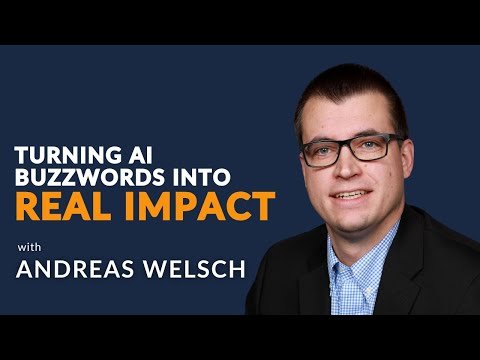
AI leadership is increasingly defined by a leader’s ability to translate AI excitement into measurable business outcomes. In a wide-ranging Mind Speaking Podcast conversation, Andreas Welsch, explains why successful AI efforts depend on more than models, tools, and data.
Welsch frames enterprise AI as a socio-technical shift that requires empathy, clear vision, and strong execution. He also warns against treating AI like “any other IT project,” because AI introduces additional complexity in governance, skills, and stakeholder alignment.
The discussion is especially relevant for CIOs, CTOs, CHROs, and business leaders who need AI adoption at scale without triggering fear, confusion, or wasted automation.
Original source: Mind Speaking Podcast
Executive Summary
- AI requires leadership across people, governance, and business value—not only technology.
- Empathy reduces fear and improves adoption when automation changes daily work.
- Communication must match stakeholder level, from executives to individual contributors.
- Pair domain experts with AI specialists to accelerate practical outcomes.
- Automate selectively; avoid “because it can be automated” thinking.
Key Takeaways
- Welsch emphasizes a leadership triangle: empathy, vision, and execution.
- AI success starts with a defined objective and measurable business impact.
- Buzzwords create excitement, but concrete examples create alignment and trust.
- AI programs need governance and data clarity (access, privacy, allowable use, annotation).
- Cross-functional “pairing” helps solve the scarcity of combined AI + domain expertise.
- Sponsorship from senior leadership is essential when new collaboration patterns feel uncomfortable.
- Upskilling accelerates when organizations encourage learning communities and hands-on starting points.
What is AI Leadership?
AI leadership is the discipline of guiding an organization to adopt AI responsibly and effectively by aligning people, processes, data, and technology around outcomes. In Welsch’s view, it includes empathy for workforce concerns, a clear vision for value creation, and execution discipline that avoids hype-driven projects. It also requires communication that makes AI tangible to non-technical stakeholders and governance decisions about data access, privacy, and allowable use.
AI Leadership Starts With Empathy, Vision, and Execution
Welsch highlights that technology leaders increasingly manage teams in hybrid and remote contexts. In that environment, empathy becomes operational, not optional, because employees juggle work rhythms, personal constraints, and shifting schedules.
He also stresses that leaders must set a clear vision instead of “floating along” as an individual contributor might. That vision informs team design, capability building, and how skills gaps are addressed through development or hiring.
Key Insight: Welsch frames effective leadership in AI-adjacent teams as a triangle of empathy, vision, and execution. Empathy supports sustainable performance, vision clarifies direction and priorities, and execution converts intent into outcomes. Weakness in any corner undermines AI adoption momentum.
Move Beyond Buzzwords: Make AI Tangible for the Business
Welsch argues that buzzwords can create hype but often reduce clarity. When “everything is AI,” stakeholders can misunderstand what is actually being deployed, whether it is rules, statistics, predictive methods, or machine learning.
He recommends translating AI into concrete process-level improvements. For finance stakeholders, an AI-supported matching workflow can reduce manual review from dozens of items to only exceptions, enabling staff to focus on higher-value customer follow-up rather than repetitive triage.
This kind of example also counteracts Hollywood-inspired misconceptions about AI. Clear language helps business leaders understand why AI matters, what it changes, and what it does not do.
Key Insight: Welsch recommends substituting buzzwords with simple, job-relevant examples. Explaining how AI reduces exception-handling time in finance is more persuasive than describing model features. Tangibility improves understanding, speeds decisions, and helps bridge the IT–business gap.
Why AI Programs Fail When Treated Like Standard IT Projects
Welsch’s central warning is that AI should not be treated like “any other IT project.” AI initiatives add complexity across people, governance, privacy, and cross-functional ownership.
He points to governance questions leaders must address: what data exists, where it comes from, who can access it, what it is permissible to do with it, and whether it contains personally identifiable information. Teams also face training data challenges, such as annotation quality and data scarcity.
AI programs succeed more often when leaders maintain a 360-degree view of outcomes, including how value is delivered internally and—when relevant—how “data products” are positioned with marketing and sales.
Key Insight: AI programs expand the scope of leadership from delivery management to socio-technical change. According to Welsch, governance, privacy, data readiness, and workforce enablement can be decisive. Ignoring these elements can stall adoption even when the technology works.
Build Cross-Functional Pairing to Close the AI + Domain Expertise Gap
Welsch observes that deep AI expertise and deep domain expertise rarely exist in the same person. Rather than waiting for unicorn profiles, he recommends pairing experts: a domain specialist (manufacturing, finance, or another function) and a data/AI specialist working closely together.
He describes this as a “greenhouse effect,” where both people grow: the AI specialist learns the business process realities, while the domain expert develops AI literacy and learns how to spot high-impact opportunities.
Welsch also notes that this approach can be uncomfortable at first due to different expertise levels and personalities. He suggests that senior sponsorship makes a critical difference by framing the collaboration as strategic, expected, and inherently iterative.
Executive sponsorship makes collaboration “safe”
Welsch stresses that new ways of working often require top-down reinforcement. When leaders clearly communicate that AI collaboration is a priority and that early attempts will be imperfect, teams can treat friction as a learning opportunity instead of a failure signal.
Automation: Avoid Blind Execution and Focus on Value
Welsch supports automation and AI, but warns that excitement can “cloud judgment.” A common mistake is rushing into execution by chasing low-hanging fruit without verifying whether automating a task improves outcomes.
He recommends stepping back to validate value: whether automation makes someone’s life easier, whether it influences business KPIs, and whether ROI can be expected and measured. In some cases, the best improvement is not AI at all, but a rule-based solution or even removing an outdated process step.
Welsch highlights a practical question leaders should ask: if a process has existed for decades, does anyone still know why it exists? That “clean house” moment can eliminate waste before investing in automation.
Communication That Fits the Stakeholder Level
Welsch describes communication as situational. Senior executives need concise framing on business impact and roadblocks. Mid-level leaders need clarity on collaboration, capacity, and mutual benefit. Individual contributors need reassurance about role impact and augmentation, not replacement.
He shares an internal example where a meeting with portfolio and architecture leaders became less effective due to insufficient preparation and excessive focus on model optimization details. The key lesson is to prioritize what the stakeholder needs to decide, then practice and rehearse to deliver that story succinctly.
For AI leadership, this is not presentation polish. It is decision enablement.
Workforce Transformation: Reduce Fear by Designing for Augmentation
Welsch notes that automation often triggers concern and distrust, especially in shared services environments. Employees may worry that AI will remove their job “in a couple of months” if it can work faster and cheaper.
His recommended response is clarity and follow-through: articulate that the objective is not replacement, but augmentation. When AI reduces repetitive work, employees can spend more time on higher-value, human interactions such as customer follow-up and relationship-based problem solving.
In Welsch’s framing, AI can strengthen the “human connection” by freeing time to do work that only people can do well.
Create a Learning Culture for AI Upskilling
Welsch argues that organizations can encourage growth by making learning and cross-functional exposure normal. Not every company has formal rotation programs, but leaders can still build learning communities through informal networks, coffee chats, and knowledge exchanges across functions.
He emphasizes that AI literacy improves when people understand how other departments work and where collaboration opportunities exist. Upskilling does not require “superheroes,” but it does require getting started and building momentum through accessible learning resources.
Welsch also points to widely available training options, including vendor training and platforms such as Coursera and YouTube, as practical entry points for workforce development.
Leadership Implications
- Define objectives early: clarify why AI is being pursued and which outcomes matter.
- Design for augmentation: communicate how roles shift toward exception handling and relationship work.
- Build governance into delivery: address data sources, access rights, permissible use, and privacy constraints.
- Pair experts intentionally: combine domain specialists with AI specialists and protect collaboration time.
- Measure value, not activity: validate KPI impact before automating; remove obsolete steps where possible.
Why This Conversation Matters
This Mind Speaking Podcast conversation speaks to a leadership audience navigating AI adoption across real teams and real workflows. Welsch’s emphasis on empathy, stakeholder-specific communication, and sponsorship highlights that workforce transformation is inseparable from AI delivery.
The discussion also aligns with Andreas Welsch’s broader focus as an AI leadership expert associated with AI governance, AI strategy, AI adoption, and workforce transformation. The central theme is consistent: turning hype into outcome depends on clarity, collaboration, and disciplined value creation.
Additional context and related thinking can be explored via Intelligence Briefing’s resources and AI leadership coverage.
Conclusion
AI leadership is not a technical title; it is a practice of aligning people, governance, and business value around responsible adoption. Welsch’s guidance reinforces that successful AI programs require empathy for workforce realities, concrete communication, and a value-first approach to automation.
Organizations that pair domain expertise with AI expertise, prepare stakeholders for change, and avoid buzzword-driven delivery are better positioned to convert AI interest into sustainable outcomes.
About the Author
FAQ
What makes AI leadership different from traditional IT leadership?
AI leadership differs because it must align people, governance, and business outcomes alongside technology delivery. Welsch emphasizes empathy, stakeholder-specific communication, and data governance questions (access, privacy, allowable use) that typically exceed standard IT project requirements.
Why should AI not be treated like any other IT project?
AI should not be treated like any other IT project because it introduces additional complexity across data readiness, privacy, governance, skills, and adoption dynamics. Welsch notes that ignoring these dimensions can undermine value even when the technical solution performs well.
How can executives reduce employee fear about AI replacing jobs?
Executives can reduce fear by clearly positioning AI as augmentation rather than replacement and then delivering on that promise in workflow design. Welsch recommends explaining how AI frees time for higher-value work, such as customer follow-up and exception management.
What communication approach works best for AI adoption across stakeholders?
The best communication approach adapts to stakeholder level: executives need business impact and roadblocks, managers need collaboration and capacity planning, and individual contributors need role clarity. Welsch also advises rehearsing key messages to avoid over-indexing on model details.
How can leaders make AI less “buzzwordy” for business teams?
Leaders can reduce buzzword confusion by describing AI in plain language and connecting it to job-specific outcomes. Welsch suggests concrete examples, such as finance exception handling, rather than terminology-heavy descriptions that non-technical stakeholders may not understand.
What are common mistakes organizations make in AI programs?
Common AI program mistakes include unclear objectives, rushing into automation without value validation, and overlooking governance and workforce adoption needs. Welsch highlights that success improves when objectives are defined early and AI initiatives are framed around measurable business outcomes.
How can organizations address the shortage of AI + domain expertise?
Organizations can address the shortage by pairing domain experts with AI specialists instead of searching for rare combined profiles. Welsch describes a “greenhouse effect” where both parties learn, improving AI literacy and ensuring solutions match real process needs.
When should automation be avoided, even if it is possible?
Automation should be avoided when it does not add value, improve KPIs, or simplify work meaningfully. Welsch warns that excitement can drive wasteful automation, and sometimes the best choice is a simple rule or removing an outdated process step entirely.
What is a practical first step for leaders starting AI initiatives?
A practical first step is to begin with strong domain knowledge and explore where AI can augment that domain’s workflows. Welsch encourages leaders to “get started,” use accessible training resources, and create learning communities that build AI literacy over time.
What role does executive sponsorship play in AI adoption?
Executive sponsorship is critical because it signals AI work is strategic and legitimizes cross-functional collaboration. Welsch notes that pairing teams and changing workflows can be uncomfortable initially, and sponsorship helps teams treat early imperfections as learning, not failure.