

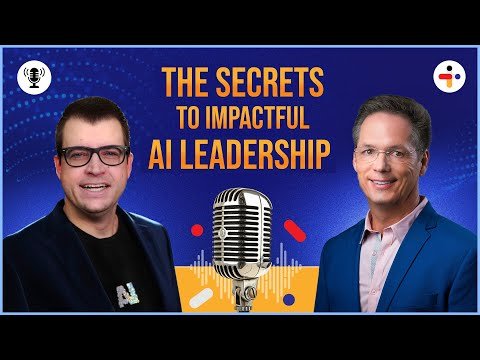
Turning Hype Into Business Outcomes
AI leadership has become an executive mandate: boards and senior teams now ask whether an organization has an AI strategy, what it looks like, and how it will create measurable value.
In a conversation from the AI Unplugged Without Borders podcast (part of the Transatlantic AI Exchange), AI leadership expert Andreas Welsch explained why “technology is meaningless” unless it improves business metrics such as customer satisfaction and Net Promoter Score.
Welsch is the founder and chief AI strategist at Intelligence Briefing and the author of The AI Leadership Handbook, which distills learnings from more than 60 conversations with AI leaders on turning technology hype into business outcomes.
Executive Summary
- AI hype creates demand; value comes from targeted outcomes and adoption.
- Start with business metrics (e.g., NPS), then work backward to AI use cases.
- Communities of practice help scale trust, skills, and real-world adoption.
- Agentic AI shifts software interaction from “instructions” to “goal delegation.”
- Responsible AI includes compliance, privacy, and energy/sustainability trade-offs.
Key Takeaways
- Andreas Welsch argues leaders should resist “shiny object” AI projects driven by FOMO and vendor noise.
- Business value often starts in customer service: better responses, shorter wait times, and actionable answers can move NPS.
- Generative AI lowered the barrier to entry: practical use no longer requires a PhD, but it does require good instructions (prompts).
- Trust and adoption are critical: employees may reject AI if they do not understand or trust its outputs.
- Scaling AI requires multipliers: champions trained to spread practical know-how across teams.
- Europe vs. the U.S. shows cultural differences: Europe’s stronger focus on regulation can risk slowing innovation.
- AI agents introduce a new paradigm: define the goal, and software plans tasks to achieve it—raising new leadership questions.
What is AI Leadership?
AI leadership is the executive capability to turn AI—from embedded features to generative tools and emerging agents—into measurable business outcomes while bringing employees along. In Andreas Welsch’s view, it includes managing expectations across stakeholders, focusing on tangible KPIs (such as customer satisfaction), and ensuring adoption through training and internal champions. AI leadership also includes responsibility: aligning use with regulations, data privacy and security expectations, and broader considerations such as sustainability and energy consumption.
Why this conversation matters
This discussion took place in the context of a transatlantic leadership audience confronting rapid AI acceleration across vendors and platforms. Welsch’s perspective is relevant because it addresses the executive reality behind the headlines: AI is easy to try, hard to operationalize, and impossible to scale without trust, workforce enablement, and clear business outcomes.
For CIOs, CTOs, and CHROs, the conversation connects AI governance and adoption to workforce transformation: training, change management, and practical pathways for employees to contribute meaningful use cases rather than waiting for top-down “AI rollouts.”
AI hype vs. AI hope: where leaders should focus
Welsch differentiates between hype and hope. Hype is useful because it creates awareness and demand and pushes leadership teams to ask strategic questions about AI readiness.
Hope begins when “the rubber meets the road”: leaders shift from abstract “art of the possible” discussions to decisions about data, vendors, scenarios, and ROI.
Key Insight: Andreas Welsch explains that hype can be productive because it triggers executive attention and investment. But hope is where operational work begins—translating AI excitement into concrete use cases, clear owners, and measurable improvements in customer or financial metrics.
AI leadership requires more than technology
Welsch highlights a common leadership pitfall: jumping straight into a technology discussion. In practice, this often results from internal and external pressure—vendor announcements, media stories, and fear of missing out.
AI leaders sit in the middle of competing expectations. They must acknowledge AI’s potential while setting realistic timelines and ensuring initiatives are purposeful rather than reactive.
In Welsch’s framing, even the “best technology” can fail if adoption is zero. Employees may not use tools they do not understand or trust, especially if those tools challenge established expertise and routines.
Key Insight: Welsch warns that AI programs can stall when leadership treats AI as a tool rollout instead of a business transformation. The core risk is not model performance alone; it is low adoption, low trust, and unclear outcomes—leading to impressive demos but no measurable change.
Start with outcomes: customer satisfaction, NPS, and operational KPIs
One practical entry point Welsch describes is customer service. If NPS or customer satisfaction is below target, AI can help improve response quality, specificity, and speed.
The leadership move is to work backward from the metric. If customers complain about wait times or non-actionable answers, leaders can examine the data already available—product information, known issues, and recurring service patterns—and use AI to make that knowledge easier to access and apply.
Welsch notes that solutions such as assistants and chatbots can help turn existing business data into actionable support for agents and customers, improving experience without treating AI as a standalone science project.
Example: “peel it back” from the KPI
Welsch’s example approach is diagnostic: identify the targeted improvement (e.g., raise NPS by 1–3 points), then identify the operational drivers (wait time, accuracy, specificity), and then determine where AI can support those drivers using existing data and workflows.
Culture and regulation: a transatlantic view of AI adoption
Based on his experience across the U.S. and Germany, Welsch observes cultural differences in how AI is discussed and adopted. In Germany and Europe, he sees stronger risk aversion and a heavier emphasis on data concerns, privacy, and regulation.
Welsch considers responsible AI, ethics, and secure handling of data to be valid concerns. At the same time, he cautions that “over-regulating” can stifle innovation.
In the U.S., Welsch observes more openness to experimentation and practical enablement, including universities providing access to tools (such as copilots in office suites) and professors using them for summarization and drafting.
Key Insight: Welsch’s transatlantic takeaway is that responsible AI and innovation must coexist. Regulation and compliance matter, but leadership must avoid letting policy debates become an excuse for inaction—especially when competitors are already building skills, trust, and operational capabilities.
Communities of practice: scaling trust and AI upskilling
Welsch repeatedly returns to a workforce-centered method: communities of practice built from early adopters, champions, and multipliers. The goal is to expand practical skill-building, not just awareness.
He describes training programs designed to teach employees how to use tools, what the “dos and don’ts” are, and how to get relevant output through better prompting. After training, champions spread learnings within their teams and functions.
This approach also helps surface real use cases. Subject-matter experts can identify daily friction points—exceptions, follow-ups, and repeated manual work—and propose AI-enabled improvements back to AI or technology teams.
Why trust is a leadership problem (not a user problem)
Welsch emphasizes that employees may distrust AI that appears to “know better” than experienced staff. If the workforce does not understand how AI works, leaders should expect pushback and low usage.
Agentic AI: the next shift in how software gets work done
Welsch describes AI agents as another step-change in software interaction. Traditional software follows explicit instructions (“if this, then that”). Earlier AI added recommendations, but humans still made the final choices.
With agentic AI, the user defines a goal and the software attempts to determine how to achieve it—breaking work into subtasks and coordinating specialized agents as a “virtual team.” Welsch uses a marketing brief example: audience definition, value propositions, copy suggestions, and even creative assets could be delegated across agents and then returned with rationale.
This shift increases the need for strong AI leadership: organizations must decide where agentic workflows are appropriate, how to govern them, and what human oversight is required to ensure outputs align with business needs.
Responsible AI: compliance, privacy, and sustainability considerations
Welsch argues that AI leaders carry additional responsibility beyond implementation. Compliance with rules and regulations matters, including GDPR in Europe and emerging regulation such as the EU AI Act.
He also raises sustainability: large language models can consume significant energy during development and usage. Welsch frames the leadership challenge as balancing that cost against potential emissions reductions enabled by AI-driven efficiency (for example, better routing or reduced paper-based processes).
Navigating AI noise: what leaders should ignore—and what to prioritize
Welsch recognizes the practical overwhelm: major model announcements arrive weekly, and it can be difficult to determine what is timely and useful. He recommends a relevance filter: if an update is not immediately useful to the business, it may not be worth executive attention.
For business leaders, the more durable questions are industry-specific and operational: what can be done today to reduce cost, improve customer experience, grow revenue, or find better audiences for products? That focus helps separate signal from noise without ignoring AI innovation altogether.
Who the AI Leadership Handbook is for
Welsch positions The AI Leadership Handbook as a practical guide for IT, data, and AI leaders—and for executives moving into those roles—who want a structured way to make AI initiatives succeed. The book summarizes learnings from more than 60 conversations with AI leaders and experts.
In the conversation, Welsch notes that the book describes nine aspects AI leaders need to get right to succeed with AI initiatives. He also underscores a key reassurance: leaders facing challenges are not alone—many peers have experienced similar obstacles or already navigated them.
Leadership Implications
- Anchor AI governance in outcomes: select use cases by KPI impact (e.g., NPS, response times), not novelty.
- Design for adoption: assume trust must be earned through transparency, training, and practical usage guidance.
- Scale workforce enablement: build communities of practice with champions who multiply skills across teams.
- Prepare for agentic workflows: define where “goal delegation” is acceptable and what oversight is required.
- Operationalize responsible AI: include privacy, regulation, and sustainability considerations in leadership decisions.
Conclusion
Welsch’s central message is that AI leadership determines whether AI remains hype or becomes sustained performance improvement. Generative AI lowered barriers to experimentation, but enterprise value depends on outcomes, adoption, trust, and responsible governance.
As agentic AI reshapes how software executes work, leaders who build skilled communities, focus on measurable business metrics, and manage responsibility across privacy and sustainability will be best positioned to turn AI into durable advantage.
About the Author
FAQ
What is AI leadership in practical terms?
AI leadership is the ability to connect AI initiatives to measurable outcomes, drive adoption, and manage responsibility. In this conversation, it includes working backward from KPIs, building trust through upskilling, and addressing privacy, regulation, and sustainability realities.
How should executives think about AI hype versus business value?
Executives should treat hype as awareness and treat value as execution. Andreas Welsch describes a shift from “art of the possible” to actionable decisions: selecting use cases, ensuring data readiness, choosing tooling, and proving ROI via operational metrics.
Where is a strong starting point for AI adoption?
A strong starting point is a business area with clear pain and measurable metrics, such as customer service. Welsch points to levers like response time and answer quality, where assistants or chatbots can make existing knowledge more actionable.
Why do AI rollouts fail even when the technology works?
AI rollouts fail when adoption is low and trust is missing, even if models perform well. Welsch notes employees may reject tools they do not understand or that challenge established expertise, making enablement and change management essential for AI strategy.
What are communities of practice and why do they matter for AI upskilling?
Communities of practice are networks of early adopters and champions trained to spread practical AI skills across teams. Welsch describes using multipliers to teach dos and don’ts, prompting, and tool usage, helping organizations scale adoption beyond a central AI team.
What is agentic AI and why is it different from chatbots?
Agentic AI shifts from following step-by-step instructions to pursuing a defined goal by planning and executing subtasks. Welsch explains that agents can operate like a virtual team—for example, producing elements of a marketing brief—changing how leaders govern workflows.
How should leaders handle AI governance and regulation across regions?
Leaders should treat governance as a business enabler: protect data, meet regulatory expectations, and still move forward. Welsch highlights Europe’s strong focus on privacy and regulation (including GDPR and the EU AI Act) and warns against over-regulation that slows innovation.
What should a CEO ignore amid constant AI announcements?
A CEO should ignore updates that are not timely, relevant, or useful to current priorities. Welsch recommends focusing on what can be done today in a specific industry—reducing cost, improving customer experience, or accelerating growth—rather than tracking every new model release.
Who should read The AI Leadership Handbook?
The book is positioned for IT, data, and AI leaders—and executives moving into those roles—who want practical guidance to turn AI into outcomes. Welsch says it summarizes learnings from 60+ AI leader conversations and covers nine aspects needed for successful AI initiatives.
How does responsible AI connect to sustainability and energy use?
Responsible AI includes considering energy consumption from large models and weighing it against potential emissions reductions from efficiency gains. Welsch notes that generative AI can consume significant energy, while AI-enabled optimization (routing, digitization) may remove emissions elsewhere in operations.