

AI Leadership That Turns Technology Hype Into Business Outcomes
AI leadership is moving from experimentation to accountability as executives ask what AI will do for growth, cost, and resilience—not just novelty.
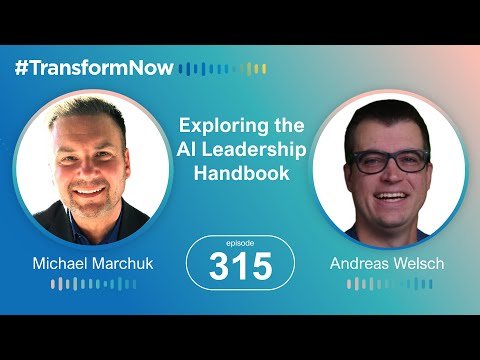
In a conversation on the Transform Now podcast, AI adviser and author Andreas Welsch described recurring enterprise patterns: leaders feel urgency, teams chase the “shiny object,” and initiatives stall when value and feasibility were not defined upfront.
Welsch’s perspective is shaped by global process automation work, enterprise product experience at SAP, and teaching hands-on generative AI modules as an adjunct professor. The throughline: outcomes depend as much on people, expectations, and change as on models and data.
Executive Summary
- Start with business objectives, not tools.
- Prioritize use cases before requesting data or building models.
- Educate leaders and frontline teams to align expectations.
- Design transparency into AI outputs to support trust.
- Prepare for agentic AI as “virtual teams,” not simple rules engines.
Key Takeaways
- Andreas Welsch stresses that AI initiatives should be guided by business goals at the unit, team, quarter, and year level.
- He warns that chasing hype—seen previously in machine learning and now in generative AI—often creates “money pits” without measurable outcomes.
- He recommends combining leadership priorities with frontline operational insight to surface high-impact, realistic opportunities.
- He views adoption as a paradigm shift: AI outputs may be wrong, requiring new user habits and critical thinking.
- He highlights the importance of communicating AI confidence in human-friendly ways to prevent misuse and over-trust.
- He expects agentic AI to evolve toward multi-agent “virtual teams” that can delegate and quality-check work.
- He sees an emerging AI leadership role (often a Chief AI Officer) as a needed “center of gravity” across functions.
What is AI leadership?
AI leadership is the ability to align AI capabilities—machine learning, automation, and generative AI—to business strategy and measurable outcomes while guiding people through change. In Andreas Welsch’s view, it includes educating leaders and teams on what AI can and cannot do, prioritizing use cases before model-building, and creating transparency so users understand outputs and limitations. It also requires ongoing enablement: keeping data current, managing expectations, and preparing the workforce to collaborate with AI “coworkers,” including emerging agentic AI systems.
Why AI leadership starts with business goals (not tools)
Welsch’s first recommendation is to begin with business goals and objectives—at the company level and at the level of a unit or team. The most reliable “guiding light” is what must be accomplished this year, this quarter, or this month.
From there, he advises approaching opportunity discovery from two directions: leadership priorities (top-line and bottom-line focus) and frontline insight from the people who execute processes every day. Combining the two raises the probability that AI drives outcomes that are both measurable and operationally grounded.
Key Insight: Andreas Welsch, an AI leadership expert, argues that the fastest route to measurable AI value is not a model-first approach. Instead, leaders should anchor on business objectives and then validate opportunities with the employees who live inside the workflow, where failure points and exceptions are visible.
From machine learning to generative AI: avoiding the “shiny object” trap
Welsch describes a repeat pattern: leaders declare AI “important,” teams feel pressure to deliver something exciting, and projects drift toward novelty—fewer clicks, happier employees, clever demos—without clear measurement.
He observed this during earlier machine learning cycles and now sees it again in generative AI. Employees can experiment instantly using tools like ChatGPT, Claude, or Midjourney, but the enterprise question is what happens after recipes, poems, and playful images. Welsch’s emphasis is on analysis upfront: prioritizing what is valuable and feasible before requesting data, building models, or trying to match competitors.
In his framing, leaders need an “innovation funnel” mindset—moving from many ideas to a portfolio of initiatives that are actively managed and tied to outcomes.
Education is governance: resetting executive expectations
Welsch notes that executives often absorb AI narratives through headlines—either inflated optimism or inflated fear. Education helps temper both by clarifying real capabilities, constraints, and responsible use.
As an adjunct professor at West Chester University of Pennsylvania, Welsch dedicates modules to AI and generative AI with hands-on lab exercises. His goal is practical readiness: preparing students for how AI is used in business, while reinforcing guardrails and critical thinking.
He also highlights a teaching-circle effort in which professors explored how generative AI can support activities such as creative writing, while warning students that sources may be fabricated and outputs should not be taken at face value. Welsch describes this as a paradigm shift: users are now expected to verify AI recommendations because they may be right—or wrong.
Key Insight: Welsch emphasizes that education is not optional “enablement.” It is a practical governance mechanism that reshapes how people interact with software—teaching leaders and employees to validate outputs, recognize limitations, and use generative AI within clear guidelines.
Designing trust: how AI results should be communicated to users
One of Welsch’s favorite examples comes from an 18-month engagement with a large U.S. biopharma company focused on finance automation. The work included leadership education on machine learning and practical use cases such as account reconciliation and cash application—matching incoming payments to open invoices.
Welsch describes a key adoption lesson: prediction confidence must be communicated in a way end users can interpret accurately. A “90% confident” prediction sounded excellent to cash collectors, even when it was operationally insufficient. In response, the team shifted from numeric confidence to a simpler indicator (such as checkmarks or stars) that better conveyed when a transaction required review versus when the system was highly confident.
This human-centered design detail connects directly to generative AI: outputs may contain errors or misalign with organizational values, and teams must help users understand how to interpret results safely.
Key Insight: Welsch’s biopharma example shows that adoption often hinges on communication, not accuracy alone. If users misunderstand confidence signals, they may over-trust outputs. Translating model confidence into intuitive cues can reduce risk and focus attention on exceptions rather than routine transactions.
Agentic AI and multi-agent systems: a “virtual team” model
Welsch is optimistic about agentic AI because it brings earlier multi-agent system visions closer to operational reality. He traces this interest back roughly a decade, when multi-agent systems were explored as a way to automate business decisions based on goals—such as sourcing alternatives when supply delays occur.
He points to emerging frameworks (including Microsoft Autogen and early efforts like BabyAGI) as signs of progress, while cautioning that current agents are still relatively rudimentary and only gradually becoming enterprise-ready.
Importantly, he challenges the idea that agents are merely “if-this-then-that” automation. In his view, an agent is closer to a system given a goal that can figure out steps, delegate tasks to other agents, and return recommendations. He describes the aspiration as a team of specialized assistants—one handling intake, another specializing in product knowledge, and another checking quality—supporting humans rather than replacing them.
Preparing the workforce to collaborate with AI “coworkers”
Welsch draws an analogy between human teams and agentic systems: organizations already operate with role specialization, escalation paths, and review functions. The challenge is preparing employees to work alongside non-human “coworkers.”
He says the enabling conditions include transparency about what an agent can do, where it is not suited, and how it should be used. He also links “training” for agents to data quality and currency: without accurate, complete, and fresh information, an AI support agent may provide outdated guidance on the wrong product version—just as a human agent would if poorly trained.
Welsch notes this is not a one-time effort. Agent capabilities and enterprise software evolve, requiring continuous maintenance, communication, and expectation management.
Why an AI leader role is becoming a center of gravity
Welsch describes an emerging organizational need for a single orchestrating AI leadership role—often framed as a Chief AI Officer—to drive awareness, enablement, and proof points across business functions while also guiding technology decisions.
He relates this to prior evolutions such as Chief Information Security Officers and Chief Data Officers: complex cross-functional responsibilities benefit from a focal point. He also notes the U.S. federal government’s stated intent to appoint hundreds of Chief AI Officers across agencies to spearhead adoption.
In Welsch’s framing, this role bridges business and technology: aligning AI strategy to business strategy, selecting enterprise-grade solutions that can be maintained, and ensuring updates and capability evolution do not leave the organization behind.
Leadership Implications
- Anchor AI governance in business outcomes: require each initiative to map to an objective (growth, cost, risk, service levels) before model work begins.
- Build a prioritization discipline: create a portfolio view so teams avoid chasing “shiny objects” and can compare value vs. feasibility.
- Institutionalize education and critical thinking: treat AI literacy as a leadership responsibility, not an optional training event.
- Design workflows for verification: assume AI outputs can be wrong; ensure user interfaces communicate confidence and escalation paths clearly.
- Prepare for agentic AI as workforce transformation: define what “AI coworkers” can do, how they are maintained, and how roles shift toward exception handling.
Why this conversation matters
This Transform Now podcast conversation is relevant to CIOs, CTOs, CHROs, and functional leaders because it treats AI leadership as an operating model question—not a tooling debate. Welsch’s examples connect executive intent to frontline reality, showing how outcomes depend on prioritization, communication, and change management.
It also places generative AI in the longer arc of enterprise automation. Welsch’s experience spans process automation, machine learning, and generative AI, and he positions agentic AI as the next step: moving from single tools to coordinated systems that can act as specialized virtual teams.
The conversation aligns with Welsch’s broader work, including his book AI Leadership Handbook, which he describes as a practical guide for turning technology hype into business outcomes and leading people through the change required for sustained adoption.
Conclusion: AI leadership is a people-and-outcomes discipline
Welsch’s message is consistent: AI leadership begins by clarifying what the business is trying to achieve, then selecting and shaping AI initiatives that are feasible, measurable, and usable in daily work. Education and expectation management are governance tools, not soft extras.
As generative AI and agentic AI mature, enterprises will increasingly compete on their ability to redesign workflows, communicate trust signals, keep AI “coworkers” current, and orchestrate adoption across functions. That is the practical core of AI leadership.
FAQ: AI leadership, adoption, and agentic AI
1) What is AI leadership in an enterprise context?
AI leadership is the practice of aligning AI initiatives to business strategy, prioritizing use cases before model-building, and guiding people through adoption with clear guardrails and transparency. It also includes communicating limitations so employees verify outputs rather than blindly trusting them.
2) How should leaders choose the right AI use cases?
Leaders should start with business goals and combine executive priorities with input from frontline employees who run the workflows daily. Andreas Welsch emphasizes that this pairing surfaces issues, exceptions, and measurable opportunities before teams request data or build models.
3) Why do AI projects become “money pits”?
AI projects become money pits when organizations chase hype and build solutions without upfront analysis of value and feasibility. Welsch notes this happened in machine learning cycles and is repeating with generative AI, where excitement can outpace clear measurement and prioritization.
4) What role does education play in AI governance and adoption?
Education functions as practical governance by resetting expectations and teaching users how to validate AI outputs. Welsch describes a paradigm shift: unlike older software, generative AI may be wrong, so critical thinking and usage guidelines are required across executives and employees.
5) How can organizations build trust in AI results?
Organizations can build trust by clearly communicating what outputs mean and when humans must review exceptions. Welsch’s biopharma example shows that numeric confidence scores can be misread, so teams may need more intuitive indicators that guide verification behavior.
6) What is agentic AI, according to Andreas Welsch?
Agentic AI is an approach where systems are given goals and can determine steps, delegate tasks to other agents, and return recommendations. Welsch cautions that agents are more than simple “if-this-then-that” automation and are still maturing toward enterprise readiness.
7) How should leaders prepare employees to work with AI agents?
Leaders should prepare employees by explaining agent capabilities, limitations, and how to collaborate with non-human coworkers. Welsch highlights transparency and expectation management, plus ongoing “training” via accurate and current data so agents do not provide outdated or incorrect guidance.
8) Why is the Chief AI Officer role emerging?
The Chief AI Officer role is emerging to provide a center of gravity across functions—driving awareness, enablement, and proof points while bridging business and technology decisions. Welsch compares it to earlier C-level evolutions like security and data leadership roles.
9) What skills matter most for future AI leaders?
The most important skill is understanding business strategy and mapping AI strategy to it. Welsch argues there is no single career path; AI leadership can emerge from IT, data, or business functions, as long as leaders can connect AI capabilities to priorities and change.