

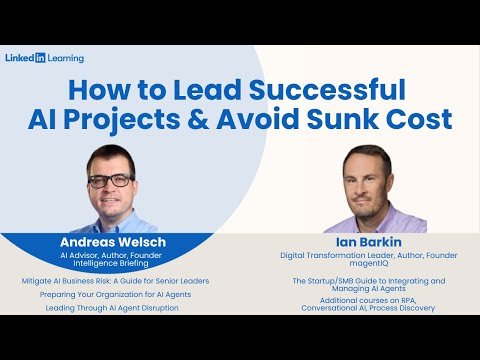
How to Run Successful AI Projects Without Overspending
AI leadership has become a board-level expectation—often before organizations have clarity on what “success” actually means. Business leaders feel pressure to “do something with AI,” while also seeing real opportunities to improve efficiency and launch new services.
In a conversation between AI leadership expert Andreas Welsch and automation leader Ian Barkin, the discussion cuts through market noise to focus on what makes AI initiatives work in practice: measurable outcomes, iterative delivery, lightweight governance, and workforce enablement.
The conversation also reflects a recurring pattern Welsch has seen across multiple AI waves—from machine learning to generative AI to agentic AI: hype promises linear projects and fast results, but enterprise reality is complex, cyclical, and operational.
Why this conversation matters
This transcript reflects an executive-focused discussion designed for leaders responsible for AI strategy, AI governance, and adoption at scale. It is especially relevant for organizations struggling with competing tool requests, unclear ROI narratives, and the misconception that AI projects behave like traditional “start-to-finish” initiatives.
For AI leadership and workforce transformation, the value is practical: it emphasizes aligning work to KPIs, setting realistic expectations about iteration, and building a learning culture that treats “failure” as insight—while still knowing when to stop investing.
Executive Summary
- AI projects must map to business KPIs, not “shiny objects.”
- AI delivery is iterative; linear project plans often mislead executives.
- Lightweight AI governance helps prevent tool sprawl and overspending.
- Operational success requires continuous monitoring after deployment.
- AI literacy and role-based enablement unlock adoption and value.
Key Takeaways
- Andreas Welsch emphasizes that success starts with explicit KPI alignment and measurable outcomes.
- Welsch highlights that AI projects are cyclical: hypothesis, testing, data needs, production, and ongoing operations.
- Welsch stresses the importance of deciding when to stop projects to avoid “throwing good money after bad.”
- Welsch points to culture as a leadership lever: treat setbacks as learning that informs the next initiative.
- Welsch encourages lightweight governance—simple intake questions, review, and follow-up measurement—rather than heavy committees.
- Welsch notes workforce enablement is not optional; rolling out tools without actionable guidance limits value.
What is AI leadership?
AI leadership is the executive capability to turn AI—from generative AI to agentic AI—into measurable business outcomes while managing risk, cost, and change. In the context of Welsch’s discussion, it includes selecting the right problems to solve, aligning initiatives to KPIs, setting realistic expectations for iterative delivery, and enabling the workforce to use AI responsibly and effectively.
It also requires governance that prevents overspending and duplicated tools, without stifling innovation. AI leadership is less about chasing technology trends and more about operationalizing AI in real workflows and decision cycles.
AI project “failure” is common—so leaders must define success precisely
Welsch points to widely cited failure rates as a reality check: an MIT-reported figure that “95% of generative AI projects in businesses are failing” and a long-standing Gartner quote that “85% of AI and machine learning projects” do not deliver intended value.
In Welsch’s framing, these numbers matter less than what leadership does with them. “Failure” can be a misleading label when teams learn about processes, data constraints, and organizational readiness. However, the real leadership task is to clarify what value the project is supposed to create—and how it will be measured.
Key Insight: Andreas Welsch argues that AI projects improve when leaders tie initiatives to a specific KPI and measurement plan—rather than approving AI because it sounds innovative. Clear success criteria also help organizations decide whether to pivot, invest more, or stop a project before costs compound.
AI leadership starts with KPI alignment (not fewer clicks)
Welsch describes a recurring issue: organizations get excited about “cool” AI capabilities, but struggle to justify budgets unless the initiative maps to business outcomes. He notes that benefits like “fewer clicks” and “happier employees” can matter—yet CFOs and business sponsors typically expect hard metrics.
In his approach to running successful AI projects, Welsch focuses on the connection between the project and measurable impact: customer satisfaction scores, revenue, defect reduction, or other performance indicators that “move the needle.” The clearer the linkage, the higher the chance of sustained support and success.
Welsch also highlights that leaders should resist “throw spaghetti on the wall and see what sticks” as the primary strategy. Sampling tools can be useful, but KPI-driven prioritization improves outcomes and reduces wasted spend.
Why AI projects aren’t linear—and why executives must set expectations
Welsch contrasts traditional project management expectations—linear plans learned in PMP-style frameworks—with the reality of AI delivery. AI projects often operate as cycles: define an idea, test a hypothesis, discover data gaps, retrain or redesign, move to production, and then manage ongoing performance.
He stresses that the “fun starts” after deployment: operating, monitoring, and maintaining AI systems is continuous work. This is where executives must recalibrate stakeholder expectations, especially when leadership pressure demands quick wins.
Key Insight: Andreas Welsch highlights that treating AI as a three-month “start-and-finish” project often sets teams up for disappointment. Successful AI leadership sets a cadence for review and iteration, communicates uncertainty honestly, and manages AI as an operational capability—not a one-time release.
When to pull the plug: avoiding sunk-cost traps in AI initiatives
Welsch calls out an uncomfortable truth: not every AI initiative will pay off, and leaders must know when to stop. He notes the cost and pain of “throwing good money after bad,” especially when teams keep investing because hope remains high that a breakthrough is near.
His practical recommendation is to establish a regular cadence—often monthly—with stakeholders to review what progress has been made in the last four weeks. If progress stalls, teams may need different data, additional subject-matter expert input, different resourcing, or a reframed problem definition.
But if the initiative still cannot deliver the needed results, AI leadership requires an explicit decision to pivot or stop, paired with a structured “what did this teach us?” review that strengthens the next project.
Key Insight: Welsch emphasizes that leadership discipline is not only funding experiments—it is also stopping them. A project can be a learning success and still be a business investment failure. Leaders should separate the two, capture insights, and redeploy effort toward higher-value work.
Lightweight AI governance: control spend without stifling innovation
Welsch describes a common scenario: employees “run down the door” requesting AI tools, creating risk of overlapping licenses, uncontrolled spending, and inconsistent usage. Leaders want innovation—but also need guardrails.
Rather than a slow, heavy committee process, Welsch proposes lightweight governance that scales. For example, a simple intake survey can capture the tool being requested, expected cost, expected savings, and how success will be measured. IT and the requesting business owner can jointly evaluate whether the investment makes sense.
Welsch also recommends a follow-up review a quarter or two later: did the tool deliver the promised outcome, or should the organization switch approaches? This closes the loop that many organizations never close.
Role-based adoption: shapers, makers, and takers
Welsch shares an example from learning and development leaders who rolled out Copilot in a large global company. They organized enablement around three groups: “shapers” (strategic leaders), “makers” (developers and builders), and “takers” (the broader workforce using AI in daily work).
This structure recognizes that different groups require different tools, platforms, and training. Strategic leaders need awareness and decision guidance. Builders need engineering environments to create agents and solutions. The wider workforce needs safe, actionable usage patterns that map to everyday tasks.
For AI leadership, this is a workforce transformation lesson: adoption does not happen evenly, and success depends on meeting each group where it is—without requiring everyone to become a technical expert.
AI upskilling: tool rollout is not enablement
Welsch argues that simply providing tools—Copilot, ChatGPT, or other systems—does not guarantee adoption or value. Organizations need a baseline of AI literacy and practical training that shows employees how to make AI actionable.
He notes that many employees believe they already “know AI” because they have used chat tools at home. Yet in training settings, there are often “light bulb moments” when people discover broader usage patterns: AI as a thought partner, a role-play partner, a feedback coach, or a way to accelerate tasks beyond simple Q&A.
Welsch positions this as a leadership responsibility: workforce enablement reduces shadow usage, improves consistency, and increases the odds that AI investments translate into real business outcomes.
Technology matters less than execution discipline
A central theme of Welsch’s discussion is that organizations spend too much time debating technology labels—and too little time building the execution mechanisms around AI. The conversation touches on agentic AI without making technology the centerpiece.
Instead, the focus remains on what leaders must get right: governance to manage cost and risk, KPI alignment to justify investment, realistic expectations about iteration, and workforce enablement to make adoption practical.
In this framing, AI leadership is a management capability—one that makes AI operational in complex organizations rather than treating it as an isolated innovation experiment.
Leadership Implications
- Operationalize KPI alignment: Require every AI initiative to map to a business metric and measurement plan.
- Adopt iterative governance cadences: Run monthly stakeholder reviews to assess progress, risks, and data needs.
- Implement lightweight intake controls: Use a short tool-request survey to reduce duplication and control spend.
- Plan for “post-go-live” work: Treat monitoring, maintenance, and continuous improvement as part of delivery.
- Enable workforce transformation: Provide AI literacy and role-based guidance for leaders, builders, and daily users.
Conclusion: AI leadership is the difference between hype and outcomes
The market will continue to amplify AI hype, new acronyms, and promises of “lights-out” autonomy. Welsch’s perspective is more pragmatic: successful AI projects come from disciplined AI leadership—KPI-driven prioritization, iterative delivery expectations, lightweight AI governance, and intentional workforce enablement.
For executives, the goal is not to “do AI.” The goal is to run the right AI initiatives, in the right way, with measurement and learning built in—so AI adoption becomes a durable capability rather than a costly experiment.
FAQ
1) How can executives run AI projects successfully?
Successful AI projects start when leaders align the initiative to a specific business KPI, define how results will be measured, and plan for iterative delivery and ongoing operations. This AI leadership discipline prevents “shiny object” work and improves value realization over time.
2) Why do so many AI initiatives fail to deliver value?
Many AI initiatives fail because they begin with technology hype instead of measurable business outcomes, and because leaders expect linear delivery. Andreas Welsch emphasizes that AI projects are cyclical and require ongoing monitoring and adjustment, which many organizations underestimate.
3) What KPIs should AI leadership use to justify investment?
AI leadership should prioritize KPIs that “move the needle,” such as customer satisfaction scores, revenue impact, or defect reduction. Welsch notes that softer benefits like fewer clicks can help, but budget owners typically require measurable outcomes tied to business performance.
4) Are AI projects linear like traditional project management?
AI projects are rarely linear; they typically run in cycles of hypothesis, testing, data refinement, production, and continuous maintenance. Welsch advises leaders to set these expectations early, so stakeholders understand that success comes from iteration, not one-time delivery.
5) When should leaders stop an AI project?
Leaders should stop an AI project when progress consistently fails to meet the intended measurable outcomes and the path to improvement is unclear or unjustifiably expensive. Welsch recommends monthly stakeholder reviews to evaluate progress and avoid throwing good money after bad.
6) What does lightweight AI governance look like in practice?
Lightweight AI governance can be as simple as a short intake survey that asks what tool is requested, what it costs, what it will save, and how success will be measured. Welsch suggests evaluating jointly with IT and revisiting results after a quarter or two.
7) How can organizations prevent AI tool sprawl and duplicated spend?
Organizations reduce AI tool sprawl by adding minimal friction before purchases: require cost, expected benefit, and measurement plans, then follow up after implementation. This governance approach, described by Welsch, balances innovation with fiscal control and consistency.
8) How should executives think about workforce adoption of AI tools?
Executives should enable AI adoption by recognizing different user groups need different support: strategic leaders, builders, and day-to-day users. Welsch highlights a “shapers, makers, takers” approach used during a Copilot rollout, aligning training and tools to roles.
9) Why is AI upskilling necessary if employees already use chat tools?
AI upskilling is necessary because many employees only use AI for simple Q&A and miss higher-value patterns like coaching, role play, feedback, and task acceleration. Welsch notes that structured training often creates “light bulb moments” that drive responsible, practical adoption.
10) How does agentic AI change the way leaders approach automation?
Agentic AI increases opportunity and urgency, but it does not remove the need for disciplined AI leadership. The conversation emphasizes that technology is not the main constraint; governance, KPI alignment, iterative delivery, and workforce enablement determine whether agentic capabilities produce real business value.