

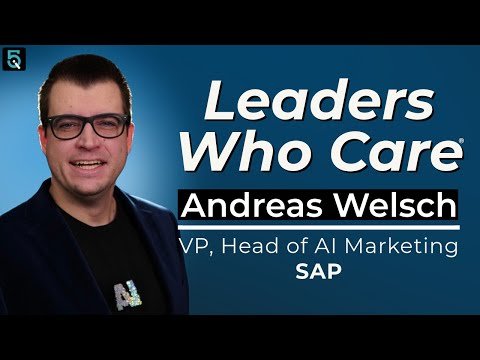
AI Leadership That Puts People First
AI leadership is no longer a future-facing topic—it is a day-to-day leadership test of how organizations introduce change without losing trust, momentum, or talent.
In a conversation from the “Leaders Who Care” series, Andreas Welsch—an AI leadership expert and long-time SAP leader—describes what it takes to adopt AI with confidence: putting humans at the center, making time for learning, and communicating clearly about what is changing and why.
Welsch’s perspective is grounded in his experience across internal IT, customer-facing AI education, a data science center of excellence, and global AI marketing—alongside a consistent emphasis on responsible change management and workforce enablement.
Executive Summary
- AI leadership starts with caring: humans must remain central to AI change.
- Fear of AI is often fear of change; address it with clarity and psychological safety.
- AI upskilling requires protected time, peer learning, and practical tool exposure.
- AI becomes actionable when leaders make it tangible: patterns, predictions, recommendations.
- Real value comes when AI moves from hype to measurable, everyday business benefit.
Key Takeaways
- Welsch emphasizes that AI systems may be technical, but outcomes are human.
- He has seen leadership narratives shift from “headcount reduction” to “freeing people for higher-value work.”
- He recommends explicit learning time and shared learning sessions to build capability.
- He points to “acceptable use” boundaries and policies as essential for practical adoption.
- He argues the AI “head start” in most organizations is only months—making early action achievable.
- He encourages leaders to demystify AI by explaining it as pattern recognition and prediction.
- He uses music and orchestra performance as an analogy for diverse skills aligned to one objective.
What is AI Leadership?
AI leadership is the ability to guide an organization through AI-driven change while protecting trust, capability, and business outcomes. In the conversation, Andreas Welsch frames it as balancing economic objectives with the realities of human impact—because people design AI systems, use them, and are influenced by them. Effective AI leadership makes AI tangible, invests in learning, supports psychological safety, and communicates what is changing in ways that reduce fear and increase confidence.
AI Leadership: Why “Humans at the Center” Is the Operating Principle
Welsch repeatedly returns to one core idea: AI initiatives succeed when leaders treat them as human change, not just technical deployment. Even when value is framed economically, he argues that outcomes must be balanced with the lived experience of employees and teams.
That balance matters because AI “inevitably brings change.” Some change is subtle; some is rapid and disruptive. Leaders who ignore the human dimension may accelerate resistance, mistrust, or adoption theater.
Key Insight: Andreas Welsch, an AI leadership expert, emphasizes that AI is never “just technology.” Humans design AI, humans use AI, and humans are affected by AI. Leaders therefore must balance economic objectives with employee experience, readiness, and trust—or adoption will stall and value will remain theoretical.
From Curiosity to Enterprise AI: The Experience Behind the Perspective
Welsch’s leadership viewpoint is shaped by a non-traditional career path. Originally from Germany, he began working at 16 through an apprenticeship model (part business, part school), developing early engineering problem-solving habits and curiosity about how things work.
Later, he moved to the U.S. (around age 25) and continued his career through SAP, where he progressed from internal IT to roles closer to customers and ultimately to organization-wide AI efforts. He described the discomfort—and growth—of seeing customers for the first time after years in internal roles, fielding real questions, and translating AI concepts into practical business language.
This progression matters for executives because it mirrors the organizational journey many companies face: AI starts as a technical capability, then becomes a customer story, and finally turns into a cross-functional operating model question.
Key Insight: Welsch’s path—from IT to customer-facing AI education, to AI governance and enablement via a center of excellence, to global AI marketing—highlights a common enterprise reality: AI value requires translation, prioritization, and workforce enablement, not only model-building.
Managing Fear and Resistance: Change Is the Real Problem to Solve
According to Welsch, resistance to AI often shows up as mistrust: employees trust their own “gut” but not a system—especially when they cannot understand why it recommends something or whether it is “always perfect.”
He also notes that AI fear is not unique—large organizations experience constant change. The difference is that AI change can feel personal: it may change how work is done, what skills are needed, or how roles evolve.
The leadership response is not to dismiss fear, but to actively manage it through care, communication, and preparation. In Welsch’s framing, caring does not mean neglecting business objectives; it means “genuinely seek[ing] the best outcomes” for people while moving the organization forward.
Key Insight: Welsch frames AI adoption resistance as a leadership challenge: teams vary from excited to concerned. Leaders reduce conflict by acknowledging differences, communicating openly about what is changing, and helping employees build relevant skills—creating psychological safety without abandoning business goals.
AI Upskilling That Works: Protect Time, Encourage Peer Learning, Normalize Experimentation
Welsch is explicit that workforce readiness requires more than encouragement; it requires protected time. Leaders should “make time and give employees time to learn,” including space to attend training, read, or work offline for focused development.
He also highlights learning from each other: dedicated sessions where team members share what they are working on, how they are using AI tools, and what they are discovering. This converts isolated experimentation into organizational capability.
Finally, he encourages practical exposure to tools such as ChatGPT, Bard, and Bing—within policy and within reason—because early familiarity builds confidence. Importantly, he notes that most “head starts” are only 12–14 months, meaning leaders can still close the gap quickly with consistent learning investment.
Key Insight: Welsch argues that AI upskilling becomes real when leaders create capacity for it. Protected learning time, peer-to-peer knowledge sharing, and tool experimentation—within acceptable-use boundaries—build AI fluency faster than top-down mandates.
Making AI Tangible: Literacy, Fluency, and an “AI Mindset”
Welsch warns that many AI conversations remain trapped between extremes: hype-driven fear of missing out, and dystopian narratives shaped by Hollywood. Leaders must pull teams into the practical reality of what AI is “today.”
In plain terms, he describes AI as recognizing patterns in data and making predictions. From that base, leaders can translate AI into everyday business work: generating text (meeting minutes, job descriptions), summarizing information, making recommendations, and predicting next best actions.
He uses a common e-commerce example—“people who bought this also bought that”—to show that AI can be understandable and concrete. When AI becomes tangible, leaders and teams can evaluate which tools matter, where risks are, and where business value is likely.
Key Insight: Welsch emphasizes that AI becomes adoptable when it becomes understandable. Explaining AI as pattern recognition and prediction helps leaders move teams beyond hype and fear, toward practical use cases such as summarization, content drafting, and recommendations that fit real workflows.
AI Governance in Practice: Define “Acceptable Use” and Reduce Uncertainty
In the conversation, Welsch links successful adoption to clarity. Experimentation matters, but it needs guardrails. He specifically points to defining what is “acceptable use of AI” and what it looks like for an organization.
That governance framing is practical: teams are encouraged to explore tools, but within boundaries that prevent misuse and confusion. The benefit is not only risk reduction—it is speed. Employees move faster when they do not have to guess what is allowed.
Welsch also stresses that leaders should talk about what is changing and discuss it with team members. That transparency is part of governance, not separate from it: people need context to make good decisions with new tools.
Key Insight: Welsch connects AI governance to adoption velocity. Defining acceptable use, encouraging experimentation within policy, and communicating clearly about change reduces uncertainty—so teams can build confidence and capability without waiting for perfect conditions.
Workforce Transformation: From Cost-Cutting Narratives to Human Capability
Welsch describes a notable shift he has seen over time. Earlier AI discussions with business leaders often focused on savings: “How many people do we no longer need?” He acknowledges that economic logic, while also signaling that it may not be the most responsible approach to leadership.
More recently, he has seen the conversation move toward augmentation: how AI can help people do more, free them from repetitive tasks, and give time back for customer conversations and higher-value work.
He also introduces a realistic caution: organizations may never run out of mundane tasks. The definition of “mundane” simply shifts upward as technology evolves. That view reinforces why continuous upskilling matters—it is not a one-time initiative.
Key Insight: Welsch points to a leadership narrative change: from replacing people to enabling people. Framing AI as a tool to remove repetitive work and elevate human contribution supports healthier adoption and better workforce transformation than a purely cost-focused strategy.
Diversity of Skills and the Orchestra Analogy
Beyond technology, Welsch draws leadership lessons from music. A multi-instrumentalist since childhood—keyboards and accordion from age six, plus self-taught drums, percussion, ukulele, and flute—he values progress over time and the discipline of steady improvement.
His favorite analogy connects directly to cross-functional AI programs: an orchestra. Rich music needs different instruments, tones, and roles. Skilled players must know their part and stay on the same beat. Differences exist, even tensions between sections, but success depends on alignment to a shared objective: a performance that earns a standing ovation.
For executives, the message is clear: AI initiatives require diverse skill sets (technical, business, operational) and a unifying goal that makes collaboration worth the friction.
Key Insight: Welsch’s orchestra analogy clarifies cross-functional AI execution. Different roles and perspectives are necessary for “rich” outcomes, but only if leaders align everyone to a shared objective, clear responsibilities, and a common cadence—otherwise, misalignment becomes audible and costly.
From Hype to Tangible Value: What Welsch Is Grateful and Hopeful For
Welsch says he is grateful that AI is now easier to use and more widely discussed. He notes that at the end of 2022, some analysts were already predicting another “AI winter” with declining investment and interest—until ChatGPT accelerated momentum across the industry.
His hope is practical: AI should translate into tangible business benefits—not just apps, images, or prompt experiments. In business, that means AI being used in real workflows, creating value for employees and companies, and ultimately improving experiences for customers.
He also expresses a personal hope aligned with his broader work: helping more leaders understand how to participate in the AI shift by bringing the right people together, prioritizing what makes sense, and avoiding “throwing money at it” simply because AI is new.
Leadership Implications
- Put humans at the center: Treat AI adoption as workforce change, not just system rollout.
- Define acceptable use: Establish clear boundaries so teams can experiment safely and faster.
- Protect learning time: Allocate real time for training, reading, and focused AI skill development.
- Institutionalize peer learning: Create recurring sessions to share how teams are using AI tools.
- Communicate what is changing: Reduce fear by discussing impacts, paths forward, and skill relevance.
Why This Conversation Matters
This “Leaders Who Care” conversation is aimed at a leadership audience navigating rapid technology shifts. Its relevance to AI leadership and workforce transformation is direct: Welsch describes how organizations can adopt AI without turning it into a trust-breaking cost narrative.
Rather than presenting AI as a purely technical agenda, the discussion emphasizes psychological safety, communication, and practical fluency. Those are executive levers—especially for CIOs, CTOs, and CHROs—because AI outcomes depend on how quickly people can apply tools responsibly inside real workflows.
The conversation also reflects Welsch’s broader focus: helping leaders implement AI successfully and with confidence by bringing the right stakeholders together and prioritizing tangible use cases over hype.
Conclusion
AI leadership is ultimately the discipline of making rapid technological change workable for real people inside real organizations. In this conversation, Andreas Welsch ties successful AI adoption to care, clarity, protected learning time, and governance boundaries that enable safe experimentation.
For executives, the challenge is not simply selecting tools—it is building a culture that can learn, adapt, and deliver tangible value while keeping trust intact. That is the standard of AI leadership that scales.