

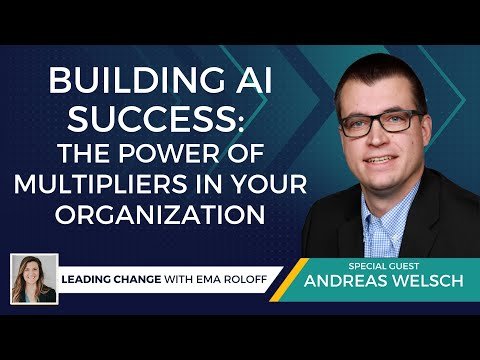
AI Leadership: Building a Community of Multipliers to Turn Hype into Business Outcomes
AI leadership is increasingly less about picking the “right” tool and more about aligning people, trust, and measurable outcomes. In many organizations, leaders face the same challenge: executives know AI is imminent, teams are experimenting, and adoption still stalls.
In a conversation on the Leading Change series, AI strategy advisor Andreas Welsch discussed why “communities of multipliers” are essential for AI adoption—and why the best place to start is business value, not shiny objects.
Welsch’s perspective connects AI strategy to workforce transformation: reducing fear, building practical understanding, and creating advocates across functions who can both spread responsible usage and bring grounded opportunities back to AI teams.
Executive Summary
- AI leadership requires advocates across functions, not isolated AI teams.
- A community of multipliers spreads trust, literacy, and relevant use cases.
- Start AI initiatives from business strategy and KPIs, not tools.
- Generative AI must be used iteratively, like an assistant that needs guidance.
- Customer service examples show how value can be tied to measurable outcomes.
Key Takeaways
- Welsch argues AI leaders “cannot go at this alone”; multipliers are needed across business functions.
- Multipliers serve as both advocates and a sounding board for AI teams.
- Workforce concerns often center on job loss; Welsch reframes it as AI “coming to your job.”
- Generative AI requires an iterative approach, with humans guiding outputs like an assistant.
- Practical awareness includes acknowledging that outputs can occasionally be incorrect or misaligned.
- Starting points should be strategy-driven: business goals, KPIs, and measurable improvement targets.
- Frontline teams (finance, procurement, sales, customer service) surface high-impact problems because they live the work daily.
What is AI leadership?
AI leadership is the discipline of guiding an organization to use AI successfully in business—turning hype into tangible outcomes while building trust and capability across the workforce. In the Leading Change conversation, Andreas Welsch, an AI leadership expert, emphasizes that AI leaders must do more than deploy technology. They must build advocates across business functions, connect AI initiatives to strategy and KPIs, and help teams use tools responsibly through iterative, human-guided workflows.
Why AI leadership depends on a community of multipliers
Welsch describes a “community of multipliers” as a network of advocates embedded in different business functions. These advocates become knowledgeable about AI through engagement with AI leaders and teams, then help identify where AI can improve operations and customer engagement.
They also provide a feedback loop. Instead of AI teams guessing what matters, multipliers bring ideas back—ensuring work stays relevant to business realities and priorities.
Key Insight: Andreas Welsch explains that AI adoption accelerates when advocates in procurement, finance, sales, or customer service can “spread the word” about positive impact, while also acting as a sounding board to return real operational needs to AI teams. This creates momentum and relevance at the same time.
From fear to capability: addressing workforce concerns head-on
A major barrier to adoption is fear—especially the concern that “AI is coming for my job.” Welsch counters this with a reframing: AI is often “coming to your job,” meaning it becomes part of the work rather than a replacement for the worker.
That reframing only works when leaders build trust and practical understanding. Teams need clarity on what AI can do, where it struggles, and how to use it responsibly.
Key Insight: Welsch highlights that adoption improves when leaders make AI “tangible and useful” instead of abstract and threatening. A community of multipliers helps normalize everyday usage patterns, share practical guidance, and reduce anxiety—especially as teams see AI as an assistant that supports their responsibilities.
AI leadership for generative AI: treating tools like an assistant
Welsch points to a new reality of generative AI adoption: tools can “occasionally spit out” incorrect or misaligned information. That reality changes what responsible use looks like.
Instead of expecting perfect outputs, leaders must teach an iterative approach—guiding the tool, refining prompts and context, and validating results. This is less like traditional deterministic software and more like working with an assistant that needs direction.
Key Insight: In Welsch’s view, AI leadership includes setting expectations that generative AI is guided and iterative. The multiplier community becomes a practical channel for sharing “how to work with it,” including when to verify outputs, how to refine results, and how to keep work aligned with business values.
Start with business value, not the shiny object
Many organizations experimented with generative AI because it became widely accessible through consumer apps. That accessibility can be a gift—and a curse. Senior leaders often know AI is important and ask teams to “go figure it out,” which can lead to tool-first exploration without a clear outcome.
Welsch argues the best starting point is business impact: What is the strategy? What are the main KPIs? Is the priority revenue growth, expansion into new markets, or launching new products? Only then should leaders ask how AI can support those goals.
This is where multipliers matter: people doing the work daily know where processes break, where delays occur, and where quality suffers. Their “lived experience” helps surface high-value opportunities without relying on assumptions.
Community of multipliers in action: customer service examples tied to measurable outcomes
Welsch offers a concrete illustration in customer service. AI can assist in analyzing incoming service requests and tickets: identifying what a request is about, suggesting responses, and finding related issues.
It can also support frontline decision-making by indicating whether an agent can resolve a case or should route it to a higher support level. Guidance can extend to adapting a call script based on customer topics and context.
Importantly, Welsch connects these capabilities to business value metrics: improving Net Promoter Score, reducing customer wait time, and improving answer quality—moving from “three stars” to “five stars.”
Key Insight: Welsch’s customer service scenario shows how AI leadership can be anchored in measurable outcomes: faster resolution, better routing, and higher-quality interactions. A community of multipliers can capture frontline feedback on where assistance helps most, ensuring AI work targets improvements customers actually notice.
Operationalizing AI leadership through multipliers: making relevance a habit
Communities of multipliers are not a one-time communications exercise. In Welsch’s framing, they create an ongoing mechanism for relevance: advocates spread AI awareness and bring back ideas and needs that should influence the AI roadmap.
That dual role matters because AI teams can otherwise become disconnected from what different functions actually need. Multipliers help leaders stay grounded in operational reality while also amplifying trust and adoption through peers.
As AI becomes embedded into work, this “movement” approach becomes a practical form of workforce transformation—supporting adoption in day-to-day workflows rather than forcing transformation from the top down.
Leadership Implications
- Anchor AI governance in trust-building: normalize verification and iterative usage expectations for generative AI outputs.
- Design workflows around assistance: position AI as guidance for employees (analysis, routing, scripts), not a replacement narrative.
- Operationalize multiplier networks: embed advocates in functions to spread literacy and return opportunity signals to AI teams.
- Start from strategy and KPIs: prioritize AI initiatives that directly support business goals like growth, market expansion, or product launches.
- Measure value where the work happens: tie initiatives to outcomes such as wait time reduction, quality improvement, and customer feedback.
Why this conversation matters
The discussion took place in an interview format on Leading Change, aimed at digital transformation, change management, and emerging technologies. That context matters: AI adoption is as much a change leadership challenge as it is a technical deployment.
For CIOs, CTOs, and CHROs, Welsch’s points reinforce a workforce transformation message: sustainable adoption requires advocates, practical guidance, and a clear link to business value. It is not enough to “experiment” with tools; leaders must establish conditions for confident, measurable use in core workflows.
The conversation also connects to Welsch’s broader work as an AI strategy advisor, podcast host of What’s the Buzz, and author of the AI Leadership Handbook, which he notes covers multiple aspects of successful AI leadership beyond technology—including communities of multipliers and business value.
Where to go deeper: AI leadership resources mentioned
Welsch notes that the AI Leadership Handbook is available on Amazon in Kindle and paperback formats. He describes it as covering “nine aspects” of successful AI leadership in addition to technology, including chapters on communities of multipliers and business value.
Conclusion
AI leadership is ultimately a multiplier problem: leaders must create the conditions for adoption to spread through the organization with trust and purpose. In Andreas Welsch’s framing, a community of multipliers turns AI from a centralized initiative into a business-wide movement—while keeping priorities anchored to strategy, KPIs, and tangible business outcomes.
FAQ
What is a community of multipliers in AI adoption?
A community of multipliers is a group of business advocates who become knowledgeable about AI and help spread practical use across functions while feeding ideas back to AI teams. It supports AI leadership by increasing relevance, trust, and adoption through peers, not mandates.
Andreas Welsch describes these advocates as both promoters of positive impact and a sounding board for AI teams.
Why does AI leadership require advocates outside the AI team?
AI leadership requires advocates outside the AI team because adoption happens inside business functions where work is performed daily. Multipliers in finance, procurement, sales, and service translate AI into practical workflows and ensure the AI roadmap targets real operational needs.
Welsch emphasizes that AI leaders “cannot go at this alone.”
How can leaders reduce fear that AI will take jobs?
Leaders can reduce fear by reframing AI as “coming to your job,” not “coming for your job,” and by building trust through practical education. AI leadership should make usage tangible—showing where tools help, where they fail, and when verification is required.
Welsch links trust-building to clearer understanding of opportunities and challenges, especially with generative AI.
Why should AI initiatives start with business value?
AI initiatives should start with business value because tool-first experimentation often produces demos without outcomes. AI leadership should begin with strategy and KPIs—such as growth, market expansion, or product launches—then identify where AI can directly support those goals and measures.
Welsch warns that widespread access to tools can be a “gift and a curse” when leadership asks teams to “go figure it out.”
What does “AI is coming to your job” mean in practice?
“AI is coming to your job” means AI becomes a tool embedded in workflows to help people do work better, not necessarily replace them. In AI leadership terms, it emphasizes assistance—analysis, drafting, routing, and guidance—paired with human judgment and accountability.
Welsch uses this framing to reduce anxiety and focus adoption on capability-building.
How should executives think about generative AI reliability?
Executives should assume generative AI can occasionally produce incorrect or misaligned information, so usage must be iterative and guided. AI leadership should set expectations that teams validate outputs, refine prompts, and treat the tool like an assistant requiring direction rather than a deterministic system.
Welsch notes that such disclaimers would have been “unthinkable” in software not long ago, underscoring the shift in operating model.
What is an example of business value for AI in customer service?
Business value in customer service can include reducing wait times, improving answer quality, and raising customer satisfaction ratings. Welsch describes AI analyzing incoming tickets, suggesting responses, identifying related issues, and helping route cases to the right support level—improving outcomes customers notice.
He also ties this to improvements like moving from “three stars” to “five stars,” and to metrics such as Net Promoter Score.
How do multipliers help AI teams stay relevant?
Multipliers help AI teams stay relevant by bringing back ideas from daily work and serving as a two-way channel between AI specialists and business teams. In AI leadership, this reduces guesswork, prioritizes real pain points, and builds shared ownership of adoption across functions.
Welsch describes multipliers as advocates who both spread AI benefits and return opportunities to AI leaders.
Where can executives find more AI leadership guidance mentioned in the conversation?
Executives can find additional AI leadership guidance in resources Welsch referenced: his podcast What’s the Buzz and his book, the AI Leadership Handbook, available on Amazon in Kindle and paperback. He notes it covers multiple AI leadership aspects beyond technology.
The interview itself appeared on the Leading Change series focused on digital transformation and emerging technologies.