

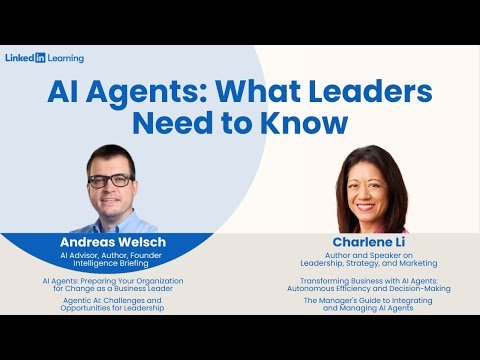
How Leaders Can Cut Through the Agnetic AI Hype
Agentic AI is generating more hype, noise, and confusion than clarity—especially for leaders responsible for AI strategy, governance, and workforce transformation.
In a conversation, Andreas Welsch—an AI leadership expert focused on AI adoption, agents, governance, and workforce transformation—discussed what executives should prioritize: starting from business problems, validating vendor claims, and bringing employees along transparently.
The discussion featured LinkedIn Learning instructor Charlene Lee and centered on what is real versus “AI agent” marketing, the practical definition of agentic systems, and the leadership skills required to move from experimentation to responsible, scalable adoption.
Executive Summary
- Agentic AI shifts interaction from step-by-step instructions to goal-driven outcomes.
- Leaders should start with business problems, not technology demos.
- Vendor “agents” vary widely; executives should ask if autonomy is real or workflow automation.
- Adoption depends on transparency, employee enablement, and trust-building.
- Most organizations should avoid building everything; start with existing platforms and small wins.
Key Takeaways
- Andreas Welsch emphasizes beginning with the business problem, then evaluating whether agentic AI is a fit.
- Welsch defines a key shift: giving systems a goal and reviewing outcomes versus scripting every step.
- Welsch advises leaders to scrutinize vendor claims: some “agents” are workflows with AI “sprinkled in.”
- Welsch recommends most companies should not build everything; leverage vendors already in the stack.
- Welsch highlights change management: transparency, collaboration, and clear benefit to employees and the organization.
- Welsch notes hands-on experimentation is now accessible via widely available AI assistants.
- Welsch frames agentic AI adoption as both automation and skill evolution—faster and more frequent than past tech shifts.
What is Agentic AI?
Agentic AI refers to systems that can be given a goal and then act toward that goal more autonomously than traditional software. Andreas Welsch describes the evolution from “if this happens, then do that” software, to machine learning that finds patterns and makes recommendations, to agentic systems that can plan and execute multi-step tasks (such as travel planning or marketing planning) with human review. The leadership shift is practical: defining the goal, monitoring progress and outputs, and governing risks—rather than specifying every step.
Why this conversation matters
This discussion is relevant to CIOs, CTOs, CHROs, and business leaders facing mounting pressure to “do something with agents” while avoiding misaligned investments and unnecessary workforce anxiety. It also reflects a broader leadership reality: agentic AI is arriving through major enterprise vendors, but maturity varies and organizational trust is not guaranteed.
Welsch’s perspective connects strategy and execution: leaders need practical definitions, sharper vendor questions, and clear internal communication so AI adoption supports productivity and workforce transformation rather than confusion and backlash.
Agentic AI vs. automation: what executives should verify
One of the biggest sources of confusion is inconsistent language. Many vendors label capabilities “agents,” but those capabilities may range from truly goal-driven systems to predefined workflows enhanced with AI.
Welsch advises leaders to ask vendors how their agents work “under the hood.” The practical test is whether the system can take a goal, break it into sub-steps, and act more autonomously—or whether it is still “if this happens, then do that” automation with a generative interface.
Key Insight: Leaders should not accept “agent” as a label. They should ask whether the product is truly goal-driven and autonomous, or a workflow with AI added—because governance, risk, and value realization differ significantly across these approaches.
Start with business problems, not technology demos
Charlene Lee notes that many leaders still debate AI at a high theoretical level—good versus bad—while too few use it to solve real problems. Her recommendation is direct: identify the organization’s biggest problems and challenge teams and vendors to address those problems with AI.
This aligns with Welsch’s emphasis on pragmatism: leaders often start with the technology (“here’s a new thing”) and then search for a use case, which frequently fails. Problem-first framing improves prioritization, accelerates learning, and reduces “pilot purgatory.”
Key Insight: Agentic AI adoption should be anchored in a short list of business-critical problems. This shifts evaluation from impressive demos to measurable outcomes—and helps leaders decide where autonomy is helpful versus where humans must remain in control.
What agentic AI changes for leaders: goals, review, and responsibility
Welsch explains that the leadership interaction model is changing. Instead of instructing software step-by-step, leaders can define the goal and review outputs. Examples discussed include planning travel for an offsite (airfare, hotels, ground transport, cost and route comparisons) and developing marketing strategies (ideal customer profile through messaging and creative).
With that shift comes a new responsibility: ensuring employees understand that AI is a collaborative approach—humans plus AI—where AI can take on boring, repetitive tasks while people focus on higher-value work.
Key Insight: As agentic AI increases automation, leaders should pair delegation with transparency—what is being automated, why, and how employees benefit—so adoption becomes augmentation rather than an avoidable culture shock.
Hands-on experimentation: the fastest way to move from hype to competence
Welsch highlights how accessible experimentation has become. Many leaders now have AI assistants available through mobile apps or browser-based tools, making it possible to learn quickly without large-scale programs.
Charlene Lee describes a concrete leadership practice: using AI to analyze meeting transcripts and provide coaching on presentation, proposals, and communication. The core point is not novelty—it is deliberate practice, feedback loops, and building familiarity with what AI can (and cannot) do.
For leaders, experimentation also builds the foundation for governance. It becomes easier to set realistic expectations, define “human in the loop” requirements, and recognize vendor overclaims.
Vendor reality check: expectations should be low, possibilities high
Major enterprise vendors increasingly claim agentic capabilities in products, reflecting how quickly the market moved from early experiments to packaged offerings. Welsch notes that innovation is moving fast, but maturity and autonomy differ.
Charlene Lee recommends setting expectations low in the early days, even if the long-term potential is high. She also stresses transparency into how an agent learns and makes decisions—without explanations, teams cannot troubleshoot, correct assumptions, or improve outcomes.
Key Insight: Leaders should treat early agentic AI as incremental capability. Demand transparency into decision-making and learning, and scale scope gradually as confidence grows—similar to how organizations trust new employees more over time.
Build vs. buy: why most organizations should not build everything
Welsch draws a parallel to the earlier wave of machine learning initiatives, when many organizations attempted to build models from scratch and discovered how hard it is to assemble the right data—complete, fresh, and fit for purpose.
His recommendation is direct: most companies do not need to build everything. Leaders should look first to vendors already in the technology stack, evaluate current capabilities and roadmaps, and confirm whether available solutions solve real business needs.
At the same time, Charlene Lee notes that building “a little bit” can improve buyer competence. Mapping workflows in detail often reveals that organizations do not fully understand the real process variations. That clarity helps executives specify requirements and assess vendor fit.
Communication risk: “AI-first” memos and the workforce trust gap
The conversation also addressed recent CEO memos signaling “AI-first” operating models and the public reaction they can trigger. Welsch highlights a leadership tension: organizations may feel urgency to evolve, but unclear or blunt messaging can create unnecessary fear and long-term cultural damage.
Both speakers emphasize the need for transparency and clear articulation of why AI is being adopted, how it benefits stakeholders, and how employees will be supported. Welsch underscores that employees may assume AI makes them obsolete unless leadership explains augmentation, reskilling, and where human expertise remains essential.
Charlene Lee adds that public sentiment can amplify backlash, particularly in consumer-facing contexts, making communication strategy a leadership competency—not a PR afterthought.
Leadership Implications
- Govern autonomy deliberately: Define which decisions require human review versus which can be delegated safely over time.
- Evaluate vendors with precision: Ask whether “agents” are goal-driven and autonomous or just scripted workflows with AI.
- Design around workflows: Map real workflows with front-line teams to find variations, bottlenecks, and high-leverage insertion points.
- Enable the workforce: Make AI a collaborative “humans plus AI” effort, and be explicit about how roles evolve.
- Communicate transparently: Explain what is changing, why, and how employees and customers will benefit—reducing rumor-driven fear.
Conclusion
Agentic AI represents a real interaction shift: leaders can increasingly set goals and govern outcomes rather than prescribe every step. Andreas Welsch’s guidance centers on execution discipline—start with business problems, validate what “agents” actually do, and adopt responsibly with transparency and workforce enablement.
For executive teams, the near-term advantage comes from pragmatic learning and governance: building trust incrementally, aligning vendors to real workflows, and communicating clearly so agentic AI supports sustainable AI adoption and workforce transformation.
FAQ: Agentic AI for Leaders
What is agentic AI in business terms?
Agentic AI is a goal-driven approach where a system can take an objective and work toward it more autonomously than traditional software. In practice, leaders define outcomes and review results, rather than specifying every step of execution. This changes governance and oversight.
How is agentic AI different from automation?
Agentic AI differs from automation by emphasizing goals and adaptive multi-step execution instead of fixed “if-then” workflows. However, many products marketed as AI agents may still be workflow automation with AI features. Leaders should validate autonomy and decision transparency.
What should executives ask vendors claiming “AI agents”?
Executives should ask whether the AI agent truly takes a goal, decomposes it into steps, and acts autonomously—or whether it runs predefined workflows with AI “sprinkled in.” They should also ask how decisions are explained for troubleshooting and training.
Where can agentic AI be used first in an organization?
Agentic AI can be piloted in bounded, high-friction processes where outputs are reviewable, such as planning tasks or drafting structured deliverables. The conversation cited examples like planning travel logistics and supporting marketing planning from persona definition to messaging.
Should companies build their own agentic AI systems?
Most companies should not build everything themselves because AI initiatives often fail on data readiness and operational complexity. Andreas Welsch recommends starting with vendors already in the technology stack and their roadmaps, while building small experiments to become informed buyers.
How can leaders reduce workforce fear about AI agents?
Leaders can reduce fear by being transparent about what is being automated, why it is changing, and how employees benefit through augmentation. Welsch emphasizes “humans plus AI,” delegating boring repetitive tasks while upskilling people for higher-value work.
What leadership skills matter most for agentic AI adoption?
The most important skills are pragmatic problem framing, hands-on experimentation, and clear communication. Leaders need to translate agentic AI into specific business problems, evaluate vendor maturity realistically, and guide teams through change with transparency and collaboration.
How should leaders think about trust and “human in the loop”?
Leaders should treat agentic AI trust like onboarding a new employee: start with oversight, measure performance, and expand delegation over time. The goal is to define when human review is required and when autonomy is acceptable as confidence, metrics, and controls mature.
What is a practical way for leaders to start using AI today?
A practical starting point is using widely available AI assistants for real work, not toy prompts, and then reviewing outputs critically. The discussion included analyzing meeting transcripts to get coaching feedback on communication and proposals, building familiarity and competence quickly.