

How to Adopt Agentic AI Responsibly
Agentic AI is quickly becoming the newest label attached to enterprise software, productivity tools, and automation platforms—often faster than leaders can validate what it truly does. For executives, the challenge is no longer whether AI exists in the stack, but whether it is being adopted with the right business goals, governance expectations, and workforce realities in mind.
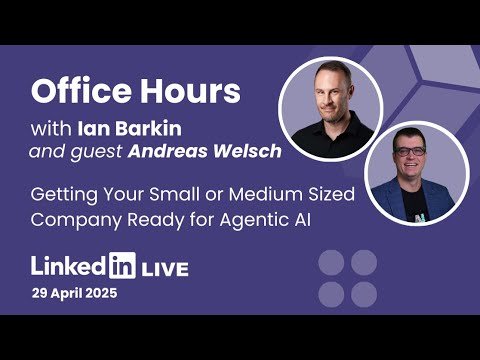
In a LinkedIn Live office hours conversation, Andreas Welsch—an AI leadership expert with deep experience across machine learning, robotic process automation (RPA), generative AI, and agentic AI—explained what AI agents are, how they differ from earlier automation, and how leaders (especially in small and medium-sized businesses) can start pragmatically.
The discussion focused on executive decision-making: separating vendor marketing from real capability, measuring organizational readiness (including people readiness), and using agentic systems to remove low-value work without losing accountability.
Executive Summary
- AI agents are goal-oriented systems that plan and execute tasks using tools and data.
- Agentic AI differs from rules-based automation by handling higher variance and reasoning-like steps.
- SMBs should start with business pain points, then check existing vendors for built-in capabilities.
- Readiness depends on data, infrastructure, process clarity, and people readiness.
- Responsible adoption requires KPIs, monitoring, and a human review step before action.
Key Takeaways
- Andreas Welsch describes AI agents as systems that take a goal, break it into subtasks, use tools, and return recommendations.
- Agentic AI represents a shift from explicit instructions and pattern recognition toward goal-based execution.
- Modern chatbot experiences improve because large language models reduce the need for extensive up-front training phrases.
- Vendor “agentic AI” claims should be tested by asking how open-ended the system is and whether it is truly goal-driven.
- For SMBs, the fastest path is often leveraging AI and agentic features already embedded in existing applications.
- Readiness measurement is a business transformation conversation—not only a technology conversation.
- People readiness matters: leadership messaging can reduce fear and improve adoption.
What is Agentic AI?
Agentic AI refers to AI systems designed to pursue a defined goal by planning steps, using tools (such as web search or company databases), and iterating toward an output. In the conversation, Andreas Welsch explained that an AI agent can take a goal like researching a market niche, break it into smaller subtasks, execute those subtasks, and return a recommendation the user can refine or approve. Unlike older automation approaches that rely on fixed rules, agentic systems are positioned to handle more variance by deciding “what to do next” in pursuit of an outcome—while still requiring oversight when decisions carry risk.
From Rules to Goals: How Agentic AI Differs From Earlier Automation
Welsch contrasted three eras of automation and intelligence. First came explicit instruction: classic software and rules-based automation (“if this happens, then do that”). Next came data-driven pattern systems such as machine learning, which recognize relationships and make predictions from historical examples.
Agentic AI adds a goal-oriented layer. Instead of defining every step, leaders can define an outcome and allow the system to plan, sequence tasks, and use tools to move toward a result—asking clarifying questions or returning a recommendation to iterate.
Key Insight: Andreas Welsch explains that agentic AI shifts automation from “explicit steps” and “pattern prediction” to “goal-oriented execution,” where a system can break work into subtasks, use connected tools, and return recommendations—reducing the need to predefine every step.
AI Agents vs. Chatbots: Why the Experience Is Changing
Traditional chatbots often required training with many variations of questions so the system could map a user’s language to a fixed intent. Welsch noted that with generative AI and large language models, this dependence on pre-training dozens of sample phrases decreases because models can better interpret language and intent—even when phrased in new ways.
The impact is practical: faster time-to-value and more robust interaction. A generative AI-based chatbot can be more flexible and helpful, reducing experiences where a user is forced into a narrow menu of options.
Key Insight: Welsch highlights that generative AI reduces chatbot setup friction by minimizing the need to pre-train countless question variations. That change can improve reliability and accelerate adoption because the system can interpret intent even when phrasing differs from expected scripts.
Vendor “Agentic AI” Claims: What Leaders Should Ask
Welsch acknowledged the reality leaders face: vendors often cannot afford to say they do not have agentic AI. As a result, “agentic” can become a marketing label applied to workflows that may still be rules-driven or only lightly enhanced by generative AI.
His recommendation: interrogate the mechanics. Leaders should ask whether the system is truly goal-oriented, whether it uses large language models, how open-ended the goal definition can be, and how connected the agent is to enterprise tools and data. The objective is to determine whether the “agent” is actually planning and adapting, or simply executing a pre-set workflow with a new name.
Key Insight: Welsch advises leaders to test “agentic AI” announcements by asking how the capability works: is it goal-driven, does it plan and adapt, does it use LLMs, and how well is it connected to real business tools and data?
Where SMBs Should Start With Agentic AI
For small and medium-sized businesses, Welsch recommended starting with an inventory of existing applications and vendors. Many tools already in use have added AI in the last two years, and more are now embedding agentic capabilities.
At the same time, he cautioned against starting with technology. Leaders should begin with business problems: repetitive tasks, delays, and recurring customer service questions. Once a high-friction area is identified, the next step is to check whether a current platform already provides agents to address it—reducing the need to buy or build something entirely new.
In customer service, for example, if 80% of inquiries are repetitive, an agent embedded in the existing support system can handle common questions and free staff to focus on complex issues.
Measuring Readiness: It’s Infrastructure, Data, and Process Clarity
When asked how to measure AI readiness before “jumping in,” Welsch emphasized that the conversation often reveals broader transformation gaps. Some organizations lack the data quality, infrastructure maturity, or application landscape needed to support connected agents. Others are held back by older deployment models or versions that limit the availability of newer AI features.
Readiness also depends on understanding how the business actually works. That can be done with sophisticated tools such as process mining, or with simpler methods appropriate to an SMB—like mapping the process in a basic diagram and validating it by talking directly with the people doing the work.
Finally, Welsch stressed alignment to strategy and measurable outcomes. Leaders should establish key performance indicators (KPIs) and process performance indicators: for example, how long it takes to send an invoice or to collect cash after invoicing, then define targeted improvements and measure progress.
Key Insight: Welsch frames AI readiness as a transformation question: infrastructure and data must support connected tools, processes must be understood end-to-end, and adoption should be tied to strategy through measurable KPIs such as cycle time and cash collection.
A Practical Example: Automating Content Repurposing With Review in the Loop
Welsch shared a concrete example from his own operating model: after recording an episode for a podcast or live stream, repurposing the content into a newsletter and promotional posts used to take three to four hours. Using AI and agents, that repurposing workflow was reduced to about a minute and twenty seconds to generate the draft outputs.
However, Welsch stressed that the output should not be sent blindly. The process still requires a review step—often 30 to 45 minutes—to refine and ensure quality before publishing. The time savings comes from removing low-value formatting and rewriting work, not from eliminating accountability.
Key Insight: Welsch’s example shows a leader-ready adoption pattern: use agentic automation to generate first drafts quickly, then keep a human review step for quality control. Time is saved by eliminating low-value reformatting, not by removing responsibility.
Are Human Roles Still Relevant? Why People Readiness Is a Governance Issue
Welsch addressed a recurring executive concern: whether AI will replace jobs. He tied the question to past innovation waves such as RPA and machine learning, where automation shifted work away from repetitive tasks toward higher-value activities.
In his view, many tasks that can be automated—such as repetitive extraction or matching activities—are not why most professionals pursued their education or roles. Agentic AI extends what software can handle, enabling people to focus on analysis, collaboration, creativity, communication, and empathy—especially in customer-facing moments where human interaction remains valuable.
Crucially, Welsch positioned people readiness as part of readiness overall. If leaders communicate “AI first” without clarity, employees may assume replacement is imminent, triggering anxiety and resistance before the first agent is even deployed.
Leadership Implications
- Start with business outcomes, not tools: identify repetitive work, delays, and common customer inquiries before selecting agentic capabilities.
- Challenge vendor claims: require clear explanations of how “agentic” features plan, adapt, and connect to enterprise tools and data.
- Measure readiness beyond technology: validate data quality, infrastructure maturity, and process clarity, then tie initiatives to KPIs.
- Design with human review: use AI agents for first drafts and routine execution, while preserving oversight for quality and risk control.
- Lead the people transition: communicate intent and role evolution to reduce anxiety and improve AI adoption.
Why This Conversation Matters
This LinkedIn Live office hours conversation was aimed at leaders navigating rapid change and uneven terminology. Agentic AI is evolving quickly, and executive teams must make decisions amid vendor hype, shifting capabilities, and workforce concerns.
Welsch’s perspective is particularly relevant for AI leadership and workforce transformation because it anchors adoption in business reality: what processes exist, where friction occurs, what data and infrastructure can support connected tools, and how leadership communication shapes employee readiness.
The emphasis on people readiness also links agentic AI to governance. Governance is not limited to model controls; it includes decision rights, accountability, and how leaders protect trust while changing work.
Conclusion
Agentic AI creates a compelling new automation layer because it is designed to pursue goals, plan tasks, and work across tools and data. But leadership value comes from disciplined adoption: validate what “agentic” really means, start from business friction, measure readiness and outcomes, and protect trust through clear communication and human oversight.
As Andreas Welsch emphasized, responsible Agentic AI adoption is as much about people readiness and strategy alignment as it is about technology capability.
About the Author
FAQ
What are AI agents in practical business terms?
AI agents are goal-driven systems that can break a task into subtasks, use tools like web search or company data, and return recommendations for review. In agentic AI, the system plans steps rather than following only fixed rules.
How is agentic AI different from RPA?
Agentic AI is oriented around goals and planning, while RPA typically follows predefined steps (“if this happens, then do that”). Agentic approaches are positioned for higher variance tasks, but still benefit from oversight and clear process definitions.
How is an AI agent different from a chatbot?
A chatbot focuses on conversation and answering questions, while an AI agent can plan and execute multi-step tasks toward a goal. Welsch notes that modern generative AI improves chatbots by reducing the need to train many question variations.
Where should SMBs start with agentic AI adoption?
SMBs should start with business pain points and repetitive work, then check whether existing vendors already provide AI or agentic AI features. This reduces the need to build from scratch and aligns adoption to immediate operational value.
How can leaders test vendor claims about “agentic AI”?
Leaders should ask how the capability works: whether it is truly goal-oriented, whether it uses large language models, how open the goal definition is, and how well it connects to enterprise tools and data. Marketing labels alone are insufficient.
What does “AI readiness” mean for a mid-sized company?
AI readiness includes infrastructure and data maturity, clarity on how processes work, and alignment to strategy through measurable KPIs. Welsch also emphasizes people readiness: leaders must communicate clearly to avoid fear-driven resistance during AI adoption.
Will agentic AI replace jobs?
Agentic AI can automate repetitive, low-value tasks, but Welsch argues that this often shifts work toward higher-value responsibilities such as analysis, creativity, communication, collaboration, and empathy. Role change is real, so leadership communication is critical.
What metrics should be used to govern agentic AI initiatives?
Leaders should track process performance indicators and KPIs tied to business outcomes, such as time to send invoices or time to collect cash after invoicing. Governance strengthens when agentic AI improvements are measured against defined targets.
Why keep a human review step if an AI agent is fast?
Welsch recommends using agents to generate drafts or execute routine steps quickly, then applying human review before publishing or acting. This protects quality and accountability, especially in customer-facing content or operational decisions where errors matter.